Why Every Business Needs an Order Management System to Simplify Operations
Running an ecommerce business is not only about listing products and receiving orders. Behind every successful order, there is a complete operational process that includes order tracking, inventory updates, payment confirmation, packaging, shipping coordination, and customer communication.
In the early stage of a business, these tasks may seem manageable. A small team can track orders using spreadsheets or manual processes. However, as the number of orders grows, managing everything manually becomes difficult and time-consuming.
Even a small mistake can create major problems. For example, if inventory is not updated properly, customers may order products that are out of stock. If order processing is delayed, deliveries may be late. These issues can directly affect customer satisfaction and brand reputation.
This is where an order management system in an e-commerce solution becomes extremely valuable.
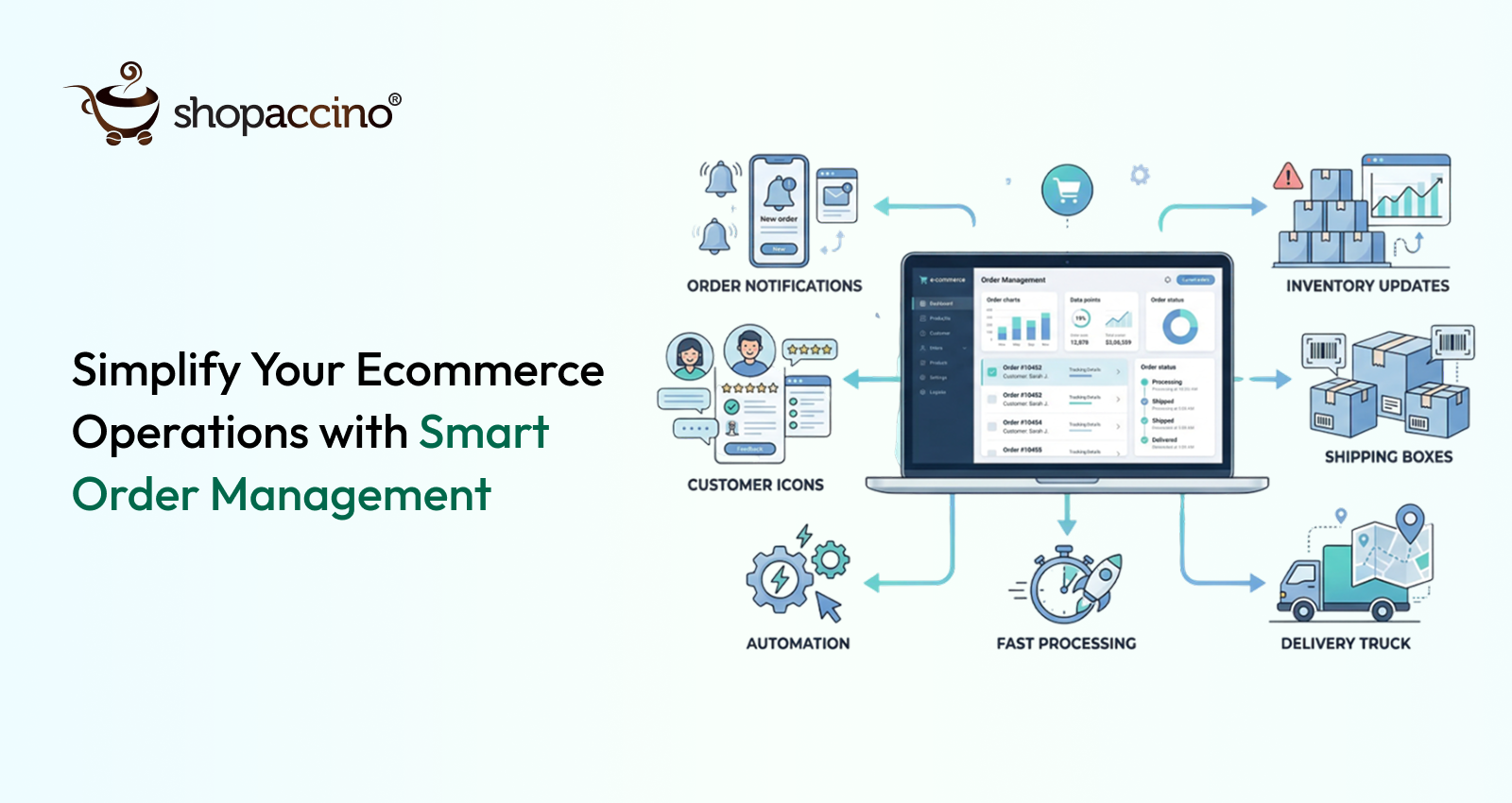
An order management system helps businesses organize, track, and manage the entire order lifecycle in one place. Instead of using multiple tools or manual records, businesses can monitor every order from the moment it is placed until the product reaches the customer.
For growing ecommerce brands, having a structured order management process helps improve efficiency, reduce operational errors, and create a better customer experience.
In this article, we will explore why order management is important for modern ecommerce businesses and how the right system can simplify daily operations.
Understanding the Role of Order Management in E-commerce
Order management refers to the process of tracking and handling customer orders from start to finish. It ensures that every order moves smoothly through the business workflow.
This process includes several important steps.
Typical order management workflow:
- Customer places an order on the website or marketplace
- Payment confirmation is received
- Inventory is checked and updated
- Order is prepared for packaging
- Shipping partner is assigned
- Order is shipped to the customer
- Tracking information is shared with the customer
- Delivery confirmation is completed
Each step must work correctly for the order to be delivered successfully.
If any stage of this process is not managed properly, it can cause operational issues such as delayed shipments, incorrect orders, or customer complaints.
For ecommerce businesses that receive dozens or hundreds of orders daily, managing this workflow manually becomes extremely difficult.
Why Ecommerce Operations Become More Complex as Businesses Grow
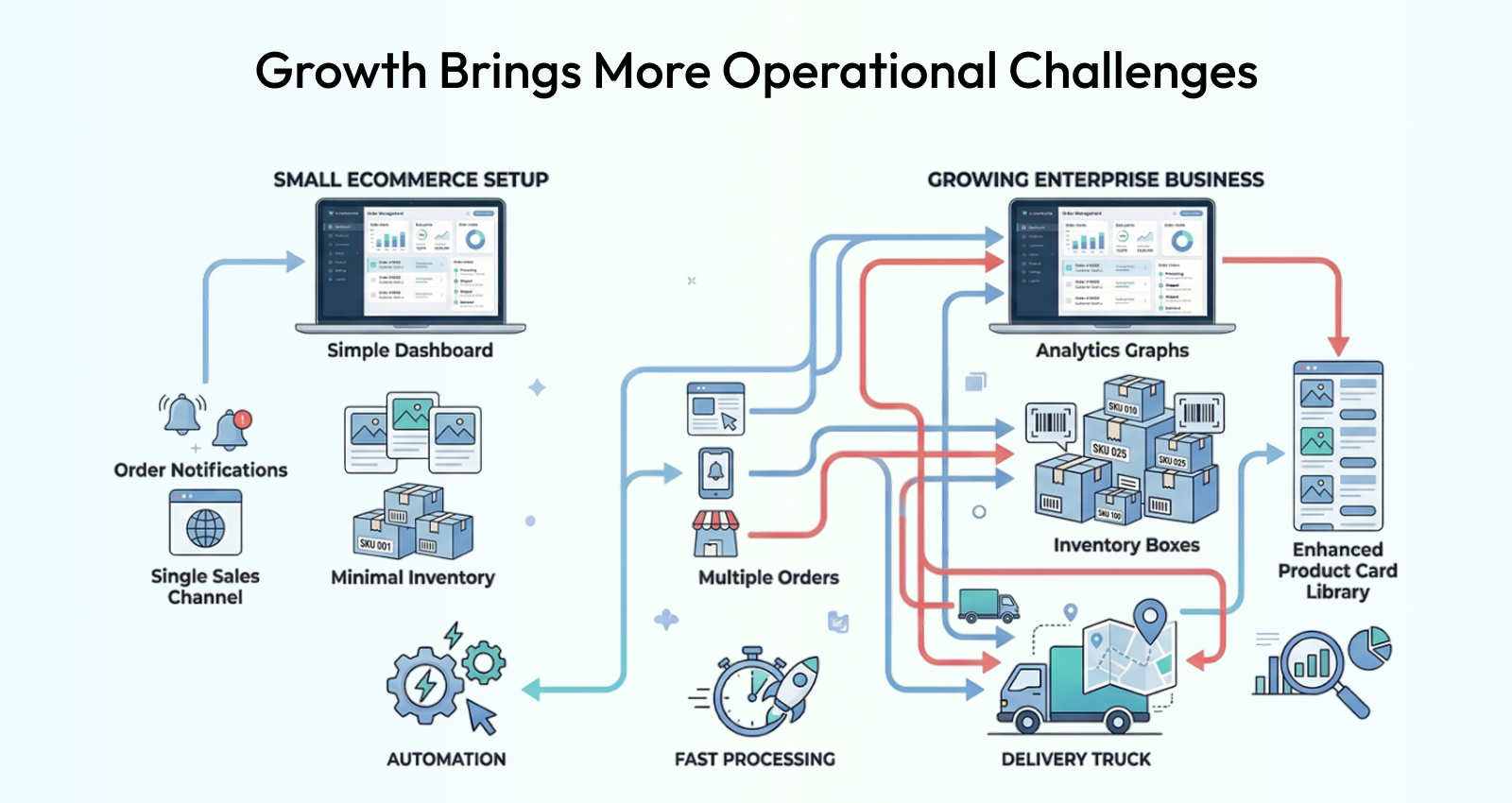
When an online store starts receiving more orders, operations naturally become more complicated. The team must manage multiple processes simultaneously while maintaining accuracy and speed.
Some of the most common operational challenges include:
Managing orders from multiple channels
Many businesses sell through websites, mobile apps, and online marketplaces at the same time.
Keeping inventory updated across channels
Inventory must remain accurate so customers do not purchase out-of-stock products.
Coordinating with shipping partners
Businesses must communicate with logistics partners to ensure timely deliveries.
Handling order cancellations and returns
Customers may request returns, exchanges, or refunds that must be managed properly.
Tracking large volumes of orders
As order numbers increase, monitoring each order manually becomes difficult.
Without an organized system, these challenges can slow down operations and increase the chances of errors.
Manual Order Handling vs System-Based Order Management
Many businesses initially handle orders using spreadsheets, emails, or basic tracking methods. While this approach may work for small order volumes, it becomes inefficient as the business grows.
The difference between manual and system-based order management can be clearly understood in the following comparison.
|
Operation Area |
Manual Order Handling |
System-Based Order Handling |
|
Order Tracking |
Managed in spreadsheets |
Real-time tracking dashboard |
|
Inventory Updates |
Updated manually |
Automatically synchronized |
|
Shipping Management |
Coordinated manually |
Integrated with logistics systems |
|
Customer Notifications |
Sent manually |
Automated notifications |
|
Order Accuracy |
Higher chance of errors |
More accurate and organized |
A structured system helps businesses reduce human errors and manage orders more efficiently.
Read Also : Weekly Ecommerce Metrics Every Founder Should Track
What Is an Order Management System?
An order management system is a software solution that helps businesses track, manage, and process customer orders from a centralized platform.
Instead of handling each order through separate tools or manual records, businesses can manage the entire order lifecycle within one system.
The system provides visibility into every stage of the order process.
Key functions of an order management system include:
Order tracking and processing
Inventory synchronization
Shipping and logistics coordination
Customer communication
Returns and refund management
By organizing these processes in one platform, businesses can operate more efficiently and reduce operational complexity.
For ecommerce businesses that handle large order volumes or sell through multiple channels, a centralized order management solution becomes extremely important.
Common Problems Businesses Face Without an Order Management System
Businesses that rely only on manual processes often encounter several operational problems as they grow.
Some of the most common issues include the following.
Order Processing Delays
Manual order processing takes more time because teams must verify and update information manually. As order volumes increase, this can slow down shipping and delivery.
Inventory Inaccuracies
Without real-time inventory updates, businesses may accidentally oversell products or fail to update stock levels correctly.
Increased Operational Workload
Employees must spend significant time managing orders, updating spreadsheets, and coordinating with logistics partners.
Limited Order Visibility
Tracking the status of each order becomes difficult when information is stored across multiple tools or documents.
Poor Customer Communication
Customers may not receive timely updates about order confirmations, shipping details, or delivery timelines.
These problems can negatively impact the customer experience and reduce operational efficiency.
Read More : Easy Multi-Warehouse Management for eCommerce
Key Features of a Modern Order Management System
Modern order management solutions provide several features designed to simplify ecommerce operations.
Some of the most important capabilities include:
Centralized Order Dashboard
Businesses can view and manage all incoming orders from one place. This improves visibility and helps teams monitor operations more easily.
Automated Order Processing
The system can automatically process orders and send them to fulfillment teams, reducing manual work.
Real-Time Inventory Management
Inventory levels update automatically when orders are placed, helping prevent stock errors.
Shipping Integration
Many systems connect with shipping partners to simplify logistics and provide tracking updates.
Customer Order Tracking
Customers receive automated notifications about their order status, shipment progress, and delivery updates.
These features help businesses maintain operational efficiency while improving customer satisfaction.
How Efficient Order Management Improves Customer Experience
Customer experience plays a major role in ecommerce success. When customers place an order, they expect the process to be smooth and transparent.
Customers usually expect:
Quick order confirmation
Accurate product packaging
Fast shipping and delivery
Clear tracking updates
Easy returns if needed
A well-organized order management system helps businesses meet these expectations consistently.
When orders are processed efficiently, businesses benefit from:
Higher customer satisfaction
Fewer order errors
Reduced operational stress
Better brand reputation
As ecommerce competition continues to grow, businesses that manage their orders efficiently gain a strong advantage in customer trust and long-term growth.
Read Also : Inventory Automation for Scale
How Automation Improves Order Fulfillment Efficiency
As ecommerce businesses grow, managing orders manually becomes slow and inefficient. Automation helps businesses process orders faster and reduce operational workload. Instead of manually checking each order, automated systems can verify payments, update inventory, and send orders for shipping instantly.
Automation helps businesses in several ways:
- Orders are processed quickly without manual delays
- Inventory updates automatically after every purchase
- Shipping labels can be generated instantly
- Customers receive automated order updates
Using order fulfillment software for ecommerce, businesses can streamline their entire order processing workflow. This type of system ensures that once an order is placed, it moves smoothly through packaging, shipping, and delivery without unnecessary delays.
Automation not only saves time but also reduces human errors, which is important for maintaining customer trust.
How Fulfillment Software Simplifies Logistics Operations
Logistics is one of the most complex parts of ecommerce operations. Businesses must coordinate with shipping partners, track deliveries, and ensure orders reach customers on time.
Without the right tools, managing logistics can quickly become overwhelming, especially when order volumes increase.
Modern ecommerce order fulfillment software helps simplify logistics by integrating order management with shipping and delivery systems. This allows businesses to handle multiple logistics partners through a single platform.
Some of the key advantages include:
- Automatic shipping partner selection
- Real-time delivery tracking
- Faster dispatch processes
- Improved shipping accuracy
For example, when a customer places an order, the system can automatically assign a shipping partner, generate a shipping label, and update the tracking details.
This reduces manual coordination and helps businesses deliver products more efficiently.
Managing Orders from Multiple Sales Channels
Many ecommerce businesses today sell products through multiple channels such as:
- Online store websites
- Mobile apps
- Online marketplaces
- Social commerce platforms
While selling across multiple channels helps increase sales opportunities, it also creates operational challenges. Businesses must track orders from different sources while maintaining accurate inventory levels.
Without a centralized system, managing multi-channel orders can become confusing and time-consuming.
An Ecommerce order Management Software solution helps businesses combine all orders into one unified dashboard. This makes it easier for teams to track, process, and fulfill orders without switching between different systems.
Benefits of centralized order management include:
- Unified order tracking across platforms
- Accurate inventory synchronization
- Faster order processing
- Better operational visibility
This approach helps businesses manage growing order volumes while maintaining accuracy and efficiency.
How Real-Time Order Tracking Improves Customer Experience
Customers today expect transparency when they shop online. After placing an order, they want to know exactly when their product will arrive.
Real-time order tracking helps businesses provide this level of transparency.
With modern order management systems, customers receive updates such as:
- Order confirmation messages
- Shipping notifications
- Delivery progress updates
- Final delivery confirmation
These updates keep customers informed and reduce the need for support inquiries.
Providing clear order tracking information improves customer confidence and builds trust in the brand.
For ecommerce businesses, fewer customer support requests also mean lower operational workload.
Read Also : Master Real-Time Inventory Sync Across Warehouses
The Role of Data in Improving Order Management
Data plays an important role in optimizing ecommerce operations. Order management systems collect valuable insights that help businesses improve their processes.
Businesses can analyze information such as:
- Order processing times
- Shipping performance
- Product demand trends
- Return rates
- Customer purchase patterns
These insights help businesses identify operational inefficiencies and improve their workflows.
For example, if data shows that certain products are frequently out of stock, businesses can adjust inventory planning. If shipping delays occur frequently, logistics partners can be reviewed and optimized.
Data-driven decisions help ecommerce businesses operate more efficiently and provide better service to customers.
Why Order Management Is Important for Scaling Ecommerce Businesses
As ecommerce businesses expand, operational efficiency becomes increasingly important. A business that manages 20 orders per day may be able to operate manually, but handling hundreds of orders requires structured systems.
An effective order management approach helps businesses scale operations without increasing operational complexity.
Key advantages for scaling businesses include:
- Faster order processing
- Reduced operational errors
- Better coordination between teams
- Improved customer satisfaction
By organizing the order lifecycle and automating repetitive tasks, businesses can focus more on growth strategies such as marketing, customer engagement, and product expansion.
This structured approach makes it easier for ecommerce brands to grow sustainably.
Read Also : Simplified COD Orders & Reconciliation
Key Features Businesses Should Look for in an Order Management Solution
When businesses decide to improve their operations, choosing the right system becomes very important. Not every platform provides the same level of functionality, so businesses should carefully evaluate the features that will support their order management process.
The right system should simplify operations, improve visibility, and reduce manual work.
Some important features businesses should look for include:
Centralized order dashboard
A centralized dashboard allows businesses to view and manage all orders in one place. This improves operational visibility and helps teams track order progress easily.
Inventory synchronization
The system should update inventory automatically whenever a product is sold. This helps prevent overselling and ensures customers only purchase available items.
Shipping integration
Integration with logistics partners allows businesses to generate shipping labels, track deliveries, and manage dispatch operations more efficiently.
Automated notifications
Customers should receive automatic updates regarding order confirmation, shipping progress, and delivery status. This keeps customers informed and improves transparency.
Returns and refund management
Handling returns efficiently is an important part of ecommerce operations. A good system should allow businesses to manage return requests and refunds smoothly.
These features help businesses simplify their operations and provide a better customer experience.
Common Order Management Mistakes Businesses Should Avoid
Many businesses experience operational challenges because they overlook the importance of structured order management. Avoiding common mistakes can help businesses maintain efficiency and customer satisfaction.
Some common mistakes include:
Relying only on manual processes
Manual tracking may work for small order volumes, but it becomes inefficient as businesses grow.
Poor inventory visibility
Without real-time inventory updates, businesses risk selling products that are out of stock.
Lack of coordination with shipping partners
Delayed communication with logistics providers can lead to slow deliveries.
Limited order tracking for customers
Customers expect clear updates about their orders. Without tracking updates, customer trust can decrease.
Ignoring operational data
Businesses that do not analyze order data may miss opportunities to improve efficiency.
Avoiding these mistakes helps ecommerce businesses maintain smoother operations and deliver better service.
How Structured Order Management Supports Business Growth
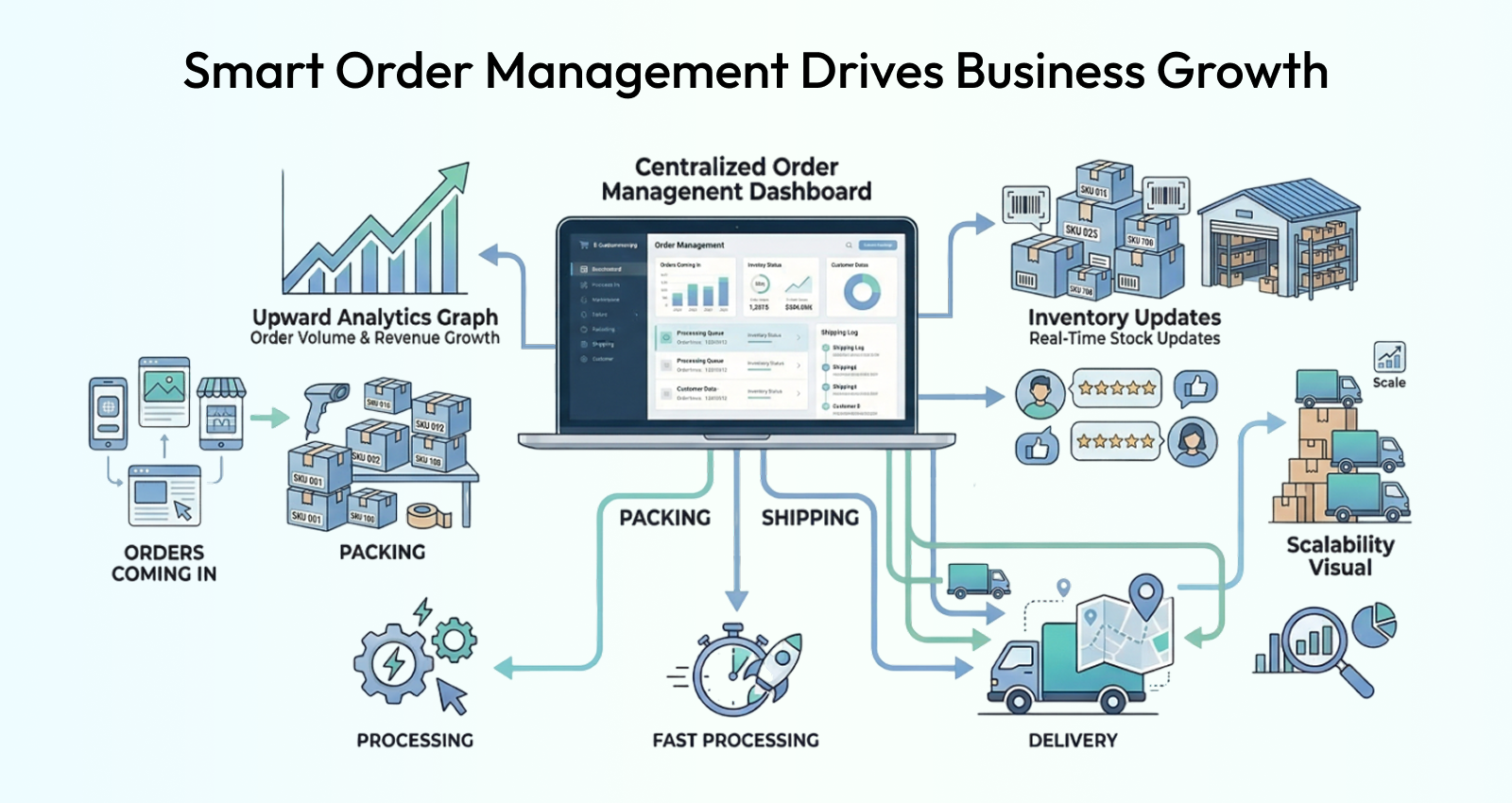
Efficient order management is not only about processing orders quickly. It also plays a key role in long-term business growth.
As ecommerce businesses expand, operational complexity increases. A structured system helps manage this complexity by organizing processes and improving coordination between teams.
A well-managed order process helps businesses achieve several advantages.
Improved operational efficiency
Teams can process more orders without increasing workload.
Better customer satisfaction
Accurate and timely deliveries help build customer trust.
Stronger inventory control
Businesses can monitor stock levels more effectively and plan inventory better.
Higher scalability
Businesses can handle larger order volumes without operational disruptions.
These advantages help businesses grow while maintaining consistent service quality.
Using order management system ecommerce solutions enables businesses to streamline workflows, reduce operational stress, and manage growing demand effectively.
The Future of Order Management in Ecommerce
The ecommerce industry continues to evolve rapidly, and order management technology is becoming more advanced. Modern systems are incorporating automation, analytics, and integrations that help businesses operate more efficiently.
Future order management solutions are expected to focus on:
Automation of complex operational tasks
AI-based demand forecasting
Advanced inventory management
Faster logistics coordination
Improved customer communication
Businesses that adopt efficient order management tools early can stay competitive and deliver better service in an increasingly demanding ecommerce environment.
Key Takeaways for Ecommerce Businesses
Managing orders effectively is one of the most important aspects of running a successful ecommerce business. As order volumes increase, manual processes become difficult to manage and can lead to operational challenges.
A structured system helps businesses simplify their operations and maintain efficiency.
Important insights for businesses include:
- Order management plays a central role in ecommerce operations.
- Manual order tracking becomes inefficient as businesses grow.
- Automation helps improve order processing speed and accuracy.
- Centralized systems simplify multi-channel order management.
- Efficient order handling improves customer satisfaction and brand trust.
By implementing the right tools and processes, businesses can simplify operations and focus on expanding their ecommerce presence.
Modern order management system in an ecommerce solutions help businesses organize their workflows, improve operational visibility, and deliver a better shopping experience for customers.
Final Thoughts
Efficient order management is essential for ecommerce businesses that want to scale successfully. As customer expectations continue to rise, businesses must ensure that orders are processed accurately and delivered on time.
An organized approach to order handling helps reduce operational complexity and improves customer satisfaction.
By adopting reliable systems, businesses can streamline their operations, improve efficiency, and support long-term growth in the competitive ecommerce market.
FAQs
An order management system for ecommerce is a software solution that helps businesses track, process, and manage customer orders from a single platform. It manages the entire order lifecycle including order placement, payment confirmation, inventory updates, shipping coordination, and delivery tracking. This helps businesses operate more efficiently and reduces manual errors.
An order management system helps ecommerce businesses simplify complex operational tasks. It centralizes order tracking, automates inventory updates, and improves coordination with logistics partners. With a structured system, businesses can process orders faster, reduce mistakes, and provide better delivery experiences to customers, which ultimately improves customer satisfaction
Order management software helps streamline order fulfillment by automating order processing, inventory updates, and shipping coordination. Once a customer places an order, the system sends it directly for packaging and dispatch. This reduces manual work and speeds up the fulfillment process, allowing businesses to handle higher order volumes efficiently.
Good ecommerce order management software usually includes features such as centralized order tracking, real-time inventory updates, shipping integrations, automated notifications, and return management. These features help businesses maintain better operational control and ensure orders are processed and delivered accurately without delays.
Yes, modern order management systems are designed to manage orders from multiple sales channels such as ecommerce websites, marketplaces, mobile apps, and social commerce platforms. All orders are collected into a single dashboard, which helps businesses track, process, and fulfill orders without switching between different systems.
An organized order management process ensures that orders are processed quickly and delivered on time. Customers receive order confirmations, shipping updates, and delivery tracking notifications. This transparency builds trust and helps customers feel confident about their purchases, which improves overall customer satisfaction and encourages repeat purchases.
Businesses that rely on manual order tracking often face challenges such as inventory errors, delayed shipments, poor order visibility, and increased operational workload. As order volumes grow, these problems can affect customer satisfaction and business efficiency. A proper order management system helps eliminate these issues.
As ecommerce businesses grow, the number of orders increases significantly. An order management system helps businesses manage this growth by automating order processing, synchronizing inventory, and improving logistics coordination. This allows businesses to handle higher order volumes without increasing operational complexity.