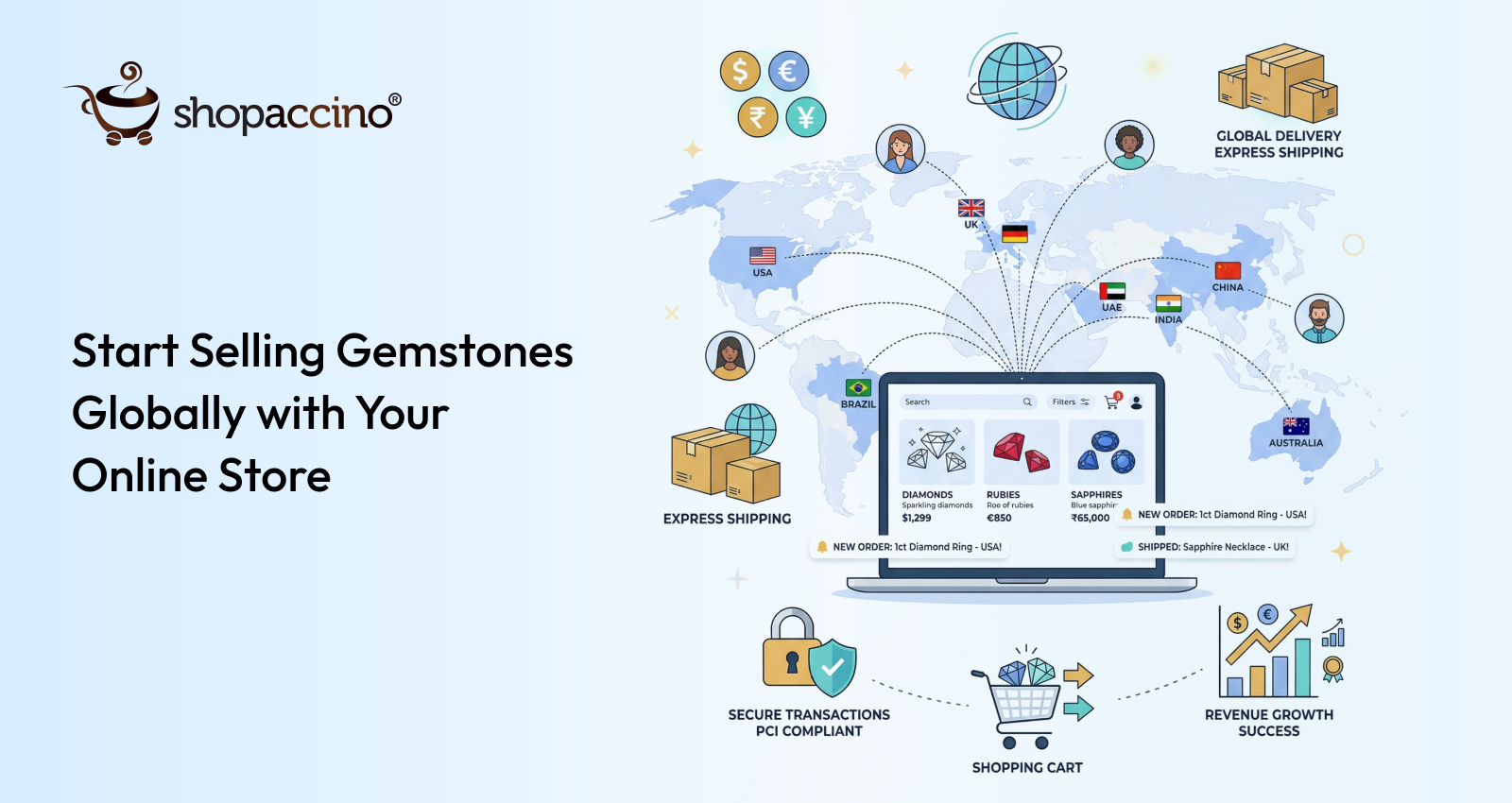
How to Sell Gemstones Online and Reach Buyers Across the World
The global gemstone market is worth over USD 30 billion annually, and a growing share of those purchases is now happening online. Buyers who once travelled to Jaipur, Bangkok, or Antwerp to source gems are increasingly buying through ecommerce stores — provided sellers can prove authenticity, present stones professionally, and handle international logistics.
If you want to sell gemstones online, you no longer need a physical showroom in a prime location. With the right strategy, you can reach buyers across countries, build trust digitally, and scale your gemstone business faster than traditional methods ever allowed.
But selling gemstones online is not just about listing products. Unlike commodity ecommerce, gemstones are a high-trust, high-value category. Success requires four things working together:
- Authenticity — certified stones with traceable origin
- Professional presentation — high-quality images, video, and detailed specs
- Trust signals — reviews, return policies, certification displays
- Targeted marketing — reaching jewelry designers, collectors, and retail buyers
In this complete guide, you will learn how to start an online gemstone business, build a professional ecommerce store, price gems correctly, attract international buyers through SEO and paid ads, and scale your business sustainably.
To sell gemstones online successfully, you need to choose a niche, source certified gemstones, create a professional website, add high-quality images and descriptions, set the right pricing, and promote your products using SEO and digital marketing.
This step-by-step approach helps you build trust, attract global buyers, and grow your gemstone business online.
How to Sell Gemstones Online: 7-Step Process for Sellers
To successfully sell gemstones online, you need a structured approach that combines product quality, trust, and digital execution.
Step-by-Step Process
Step 1: Choose your gemstone niche
Focus on a specific category like precious stones, semi-precious stones, or astrology gemstones.
Step 2: Source certified gemstones
Ensure authenticity with proper certification and reliable suppliers.
Step 3: Create a professional online store
Build a website where customers can explore and buy your products.
Step 4: Add high-quality images and videos
Show multiple angles and real appearance of gemstones.
Step 5: Write detailed product descriptions
Include weight, origin, treatment, and certification details.
Step 6: Set competitive pricing
Research competitors and market demand.
Step 7: Promote using digital marketing
Use SEO, social media, and ads to attract buyers.
If you want to sell gemstones online successfully, you need a combination of product quality, trust, and a strong online presence.
Why Sell Gemstones Online? 5 Key Business Benefits
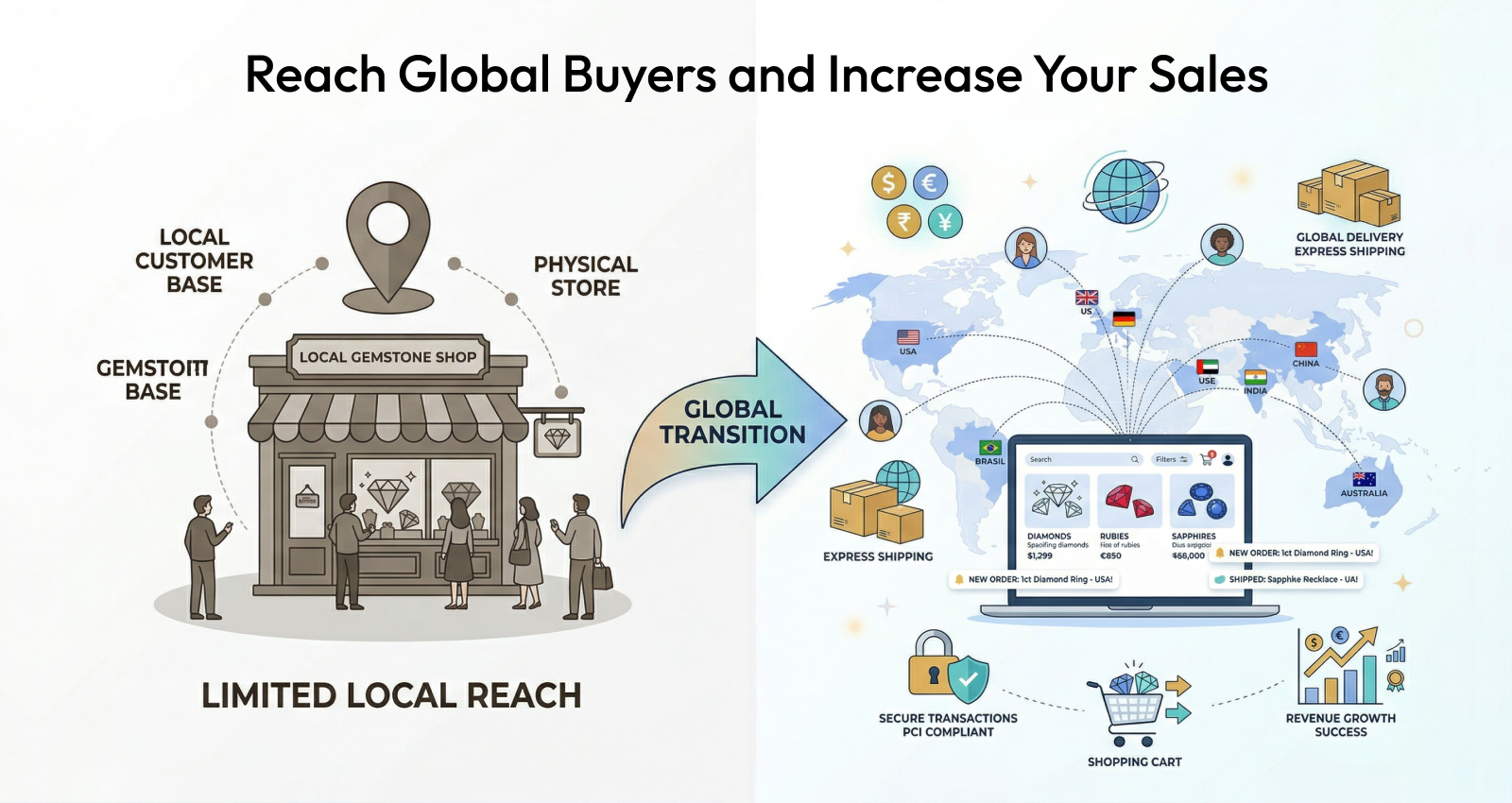
The gemstone industry has traditionally depended on offline sales, but online selling offers a clear advantage.
Key Benefits
- Global Reach: Sell to customers worldwide
- Lower Costs: No need for expensive showroom
- 24/7 Sales: Your business runs all the time
- Direct Customers: No middlemen involved
One of the biggest reasons to sell gemstones online is the shift in buyer behavior. Today, customers prefer researching and comparing gemstones online before making a purchase. They look for detailed information, certification, and transparent pricing, which makes online platforms more suitable than traditional methods.
Example: A seller in Jaipur can directly sell gemstones to a buyer in the US without any physical presence.
Understanding Who Buys Gemstones Online (4 Buyer Types)
Before starting, understanding your buyers is essential.
Who Buys Gemstones Online?
- Jewelry designers
- Retail customers
- Collectors
- Astrology buyers
Each buyer type has different expectations:
- Designers focus on quality and uniqueness
- Retail buyers focus on price and trust
How to Start an Online Gemstone Business (Detailed Setup)
Starting an online gemstone business requires planning, sourcing, and execution.
1.Choose Your Gemstone Niche
Instead of selling everything, focus on a specific niche.
Popular Niches
- Precious gemstones (Ruby, Emerald, Sapphire)
- Semi-precious stones
- Healing crystals
- Birthstones
A focused niche helps you build authority and attract targeted buyers.
Most Profitable Gemstones to Sell Online
Not all gemstones perform equally online. Some categories convert better, command higher margins, and have stronger search demand. Here is what consistently sells well:
Gemstone | Buyer Type | Average Price Range | Why It Sells Online |
|---|---|---|---|
Blue Sapphire | Jewelry, Astrology | $100 – $5,000+/ct | High global demand; strong astrology buyer base |
Ruby | Jewelry, Collectors | $200 – $10,000+/ct | Strong investment perception; recognizable name |
Emerald | Jewelry, Collectors | $150 – $8,000+/ct | Premium category with growing online buyer trust |
Yellow Sapphire | Astrology, Jewelry | $50 – $1,500/ct | High repeat-purchase rate from astrology buyers |
Tanzanite | Collectors, Jewelry | $300 – $2,000/ct | Rare single-source gem; collector demand |
Opal | Jewelry, Designers | $10 – $500/ct | Highly visual; great social media performance |
Amethyst | Retail, Healing | $5 – $50/ct | Low entry price; high volume; healing-crystal demand |
Turquoise | Jewelry, Healing | $3 – $200/ct | Strong demand in Western jewelry markets |
Diamonds (Lab-Grown) | Jewelry, Investment | $200 – $3,000/ct | Fast-growing category; younger ethical buyers |
Healing Crystals | Wellness, Spiritual | $5 – $100 | Massive wellness market; recurring purchases |
Pricing ranges are approximate and depend heavily on clarity, origin, treatment, and certification. Use this as a category-demand guide, not a strict price chart.
2.Source High-Quality Gemstones
Quality is the backbone of your business.
Where to Source
- Direct miners
- Wholesale suppliers
- Local markets like Jaipur
What to Check
- Authenticity
- Certification
- Clarity and cut
- Origin
Always provide certification to build trust with buyers.
3.Build Trust (Most Important Factor)
Gemstones are high-value products, and trust plays a major role in online sales.
How to Build Trust
- Provide certification details
- Use high-quality images
- Add product videos
- Offer return policy
- Display clear product specifications
Buyers are more likely to purchase when they feel confident about authenticity.
3 Channels to Sell Gemstones Online (Pros & Cons of Each)
There are multiple channels to sell gemstones online, and each has its own role.
Selling Channels Comparison
|
Method |
Advantage |
Limitation |
|
Marketplaces |
Easy to start |
High competition |
|
Social Media |
Direct engagement |
Time-consuming |
|
Own Website |
Full control |
Needs setup |
Best Strategy
Combine all channels:
- Start with marketplaces for quick sales
- Use social media to build audience
- Build your own website for long-term growth
Why You Need a Professional Gemstone Website (Not Just a Marketplace Store)
If you want to grow your business, a website is essential.
Benefits of a Website
- Build your brand
- Increase profit margins
- Direct customer interaction
- No dependency on third-party platforms
What Your Website Must Have
A strong gemstone website development strategy should include:
- Clean and professional design
- High-quality product images
- Detailed descriptions
- Secure payment options
- Mobile-friendly interface
Your website should look premium and trustworthy.
Gemstone Website vs Marketplace: Which is Better for Profit?
|
Factor |
Website |
Marketplace |
|
Branding |
Strong |
Limited |
|
Profit |
Higher |
Lower |
|
Control |
Full |
Limited |
|
Traffic |
Needs effort |
Built-in |
Marketplaces help you start, but your website helps you scale.
Choosing the Best Gemstone Ecommerce Platform (Buyer's Checklist)
To run your online store smoothly, you need the right platform.
A good gemstone ecommerce solution should offer:
- Easy product management
- Secure payments
- Mobile optimization
- SEO-friendly structure
Platforms like Shopaccino allow you to create a professional e-commerce store without technical complexity, making it easier to manage and grow your gemstone business.
Common Mistakes Online Gemstone Sellers Make (And How to Avoid Them)
Many beginners fail because of avoidable mistakes.
Avoid These:
- Selling uncertified gemstones
- Using poor-quality images
- Writing incomplete descriptions
- Ignoring customer trust
- Relying only on marketplaces
How to Price Gemstones Online: Strategies for Trust + Profit
When you sell gemstones online, pricing is not just about numbers—it directly affects trust, perception, and conversion. Unlike regular ecommerce products, gemstones are high-value and emotionally driven purchases. Buyers carefully evaluate price in relation to quality, authenticity, and seller credibility.
If your pricing is too low, buyers may doubt authenticity. If it is too high without proper justification, they may leave your site and compare other sellers. This makes pricing strategy one of the most important parts of running a successful online gemstone business.
The first step is understanding that gemstone pricing is not fixed. It depends on multiple factors such as clarity, origin, certification, and rarity. For example, two sapphires of the same size can have completely different values based on their origin and treatment.
To build trust, your pricing should always be supported by clear information. When a buyer sees certification details, origin, and high-quality visuals along with the price, they feel more confident in making a purchase decision.
Another effective approach is offering different pricing tiers. Some customers look for affordable options, while others are willing to pay premium prices for certified and rare stones. By offering entry-level, mid-range, and premium gemstones, you can cater to a wider audience without losing potential buyers.
How to Market Gemstones Online: SEO, Social & Paid Ads Playbook
Once your pricing is clear, the next step is attracting the right audience. No matter how good your products are, you cannot sell gemstones online without visibility.
Digital marketing is what connects your gemstones to global buyers. But instead of trying everything at once, it is important to focus on strategies that bring high-intent customers—people who are already searching for gemstones.
Search Engine Optimization (SEO): The Foundation of Long-Term Growth
SEO is one of the most powerful ways to grow your gemstone business online because it brings organic traffic from Google.
When someone searches for “buy ruby online” or “natural blue sapphire”, they already have buying intent. If your website appears in those results, you get highly targeted visitors without paying for ads.
To make SEO work, your product pages must go beyond basic descriptions. Instead of just listing specifications, explain the value of the gemstone. For example, instead of writing “Blue Sapphire, 5 carat”, you can describe its origin, quality, and ideal use.
Content also plays a major role. Creating helpful guides (like this blog) builds authority and increases your chances of ranking for multiple keywords related to gemstones.
Real Execution Example (How SEO Brings Buyers)
Suppose you are selling blue sapphire gemstones. Instead of just listing products, you create:
- A product page optimized for “buy blue sapphire online”
- A blog explaining benefits of blue sapphire
- Detailed descriptions with certification and origin
Now when users search for that keyword, your chances of appearing in Google results increase significantly. This is how SEO brings consistent traffic and sales over time.
Social Media: Building Trust Through Visual Content
Gemstones are highly visual products, which makes social media a powerful tool for attracting buyers.
However, posting random images is not enough. You need to create content that builds trust and interest. For example, showing how light reflects on a gemstone or sharing a short video explaining its quality can make a big difference.
Customers often discover gemstone sellers on platforms like Instagram and then visit their website to make a purchase. This means social media acts as the first touchpoint, while your website completes the sale.
Paid Advertising: Faster Results with Targeted Buyers
While SEO takes time, paid advertising can generate immediate traffic.
For example, if someone searches “buy emerald online” and your ad appears at the top, you can directly capture that demand. Similarly, social media ads allow you to target users based on interests and behavior.
Another powerful strategy is retargeting. Many users visit a website but don’t purchase immediately. Retargeting ads remind them about your products and bring them back, increasing the chances of conversion.
How to Sell Gemstones Online Internationally: 5 Steps to Reach Global Buyers
To sell gemstones online internationally, you need to offer global shipping, support international payments, provide gemstone certification, display prices in multiple currencies, and build trust through reviews and clear policies.
Selling globally is one of the biggest advantages of ecommerce, but it also requires careful planning.
The first step is logistics. You need reliable shipping partners who can deliver safely and on time. Delays or damaged products can harm your reputation, especially with international customers.
Next comes payment. International buyers prefer secure and familiar payment methods. If your website does not support these options, they may not complete the purchase.
Another important factor is currency display. Showing prices in local currencies improves user experience and reduces confusion.
Most importantly, international buyers rely heavily on trust signals. They cannot verify your business physically, so they depend on certification, reviews, and clear policies. The more transparent you are, the higher your chances of converting global customers.
International Shipping for Gemstones: What Sellers Need to Know
Shipping gemstones internationally is more complex than regular ecommerce. Stones are high-value, lightweight (high theft target), and subject to customs declarations in most countries. Here is what you must handle:
Insured Couriers
Use carriers that offer high-value parcel insurance. The standard options used by gemstone exporters worldwide:
- FedEx Priority — high coverage limits, robust tracking, common in US/Europe shipments
- DHL Express — strong global coverage including remote regions
- Brink's Global Services — specialist in high-value precious goods (used for >$50K shipments)
- Malca-Amit — specialist precious-goods logistics; preferred for premium gems
Customs & Documentation
For every international gemstone shipment, prepare:
- Commercial invoice with HS code (typically 7103 for natural precious/semi-precious stones)
- Certificate of origin (some countries require Kimberley Process for diamonds)
- Gem lab certification (GIA, IGI, etc.)
- Buyer's full address, phone, and tax/import ID
Buyer-Side Import Duties
International buyers often pay import duties on receipt. Be transparent: clearly state whether your prices include duties (DDP — Delivered Duty Paid) or whether the buyer pays at delivery (DDU — Delivered Duty Unpaid). Surprise duty bills are one of the top reasons international buyers leave negative reviews.
Insurance Beyond Carrier Coverage
For shipments above $5,000, supplement carrier insurance with a specialist jewelry/gem insurance policy (Jewelers Mutual, Lloyd's of London brokers). Standard carrier insurance caps are often lower than your gem's value.
How to Build Buyer Trust in Online Gemstone Sales (Critical Factor)
Trust is the foundation of any successful gemstone business.
Unlike regular ecommerce products, gemstones require buyers to believe in authenticity and value. Without trust, even high-quality products will not sell.
To build trust, you need to focus on transparency. Provide complete details about each gemstone, including origin, weight, treatment, and certification. Use real images and videos instead of edited visuals.
Customer reviews also play a crucial role. When new buyers see positive feedback from others, they feel more confident in making a purchase.
Another important factor is return policy. A clear and fair return policy reduces risk for the buyer and increases conversions.
How to Increase Gemstone Website Conversions (Turn Visitors into Buyers)
Driving traffic to your website is only half the job. The real challenge is converting visitors into buyers.
Many gemstone businesses struggle here because they focus only on attracting traffic but ignore user experience.
To improve conversions, your product pages must answer every question a buyer might have. This includes clear images, detailed descriptions, certification proof, and pricing transparency.
The checkout process should also be simple. If it takes too many steps or feels complicated, users may abandon their purchase.
Even small improvements, like adding trust badges or simplifying payment options, can significantly increase your sales.
Top Challenges in Online Gemstone Business — And Practical Solutions
Every business faces challenges, and the gemstone industry is no different.
One of the biggest challenges is building trust with new customers. This can be solved by providing certifications, reviews, and transparent information.
Another challenge is competition. Since many sellers are moving online, standing out requires strong branding and quality presentation.
Logistics can also be an issue, especially for international orders. Choosing reliable shipping partners and having clear policies helps reduce problems.
By understanding these challenges and preparing for them, you can build a more stable and successful business.
Future of Online Gemstone Sales: Key Trends to Watch
The gemstone industry is evolving rapidly, and businesses that adapt to digital trends will have a clear advantage.
Today, buyers are not just looking for products—they are looking for trust, transparency, and experience. This shift is shaping how gemstone businesses operate online.
One major trend is the increasing demand for certified and traceable gemstones. Buyers want to know the origin, authenticity, and ethical sourcing of stones before making a purchase.
Another important trend is video-based selling. Instead of relying only on images, sellers are now using videos to show the real appearance, shine, and clarity of gemstones. This helps reduce uncertainty and improves buyer confidence.
Additionally, mobile commerce is growing rapidly. A large percentage of users now browse and shop through smartphones, which means your website must be mobile-friendly and fast.
Businesses that focus on transparency, technology, and customer experience will grow faster in the coming years.
How to Scale Your Online Gemstone Business (4 Growth Levers)
Once you start getting consistent sales, the next step is scaling your business.
Scaling is not just about increasing sales—it’s about building a sustainable system that can handle growth efficiently.
Expand Your Product Range Strategically
Instead of adding random products, expand based on demand.
For example, if blue sapphire is performing well, you can:
- Add different quality variants
- Offer certified premium versions
- Introduce related gemstones
This helps you grow without losing focus.
Build a Strong Brand Identity
Branding is what separates successful businesses from average sellers.
When customers remember your brand, they are more likely to return and recommend you to others.
Focus on:
- Consistent design
- Professional website
- Clear messaging
- Trust signals
Leverage Customer Trust for Growth
Satisfied customers can become your biggest marketing asset.
Encourage:
- Reviews
- Testimonials
- Referrals
Word-of-mouth still plays a powerful role—even in online business.
Automate and Optimize Operations
As your business grows, manual processes can slow you down.
Use tools and systems to:
- Manage orders
- Track inventory
- Handle customer communication
This allows you to focus on growth instead of daily operations.
E-commerce vs Traditional Gemstone Selling: Side-by-Side Comparison
|
Factor |
Online Selling |
Traditional Selling |
|
Reach |
Global |
Local |
|
Cost |
Lower |
Higher |
|
Availability |
24/7 |
Limited |
|
Scalability |
High |
Limited |
|
Trust Building |
Digital proof |
Physical interaction |
This clearly shows why more businesses are choosing to sell gemstones online.
Gemstone Certifications Every Online Seller Should Know
In gemstone ecommerce, certification is not optional — it is the primary trust signal that converts hesitant buyers into paying customers. International buyers especially will not purchase uncertified high-value stones from an unknown seller. Here are the certifications buyers recognize:
Lab / Organization | Full Name | Region of Authority | Best For |
|---|---|---|---|
GIA | Gemological Institute of America | Global gold standard | Diamonds, colored stones (premium tier) |
IGI | International Gemological Institute | Global (strong in Asia, Europe) | Lab-grown and natural diamonds |
AGS | American Gem Society | North America | Diamond cut grading |
SSEF | Swiss Gemmological Institute | Europe, premium global | Rare and high-end colored stones |
Gübelin | Gübelin Gem Lab | Europe, premium global | Colored stones at the top end |
GRS | GemResearch Swisslab | Global | Rubies, sapphires, emeralds |
IIGJ / GTL | Indian Institute / Gem Testing Lab | India, parts of Asia | Astrology gems, mid-tier colored stones |
AIGS | Asian Institute of Gemological Sciences | Thailand, Southeast Asia | Sapphires, rubies, regional stones |
Always display the certification number, lab name, and a high-resolution scan of the certificate on each product page. This single change can lift gemstone product page conversion rates by 30-50%.
Final Verdict: Is Selling Gemstones Online Worth It? (Honest Answer)
Selling gemstones online is not just a trend—it is a long-term opportunity.
With the right strategy, you can:
- Reach global buyers
- Build a scalable business
- Increase profit margins
- Reduce operational costs
However, success depends on:
- Product quality
- Trust and transparency
- Strong online presence
- Consistent marketing
If you focus on these areas, you can build a successful and sustainable gemstone business.
FAQs
To sell gemstones online successfully, you need to focus on product quality, certification, and trust. Create a professional website, add detailed product descriptions, use high-quality images, and promote your products through SEO and digital marketing. Building trust through reviews and transparent policies is also essential for converting visitors into buyers.
To start an online gemstone business, choose a niche, source certified gemstones, build a professional ecommerce website, and set up payment and shipping systems. After setup, use SEO, social media, and ads to attract customers. Consistent effort in marketing and customer trust-building is key to long-term success.
Yes, selling gemstones online can be highly profitable because it reduces overhead costs and allows you to reach a global audience. Profitability depends on sourcing quality gemstones, pricing strategy, and effective marketing. Businesses that build trust and brand value tend to generate higher margins.
The best approach is to combine marketplaces, social media, and your own website. Marketplaces help you start quickly, while your website gives you full control and higher profit margins. Using a reliable gemstone ecommerce solution helps you manage and scale your business efficiently.
You can build trust by providing certification, high-quality images, product videos, clear descriptions, and customer reviews. Offering a return policy and transparent pricing also helps customers feel confident in their purchase decisions.
Gemstone pricing depends on factors like type, clarity, origin, certification, and weight. Use competitive and value-based pricing strategies to stay profitable while building customer trust. Offering multiple pricing tiers can help attract different types of buyers.
Yes, you can sell gemstones internationally by enabling global shipping, supporting international payments, and displaying prices in multiple currencies. Providing certification and building trust are essential for attracting global buyers.