Same Products, Different Prices: How to Sell Wholesale and Retail Together
Most store owners treat wholesale and retail as two separate businesses that happen to sell the same thing. One needs a shopfront and single-unit prices. The other needs bulk deals, trade accounts, and a completely different rhythm. So they pick one lane and ignore the other, or they run two disconnected systems and drown in double the admin.
Here is the good part: you do not have to choose, and you do not need two of everything. With the right setup, the same products can carry two sets of prices, serve two kinds of buyers, and run from a single store. You already own the inventory. You very likely already have demand from both sides. Learning to sell wholesale and retail together is mostly about wiring it up so each customer sees the right price at the right moment.
This is a practical guide to doing exactly that: the mechanics that make it work, the decisions you will face, and the traps worth sidestepping before you start.
What does selling wholesale and retail together actually mean?
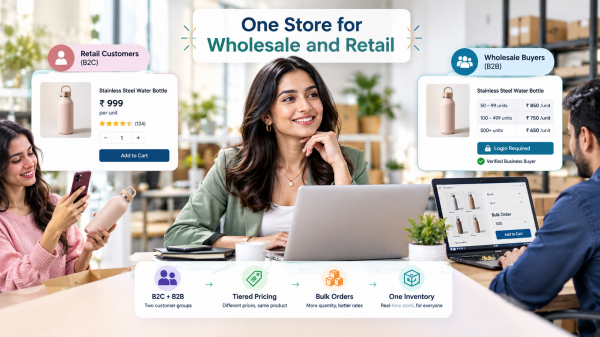
Short answer: It means running one store where retail shoppers pay per-unit prices while wholesale buyers see lower, bulk-based prices on the very same products, and neither group ever sees the other's deal.
Selling both means your catalog does double duty. A retail customer visits, browses, and buys a single item at the normal price. A wholesale customer, usually a business reselling your product, logs in and sees trade pricing, buys in larger quantities, and often works on terms a walk-in shopper never would.
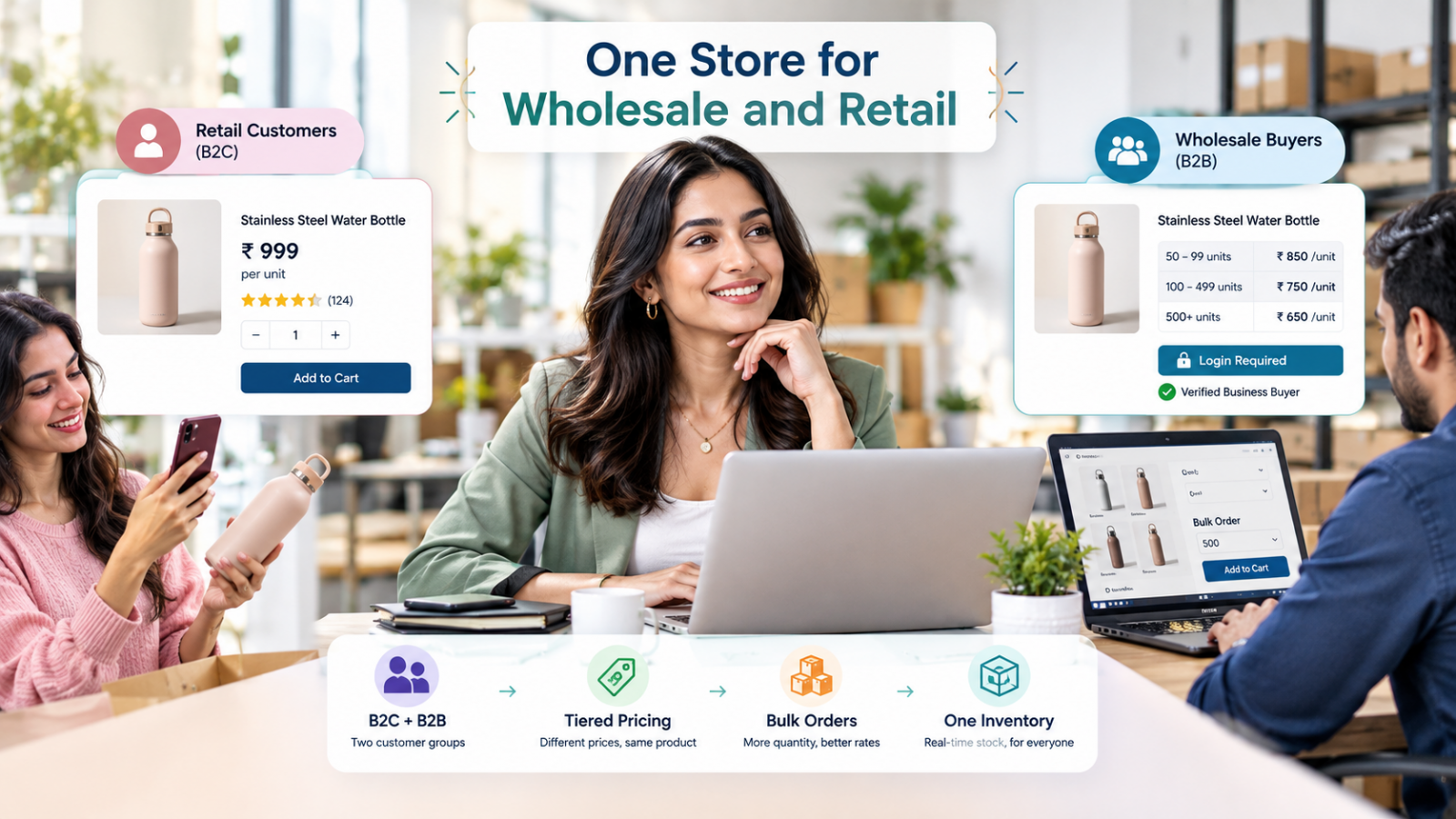
The products are identical. What changes is who is looking and what they are allowed to see. Retail is B2C, selling to the end user. Wholesale is B2B, selling to another business. Running both from one place means one inventory, one dashboard, and one source of truth, with the pricing logic quietly doing the heavy lifting in the background. That is the whole idea in a sentence: serve B2B and B2C together without building two of everything.
Why sell both wholesale and retail from one store?
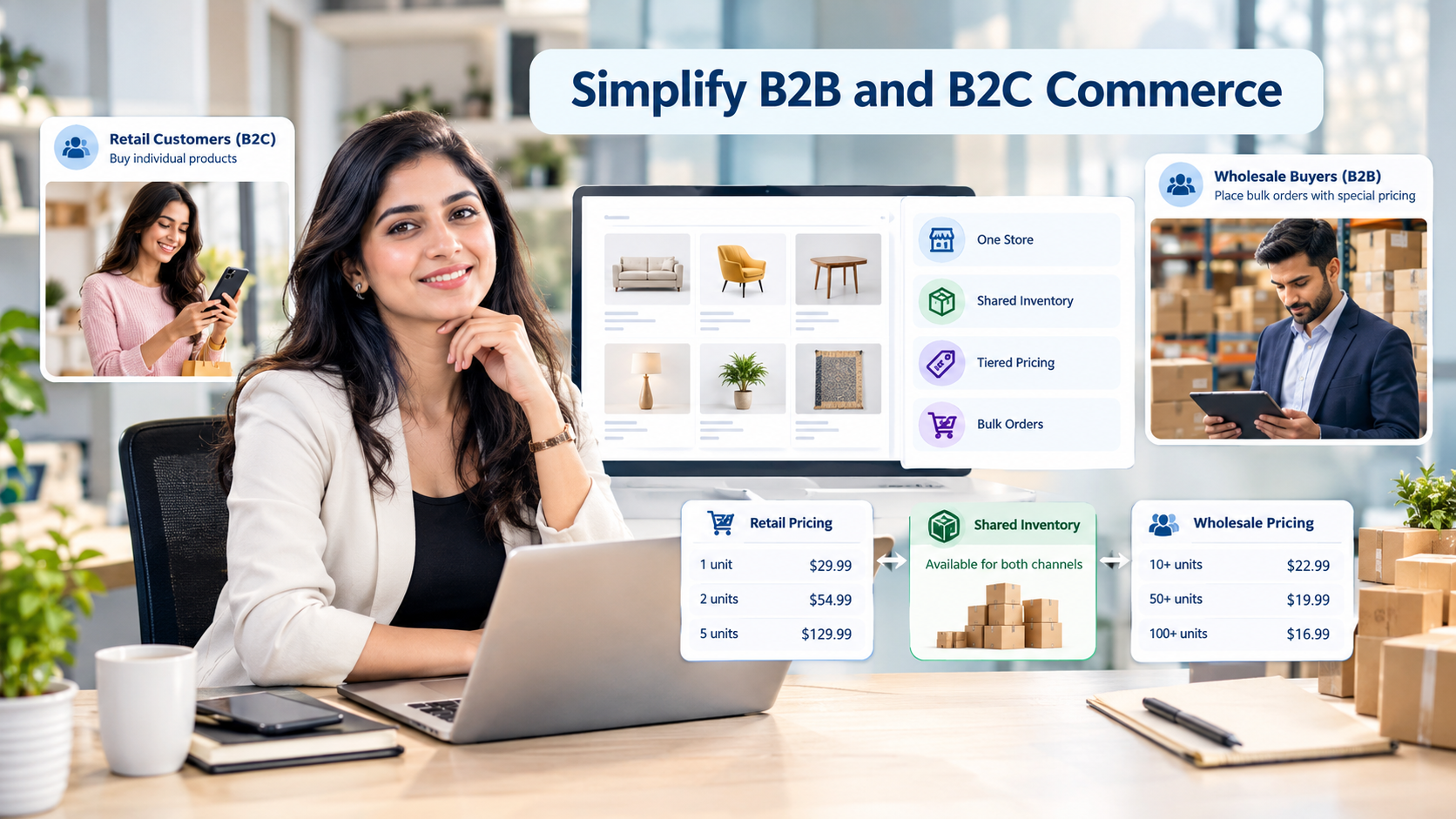
Because it is one of the fastest ways to grow revenue without inventing a new product or chasing a brand new market from scratch. You are simply opening a second door into the business you already run every day.
Retail gives you margin and brand control. You sell at full price, you own the customer relationship, and you build recognition one order at a time. Wholesale gives you volume. A single trade order can equal dozens of retail sales, and a handful of loyal stockists can smooth out the ups and downs of consumer demand across a slow season.
Run together, the two channels balance each other beautifully. Retail keeps your margins healthy while wholesale keeps volume steady. And because both pull from the same inventory and the same back office, you get that second revenue stream without doubling your workload or your software bill. For manufacturers, distributors, and growing D2C brands especially, this is less a nice-to-have and more the natural next step once the first channel is working.
Picture a small brand selling handmade candles. Retail brings in steady orders of one or two units at full price, which pays the bills and builds a following. Then a boutique asks to stock the range and orders 200 units at a trade rate. That single order matches a month of retail sales, and it repeats every quarter. Nothing about the product changed. The brand simply let the same catalog serve a business buyer as easily as a shopper, and doubled its reach in the process. That is the quiet power of running both channels at once.
What makes dual pricing tricky?
Short answer: The challenge is showing different prices to different people on the same product, so retail shoppers never glimpse wholesale rates and wholesale buyers are never stuck paying full retail.
Here is the knot at the centre of it all. A single product can only display one price to an anonymous visitor. If you show your wholesale price publicly, retail customers will expect it too, and your margins quietly evaporate. If you only ever show retail prices, your trade buyers have no reason to order in bulk from you rather than someone else.
So the entire game is controlled visibility. The store needs to recognise who is shopping and adjust what they see accordingly. A retail visitor sees retail pricing. A verified wholesale customer, once logged in, sees their own wholesale pricing. Get that recognition right and everything else clicks into place. Get it wrong and you either leak your trade rates to the public or frustrate the exact buyers you most want to keep.
This is why doing it properly needs more than a hidden discount code passed around by email. Codes get shared, screenshotted, and posted online, and once a wholesale rate leaks it is almost impossible to claw back. What you want instead is a store that genuinely understands customer identity and prices accordingly, so the right rate is tied to the account rather than to a secret anyone can pass along.
How do you show different prices to different customers?
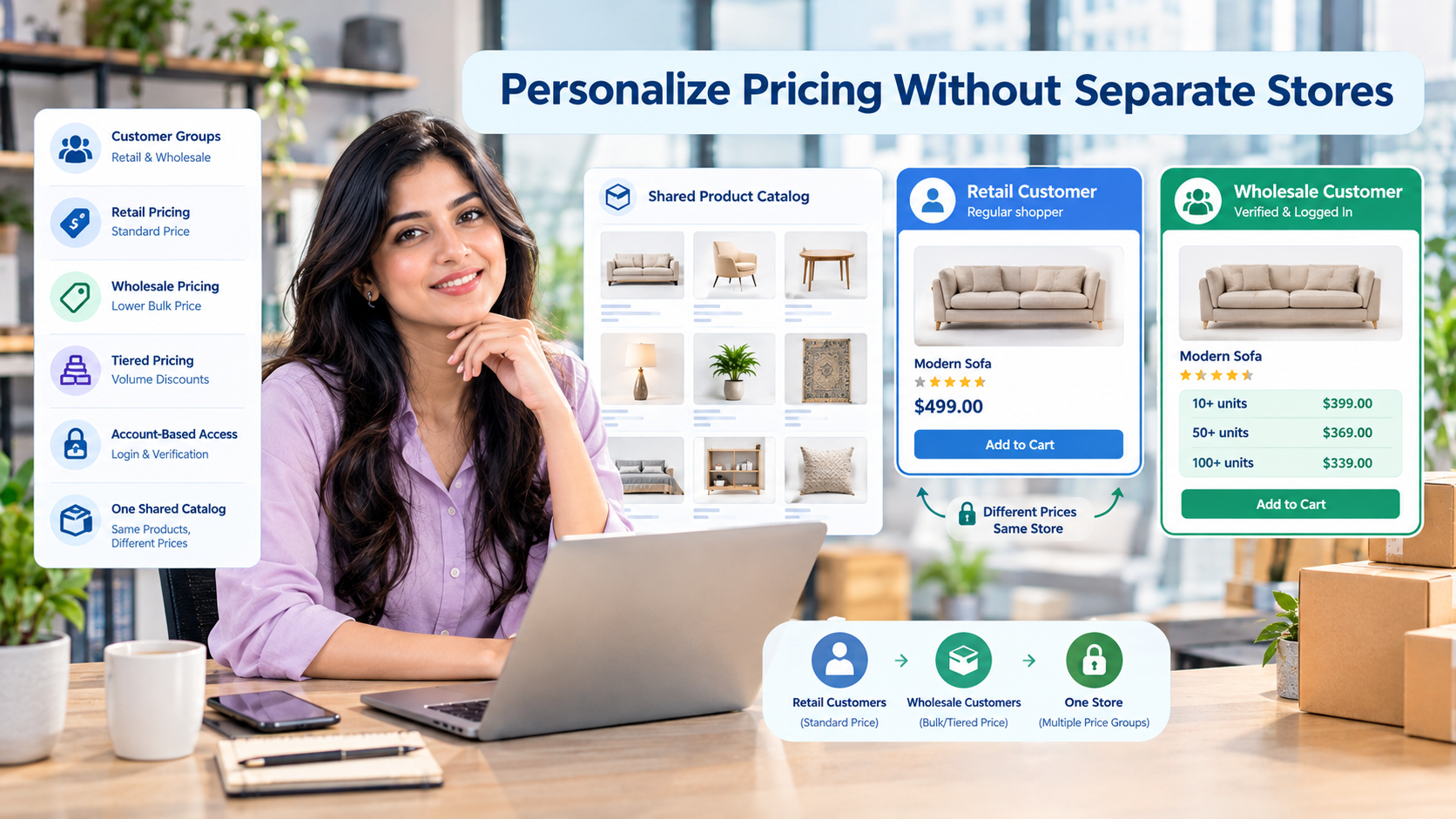
This is where the mechanics come in, and where a store built for both channels really earns its place. A handful of tools, used together, make dual pricing feel effortless. Here is how each piece works.
Use customer groups to unlock the right prices
The backbone of the whole system is customer groups. You sort buyers into segments, retail and wholesale at a minimum, then assign pricing rules to each. A retail shopper browses at standard prices. A wholesale buyer logs into an approved account and the same catalog quietly re-prices to their trade rate. No separate website, no manual quoting back and forth, just the right numbers appearing for the right person the moment they sign in.
Set tiered pricing so bigger orders earn better rates
Wholesale rarely means one flat discount. Buyers who order more expect to pay less per unit, and tiered pricing delivers that automatically. Picture 10 to 49 units at one rate, 50 to 199 at a better one, and 200 or more at your best price. The store runs the calculation at checkout, which rewards larger orders and gently nudges buyers toward the next tier without a single email changing hands.
Require a minimum order quantity for wholesale
Wholesale only makes sense above a certain volume, so set a minimum order quantity for trade buyers. It keeps small orders in the retail lane where your margins live, and reserves wholesale pricing for genuine bulk purchases. It also signals that you run a professional operation, since serious trade buyers expect a minimum order quantity and already know how to work with one.
Control who sees what with catalog access
Sometimes you want wholesale to mean more than cheaper prices. You might offer trade-only products, bulk pack sizes, or an entire section that walk-in shoppers never see. Restricting parts of your product catalog to logged-in wholesale accounts lets you tailor the whole experience per channel, not just the price tag. Retail sees the consumer range; wholesale sees the trade range built for resellers.
Offer the payment and tax terms each channel expects
Retail customers happily pay upfront by card. Wholesale buyers often expect invoicing, credit terms, or tax handling suited to a business rather than a consumer. A store that can apply different payment options and tax rules by customer group lets each side transact the way it is used to, which removes friction at exactly the point where large orders are won or lost.
Make reordering effortless for repeat trade buyers
Retail is about discovery, but wholesale is about repetition. Your stockists buy the same lines again and again, so anything that shortens the reorder is money in the bank. Saved order history, quick reorder from a past invoice, saved carts, and bulk add-to-cart by SKU all turn a tedious job into a two-minute task. When reordering is painless, wholesale customers stay loyal simply because leaving would be more effort than staying.
How do you approve and onboard wholesale buyers?
Short answer: Let businesses apply for a trade account, verify they are genuine resellers, then approve them into a wholesale customer group that unlocks trade pricing automatically at their next login.
Wholesale pricing should be a privilege buyers earn, not a discount anyone can grab. A simple, well-run approval flow protects your rates and still feels welcoming to real trade customers. In practice it usually runs like this:
- Add a clear "apply for a wholesale account" option so interested businesses know the door exists.
- Collect the details that prove they are a genuine reseller, such as a business name, tax or registration number, and what they sell.
- Review each application quickly, since slow approvals are the fastest way to lose an eager buyer to a competitor.
- Approve the buyer into your wholesale customer group, which unlocks trade pricing, tiered rates, and any trade-only products for them.
- Welcome them with the essentials up front: minimum order quantity, payment terms, lead times, and how to reorder.
Done well, the whole thing feels effortless from the outside. A buyer applies, gets approved, logs in, and the same store they browsed yesterday now shows their wholesale prices. Behind that smooth experience is the simple discipline of verifying before you unlock, which keeps your trade rates exactly where they belong.
Should wholesale and retail live on one store or two separate ones?
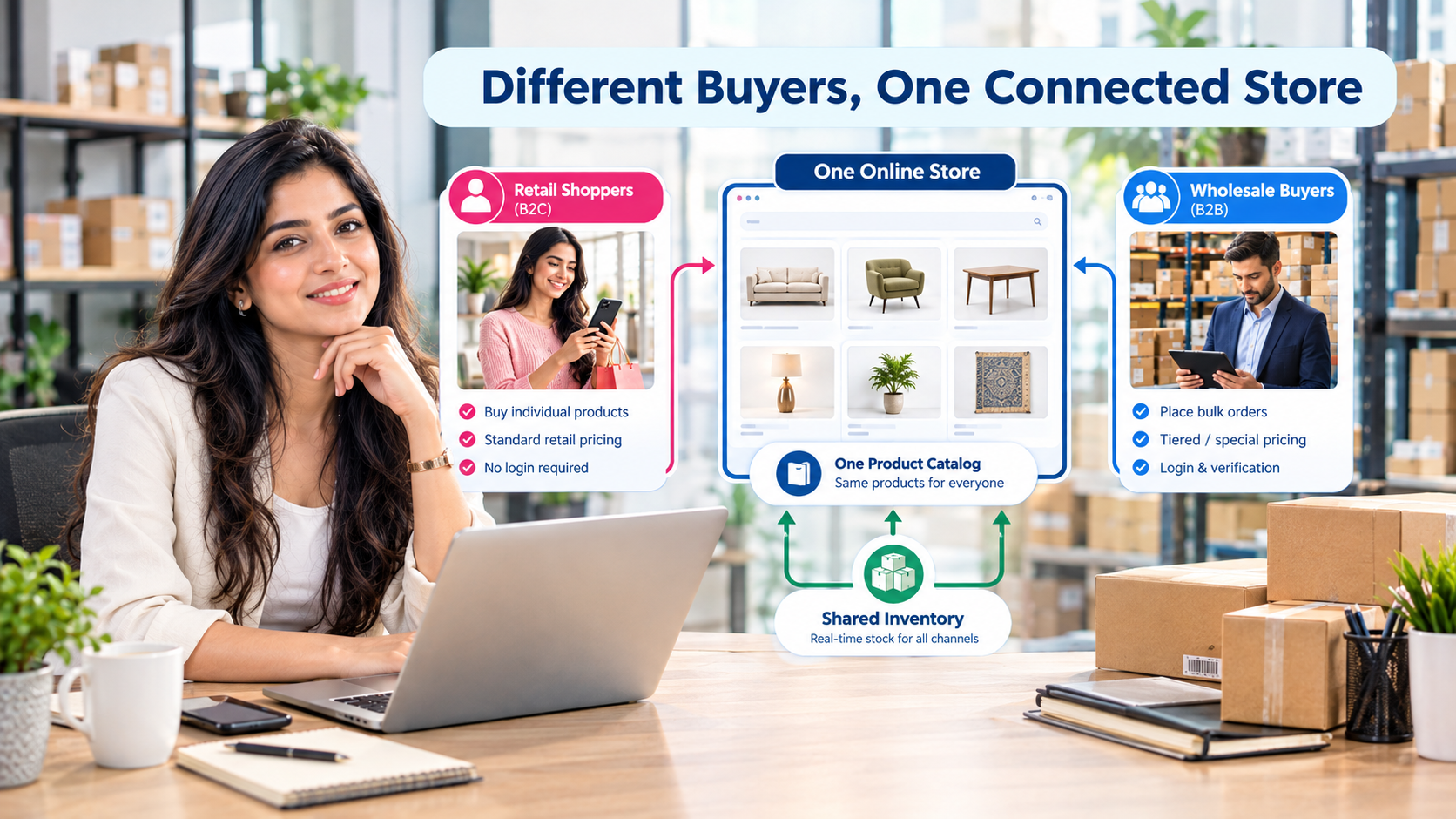
Short answer: For most businesses, one store with customer groups is simpler and cheaper. Two separate stores only earn their keep when the brands, audiences, or operations are genuinely distinct.
The single-store approach wins on sheer efficiency. One inventory count, one admin panel, one set of updates, and pricing that flexes automatically by customer group. When a wholesale order ships, stock drops for retail too, without anyone touching a spreadsheet. Nothing drifts out of sync because there is only ever one source of truth. This fits the large majority of businesses selling both channels.
Two stores can make sense in specific situations: when your wholesale brand and retail brand are deliberately different, when the two audiences should never overlap, or when the operations are so distinct that sharing a system creates more friction than it removes. Just walk in clear-eyed. Two stores means double the maintenance, double the risk of mismatched stock, and double the cost. Plenty of sellers who think they need two really need one store configured well.
What mistakes trip up businesses selling both?
Even with the right tools in hand, a few missteps show up again and again. Sidestep these and the rest of the journey stays smooth.
- Showing wholesale prices publicly. The moment retail visitors can see trade rates, your retail margins come under pressure. Keep wholesale pricing tucked safely behind a login.
- Approving trade accounts with no checks. Letting anyone claim a wholesale account turns your trade rate into a public discount. Verify buyers before you unlock their pricing.
- Forgetting a minimum order quantity. Without one, you end up selling single units at wholesale prices, which quietly defeats the entire purpose.
- Running stock in two places. Separate inventory for each channel leads to overselling and disappointed customers. One shared inventory keeps every number honest.
- Treating wholesale buyers like retail ones. Trade customers want terms, tiered pricing, and fast reordering, not a consumer checkout. Serve them the way businesses expect to be served.
How does Shopaccino handle wholesale and retail together?
Shopaccino is built to run B2B and B2C from a single platform, which is precisely what selling both channels asks for. You can set up customer groups for retail and wholesale, apply tiered pricing and a minimum order quantity to trade accounts, control which products each group sees, and offer channel-appropriate payment and tax handling, all on one shared inventory. Manufacturers, distributors, and D2C brands use it to serve walk-in shoppers and bulk buyers side by side, with integrated inventory, payments, logistics, and multi-warehouse fulfilment working quietly in the background, plus zero platform transaction fees so climbing volume never eats into your margin. Add built-in multi-currency and international shipping, and the same setup stretches to wholesale customers overseas, not only the ones at home.
The bottom line: one store, two revenue streams
Selling wholesale and retail together is not about building two businesses. It is about getting far more out of the one you already have. Same products, same inventory, same store, with pricing smart enough to greet each customer with the right number the moment they arrive. Set up customer groups, add tiered pricing and a sensible minimum order quantity, keep your trade rates behind a login, and you open a second revenue stream that largely runs itself. The products never change. What changes is how hard they work for you. Start with one wholesale customer group and a single tiered price, watch how it behaves, then expand from there. The businesses that grow fastest are rarely the ones with the most products. They are the ones that squeeze every drop of value from the products they already sell.
FAQs
Yes. With customer groups, one store can show retail prices to shoppers and wholesale prices to verified trade accounts on the same products. You keep a single inventory and dashboard while serving both B2B and B2C buyers from one place.
Keep wholesale pricing behind a login and tie it to approved customer groups. Anonymous and retail visitors see standard prices, while verified wholesale customers see trade rates only after signing in. Never display wholesale prices publicly on product pages.
A minimum order quantity is the smallest amount a wholesale buyer must purchase to qualify for trade pricing. It keeps small orders in the retail lane and reserves wholesale rates for genuine bulk purchases, protecting your margins. Most wholesale setups need one.
For most businesses, one store with customer groups is simpler and cheaper, since inventory and admin stay unified. Two stores only make sense when the brands, audiences, or operations are genuinely separate, and they double the maintenance and cost.
Tiered pricing sets lower per-unit prices as order quantity rises, for example 10 to 49 units at one rate and 50 or more at a better one. The store applies the correct tier automatically at checkout, rewarding larger orders without any manual quoting.
Often, yes. Retail buyers usually pay upfront by card, while wholesale buyers may expect invoicing, credit terms, or business-specific tax handling. A store that sets payment and tax rules by customer group lets each channel transact the way it expects.