WhatsApp Commerce vs Ecommerce Website: What Should Businesses Use?
One channel lives in your customer's pocket. The other lives on Google. Both can bring you orders, but only one of them should be the foundation your business stands on, and picking the wrong one quietly caps how far you can grow.
This guide breaks down WhatsApp commerce vs. an e-commerce website in plain terms: what each one does well, where each one falls apart, what they really cost as you scale, and how smart businesses combine the two without doubling their workload.
Quick answer An ecommerce website should be your core sales channel because it can be found on Google, handles unlimited products and orders automatically, and builds long-term brand trust. WhatsApp commerce works best as a conversation and retention layer on top of it: answering questions, confirming orders, sending updates and driving repeat purchases. Most growing businesses get the best results by using both, connected to one system. |
Key Takeaways
- WhatsApp is a conversation tool first. It shines at personal selling, quick replies, and repeat orders from people who already know you.
- A website is a discovery and scale tool. It brings in new buyers through search, runs 24/7 and processes orders without manual effort.
- WhatsApp alone hits a ceiling. Chats are invisible to Google, hard to track at volume and dependent on one phone or one team.
- A website alone can feel cold. Without fast, human answers, high-consideration buyers leave before they buy.
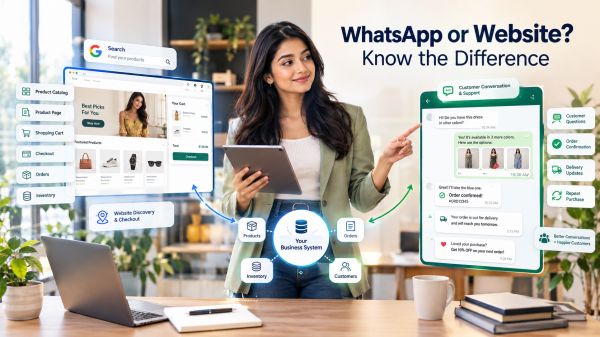
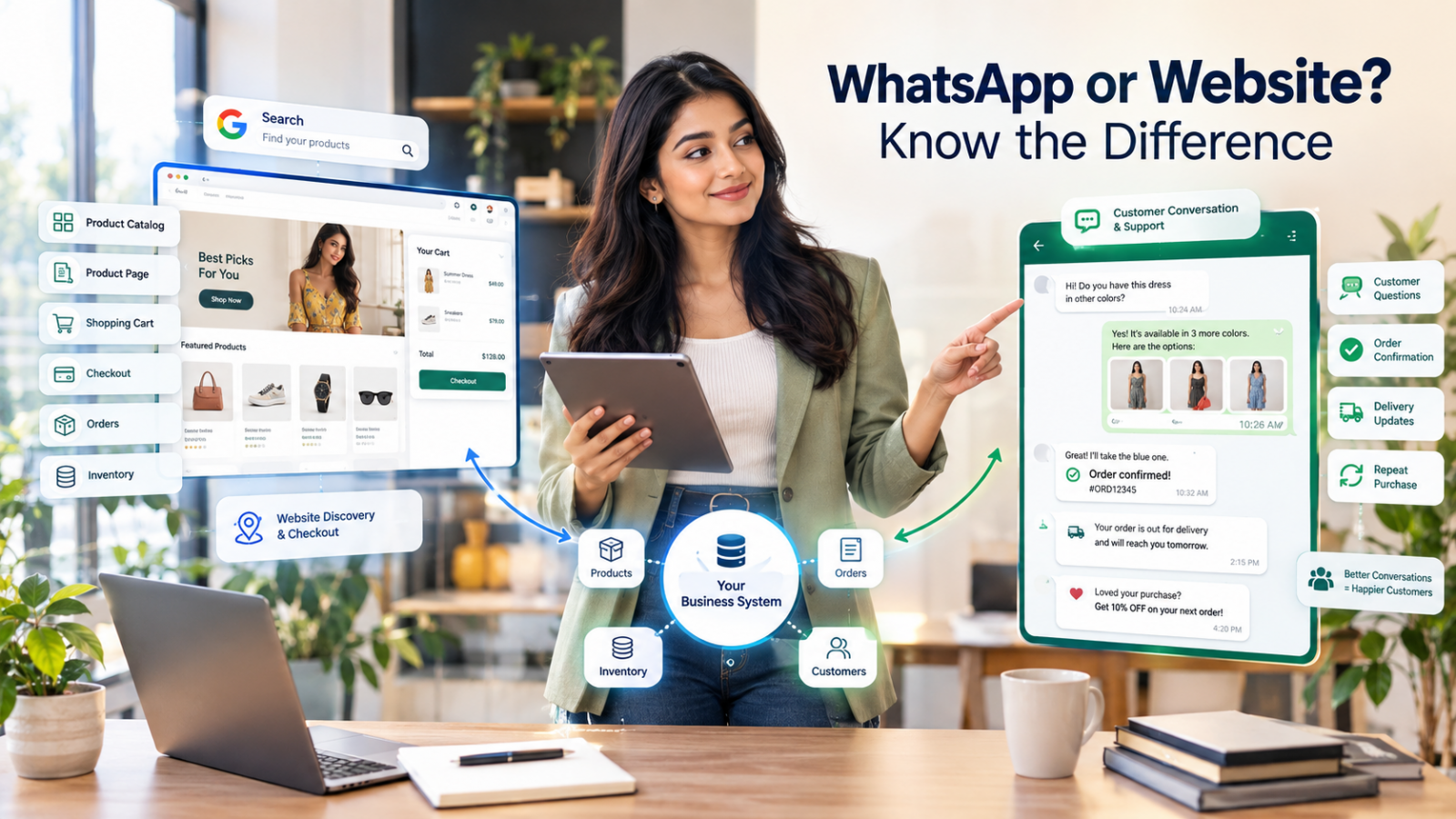
- The winning setup is connected. Website for discovery and checkout, WhatsApp for support, updates and reorders, all feeding the same order and inventory data.
What Is WhatsApp Commerce?
WhatsApp commerce is the practice of selling products through WhatsApp chats, from sharing a catalog to taking the order and collecting payment.
It usually starts simple. A business owner shares product photos with a customer, agrees on a price in chat and sends a payment link. As things grow, businesses move to the WhatsApp Business app (with a catalog, quick replies and labels) and later to the WhatsApp Business Platform, often called the API, which allows automation, chatbots, order notifications and multiple agents on one number.
The appeal is obvious. According to WhatsApp, more than 3 billion people in over 180 countries use the app. Your customer does not need to download anything, create an account or learn a new interface. They just message you.
This style of selling falls under the wider idea of conversational commerce: buying and selling through a two-way conversation instead of a self-service page.
What Is an Ecommerce Website?
An ecommerce website is your own online store where customers can browse products, add them to a cart, pay and track orders on their own, at any hour.
It is the digital version of a shop you fully own. You control the design, the product pages, the pricing rules, the checkout and the customer data.
Online stores keep growing as a share of how people buy. The U.S. Census Bureau reports that ecommerce accounted for 17.1 percent of total U.S. retail sales in the second quarter of 2026, with seasonally adjusted online sales of 340.2 billion dollars in that quarter alone. Buyers everywhere now expect a proper place to browse before they buy.
WhatsApp Commerce vs Ecommerce Website: How Do They Compare Side by Side?
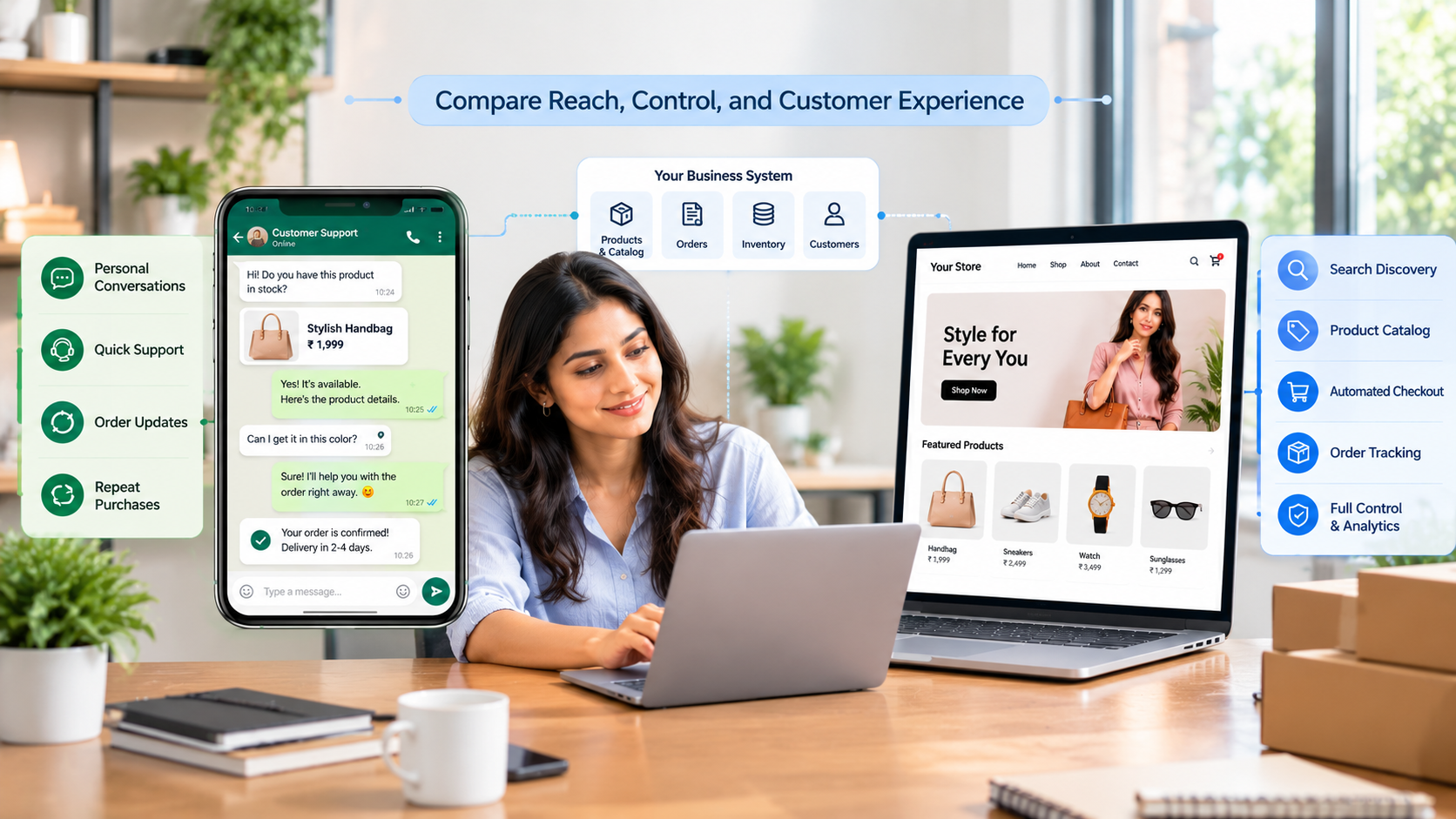
WhatsApp wins on speed, personal touch and re-engagement, while a website wins on discovery, automation and scale.
Here is how the two stack up on the factors that matter most when you are choosing where to put your time and money.
Factor | WhatsApp Commerce | Ecommerce Website |
|---|---|---|
Setup time | Minutes with the Business app | Days to a few weeks, depending on catalog size |
Found on Google | No, chats are private | Yes, every product and category page can rank |
New customer discovery | Depends on ads, referrals and social links | Organic search, ads, marketplaces and content |
Product catalog size | Best for small, simple catalogs | Handles thousands of products and variants |
Checkout | Manual or semi-automated in chat | Fully automated cart and payment |
Order tracking | Scattered across chats unless integrated | Built-in order history and status |
Personal touch | Very high, feels like talking to a person | Lower, unless live chat is added |
Repeat purchases | Strong through broadcasts and reminders | Strong through accounts, emails and one-click reorder |
Brand control and data | Limited by platform rules | You own the storefront and customer data |
Best role | Conversation, support and retention | Discovery, sales and operations |
The table makes one thing clear: these are not really rivals. They do different jobs. The mistake businesses make is asking one of them to do the other's job.
Where Does WhatsApp Commerce Win?
WhatsApp commerce wins whenever a sale depends on trust, quick answers or an existing relationship.
Think about a buyer looking at a handwoven rug, a custom piece of furniture or a bulk order of industrial parts. They have questions. Is the color accurate? Can you deliver by Friday? What price do I get for 500 units? A product page cannot answer all of that. A 30-second chat can.
WhatsApp also works beautifully after the first sale. Order confirmations, shipping updates, restock alerts and reorder nudges land in the same app your customer uses to talk to family, so they actually get seen.
Pros of WhatsApp commerce
- Zero learning curve for customers who already use the app daily
- Fast, human answers that close high-consideration sales
- Strong channel for order updates, reminders and repeat business
- Very low cost to start with the free Business app
- Easy to share with a link, a QR code or a button on social profiles
Cons of WhatsApp commerce
- Invisible to search engines, so strangers cannot find you
- Becomes messy at volume with no clear order status or queue
- Heavy reliance on staff availability and response time
- Limited catalog and filtering for large product ranges
- Platform rules, message templates and pricing are set by Meta, not by you
Where Does an Ecommerce Website Win?
An ecommerce website wins when you want new customers, bigger catalogs and sales that happen without you being online.
A website works while you sleep. Someone in another city or another country searches for the exact product you sell, lands on your product page, compares variants, reads the details and pays. No chat. No wait. No staff needed.
It is also the only channel that compounds over time. Every product page, category page and blog post you publish becomes a small, permanent door into your business through organic search and, increasingly, through AI answer engines that pull from well-structured web pages. A WhatsApp chat, however good, disappears into one person's inbox.
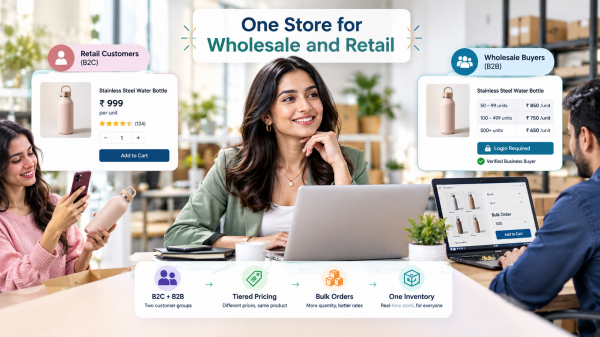
For businesses that sell wholesale, the website is where the rules live: tiered pricing, minimum order quantities, customer-specific catalogs and credit terms. Managing those rules by memory in chat is where errors creep in.
Pros of an ecommerce website
- Discoverable on Google, marketplaces and AI search tools
- Automated checkout, payments, invoices and inventory management
- Handles large catalogs with filters, variants and search
- Builds brand credibility with buyers who check you out first
- Full ownership of design, pricing logic and customer data
Cons of an ecommerce website
- Takes longer to set up than a WhatsApp account
- Needs ongoing effort on SEO, content and ads to drive traffic
- Can feel impersonal for buyers who want to ask questions first
- Cart abandonment happens silently unless you follow up
What Does Each Channel Really Cost as You Grow?

WhatsApp looks cheaper at the start, but the real cost shows up later in staff time, message fees and lost orders, while a website costs more upfront and less per order as you scale.
The free WhatsApp Business app costs nothing to use. The moment you need automation, multiple agents or order notifications at scale, you move to the WhatsApp Business Platform. According to Meta's official pricing documentation, the platform switched to per-message pricing on July 1, 2025. Marketing template messages are always charged, while utility and authentication templates are charged outside the customer service window. Replies sent within an open 24-hour customer service window are free.
That model is fair, but it adds up. Every promotional broadcast, abandoned cart reminder and win-back message has a price tag. On top of that, you still pay a provider or tool to manage the API.
The bigger hidden cost is people. If every order is typed, confirmed and tracked by hand, your sales capacity equals the number of hours your team can spend chatting. Double the orders and you roughly double the effort.
A website works the other way around. You pay for the platform, a theme and some setup time, then each extra order costs almost nothing to process. The checkout, payment, invoice and stock update happen automatically.
Here is a simple way to think about it:
- Low volume, high touch: WhatsApp is cheaper and faster.
- Growing volume, mixed customers: A website plus WhatsApp for support gives the best cost per order.
- High volume or wholesale: A website is essential, with WhatsApp used mainly for automated updates and key accounts.
Can You Run a Business on WhatsApp Alone?
You can start on WhatsApp alone, but most businesses outgrow it once orders, products or team members multiply.
Many small sellers run happily on WhatsApp for months. Then the ceiling arrives quietly: you feel busier while sales stay flat.
Watch for these signs that WhatsApp-only selling is holding you back:
- Customers ask "Is this still available?" for products that sold out days ago
- You scroll through old chats to find what a buyer ordered last time
- Orders slip through because a message was read but never answered
- Your best salesperson goes on leave, and sales drop with them
- New buyers only come from referrals, never from search
- Wholesale buyers get different prices depending on who replied
If three or more of these sound familiar, the issue is not effort. It is the system. You need a store that holds your catalog, pricing and orders in one place, with WhatsApp plugged into it instead of carrying the whole load.
Which One Should You Choose for Your Business?
Choose based on how your customers find you and how complex your orders are, not on which channel feels easier today.
Every business is different, so here is a practical starting point by business type.
If your business is... | Start with | Why it fits |
|---|---|---|
A new seller testing a few products | WhatsApp, then a website within months | Validate demand fast, then build a searchable store |
A D2C brand building a name | Ecommerce website plus WhatsApp support | Brand storytelling, SEO and fast pre-sale answers |
A manufacturer or wholesaler | B2B ecommerce website with WhatsApp updates | Tiered pricing, MOQs and reorders need structure |
An exporter selling across borders | Ecommerce website first | Global buyers search and compare before they chat |
A retailer with physical stores | Website synced with store stock, plus WhatsApp | Unified inventory and click-to-chat for walk-in regulars |
A high-ticket or custom product seller | Website for trust, WhatsApp for closing | Buyers research first, then want a human to confirm |
Notice a pattern? WhatsApp almost never disappears from the plan. It just moves from being the whole shop to being the friendly counter inside a proper store.
How Do WhatsApp and a Website Work Together?
The best setup uses the website for discovery and checkout, and WhatsApp for questions, confirmations and repeat orders, with both connected to the same order system.
This is what omnichannel selling looks like in practice. Here is a simple customer journey that uses each channel for what it does best:
- Discovery. A buyer searches Google or an AI assistant and lands on your product or category page.
- Browsing. They compare variants, check prices and read product details on your website.
- Questions. A WhatsApp chat button on the page lets them ask about sizing, delivery or bulk pricing in seconds.
- Checkout. They complete the order on your website, where payment, invoice and stock updates happen automatically.
- Updates. Order confirmation, dispatch and delivery alerts arrive on WhatsApp, where they will actually be read.
- Reorder. A timely WhatsApp reminder brings them back to the website to buy again with one click.
Each step removes a common reason buyers drop off. The website solves discovery, and WhatsApp solves the "nobody is answering my question" problem.
For B2B businesses, the same idea applies with more structure. Dealers and distributors log in to see their own prices and catalogs on the website, place bulk orders through a quick order grid, and get WhatsApp order notifications for approvals, dispatch and payment reminders. Your team stops retyping orders from chat and starts managing accounts.
How Does Shopaccino Connect WhatsApp and Your Online Store?
Shopaccino gives you a complete ecommerce website with WhatsApp built into the customer journey, so you get discovery, automation and conversation in one platform.
Shopaccino is an ecommerce platform for established businesses that sell online, offline, or both, whether they serve customers locally or across borders. Instead of choosing between a store and a chat app, you run both from one dashboard.
Here is how the WhatsApp side works on Shopaccino:
- WhatsApp Chat Bubble: Add a chat button to your store so shoppers can message you directly from any product page.
- Gallabox integration: Send automated WhatsApp notifications that drive interactions and conversions, such as order updates and reminders.
- MyOperator WhatsApp integration: Manage WhatsApp sales and support conversations from one platform, with multiple team members.
And here is what the website side adds that WhatsApp alone cannot:
- SEO-friendly product and category pages that help you get found on Google
- Customer group and party-wise pricing, contract pricing and volume discounts for B2B buyers
- Minimum order quantities, bulk grid ordering and one-tap reorder
- Credit limits, payment terms and order approval workflows for business accounts
- Private catalogs visible only to selected customer groups
- A branded ecommerce mobile app so loyal buyers can order in a few taps
The result is simple. Your website does the heavy lifting of catalog, checkout and operations. WhatsApp does what it does best: quick conversations and timely updates that keep customers coming back.
What Mistakes Should You Avoid When Choosing?
The most expensive mistake is treating WhatsApp and a website as either/or, when the real question is which one leads and how they connect.
A few other traps worth steering clear of:
- Building a website and hiding WhatsApp. Buyers with questions will leave if they cannot reach a person quickly.
- Using WhatsApp as a spam channel. Blasting promotions to everyone leads to blocks and reports, and it costs money per message on the platform.
- Keeping two separate systems. If chat orders and website orders live in different places, stock and pricing will drift apart.
- Waiting too long to build a store. Every month without a searchable website is a month of customers who could not find you.
- Ignoring mobile experience. Most WhatsApp traffic is on phones, so the pages you link to must load fast and check out easily on a small screen.
The Bottom Line
WhatsApp commerce vs ecommerce website is not a contest with one winner. It is a question of roles. Your website is the store: it gets you found, holds your catalog and processes orders around the clock. WhatsApp is the conversation: it answers questions, confirms details and brings buyers back.
Start with the channel that matches where your customers are today, but build toward a connected setup where both work from the same orders, stock and prices. That is how you keep the personal touch customers love while building a business that can grow beyond your inbox.
Ready to bring your store and your WhatsApp conversations together? Shopaccino gives you a full-featured ecommerce website with WhatsApp integrations built in, so you can sell smarter online, offline and everywhere in between.
FAQs
Neither is better on its own. WhatsApp commerce is better for personal, conversation-led selling and repeat orders, while an ecommerce website is better for getting discovered, handling large catalogs and automating checkout. Most businesses get the strongest results by using a website as the core and WhatsApp as the support and retention layer.
Yes, you can sell on WhatsApp without a website using the WhatsApp Business app and its catalog. It works well for small catalogs and existing customers. As orders grow, a website becomes important because WhatsApp chats cannot be found on Google and are hard to manage at volume.
The WhatsApp Business app is free to download and use. The WhatsApp Business Platform, needed for automation and notifications at scale, uses per-message pricing. Marketing messages are charged, while replies inside an open 24-hour customer service window are free, according to Meta's official pricing documentation.
You can connect WhatsApp to your ecommerce website by adding a WhatsApp chat button for customer questions and integrating a WhatsApp Business Platform provider for automated order notifications. On Shopaccino, this is done through ready integrations such as WhatsApp Chat Bubble, Gallabox and MyOperator WhatsApp.
WhatsApp is good for B2B communication, such as order confirmations, dispatch alerts and payment reminders. For the ordering itself, a B2B ecommerce website works better because it handles customer-specific pricing, minimum order quantities, credit limits and bulk reorders without manual errors.
A website is better for international selling because global buyers usually search, compare and research before contacting a seller. WhatsApp then helps close deals and support overseas customers, especially in regions where it is the main messaging app.