eCommerce Platform vs Website Builder: What's the Difference and Which One You Actually Need
Type "how do I build an online store" into Google, and you will drown in advice within seconds. Half of it points you toward a website builder. The other half swears by an ecommerce platform. Almost none of it stops to explain that these are two different tools solving two different problems. That gap is exactly why so many new sellers pick the wrong one, then burn a painful year rebuilding.
So let us cut through it. The ecommerce platform vs website builder question is not a matter of taste or budget alone. It comes down to what your business actually does all day. Get this right at the start and you save yourself money, migrations, and a lot of avoidable stress.
Neither tool is the villain here. A builder is not a cheap toy, and a platform is not overkill dressed up as a subscription. They are simply built for different jobs, and the trouble only starts when someone hires one to do the other tool's work. By the end of this you will know which job you are actually hiring for, and the answer will feel obvious rather than guessed.
What is a website builder?
Short answer: A website builder is a drag-and-drop tool for creating good-looking websites fast. Selling products is a feature you bolt on, not the main event.
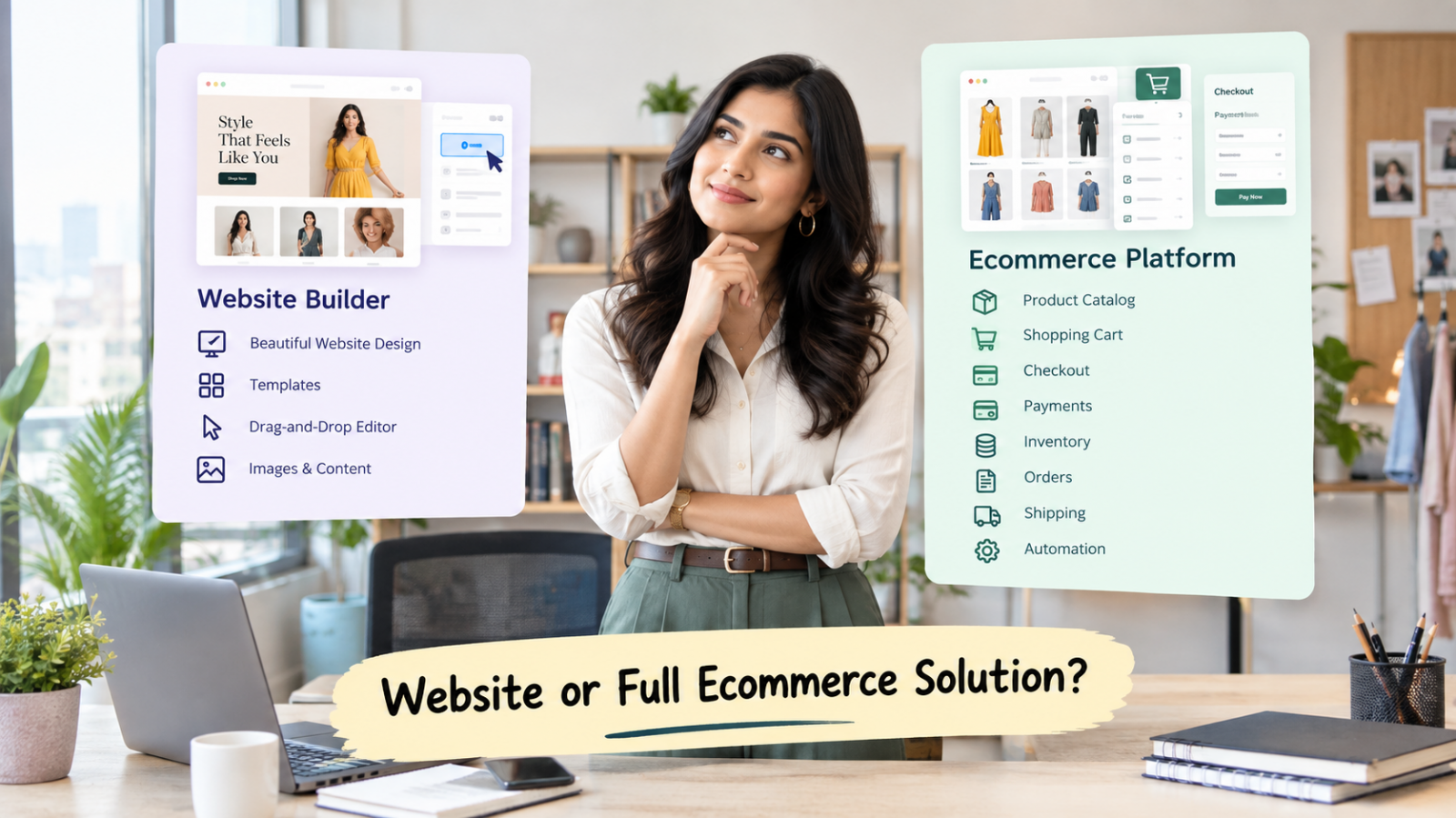
A website builder helps anyone put a site online without touching code. You drag blocks around, drop in text and images, pick a template, and hit publish. Wix, Squarespace, and GoDaddy sit in this group. They are excellent at what they were built for: portfolios, blogs, service pages, restaurant sites, and simple brochure sites for small businesses.
Most of them also let you sell. You can switch on a store section, list a few products, and take a card. But here is the thing: selling is a bolt-on. It sits on top of a product designed around pages and visuals, not around orders and stock. For five products and the odd sale, that is perfectly fine. Push past that and the seams start to show fast.
Where a builder truly earns its money is design and simplicity. If your brand lives or dies on a striking homepage, a photographer showing a portfolio, a coach selling a couple of programs, or a cafe listing its menu with a small shop on the side, a builder gets you there beautifully and quickly. The catch is that the same simplicity which makes it easy also caps how far it can carry a store that starts to take off.
What is an ecommerce platform?
Short answer: An ecommerce platform is software built from the ground up to sell. Every part of it, from the product catalog to checkout to shipping, exists to move orders.
An ecommerce platform is software engineered specifically to run an online store. Selling is not a feature here. It is the entire point. The product catalog, the shopping cart, the payment gateway, tax and shipping rules, inventory management, order tracking, customer accounts, and discount engines are all first-class parts built to work together.
That focus shows up everywhere. A real platform handles product variants like size, colour, and material without a fight. It updates stock counts the moment an order lands. It chases lost sales with automated abandoned cart emails. It connects to couriers, calculates shipping live, and manages returns. Shopify, BigCommerce, and Shopaccino are built for precisely this kind of work.
You give up a sliver of the freeform design playfulness a builder offers. In return you get a system that treats every single order as the priority it actually is.
The other thing you get is room to run. Because the software assumes you are here to sell and keep selling, it does not panic when your catalog triples or your best day brings ten times the usual traffic. Reporting, customer segments, multiple sales channels, and automation are baked in rather than bolted on, so the store you launch with is the same store that can carry you three years later, just bigger.
Why do people confuse the two?
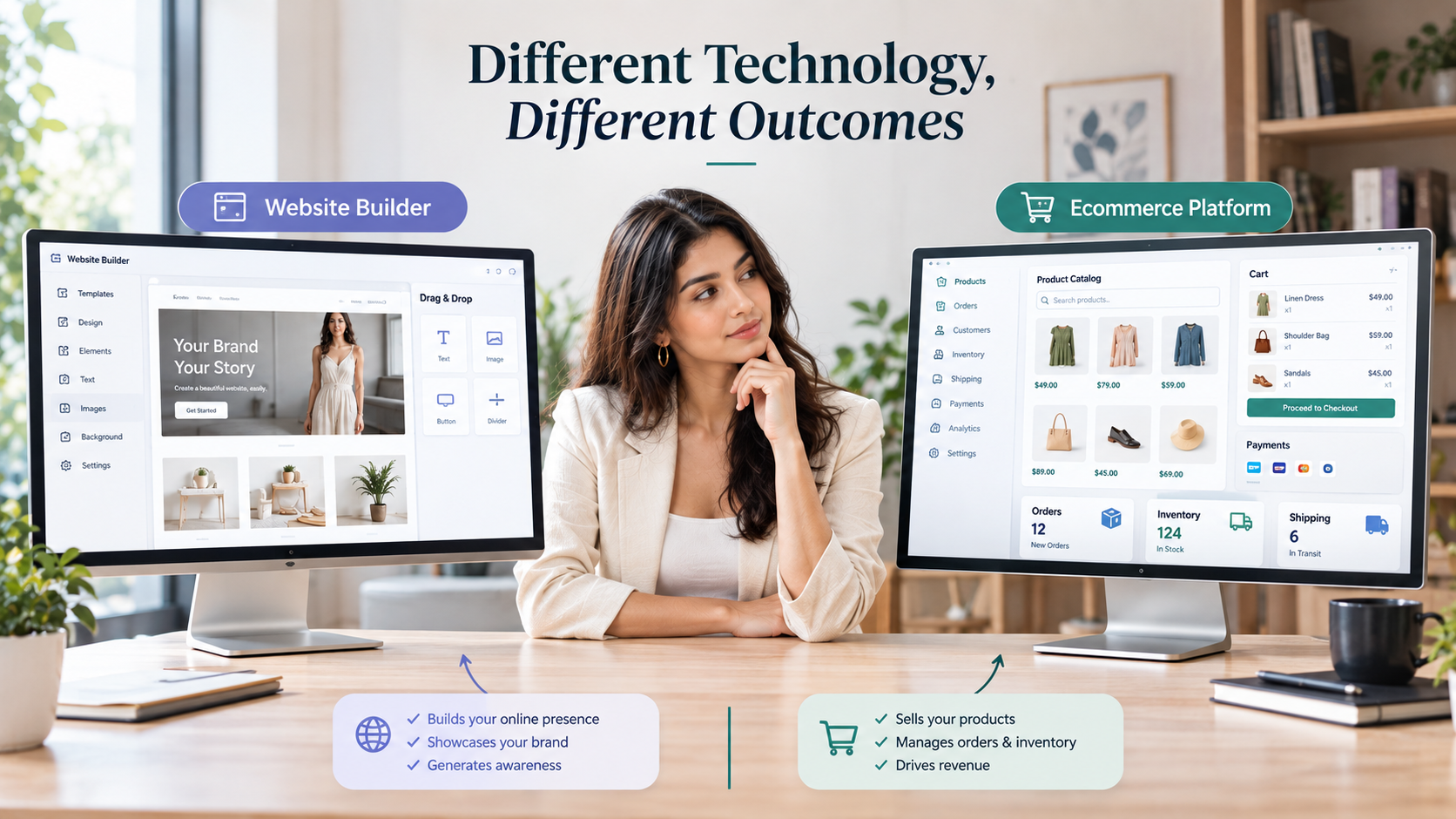
Because the marketing blurs the line on purpose. Website builders advertise "online store" features loudly, since ecommerce is where the money and the plan upgrades are. And a small handful of products displayed on a builder genuinely looks like a shop. From the outside, a five-item Squarespace store and a five-item ecommerce store look identical.
The real difference stays invisible until you scale. It lives in the plumbing: how the software copes with a hundred orders a day, a thousand SKUs, several warehouses, wholesale pricing, or customers spread across six countries. That is machinery a builder was never designed to run, and it is exactly where a purpose-built platform quietly earns its keep.
Where does the difference actually bite?
Theory is cheap. Here is where the choice shows up in real life, on the days that actually matter to your revenue.
When your catalog grows
Ten products on a website builder feels smooth. Two hundred products with variants, categories, filters, and search does not. A dedicated platform is built to manage a large product catalog, with bulk editing, organised collections, and filtering your customers can genuinely use to find things. On a builder, that same job turns into manual busywork.
When orders start flowing
A builder can email you "you got an order." A platform runs an operation. It tracks fulfilment status, syncs inventory management across every sale, flags low stock before you run out, handles partial shipments, and keeps a clean order history. When you are doing real volume, that gap is the difference between a calm morning and total chaos.
At checkout, where money is won or lost
Checkout is where browsers turn into buyers, and it is where builders tend to leak. Ecommerce platforms obsess over conversion: fewer steps, more payment gateway options, guest checkout, saved carts, and automated abandoned cart recovery. Tiny friction at checkout quietly kills sales, and this is the exact spot where a purpose-built tool pays for itself many times over.
When you want to grow up, not start over
This is the big one. A store built on a website builder tends to hit a ceiling. Once you outgrow it, you do not upgrade; you migrate. Migrating means rebuilding your store on new software and hauling products, customers, and order history across the gap. Start on a platform meant to scale and you grow inside it instead of escaping it.
When marketing and SEO enter the picture
Traffic does not appear by magic. You have to earn it, and the tool underneath shapes how easily you can. Platforms built for selling give you cleaner control over product URLs, structured data for rich results, category pages that rank, and app integrations for email, ads, and analytics. Builders can do the basics, but their product pages are often thinner on the SEO controls that move a store up the results. Over months, that quiet difference in discoverability turns into a real gap in orders.
When you sell across borders
Selling internationally raises the bar hard. Multi-currency pricing, multiple languages, region-based rates, international payment methods, and cross-border shipping are standard on a serious ecommerce platform and rare or clumsy on a builder. If the whole world is your market, this point alone tends to settle the debate.
When wholesale or B2B shows up
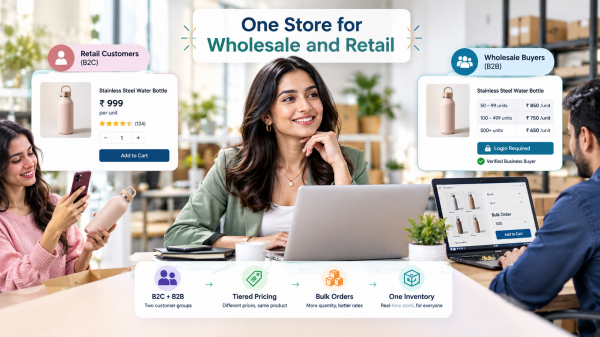
The moment a bulk buyer asks for tiered pricing, a quote, or a login that shows their special rates, a builder usually shrugs. Running B2B and B2C from one place, with customer-group pricing, minimum order quantities, and account-based catalogs, is normal territory for a purpose-built platform and near impossible to fake on a website builder. Plenty of businesses discover this the hard way, right after landing their first big trade account.
How do the real costs compare?
Short answer: A website builder is usually cheaper to start and fine for a small shop. An ecommerce platform costs a little more monthly but avoids the far bigger expense of migrating once you outgrow a builder.
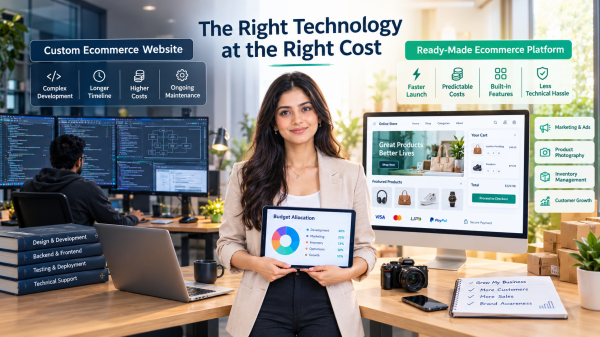
Price tags lie a little here, so look past the headline number. A website builder often wins on the first invoice. Entry plans are cheap, and for a shop selling a few items a month, that is money well saved. If your store is genuinely small and likely to stay that way, the maths favours the builder, and you should not overthink it.
The picture flips once selling becomes serious. A platform plan costs a bit more each month, but it folds in the tools you would otherwise cobble together on a builder: proper inventory management, a checkout tuned for conversion, shipping automation, and payment options. It also removes the single most expensive line item most sellers never budget for, which is the migration. Moving a live store off a builder onto real software can cost weeks of work and a dip in sales while everything settles. Add that risk into the comparison and the platform often turns out cheaper across two or three years, not more expensive.
One extra thing worth checking on either side: transaction fees. Some tools skim a percentage off every order on top of your plan, which stings more the better you do. A platform with zero transaction fees keeps that money in your pocket exactly when volume is climbing.
What should a serious online store actually be able to do?
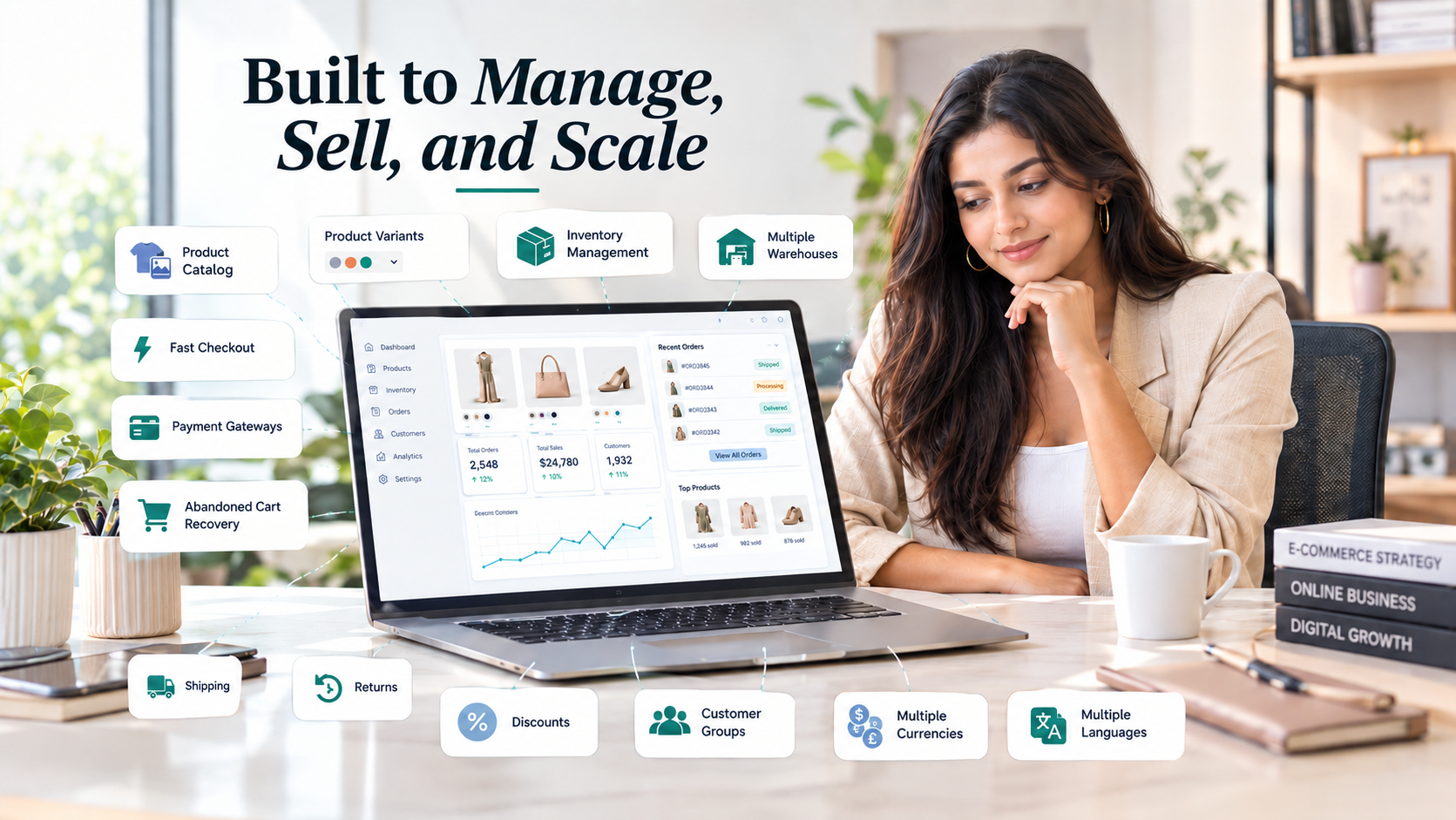
If you are leaning toward selling as your main business, use this as a quick gut check. A tool built for real commerce should handle all of the following without plugins holding it together with tape:
- Manage a large product catalog with variants, categories, search, and filters.
- Keep inventory management accurate across every sale, channel, and warehouse.
- Offer a fast checkout with multiple payment gateway choices and guest checkout.
- Recover lost sales automatically through abandoned cart follow-ups.
- Calculate live shipping, print labels, and manage returns cleanly.
- Support discounts, coupons, and customer groups, including wholesale pricing.
- Scale across currencies, languages, and countries when you go global.
A website builder will tick a few of these lightly. A dedicated ecommerce platform is expected to do all of them properly. That checklist, more than any brand comparison, tells you which side of the line your business belongs on.
So which one do you actually need?
Strip away the hype and it lands on one honest question: is selling the point of your site, or a side dish? Your answer sorts you quickly.
Pick a website builder if:
- Your site is mostly about content, brand, or services, with a small shop attached.
- You sell a handful of products and do not expect that to change much.
- Design flexibility and speed to launch matter more than deep selling tools.
- You are testing an idea and want the cheapest possible starting point.
Pick an ecommerce platform if:
- Selling is the core of your business, not an add-on to something else.
- You have, or plan to have, a growing catalog, real order volume, or stock to manage.
- Checkout performance, payment options, and conversion genuinely matter to you.
- You intend to scale, sell wholesale, or sell across borders.
On the fence? Lean toward the platform. It is far easier to grow into capacity you already have than to rebuild once you have outgrown a tool that was never meant to sell seriously in the first place.
Can a website builder grow into a real store later?
Short answer: Up to a point, and then no. Builders handle small shops well but hit a hard ceiling, and crossing it usually means migrating to a real platform, not upgrading within one.
It is the most common plan out there: "I will start cheap on a builder and switch later." It sounds sensible. It is often a trap. Switching later is not a settings change. It is a full migration, and it always seems to arrive exactly when you are busiest and least able to afford downtime.
Products, images, URLs, hard-won search rankings, customer accounts, and order history all have to move, and something usually breaks in transit. Starting on a platform that can carry you from your first sale to your ten-thousandth removes that cliff entirely. You are not boxed into a small-shop tool the moment your business finally gets interesting.
Where does Shopaccino fit into this?
Shopaccino sits firmly on the ecommerce platform side of the line, built for businesses that intend to grow rather than dabble. It gives D2C brands a branded website and mobile app, lets manufacturers and distributors run B2B and B2C sales from one system, and helps exporters sell across borders with built-in multi-currency, multi-language, international payments, region-based pricing, and international shipping. Inventory, payments, logistics, and multi-warehouse order fulfilment are integrated, automation handles the repetitive work, and there are zero platform transaction fees, so what you earn stays yours. If selling is the point of your business, that is the category you want to be shopping in.
The one-sentence version
Here is the whole thing boiled down: a website builder makes a site that can sell, while an ecommerce platform is a selling machine that happens to have a site. Both are good tools. They are simply built for different jobs. Match the tool to the job you are actually hiring it for, and the "which one" question answers itself.
FAQs
A website builder is made for creating websites, with selling added on. An ecommerce platform is built specifically to sell, with the catalog, checkout, payments, and inventory management engineered to handle real order volume.
Yes, most website builders let you add a small store and take payments, which works well for a handful of products. For a growing catalog, high order volume, or serious inventory needs, a dedicated ecommerce platform handles it far better.
Website builders often look cheaper upfront, which suits tiny shops. But if you outgrow one, migrating to a platform costs real time and money. For an actual selling business, a platform is usually cheaper over the long run.
Only up to a point. Builders handle small shops well but hit a ceiling on catalog size, order volume, and advanced features. Growing businesses usually move to an ecommerce platform to avoid a painful migration later on.
Effectively yes. Cross-border selling needs multi-currency, multiple languages, international payment gateway support, and cross-border shipping. These are standard on a proper ecommerce platform and rare or awkward on a website builder.
You can, but switching means a full migration, not a simple upgrade, and it usually lands right when you are busiest. If you expect real growth, starting on a scalable ecommerce platform saves you that disruption.