
Single Currency vs Multi-Currency Store: When Do You Actually Need to Switch?
There is a piece of advice that shows up in almost every guide about selling online: go global from day one. It sounds ambitious and forward-thinking. For most stores, it is also the wrong move made far too early. Adding multiple currencies before real demand exists adds cost and complexity without adding a single extra sale.
The honest answer to the single currency vs multi-currency store question is usually "single, for now." The real skill is recognising the moment when "for now" quietly runs out. So this guide is not about whether going multi-currency is a good idea, because it clearly can be. It is about how to tell when your store has actually reached the point where the switch pays for itself.
What is a single-currency store?
Short answer: A single currency store prices, charges, and settles every sale in one currency, no matter where the buyer happens to live.
A single currency store keeps everything simple. Products are priced in one currency, say US dollars or euros, and every customer pays in that currency wherever they are. A shopper in Germany buying from a dollar-priced store sees dollars, and their own bank handles the conversion behind the scenes at checkout.
For a business selling mostly to one country, or one that is just beginning to test international interest, this is the sensible default. There is nothing to configure, nothing extra to maintain, and no exchange rate risk to carry. It is the setup almost every store launches with, and for a good number of them, it is all they will ever need.
What is a multi-currency store?
Short answer: A multi-currency store shows prices, takes payment, and often settles in the shopper's own local currency, so buying from abroad feels local.
A multi-currency store lets customers see and pay in the currency they actually think in. A visitor from Canada sees Canadian dollars, someone in the UK sees pounds, and each pays in familiar money. Behind the scenes the store handles currency conversion, applies the right exchange rate, and connects to payment methods that work in each region.
Done properly, it reaches well beyond a converted number on a page. It touches pricing, the multi-currency checkout, local payment methods, taxes, and sometimes how funds settle into your account. That is the real gap between a store that looks international and one that is genuinely easy to buy from when you live on the other side of the world.
What are the layers of a true multi-currency store?

It helps to think of multi-currency as four layers stacked on top of each other. Most stores add them in order, and the deeper you go, the more natural the experience feels for a foreign buyer.
The display layer
This is what the shopper sees: prices shown in their own currency as they browse. It is the easiest layer to add and the one people usually mean when they say multi-currency. On its own it removes some mental maths, but the customer may still pay in your base currency at the very end.
The payment layer
Here the buyer actually pays in their currency, using local payment methods they recognise and trust. This is where conversion really improves, because the price they saw is the price that leaves their account, with no unexpected bank fee appearing after the fact.
The pricing layer
Instead of letting the exchange rate set the number, you choose clean, deliberate prices per market. That is region-based pricing, and it lets you protect margins, run local promotions, and avoid the odd figures that automatic currency conversion tends to produce.
The settlement and tax layer
The deepest layer covers how money reaches you and how taxes and duties are handled for each region. Getting international shipping costs, tax, and duties right at checkout is what keeps the final total honest, which is exactly what stops overseas buyers from feeling ambushed on the last screen.
Why does the currency a shopper sees matter so much?
Because trust at checkout is fragile, and an unfamiliar currency chips away at it. When someone lands on a product priced in money they do not use, they have to do mental arithmetic, wonder what their bank will add in conversion fees, and guess what they will really be charged. Each of those small doubts is a quiet reason to close the tab and leave.
Local pricing removes that friction. The shopper sees a number they understand instantly, pays with a method they already trust, and knows exactly what will leave their account. Everything known about cross-border ecommerce points the same way: buyers are far more likely to finish a purchase when the price appears in their own currency. That is not a cosmetic detail. It shows up directly in your conversion rate, counted in real orders.
There is a quieter cost too. Shoppers who leave over currency rarely complain or ask a question first. They simply go, and you never see them in your inbox or your support queue. That makes currency friction easy to underestimate, because the damage is invisible in everything except the one number that matters, which is how many visitors from a given country actually buy.
What are the signs you actually need to switch?
The switch should be a response to evidence, not a hunch or a fear of missing out. If several of the signals below describe your store right now, it has probably outgrown a single currency and is ready for more. One signal on its own can be noise. Two or three showing up together is a pattern, and patterns are what you act on rather than isolated hunches.
International traffic is climbing, but those visitors are not buying
Open your analytics and compare conversion by country. If a healthy share of your traffic comes from abroad yet those visitors convert noticeably worse than local ones, currency friction is a strong suspect. People are interested enough to arrive and browse, then something at the price or the checkout sends them away empty-handed.
You keep getting questions about currency and payment
When customers write in asking "how much is this in my currency?" or "can I pay with my usual method?", they are telling you exactly what is missing. A handful of these messages is a signal worth noting. A steady stream of them is closer to a mandate, and it usually means you are already losing quieter shoppers who never bothered to ask.
Carts from abroad are being abandoned at the payment step
If overseas shoppers add items to their basket and then disappear at checkout more often than domestic ones do, the checkout itself is the leak. An unfamiliar currency, a missing local payment option, or a surprise conversion fee are the usual reasons behind an abandoned cart that came from another country.
One foreign market is becoming a real chunk of revenue
When a single overseas market grows from a trickle into a meaningful slice of your sales, it earns its own currency, and often its own pricing and shipping treatment too. Continuing to serve a market like that in your home currency leaves both money and goodwill on the table, and invites a local competitor to win those buyers instead.
You want to price on purpose, not just convert
Sometimes the trigger is strategy rather than raw demand. If you would rather set clean, sensible prices in each market than let the day's exchange rate hand your customers awkward numbers like 91.37, that is region-based pricing, and it needs a proper multi-currency store to work the way you intend.
Isn't multi-currency just showing converted prices?
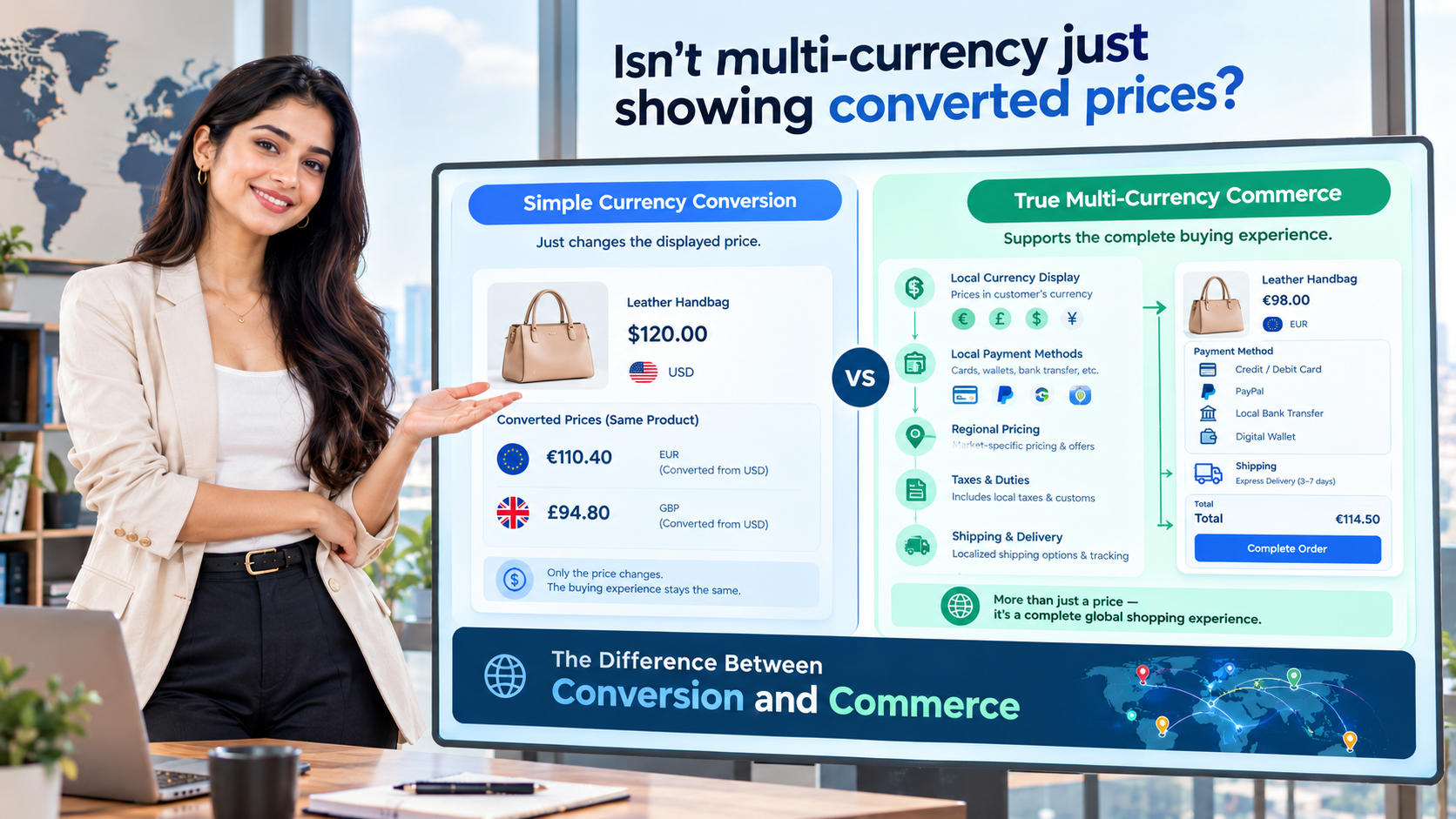
Short answer: No. Converting the displayed number is only the surface. A full multi-currency store also lets buyers pay in their currency with local methods, and often set prices you choose rather than the exchange rate.
This is the most common misunderstanding, and believing it tends to lead to a half-solution. Simply displaying a converted price is the shallow version. You have translated the label without actually changing the experience.
A genuine multi-currency setup lets the customer pay in their own currency, through local payment methods, ideally at a price you set rather than one the exchange rate decided that morning. In fact, the merchant can set the conversion rate for each currency instead of leaving it to the daily market, which keeps prices clean and predictable for buyers and shields your margins from sudden swings. The further you take it, the more "buying from overseas" starts to feel like "buying from down the road." Display-only conversion is a reasonable first step. It is not the finish line.
When is staying on a single currency still the smart move?
Switching too soon is its own mistake, so give yourself permission to wait until the case is clear. Sticking with one currency is still the right call when:
- Nearly all of your sales come from one country and international demand is still a trickle.
- You are yet to confirm whether a foreign market genuinely wants your product.
- Your margins are tight and the extra complexity would cost more than it earns today.
- You do not yet have the operations to handle international shipping, returns, and support well.
There is no prize for adding currencies you do not need. Multi-currency is a tool for demand you can already see, not a bet on demand you are merely hoping for. Keeping a single currency store a while longer is not falling behind, it is matching your setup to your reality. Prove the interest first, then build to meet it.
How do you make the switch without creating a mess?
Moving to multiple currencies is very manageable when you treat it as a sequence rather than one big flip of a switch. A sensible order looks roughly like this:
- Confirm the demand with data, and pick the top one or two countries worth serving properly first.
- Decide your pricing approach. Automatic conversion is the quick path, while region-based pricing gives you control over how prices actually read to a local buyer.
- Add local payment methods for those markets, since offering a currency without familiar ways to pay only solves half the problem.
- Sort out international shipping and taxes so the total shown at checkout is honest and complete, with no nasty surprises on the final screen.
- Test the entire journey exactly as a foreign buyer would experience it, then watch the numbers for a few weeks and adjust.
How painful any of this feels comes down to the platform underneath you. On a system where multi-currency, local payments, and cross-border shipping are already built in, most of the work is simple configuration. On one where they are not, the same change can balloon into a full development project.
What mistakes should you avoid when going multi-currency?
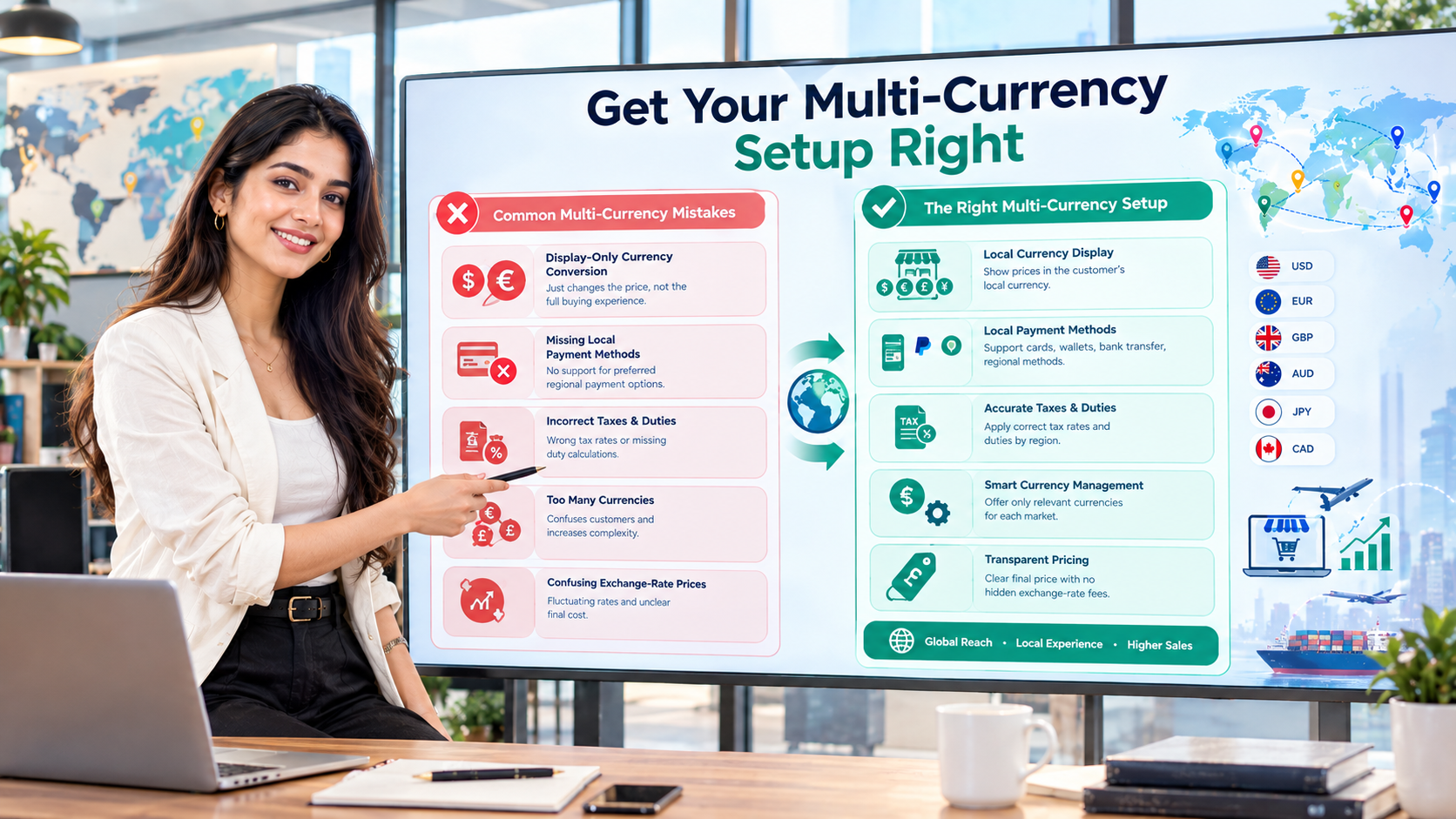
The switch goes wrong in a few predictable ways. Knowing them in advance saves you from learning each one the expensive way.
- Stopping at display-only conversion. Showing a converted price while still charging in your base currency solves the smallest part of the problem and leaves the checkout friction untouched.
- Forgetting local payment methods. A currency without the payment options a region actually uses still feels foreign, and shoppers abandon at the exact moment they expected their usual method.
- Ignoring taxes and duties. If the total jumps because of unexpected charges after checkout, trust evaporates and refunds and complaints follow close behind.
- Switching every market on at once. Turning on ten currencies you cannot support properly spreads you thin. Start with one or two real markets and expand from there.
- Letting the exchange rate print ugly prices. Numbers like 47.83 read as careless. A little region-based pricing turns them into clean, confident figures.
Where does Shopaccino fit into this?
Shopaccino is a global commerce platform with cross-border selling built into its core rather than added on later. Multi-currency, multi-language, international payments, region-based pricing, and international shipping are all part of the platform, so a business can launch on a single currency and expand into new markets from the same dashboard the moment demand becomes real. Manufacturers, distributors, exporters, and D2C brands can run B2B and B2C sales side by side, with integrated inventory, payments, logistics, and multi-warehouse order fulfilment, plus zero platform transaction fees so scaling never quietly eats into margins. When your store starts showing the signals above, that groundwork is what turns the switch into a setting instead of a rebuild.
The takeaway: this is a timing decision, not a technology one
Single versus multi-currency is really a question of timing. Start simple, sell, and pay close attention to who is showing up. When international shoppers begin arriving in numbers, asking about currency and payment, and slipping away at the final step, your store is telling you plainly that it is ready. Make the switch then, deliberately and in stages, and you turn curious overseas visitors into paying customers instead of watching them leave one checkout screen too soon. The stores that win abroad are rarely the ones that rushed. They are the ones that waited for the signals, then moved with intent once the signals were clear.
FAQs
A single currency store prices and charges every customer in one currency. A multi-currency store lets shoppers see and pay in their own local currency, handling currency conversion, local payment methods, and often region-based pricing so buying from abroad feels local.
Not to begin with. You can sell abroad in one currency while testing demand. As international orders grow, multi-currency lifts conversion by removing the friction of unfamiliar prices, so most serious cross-border ecommerce sellers eventually make the switch.
Usually, yes. Shoppers trust and complete purchases more readily when prices appear in their own currency, since there is no mental maths or fear of hidden fees. It is one of the more reliable ways to lift cross-border conversion rate.
Switch when the evidence appears: rising international traffic that converts poorly, currency and payment questions from customers, abandoned carts from abroad, or one foreign market becoming a real share of revenue. Those signals mean demand has outgrown one currency.
No. Automatic conversion only changes the displayed number. A full multi-currency store also lets customers pay in their currency with local payment methods, and often lets you set deliberate region-based prices rather than relying on daily exchange rate swings.
It depends on your platform. Where multi-currency, local payments, and international shipping are built in, it is mostly configuration. Where they are not, it can become a bigger project. Doing it in stages, starting with your top market, keeps it manageable.