
B2B Group-Specific Pricing: How to Set Different Prices for Different Customers Online
Quick Answer: To set different prices for different B2B customers online, assign each buyer to a pricing group: broad groups for segments like wholesalers and retailers, a dedicated single-account group for an individually negotiated relationship, tiered pricing for quantity-based discounts, or warehouse-based pricing for different markets. B2B group-specific pricing tools apply the right rate automatically the moment a buyer logs in, so every account sees only its own prices.
There is a persistent belief among businesses moving their wholesale operation online that ecommerce means one public price list, and that the negotiated rates they have built over years of relationships somehow have to be flattened to fit the website. It is exactly backwards. The negotiated rate structure is not an obstacle to selling online. It is the thing a proper B2B store is built to protect and automate.
Offline, differential pricing already runs your wholesale business. Your oldest distributor pays less than the account you signed last quarter. A buyer moving container loads pays less per unit than one ordering by the carton. A reseller gets margin room that an end business customer does not need. Moving online should carry all of that logic with it, applied automatically instead of remembered by a rep. This guide covers the main B2B group-specific pricing structures, how to choose between them, and how to set them up so every buyer sees exactly the price they should, and nothing else.
What Is B2B Group-Specific Pricing?

B2B group-specific pricing means your online store shows each logged-in business buyer their own rates: prices tied to the pricing group their account belongs to, their order volume, or the warehouse serving their region, instead of one public price for everyone. The group is the mechanism that carries the rate. A group can represent a broad segment such as all wholesalers, or it can hold a single buyer, which is how an individually negotiated relationship gets its own rate without needing a separate pricing feature. The store recognizes who is buying and prices accordingly, the same way a good sales rep always has, but instantly and without error.
Why it matters is simple economics. In wholesale, price is the relationship. A distributor's loyalty rests partly on knowing their rate reflects their history and volume with you. A pricing system that cannot express that forces you to choose between overcharging your best accounts and undercharging everyone else. Neither is a real option, which is why businesses without proper pricing tools end up handling every order by email, and the website becomes a brochure.
What Are the Main Ways to Structure B2B Pricing Online?
Three structures cover nearly every real-world wholesale arrangement. Most established businesses end up using two or three in combination, so read these as building blocks rather than competing options.
Group-specific pricing, including single-account groups
Buyers are placed into pricing groups, and each group gets its own pricing level across the catalog. For most of your accounts, that group is a segment such as wholesalers, retailers, resellers, or institutional buyers, and a rate change updates the entire segment at once. For an account with rates negotiated line by line, the same mechanism still applies: create a group that holds just that one buyer, and set its rates directly. That single-account group behaves exactly like an individually negotiated price list would, without requiring a separate feature to maintain.
Best for: everything from your many mid-sized accounts that fall into natural tiers, to your largest accounts and long-standing distributors whose rates were negotiated individually. Broad groups are low maintenance and update instantly. Single-account groups take more setup per buyer, so reserve them for relationships that justify the attention.
Tiered and volume-based pricing
Price falls as quantity rises: one rate for 1 to 49 units, a lower rate for 50 to 199, lower again beyond that. Tiered pricing rewards exactly the behavior you want more of, and it does so transparently, because the buyer can see the next break point and often rounds their order up to reach it.
Best for: products with meaningful economies of scale in production or shipping. Works alongside group pricing: each group can carry its own tier ladder. One caution: a break point that saves less than the effort of reaching it is decorative. Tiers only change behavior when the jump is visible and worth taking.
Warehouse-based regional pricing
Different markets carry different landed costs, duties, competitive conditions, and purchasing power. Rather than setting a rate by country directly, this works through the warehouse fulfilling the order: the same SKU carries different rates depending on which warehouse serves that buyer, in the buyer's currency, without maintaining separate stores.
Best for: exporters and any business selling across borders through more than one fulfilment location. Combined with customer groups, it answers the hardest pricing question in international B2B: what does this type of buyer, served from this warehouse, pay.
Quick Comparison: B2B Pricing Structures at a Glance
Pricing Structure | Best For | How It Works |
|---|---|---|
Group-specific pricing | Every buyer segment, from broad wholesaler and retailer tiers down to a single strategic account | Buyers are placed into a pricing group; each group carries its own rates across the catalog. A group can hold hundreds of buyers or just one, which is how a single negotiated account gets its own rate. |
Buyers whose order size varies and who are motivated by quantity discounts | The unit price drops automatically at defined quantity break points, such as 50 or 200 units, layered inside a group. | |
Exporters and any business selling across borders or serving buyers from more than one fulfilment location | The same SKU carries different rates depending on which warehouse serves the order, reflecting local duties, freight, and market conditions, shown in the buyer's currency. |
How Do You Decide Which Pricing Structure Fits Your Business?

Work from your account list, not from the feature list. Pull up your top fifty buyers and ask three questions about them.
How many have individually negotiated rates? If it is a handful, set those up as their own single-account groups and run everyone else on broad group pricing. If it is most of them, your business runs on negotiated relationships, and single-account groups are your backbone even though they cost more to maintain.
Does price depend more on who the buyer is, or how much they order? Identity-driven pricing points to broad groups and single-account groups. Quantity-driven pricing points to tiers. Most wholesale businesses are honestly both, which is why the structures are designed to stack: a wholesaler group rate, with volume tiers inside it, overridden by a dedicated group for the two biggest accounts.
Do you sell into more than one country? If yes, warehouse-based pricing is not optional polish. Quoting one global price either overprices you out of price-sensitive markets or gives away margin in premium ones, and currency conversion at checkout is not a pricing strategy on its own.
The answers usually converge on the same practical setup: broad group pricing as the base layer, volume tiers where quantity matters, single-account groups for the accounts that earned them, and warehouse-based layers if you export. Complexity should follow revenue: the more an account is worth, the more precise its pricing deserves to be.
How Do You Set Up Group-Specific Pricing on Your Online Store?
The sequence matters more than the speed. Pricing mistakes online are public in a way that a misquoted phone call never was, so build in this order.
- Consolidate every existing rate into one document. Before touching the store, collect the negotiated rates currently living in rep memories, old emails, and expired quotations. This audit almost always surfaces contradictions: two reps honoring different rates for the same account, and it is far cheaper to resolve them now than after a buyer sees the wrong price on screen.
- Define your broad customer groups and assign every account to one. Every buyer needs a home group, even the ones who will get a single-account group on top, because the broad group is the fallback rate for any SKU their individual rate does not cover.
- Load broad group rates first, then set up single-account groups for exceptions. Set the general layer before the exceptions, and confirm the override order in your platform: a single-account group's rate must beat the broader segment group's rate for that buyer.
- Gate prices behind login. Decide what a visitor sees before signing in: no prices at all, list prices only, or a request-access flow. For most wholesale businesses, hiding negotiated rates from the open web is not paranoia. It is basic protection for both your margins and your buyers' resale positions.
- Test as a buyer, not as an admin. Log in as accounts from each group, including one with its own single-account group, and check the prices they see on product pages, in cart, and on the final invoice. The invoice is where layered pricing systems most often betray a wrong override order.
On Shopaccino, these layers are native to the platform rather than stitched together from plugins: customer groups with their own pricing levels, including dedicated single-account groups for individually negotiated rates, quantity-based tier pricing, and the option to hide prices until login all work from one admin. They also sit next to the B2B mechanics that pricing depends on in practice, minimum order quantities, credit terms, and approval workflows, so a rate is never enforced in one system and ignored by another. For sellers with international buyers, warehouse-based pricing combines with multi-currency display and international payments in the same setup, which means a wholesaler in one market and a retailer in another each log in to their own correct world without you running two stores to make it happen.
What Does a Stacked Pricing Setup Look Like in Practice?
Abstract structures become clearer with a concrete build. Take a home decor manufacturer selling to three kinds of buyers: domestic retailers, overseas distributors, and a handful of large chain accounts with individually negotiated rates.
The base layer is two customer groups. Retailers see prices around 30 percent below list, distributors around 45 percent below, reflecting the margin each needs to resell profitably. Every new approved account lands in one of these groups on day one, with correct pricing from their first login and no setup work per account.
The volume layer sits inside each group. A retailer ordering 20 units of a lamp pays the group rate, at 100 units the price drops a step, and at 500 it drops again. The break points show on the product page, and buyers regularly round orders up to reach them, which is the tier doing its job.
The exception layer covers the three chain accounts. Each has its own single-account group, holding negotiated SKU-level rates that override both the broader group and the tiers for the SKUs it covers, so no SKU is ever priceless.
The regional layer comes from warehouse-based pricing. Distributors served from a regional warehouse see rates that account for local duties and freight, in their own currency, while the underlying group logic stays identical. One catalog, one admin, four coherent pricing layers.
Notice what this setup does not require: nobody emails a price sheet, no rep confirms a rate before an order goes through, and no buyer ever sees a number that was not meant for them. That is the standard your own setup should meet before launch.
How Do You Keep Negotiated Prices From Leaking?
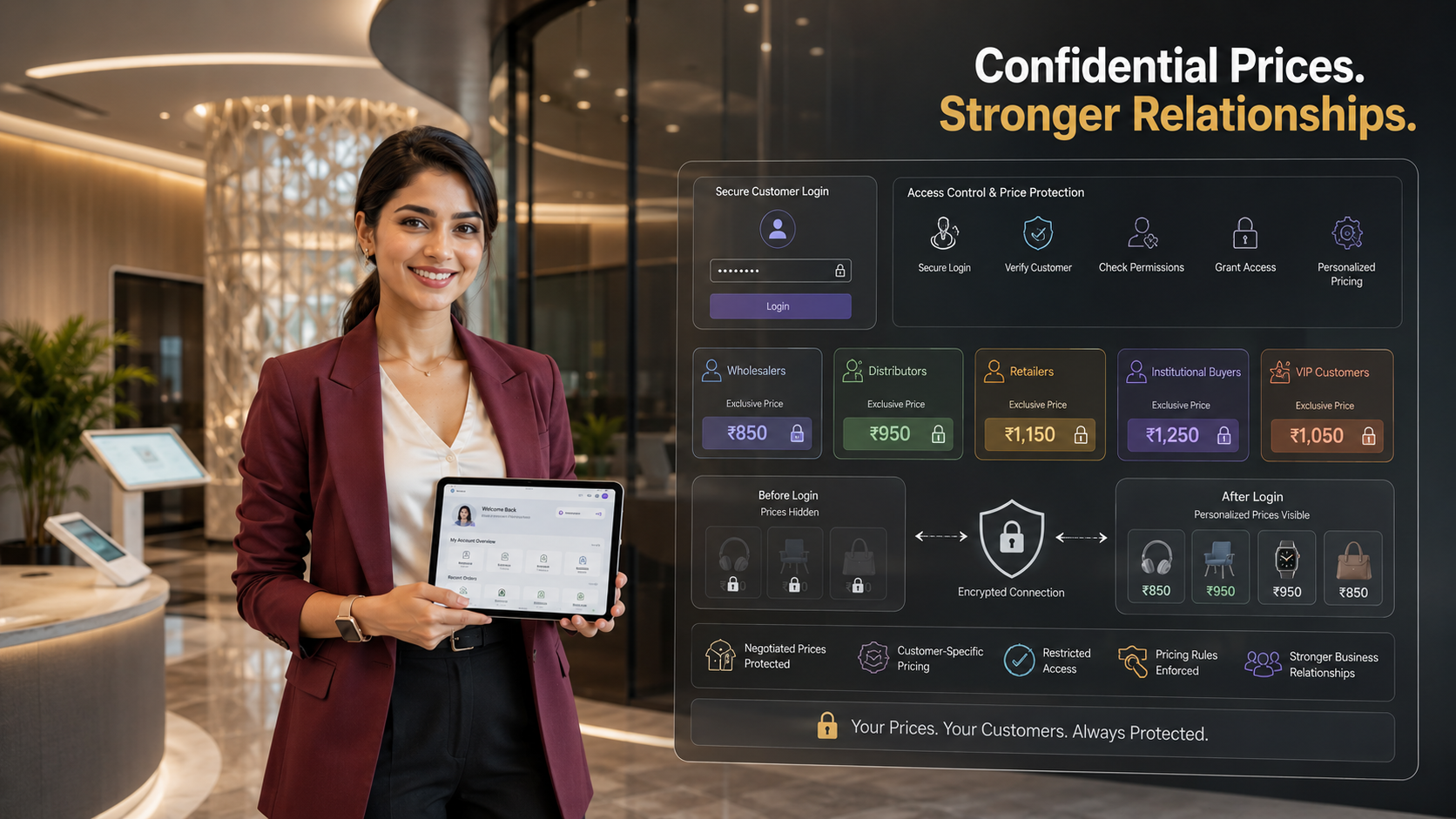
Differential pricing only works if buyers cannot casually see each other's rates. Four practices keep the structure watertight.
- Hide wholesale prices from logged-out visitors. A public page showing your lowest tier tells every prospect to demand it and every competitor where to undercut you. Login-gated pricing keeps negotiations yours to run.
- Show each account only its own price, never the ladder. A buyer should see their rate as their price, not as level three of five. Displaying the whole structure invites every account to argue its way up a level.
- Keep an audit trail of rate changes. When a price changes on an account, someone should be able to see when, by whom, and what it was before. Pricing disputes in B2B are rarely about bad faith. They are about two people remembering different numbers, and a system of record ends those conversations quickly.
- Put reps and the store on the same live rates. A rep quoting from an old sheet while the store shows the current price gives the buyer two numbers and one doubt. When reps work from the same system the store prices from, that gap cannot open.
Key Takeaways
- Differential pricing is not a complication of selling online. It is the core logic of wholesale, and the store's job is to automate it.
- Three structures cover almost everything: group-specific pricing, including dedicated single-account groups for your most negotiated relationships, volume tiers, and warehouse-based regional pricing.
- Build broad group pricing as the base, layer single-account groups on top for the relationships that earned them, and confirm the override order on real test accounts before launch.
- Gate prices behind login and show each buyer only their own rate. Pricing privacy protects both your margin and your buyers' resale positions.
- Complexity should follow revenue: the more an account is worth, the more precise its pricing deserves to be, and the platform's job is to enforce that precision automatically on every order.
Your pricing structure already exists. It is in your reps' heads, your email threads, and your last hundred invoices. Setting up B2B group-specific pricing online is not inventing something new. It is finally writing that structure down in a system that applies it perfectly, for every buyer, on every order, including the ones placed at 2 AM from a market you have never visited. On a platform likeShopaccino, where these pricing layers are built in rather than bolted on, that move is a configuration exercise, not a development project.
FAQs
It is pricing that changes based on which pricing group a business buyer's account belongs to: a broad segment, a single-account group for an individually negotiated relationship, an order quantity tier, or a warehouse-based region. The store applies the correct price automatically instead of showing one public rate to everyone.
Yes. Most B2B stores either hide prices entirely until login or show list prices publicly while reserving wholesale rates for approved accounts. This protects negotiated margins from competitors and casual browsers.
Create a pricing group that contains only that account, then set its rates directly. This single-account group overrides the buyer's broader segment rate and delivers the same result as an individual price list, without needing a separate feature.
The unit price drops automatically at defined quantity break points, for example at 50 and 200 units. Buyers see the next break point while ordering, which encourages larger orders without any negotiation.
Yes, through warehouse-based pricing. The same product can carry different rates depending on which warehouse fulfils the order, shown in the buyer's currency. Platforms like Shopaccino combine this with multi-currency and international payments for cross-border sellers.
Not from the store. Each logged-in account sees only its own rates, with no visibility into other accounts, groups, or the overall pricing ladder. Differential pricing stays a private commercial arrangement, as it is offline.