How a Mobile App Can Speed Up Order Placement for Your B2B Customers
Quick Answer: A B2B ecommerce mobile app speeds up order placement by keeping each buyer permanently logged in to their own pricing, turning repeat orders into a few taps from saved order history, showing live stock without a call, and letting buyers order from a warehouse floor or a customer visit instead of waiting to get back to a desk. Orders that took a phone call and a follow-up email close in under a minute.
How long does it take one of your wholesale buyers to place a routine reorder today? Not a new negotiation. The same forty SKUs they order every month. If the honest answer involves a phone call, a callback about stock, an emailed order sheet, or a laptop that has to be opened after the workday ends, the answer is measured in hours of elapsed time for what is, on paper, a solved problem.
B2B buyers already know what a fast order feels like, because they are also consumers. The same purchasing manager who needs three touchpoints to reorder stock from you reorders household goods on a phone in ninety seconds. That gap between the two experiences is not a small annoyance. It is a quiet, daily argument for whichever of your competitors closes it first. This article breaks down exactly where the time goes in traditional B2B ordering, and how a B2B ecommerce mobile app removes each delay one by one.
Why Is Order Placement Still Slow for Most B2B Buyers?
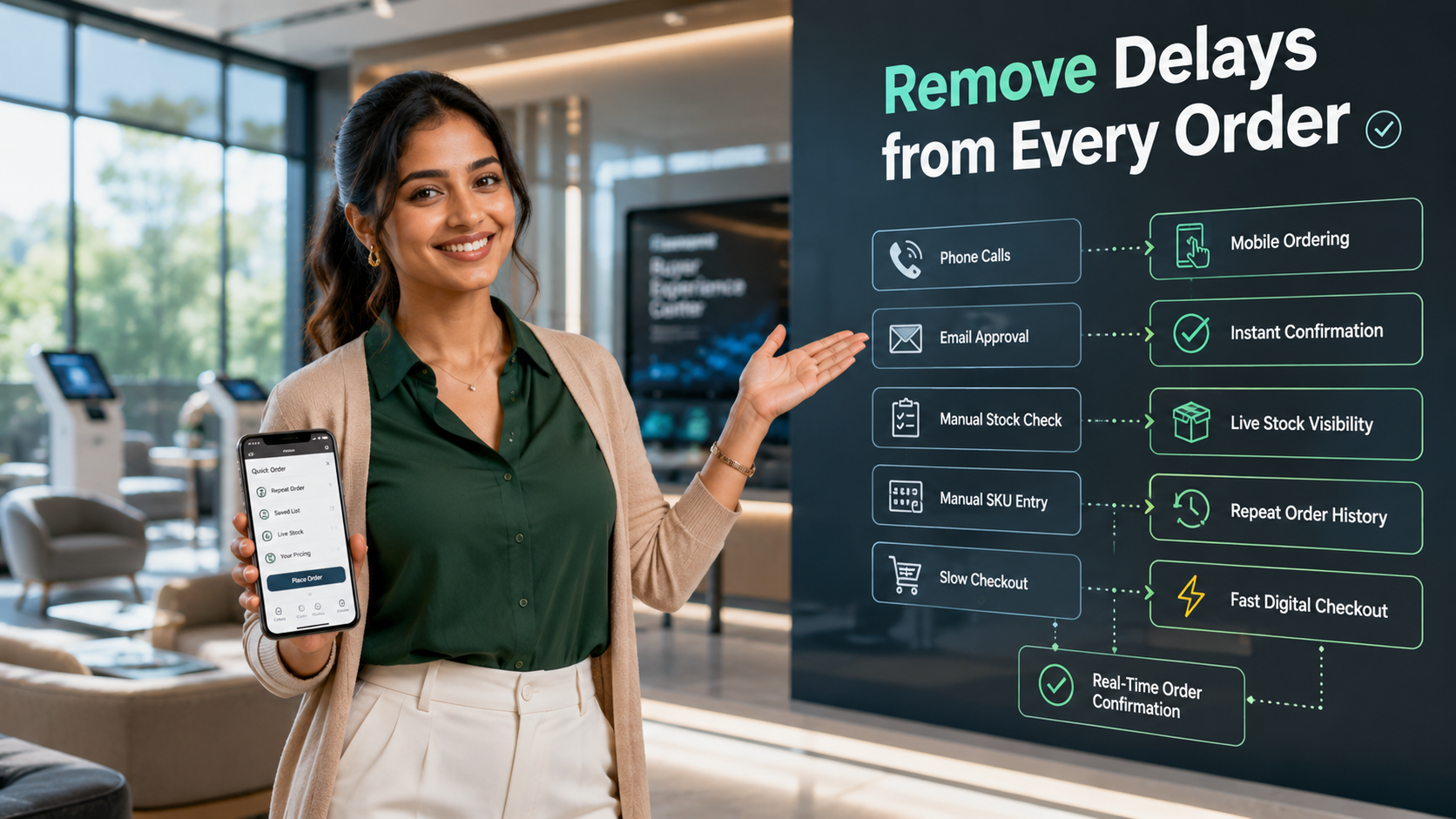
Slow B2B ordering is rarely one big delay. It is a chain of small ones, each reasonable on its own, that add up because they happen in sequence.
The buyer has to be at a desk. Most B2B portals were built for desktop browsers. A distributor doing a stock check in their own warehouse at 7 AM, or a retailer noticing an empty shelf mid-afternoon, cannot act in that moment. The order waits for the desk, and waiting orders shrink or get forgotten.
Pricing has to be confirmed. Wholesale buyers rarely pay list price. When negotiated rates live in a rep's head or a stale PDF, every order carries a confirmation step: an email, a call, a wait. The order is not placed when the buyer decides. It is placed when the pricing question gets answered.
Stock has to be checked by a person. The buyer asks, the rep checks, the rep calls back. On a good day that loop takes minutes. Across time zones, it takes until tomorrow, and the buyer who needed an answer today has already called someone else.
The order list has to be rebuilt from scratch. Reciting forty SKUs over a phone, or retyping them into a web form, means recreating information that already exists in last month's order. Every rebuilt list is slow, and every slow rebuild is another chance for a wrong code or a missed line.
None of these steps survive contact with a well-built mobile app, which is the whole point of the next section.
What Makes a B2B Ecommerce Mobile App Faster Than a Website or a Phone Call?
Speed on mobile does not come from the screen being smaller. It comes from the app removing steps that the browser and the phone call cannot. These are the specific mechanics that make mobile order placement faster, and each one maps directly to a delay from the previous section.
The buyer is always logged in to their own prices
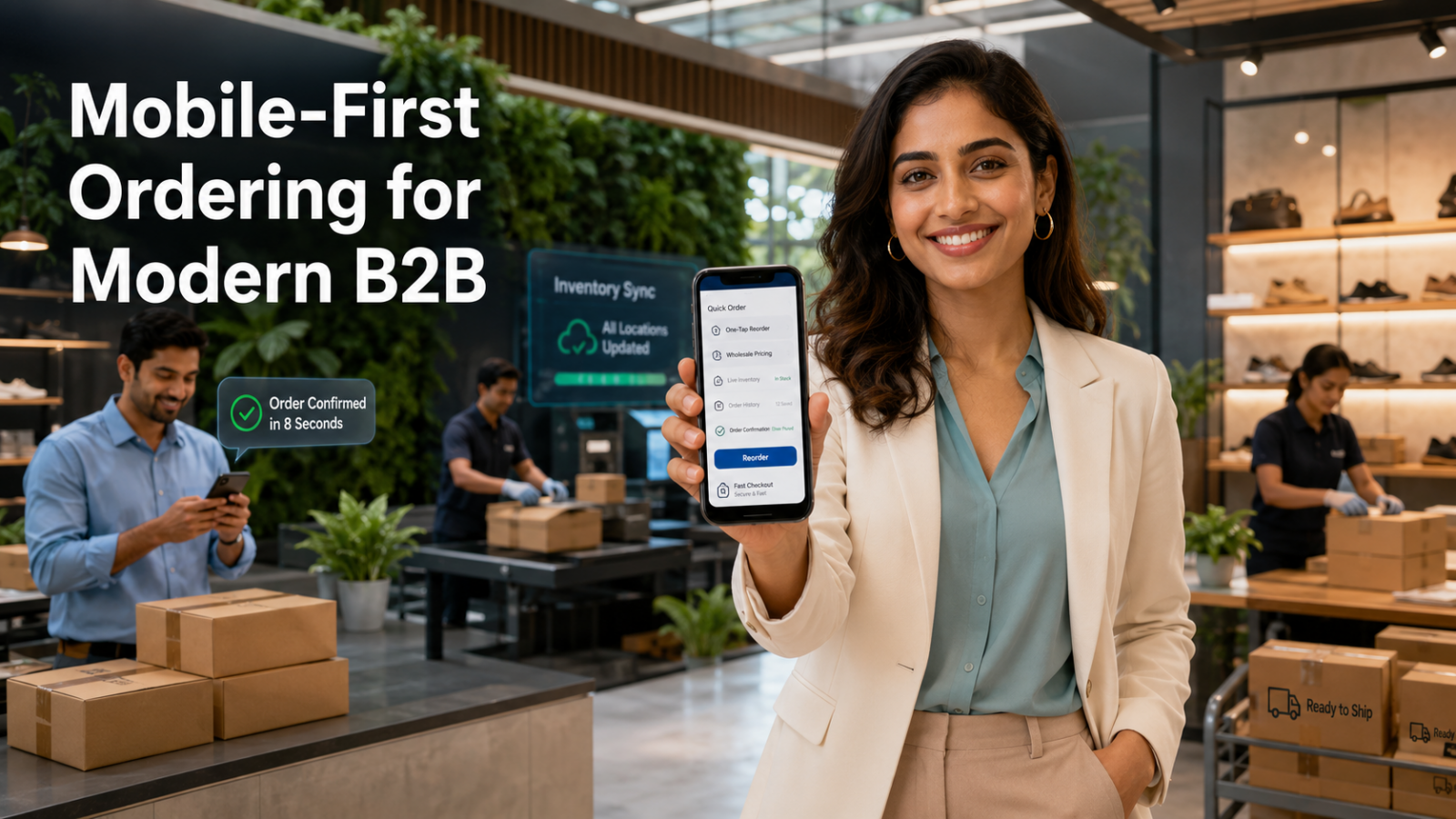
An app session persists. The moment a distributor opens it, they see their negotiated rates, their credit terms, and their approved catalog, with no login friction and no pricing confirmation loop. Personalized B2B pricing stops being a question someone has to answer and becomes the default view.
Reordering starts from history, not from zero
The single biggest speed gain in B2B mobile ordering is one-tap reordering: pull up last month’s order, adjust two quantities, confirm. A forty-line order that took a fifteen-minute call becomes a forty-second interaction, because nothing is being retyped. This works because the app carries a full order history for the account, and it’s what makes reordering from a phone faster than reordering from a desktop.
Live stock replaces the callback
When the app shows real-time availability per item, the check-and-callback loop disappears entirely. The buyer sees what can ship now, adjusts on the spot, and the order that used to span two phone calls closes inside one screen.
Ordering happens where the need appears
A retailer standing in front of a thin shelf, a distributor walking their own racks, a buyer finishing a site visit: these are the moments purchase decisions actually happen. An app puts the order form in that moment. By the time the buyer is back at a desk, the order is already in your system, allocated against live stock.
Push notifications close the loop without email
Order confirmed, order shipped, item back in stock, payment due: each of these updates lands on the buyer's lock screen instead of in an inbox they check twice a day. Push notifications also work in the other direction, quietly prompting a buyer whose usual ordering date has passed, which recovers orders that would otherwise slip a full cycle.
How Much Time Does a Mobile App Actually Save Per Order?
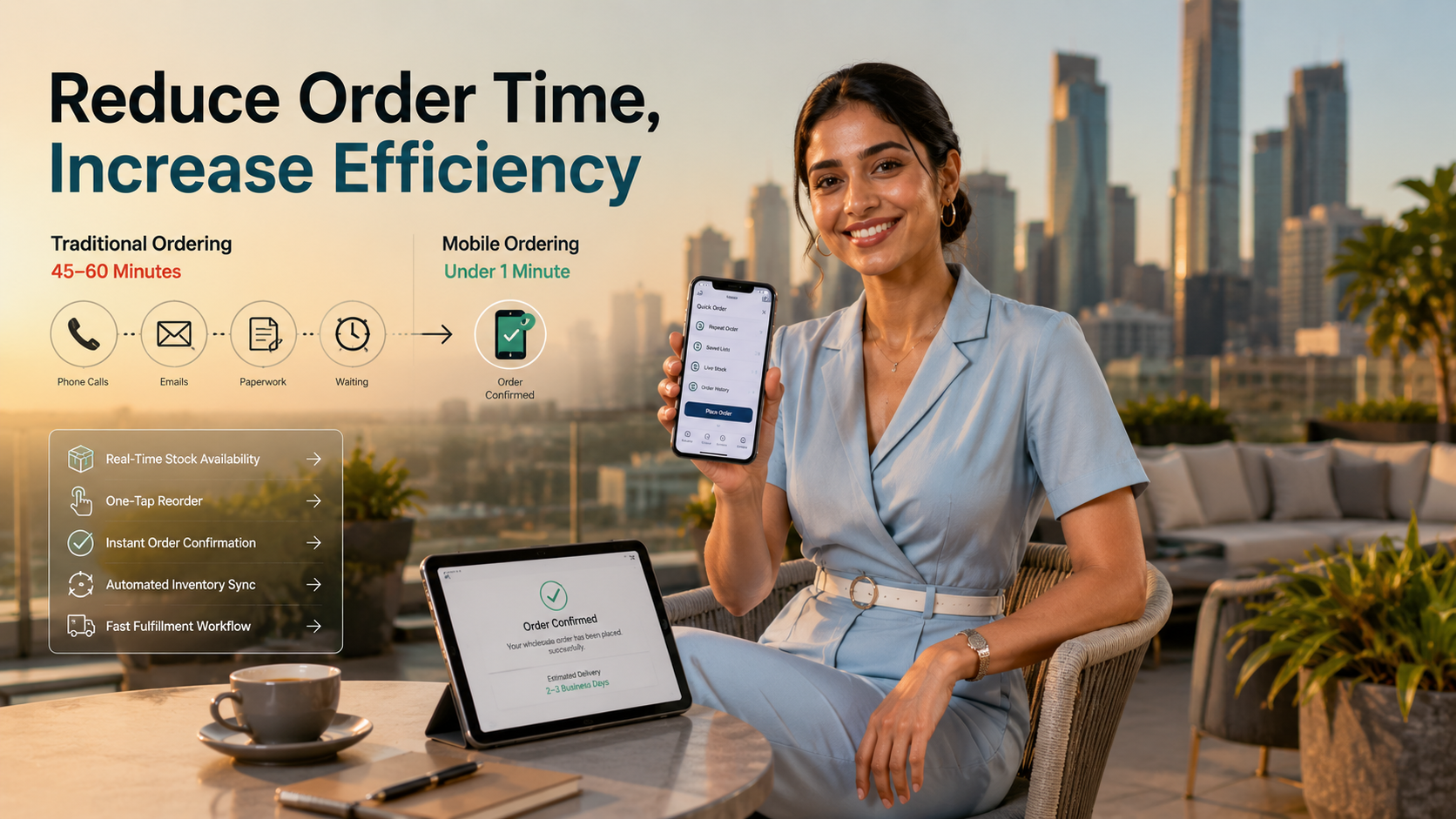
Walk one routine reorder through both paths and the difference stops being abstract.
The traditional path:
- Buyer notices stock is low, writes a list, waits until office hours align.
- Calls the rep, reads out the list, asks about availability on three items.
- Rep checks stock, calls back an hour later with substitutions.
- Buyer confirms by email so there is a record. Rep keys the order into the system.
- Confirmation arrives the next morning. Total elapsed time: half a working day to a full one.
The app path:
- Buyer notices stock is low, opens the app on the spot.
- Taps reorder on last month's order, sees live availability inline, swaps one out-of-stock item for the suggested alternative.
- Confirms. The order hits your inventory, accounts, and fulfillment queue instantly. Elapsed time: under two minutes.
Multiply that gap across every reorder, every buyer, every month, and the app is not a convenience feature. It is capacity: your reps handle exceptions and growth conversations while routine volume flows through on its own, and your buyers stop budgeting half a day for a task their phone finishes before their coffee cools.
How Do You Get B2B Buyers to Actually Use the App?
The app that speeds nothing up is the one nobody installs. B2B adoption is a habit change, and habit changes need a reason, a nudge, and patience, in that order.
- Give the app one clear advantage on day one. The strongest is reorder speed. Onboard each buyer by loading their order history first, so their very first session shows their own familiar order list ready to tap, not an empty catalog to browse.
- Let reps demo it inside real conversations. A rep placing a live order on the app during a routine call teaches more than any announcement email. Buyers copy what they see working.
- Keep the old channels open while habits shift. Phone and email ordering do not need a shutdown date. When the app is genuinely faster, volume migrates on its own, account by account, and the buyers who move first become the reference stories for the rest.
- Use notifications sparingly and usefully. Stock alerts on items a buyer actually orders and reminders timed to their real ordering cycle build trust. Generic promotional pings get the app muted, and a muted app is an uninstalled app with extra steps.
Which Businesses Benefit Most From a B2B Ordering App?
The pattern is consistent across industries: the more repetitive the ordering relationship, the bigger the payoff. A mobile ordering app for distributors and wholesale buyers earns its keep fastest in these situations.
- Manufacturers and distributors with repeat wholesale buyers, where the same accounts order on a rhythm and reorder speed compounds every cycle.
- Exporters serving buyers across time zones, where the app effectively keeps the order desk open 24 hours without staffing it, and a buyer eight hours ahead never waits for your morning.
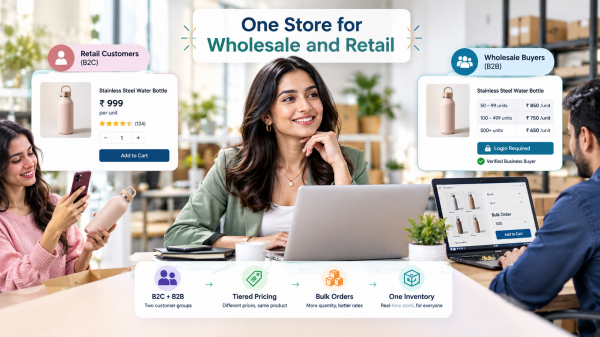
- Businesses running B2B and D2C together, where one branded app can serve retail customers while a logged-in wholesale buyer sees their own pricing and terms inside the same experience.
- Field-sales driven businesses, where reps visiting retailers can place orders on the spot from the customer's shop floor, turning a visit that used to end with a promise into one that ends with a confirmed order.
The honest exception: businesses whose B2B revenue is a few large, individually negotiated contracts a year gain little from ordering speed, because their bottleneck is the negotiation, not the order form.
What Should You Look For in a B2B Ecommerce Mobile App?
Not every mobile app is built for wholesale mechanics. A consumer app with a bulk discount bolted on will stall the first time a buyer needs credit terms. The checklist that separates a real B2B app from a resized website:
- Buyer-specific pricing tiers, credit limits, and minimum order quantities enforced natively in the app, not managed by email afterward.
- Real-time inventory visibility, ideally per warehouse, so what the buyer sees is what can actually ship.
- Order history with one-tap reorder, because this is where most of the speed lives.
- Direct sync into your inventory, accounts, and fulfillment, so an app order needs zero manual re-entry.
- Your own branding on the app itself. A branded mobile app in the buyer's app drawer is a daily impression of your business, not a marketplace you rent space in.
This is the approach Shopaccino takes: every store on the platform can run its own branded B2B ecommerce mobile app connected to the same backend as the website, so wholesale pricing tiers, live multi-warehouse stock, credit terms, and order history work identically across both. An order placed from a phone in one country lands in the same inventory and accounts as an order placed from a desktop in another, with nothing re-keyed in between.
Because Shopaccino is built for exporters, manufacturers, distributors, and D2C brands selling globally, the app carries the platform's cross-border capabilities with it: multi-currency display, international payments, and region-based pricing, so a buyer in any market orders in their own terms. And with zero transaction fees on the platform, higher order frequency through the app does not mean a growing fee line eating the gain.
What Mistakes Slow Down a B2B Mobile App Launch?
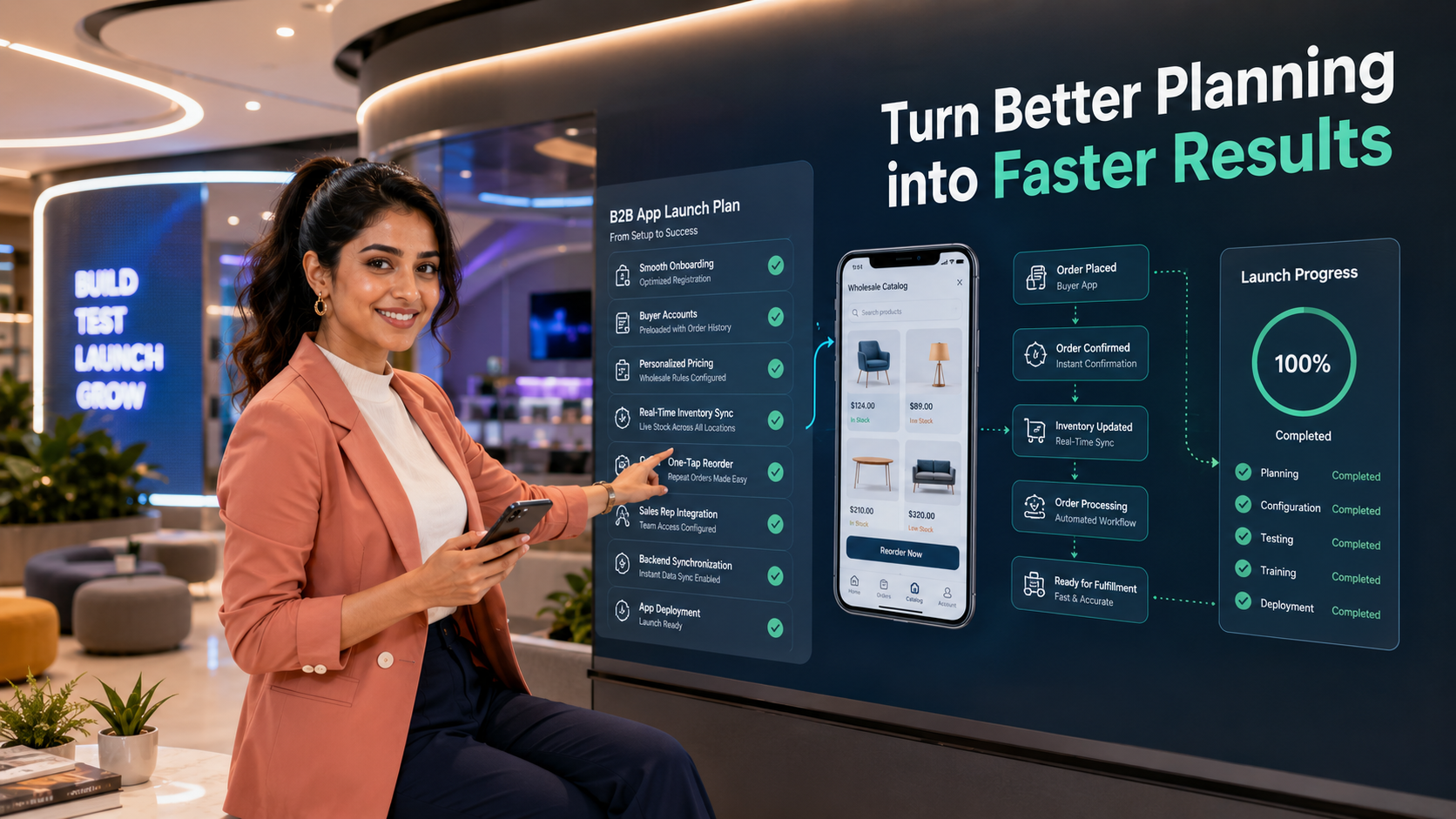
Shipping a resized website instead of a rebuilt flow. If the app is the desktop portal squeezed onto a small screen, every task takes more taps than it did clicks, and buyers quietly go back to calling. The mobile flow has to be designed around the two things buyers actually do on a phone: check stock and reorder. Everything else is secondary.
Launching with empty accounts. A buyer who opens the app to a blank order history and a full catalog to search has been handed work, not speed. Migrate each account's past orders, negotiated pricing, and saved addresses before they ever log in, so the first session already knows them.
Treating the app as a marketing channel first. The fastest way to lose lock-screen access is to spend it on promotions. The app earns its place by being the quickest way to order. Offers can come later, once the ordering habit exists, and even then they should look like useful stock information, not advertising.
Measuring downloads instead of orders. Install count is a vanity number. The metrics that matter are the share of total order volume placed through the app, average time from login to confirmed order, and how many accounts have placed a second app order. One repeat app order per account tells you more than a thousand installs.
Forgetting the reps in the rollout. If reps see the app as a threat, they will quietly steer buyers back to the phone. Position it as the tool that clears their day of order-taking, give them their own app access for placing orders during customer visits, and let their commission structure count app orders from their accounts. Reps who benefit from adoption drive it. Reps who lose from it kill it.
Key Takeaways
- B2B ordering is slow because of sequential small delays: desk dependence, pricing confirmation, stock callbacks, and rebuilt order lists. A mobile app removes each one structurally.
- One-tap reordering from order history is the single largest speed gain, turning fifteen-minute calls into forty-second interactions.
- Adoption comes from loading each buyer's history before their first session and letting reps demonstrate the app inside real orders.
- The businesses that gain most are those with repeat wholesale buyers, cross-time-zone customers, and combined B2B and D2C operations.
- A B2B ecommerce mobile app, like the branded apps Shopaccino provides, connects mobile orders straight into one backend for inventory, pricing, and accounts, worldwide, with zero transaction fees.
FAQs
It is a mobile application where wholesale buyers log in to their own negotiated pricing, browse live stock, and place or repeat orders directly, with every order syncing into the seller's inventory and accounts automatically.
It supports wholesale mechanics a consumer app lacks: buyer-specific pricing tiers, credit terms, minimum order quantities, approval workflows, and bulk reordering from account history.
No. A well-designed ordering app is simpler than a phone call, especially for reorders, which start from a familiar past order rather than an empty screen. Loading order history before launch makes the first session effortless.
No. It absorbs routine order-taking so reps spend their time on new accounts, exceptions, and growth conversations. Field reps also use the app themselves to confirm orders during customer visits.
Yes. On platforms like Shopaccino, a logged-in wholesale buyer sees their own pricing, terms, and catalog inside the same branded app that serves retail customers at standard prices.
Yes. With multi-currency display, international payments, and region-based pricing built in, buyers in different countries order in their own currency and terms, at any hour, without waiting for your office to open.