How to Set Up Bulk Quantity Pricing for Your B2B Online Store
Why would a distributor buy 200 units from you instead of 20 from someone charging the exact same price per unit? There's really only one honest answer: because buying more got them a better deal.
That single idea, reward the order size, is the entire logic behind bulk quantity pricing. It sounds obvious once it's said out loud. And yet a surprising number of B2B stores still charge every buyer the same flat rate regardless of whether they're ordering five units or five hundred, quietly leaving both bigger orders and bigger buyers on the table.
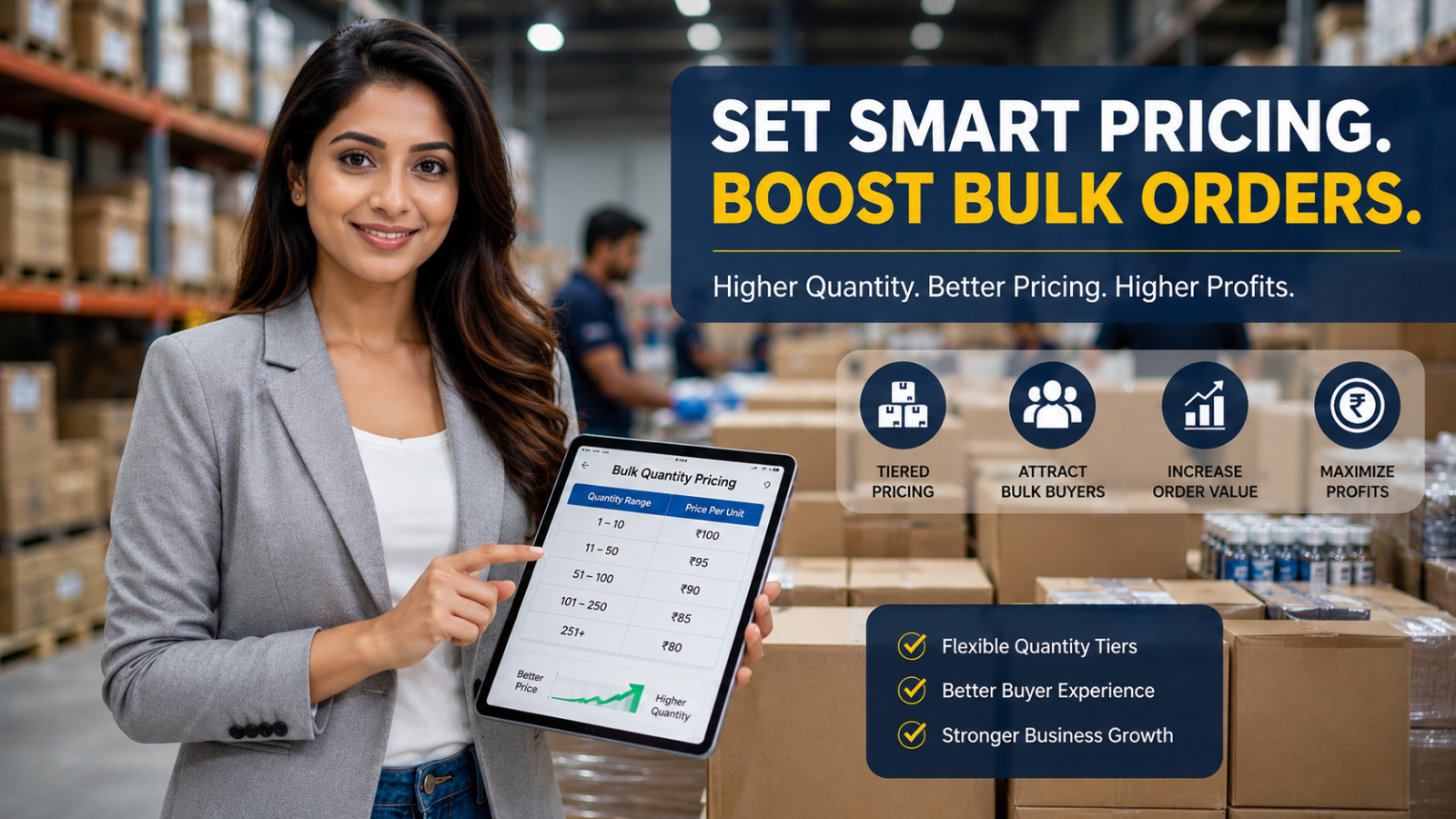
Bulk quantity pricing is a pricing structure where the per-unit price drops as order quantity increases, usually set up in tiers like 1 to 9 units at full price, 10 to 49 at a discount, and 50 or more at a deeper discount. On most B2B ecommerce platforms, it is configured per product or per customer group, and the discount applies automatically the moment a buyer's cart quantity crosses a threshold.
What Bulk Quantity Pricing Actually Means for a B2B Store

At its core, this is just the online version of something wholesale has always done. A distributor buying a pallet has always paid less per unit than a shop buying a single box. The only thing that's changed is who used to do that math, a salesperson working out a quote on the phone, and who does it now, the store itself, instantly, the moment a quantity field changes.
For a buyer, it shows up as a simple, visible incentive: order more, pay less per piece. For you, it's a lever that does several jobs at once, it rewards your best customers, it nudges smaller buyers toward larger orders, and it makes your pricing feel fair and transparent instead of something negotiated behind closed doors.
It's worth separating this from a one-off discount code or a seasonal sale. A quantity tier is permanent and structural. It's part of how a product is priced, not a temporary promotion, which is exactly why it needs to be set up carefully rather than bolted on as an afterthought.
There's also a quieter benefit that shows up on your side of the business: predictability. When bulk pricing is published and consistent, you stop fielding one-off negotiation requests for every order over a certain size. The price is simply the price at that quantity, for everyone, which frees up time that used to go into back-and-forth emails over a discount request.
Most B2B stores end up using one of three basic approaches, and it helps to know the differences before you build anything.
The Common Ways to Structure Bulk Pricing
Model | How It Works | Best For |
Quantity-based tiers | Discount increases as the ordered quantity of a single item goes up (e.g., 10+ units get 5% off, 50+ get 10%) | Straightforward catalogs where buyers reorder the same SKUs repeatedly |
Customer-group pricing | Specific buyer groups, distributors versus retailers, for instance, get their own price list regardless of quantity | Businesses with distinct buyer categories or negotiated contracts |
None of these are mutually exclusive. A lot of mature B2B stores end up layering customer-group pricing on top of quantity tiers, a distributor gets their own base rate, and then gets an additional break for ordering in bulk on top of that. Start simple though. Quantity-based tiers alone solve most of the problem for most stores, and you can always add complexity once you see how buyers actually respond.
What This Looks Like in Real Numbers
Abstract percentages are easy to nod along to and hard to actually picture. Here's a plain example using a wholesale t-shirt priced at $8.00 a unit.
Quantity Ordered | Price Per Unit | Total Cost |
1 to 9 units | $8.00 (full price) | $8.00 to $72.00 |
10 to 49 units | $7.20 (10% off) | $72.00 to $352.80 |
50 to 99 units | $6.80 (15% off) | $340.00 to $673.20 |
100+ units | $6.40 (20% off) | $640.00 and up |
Look at what happens right at the edge of a tier. A buyer ordering 49 units pays $352.80. Order just one more unit, and the per-unit price drops enough that 50 units costs $340.00, less in total for more product. That's not a rounding quirk, it's the entire point. A buyer sitting at 45 units has a genuine, visible reason to round up to 50, and that nudge is doing real work for your average order value without you having to ask for anything.
This is also where it's worth double checking your own margins before you commit to numbers. A 20% discount on a product with thin margins to begin with can turn a big order into a loss leader you didn't intend. Run the math on your actual cost price for each tier, not just the sticker price, before you publish anything.
How to Introduce This Without Upsetting Existing Buyers

If you already have B2B customers ordering at your current flat rate, publishing a new tiered structure needs a little care; otherwise, it can accidentally read as a price increase to anyone who doesn't happen to hit a discount threshold.
The simplest fix is to set your base, no-discount tier at your current price, not higher. Nobody should end up paying more than they do today simply because a tier structure now exists. The tiers above that are pure upside, a reason to order more, not a penalty for ordering the same as always.
It also helps to tell your best, highest-volume accounts directly before the change goes live, rather than letting them discover it on the site. A short note along the lines of "we've set up volume pricing, and based on your usual order size, you'll now automatically get X% off" turns a pricing change into a small, welcome surprise instead of something they stumble onto and question.
Setting It Up on Your Store, Step by Step
Once you know which model fits, the setup itself is mostly a sequence of small, deliberate decisions.
1. Decide which products actually need tiered pricing
Not every SKU benefits from this. Fast-moving, high-volume products, the ones buyers regularly reorder in bulk, are the obvious candidates. A slow-moving, low-margin item may not be worth the added complexity.
2. Set your quantity breakpoints based on real order history, not guesswork
Pull your last few months of order data and look at where your buyers naturally cluster. If most orders fall between 20 and 40 units, a tier that only kicks in at 100 units will never actually get used. It's tempting to set breakpoints that look impressive on paper, but a tier nobody reaches does nothing for your average order value.
3. Calculate each tier's discount against your actual margin, not just a round number
A flat 10 percent, 15 percent, 20 percent structure is easy to explain but not always smart. Work backward from what margin you need to protect at each volume level, then set the discount to fit. A product with a 40 percent margin can absorb a steeper bulk discount than one running at 15 percent, and treating them identically usually means underpricing one or overpricing the other.
It's worth running this same table for two or three of your actual bestsellers before launch, not just one hypothetical product. A discount curve that makes sense for a high-margin item can look very different once you apply it to something priced closer to cost, and seeing both side by side usually reveals which products should get aggressive tiers and which should get modest ones.
4. Enter the pricing tiers into your ecommerce platform's product settings
Most B2B-capable platforms let you define quantity breaks per product, either as a percentage off or as a fixed price per tier. On Shopaccino, this lives directly in the product's B2B pricing settings, so tiers sit alongside your regular D2C pricing on the same product, not in a separate system you have to maintain by hand. Fixed pricing per tier is usually easier for buyers to understand at a glance than a percentage they have to calculate themselves.
5. Make the tiers visible before checkout, not just at the cart
A pricing table shown directly on the product page, ordering 50 gets you this price, does far more to encourage a larger order than a discount that only appears after checkout math is already done.
6. Test the experience as a buyer would see it
Place a test order at each tier boundary and confirm the price actually updates the moment the quantity crosses the threshold, on both desktop and mobile. A pricing table that looks right in the admin panel but breaks on a phone screen defeats the entire purpose.
The Psychology and the Legal Side of Volume Discounts

Part of why quantity pricing works so well isn't really about the discount itself, it's about the visible threshold. A buyer who can see they're 8 units away from a better price has a concrete, easy decision in front of them, round up or don't, rather than an abstract choice about whether to trust your pricing at all. That clarity is worth more than the discount percentage suggests on paper.
There's a practical caution worth knowing if you're selling to U.S.-based B2B buyers. Volume discounts can intersect with price discrimination rules under the Robinson-Patman Act, which the Federal Trade Commission enforces, particularly the requirement that similar discounts be offered consistently to buyers competing on similar terms, rather than negotiated arbitrarily case by case (ftc.gov). This doesn't mean tiered pricing is risky, it's an extremely common and legal practice, but it does mean consistency matters. Publishing a clear, uniform tier structure that applies the same way to every buyer in a given category is both good practice and a sensible legal habit.
There's a second, quieter psychological effect worth knowing about too. Once a buyer has ordered at a certain tier once, dropping back below it on a future order tends to feel like a small loss, even though nothing was actually taken away. That's part of why quantity tiers tend to raise average order size over time rather than just on the first order where they're noticed, buyers who've experienced the better rate once are reluctant to go back to paying more per unit.
Common Mistakes That Undercut Bulk Pricing
Most of the ways this goes wrong aren't dramatic, they're small oversights that quietly cancel out the benefit.
- Too many tiers. Five or six overlapping price breaks look thorough but usually just confuse a buyer trying to do quick mental math. Three or four clear tiers almost always outperform a complicated ladder.
- Discounts set without checking margin at each tier, not just the two ends. It's easy to sanity check the smallest and largest tier and forget to verify the middle ones actually make sense too.
- Forgetting to update tiers after a cost increase. A pricing table set up a year ago against last year's supplier cost quietly erodes margin every month it goes unreviewed.
- Hiding the pricing table behind a login or a quote request. If a distributor has to ask for pricing before they can see whether ordering more is worth it, most won't bother asking.
- Applying tiers per line item when buyers actually combine multiple products into one order. If your buyers regularly mix SKUs, a quantity-only structure per product may undercount how much they're really buying from you.
Is This Worth Setting Up for Your Store?
If you already have wholesale or B2B customers ordering repeat quantities, and you're currently handling pricing through manual quotes or a flat rate for everyone, this is close to a guaranteed win. The setup cost is a few hours of decision-making, and the upside compounds every time a buyer rounds up an order to hit the next tier.
It matters less if your business runs almost entirely on one-off, heavily negotiated deals where every contract is custom anyway. In that case, a published tier table adds structure you don't really need, and your energy is better spent on account-specific agreements.
Somewhere in between are businesses with a mix of both, a base of repeat distributors alongside a handful of large custom accounts. For them, quantity tiers usually work well as the default.
pricing for everyone, with custom pricing layered on top for the handful of accounts that genuinely warrant it, rather than treating every buyer as a special case from the start.
For a business running both quantity-based pricing tiers and a regular D2C storefront from the same backend, the setup pays off twice, once by giving distributors a reason to order bigger, and again by keeping that pricing logic in one place instead of a separate spreadsheet someone has to maintain by hand. On a platform like Shopaccino, where B2B and D2C sales already run through the same product catalog and inventory, bulk pricing tiers sit right alongside your regular retail pricing on the same product, rather than living in a second system nobody remembers to update.
Go back to that distributor choosing between 200 units from you and 20 units from someone charging an identical unit price. Once bulk pricing is live, that choice isn't really a choice anymore, ordering more from you is visibly, obviously the better deal, and you didn't have to get on a call to make the case.
Bulk quantity pricing isn't a discount you're giving away. It's a reason for your best buyers to keep becoming better buyers.
Set it up once, check it against real order data every few months, and let it quietly do the negotiating you used to have to do yourself, one phone call at a time.
FAQs
It's a pricing structure where the per-unit price decreases as order quantity increases, usually set up in tiers so buyers automatically get a better rate for larger orders.
Three to four clear tiers usually work best. More than that tends to confuse buyers doing quick mental math rather than encouraging bigger orders.
Generally yes, but in the U.S. it's worth applying tiers consistently across similar buyers, since arbitrary discounting can raise issues under the Robinson-Patman Act enforced by the FTC.
It depends on how your buyers shop. If they typically order one SKU in bulk, price it per product. If they mix multiple products per order, a total-order or volume-based tier usually fits better.
Yes, through customer-group pricing, which is common when distributors and retailers are meant to see different base rates regardless of quantity ordered.
Check your recent order history and set breakpoints where buyers naturally cluster. A tier that requires an unrealistic quantity will rarely get used.