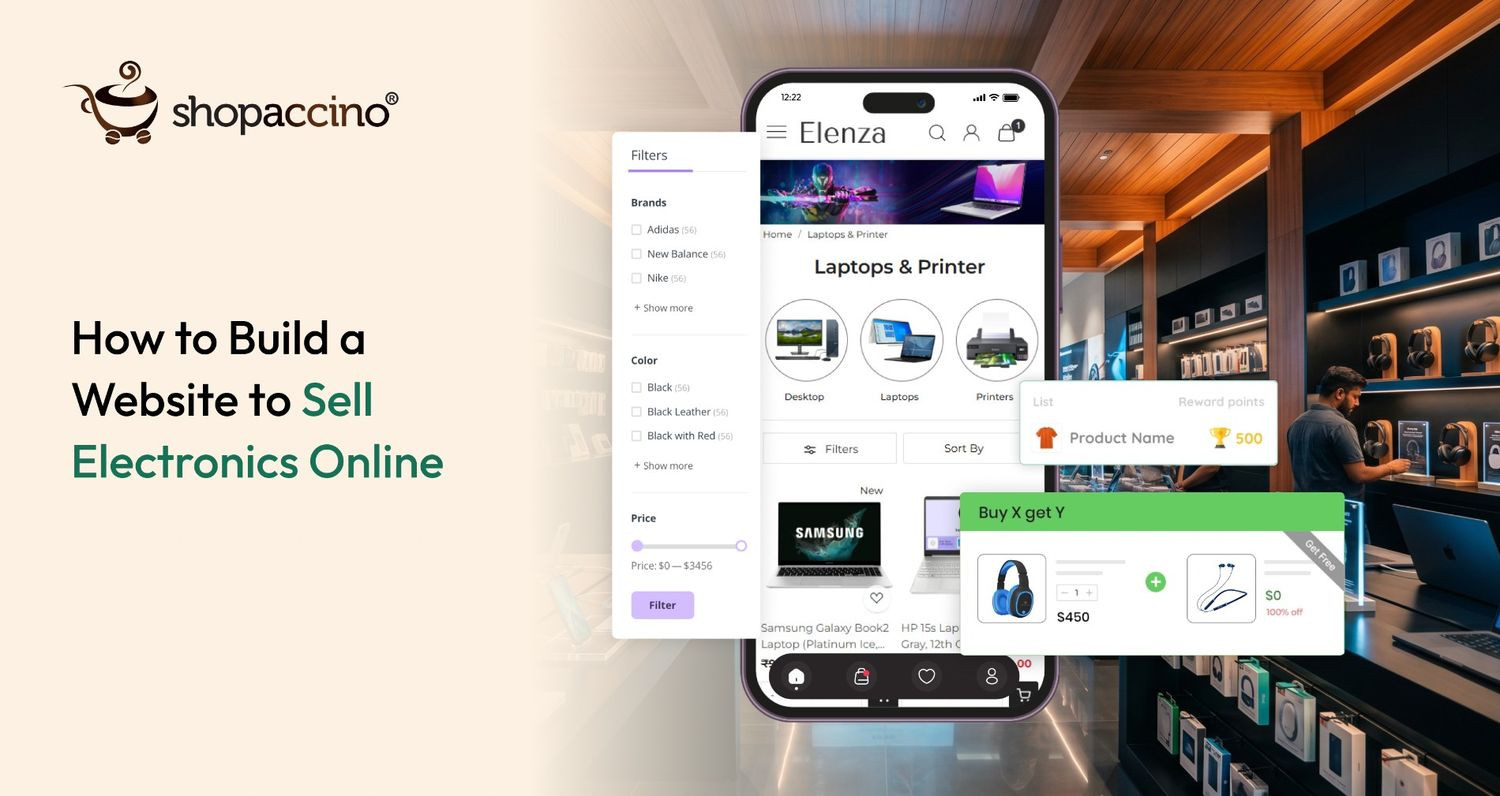
How to Build a Website to Sell Electronics Online
Overview
The global electronics market is one of the most consistently high-demand verticals in e-commerce. From smartphones and laptops to smart home devices and accessories, consumer appetite for technology products continues to grow with every wave of digital adoption. Yet despite this demand, many electronics sellers still operate through fragmented offline networks, marketplace listings with thin product data, or outdated websites that fail to build buyer confidence. Understanding
how to sell electronics online goes far beyond simply listing products — it requires building a credible, technically precise digital presence that converts visitors into buyers, especially when dealing in high-value devices, branded goods, and warranty-backed products.
Why Precision and Trust Drive Sales
Electronics buyers are among the most research-intensive consumers in any retail category. They compare specifications, read reviews, verify warranty terms, and check seller credibility before committing to a purchase. Before you build a single page of your store, internalise these five pillars:
Product Authenticity — Verified brand partnerships, authorised reseller status, and clearly displayed authenticity guarantees are non-negotiable in a category rife with counterfeits.
Warranty and After-Sales Support — A clearly communicated manufacturer warranty, an accessible claim process, and a responsive support channel directly influence conversion rates on high-value products.
Pricing Competitiveness — Margins in electronics can be tight and price comparison is effortless. Your pricing strategy must account for platform fees, shipping costs, and return rates while remaining market-competitive.
Technical Clarity — Vague descriptions are conversion killers. Detailed specifications, compatibility notes, and structured product data give customers the confidence to purchase without seeking information elsewhere.
Logistics Precision — Electronics are high-value and fragile. Delayed delivery, damaged packaging, and unclear return flows erode customer trust rapidly and generate disproportionate support overhead.
Building a robust online electronics store means addressing all five pillars simultaneously — from the first line of product data to the last-mile delivery experience.
Identify Your Market
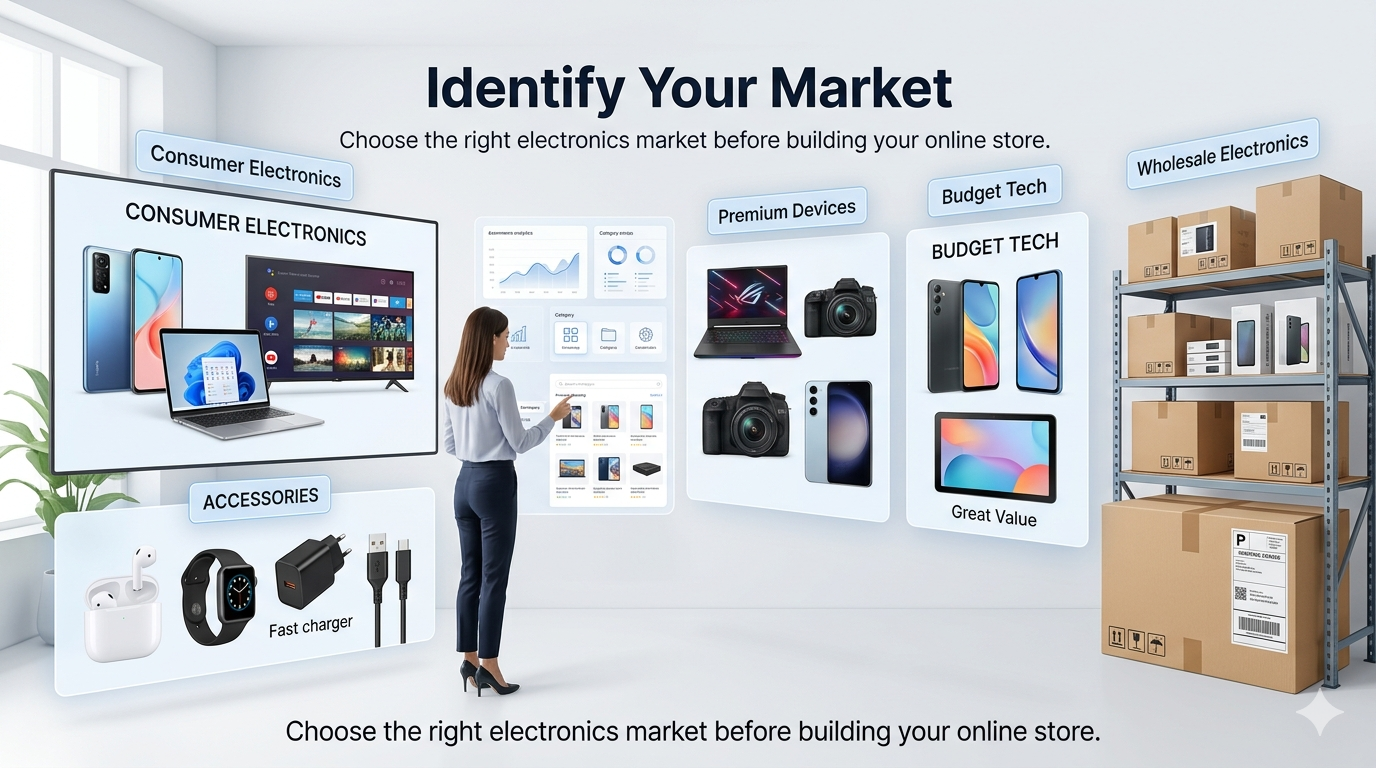
The electronics market is not homogeneous. Sellers who target everyone reach no one. Before building your website, define which segment or combination of segments you serve:
Consumer Electronics
This is the broadest segment — smartphones, laptops, tablets, televisions, audio equipment, and personal computing devices. It is highly competitive, brand-driven, and margin-sensitive. Success here depends on authorised distribution relationships, competitive pricing, and a product catalogue with complete, verified specifications.
Gadgets and Accessories
Wearables, smart devices, charging solutions, cables, cases, and peripherals represent a high-volume, lower-ticket segment. Accessories benefit from impulse buying behaviour and are highly effective as cross-sell and bundle opportunities. This is one of the most accessible entry points for new sellers learning how to sell gadgets online without heavy capital investment.
Premium Devices
High-end audio, professional cameras, flagship smartphones, and premium computing products attract buyers with strong purchase intent and higher lifetime value. The return rate is lower, but the stakes for product accuracy, authenticity documentation, and after-sales commitment are significantly higher.
Budget and Value Electronics
A growing segment driven by first-time buyers and value-conscious consumers. Entry-level alternatives, refurbished devices, and white-label products compete primarily on price and availability. Margins can be reasonable if sourcing and logistics are optimised from the outset.
Wholesale and Distribution
Understanding how to sell electronics wholesale online opens a separate B2B revenue channel. Wholesale requires volume pricing structures, credit terms, bulk packaging configurations, and dedicated account management capabilities. It is a distinct operational model but can coexist with retail operations on the right ecommerce platform.
Identify which of these segments aligns with your current inventory, supplier relationships, and long-term business vision. Your website architecture, tone of voice, and product data structure will differ significantly depending on this choice.
Identify the Gap in the Market
Before building your store, conduct a structured competitor analysis. Visit the top electronics websites currently ranking for your target keywords. Evaluate them not as a buyer, but as a strategist.
Common Gaps in Existing Electronics Websites
Lack of Product Clarity: Many sellers list product names without complete specifications — missing processor details, OS version, battery capacity, or connectivity standards. Buyers who cannot find what they need leave immediately.
Poor Filtering Options: Most mid-market electronics stores offer only basic category filters. Buyers who know what they want — for example, a laptop with 16GB RAM, an SSD, and a specific processor generation — cannot narrow results efficiently.
Weak After-Sales Support: Warranty claim processes are frequently buried in fine print or absent entirely. A buyer who cannot understand the support process before purchase will not complete the transaction.
Unclear Warranty Details: Many stores distinguish neither manufacturer warranty from seller warranty nor on-site service from carry-in service. These distinctions matter enormously to the electronics buyer.
Poor Mobile Experience: Electronics research happens predominantly on mobile. A desktop-optimised store with a broken filter experience or slow product pages is losing a majority of its traffic every day.
How to Fill These Gaps
Position your store as the most transparent and information-rich option in your category. If competitors show one product image, show five. If they list a one-line specification, provide a full structured spec sheet. If they ignore warranty clarity, make warranty terms a prominent feature of every product page.
This gap-filling strategy is what differentiates a store built for long-term customer trust from one built merely for short-term transactions.
Select a Product and Prepare Your Catalogue
Your catalogue is the commercial backbone of your online electronics business. Incomplete or inaccurate product data is the single most common cause of buyer hesitation, abandoned carts, and post-sale disputes. Anyone learning how to start an online electronics store should treat catalogue preparation as a primary investment, not a secondary task.
Required Data for Every Electronics Listing
Each product in your catalogue must include the following fields, populated with precision:
Product Name — Full commercial name including model year or generation where applicable
Category and Sub-category — Hierarchical taxonomy, e.g., Electronics > Laptops > Gaming Laptops
Brand — Official brand name verified from manufacturer documentation
Model Number and SKU — Unique identifier per variant; critical for inventory accuracy and warranty management
Specifications — RAM, storage type and capacity, processor, display resolution and size, battery, connectivity standards, OS version, weight, and dimensions
Key Features — 3 to 6 buyer-relevant highlights; factual differentiators, not marketing copy
Pricing — MRP and selling price; include GST-inclusive display where applicable
Stock Availability — Real-time or regularly synced inventory quantity with low-stock alerts
Warranty Information — Duration, type (manufacturer, brand, or seller), and claim process contact or URL
Return Eligibility — Category-specific return window, conditions for acceptance; mandatory for buyer confidence
Filtering Must Be a Priority
Your ecommerce platform must support advanced filtering across all the above attributes. A buyer searching for a laptop with 16GB RAM, 512GB SSD, Intel Core i7, and a 15-inch display cannot find what they need unless your store supports multi-attribute filtering on:
Processor brand and generation
RAM capacity
Storage type and size
Display size and resolution
Operating system
Connectivity and port configuration
Price range
Warranty type
Gather all product data directly from manufacturer spec sheets, official distributor documentation, and certification records. Do not rely on marketplace listings or approximations — inaccurate electronics data leads to disputes, returns, and lasting reputation damage.
High-Resolution Images and Videos
In the absence of physical handling, your visuals are the product experience. This is non-negotiable for an online electronics business, where a buyer needs to understand the physical device and its features without holding it.
Image Requirements
Minimum 1500 x 1500 pixels per image; 2000+ pixels recommended for zoom functionality
Multiple angles: front, back, sides, top, and base; close-up shots of ports, buttons, and hardware details
Feature highlight images: annotated or contextual images calling out key specifications — display quality, keyboard layout, connector types
In-box contents: show what the customer receives — charger, documentation, and included accessories
Scale reference: include a lifestyle or in-hand shot to communicate physical dimensions intuitively
Clean white background for all primary catalogue images for visual consistency and marketplace compatibility
Video Requirements
Product walkthrough videos of 30 to 90 seconds showing the device in use and key features in operation
Unboxing clips for premium or high-value products, where the unwrapping experience influences buyer perception
Side-by-side comparison clips for products in the same category or price tier
Why This Matters
Showing the device from every angle — including its ports, bezels, and physical build — is a trust signal, not an overinvestment. A buyer who can clearly see the product will not return it claiming misrepresentation. Interface clarity, physical condition, and included accessories must all be apparent from your visuals. Sellers who invest in professional product photography consistently report higher conversion rates and fewer post-sale disputes.
Prepare Your Content and Brand Assets
Before your website goes live, you need more than product listings. A compelling online electronics business is built on layered content that establishes credibility and reduces buying friction at every stage of the customer journey.
Essential Content to Prepare
Business Goal and Brand Story: Communicate who you are, what you sell, and why a buyer should trust you. Include your founding story, geographic reach, authorised brand partnerships, and any industry certifications or affiliations.
Product Descriptions: Write structured copy that opens with the product's primary use case and ideal buyer, then addresses the two or three most common objections. Close with a specification summary in a scannable format.
Unique Selling Propositions: Define and display your USPs prominently across the homepage, product pages, and checkout — genuine warranty, authorised seller status, same-day dispatch, extended return window, and responsive technical support.
Return, Refund, and Warranty Policies: Write these in plain, unambiguous language. State the return window, conditions for acceptance, the refund timeline, and the exact warranty claim process.
Trust Signals: Integrate systematically — customer reviews with verified buyer tags, brand authorisation logos, payment security badges, GST registration, and visible customer support contact details.
Buying Guides and FAQs: Category-level guides and FAQ sections that help first-time buyers make informed decisions reduce pre-purchase enquiries and improve conversion.
Register Your Brand
Whether you are entering the market as a new business or taking an existing offline operation online, brand registration and consistent visual identity matter more than most electronics sellers realise.
New vs. Existing Brand
If launching a new brand, register your business name, secure your domain early, and apply for trademark protection where feasible. Choose a domain that is short, memorable, and relevant without being generic. If you are taking an established retail operation online, ensure your digital presence reflects the same credibility and professionalism your offline reputation has built.
Brand Guidelines to Define
Colour Scheme: Choose a primary colour and one or two accents. Electronics brands typically use blue, dark grey, and white — colours that communicate reliability and technical precision. Define hex values and apply consistently.
Typography: Select no more than two fonts — one for headings and one for body text. Avoid decorative typefaces; they undermine the technical credibility of an electronics brand.
Tone of Voice: Electronics buyers are informed and research-oriented. Your brand voice should be clear, factual, and confident — never vague or hyperbolic. Let specifications do the selling.
Do's and Don'ts: Document how your brand name appears in context, how it should not be abbreviated, what visual styles are off-brand, and how customer communications should be signed off.
Choose the Right Ecommerce Software
The platform you build on will either support or limit your business. For electronics sellers, this decision is particularly consequential because the category has requirements that generic ecommerce templates do not address well. Anyone evaluating how to how to sell electronic products online at scale should treat platform selection as a commercial decision, not a technical one.
Key Platform Requirements for Electronics Sellers
Clear Product Attributes and Advanced Filtering: Your platform must support structured product attributes — RAM, storage, processor, connectivity, compatibility — and expose these as filterable parameters in the storefront. This is foundational to category navigation in electronics.
Warranty Registration and Claim Management: A built-in or integrated mechanism for customers to register products and submit warranty claims reduces support overhead and significantly improves the post-purchase experience.
Flexible Promotional Engine — Buy X Get Y: Category-specific discounts, combo deals, Buy X Get Y offers, and time-limited promotions are standard commercial levers in electronics retail. Your platform should support these without manual workarounds.
Reward Points System: Electronics purchases are infrequent but high-value. A structured rewards programme incentivises repeat purchases and increases customer lifetime value — particularly effective for accessories and consumables.
Referral Programmes: Word-of-mouth is significant in electronics because purchase decisions are heavily peer-influenced. A referral mechanism that rewards both referrer and referee activates this channel systematically.
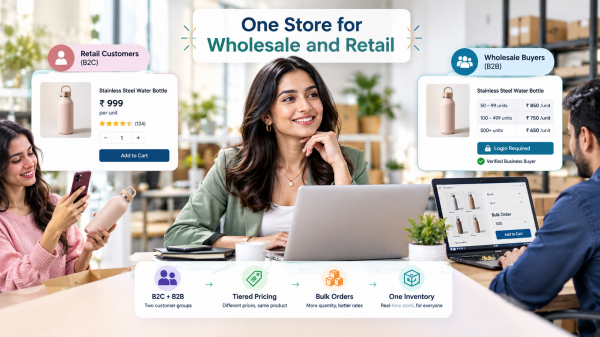
B2B and Wholesale Capability: If you plan to serve both retail and wholesale channels, your platform must support tiered pricing, bulk order workflows, and account-level terms.
Platforms like Shopaccino are designed to address the specific needs of product-intensive sellers — offering structured product attributes, flexible promotional rule configuration, rewards and referral programmes, and wholesale pricing capabilities. If you are evaluating platforms, ensure that advanced filtering, warranty form integration, and promotional flexibility are available without needing third-party plugins for core functions.
Choose a Design and Theme
Your website design must communicate technical credibility and product quality from the first second. In the electronics category, buyers make fast trust judgements based on visual presentation, navigation logic, and the accessibility of specifications.
Design Principles for Electronics Websites
Clean, uncluttered layouts that let product photography command attention without competing visual noise
Intuitive navigation: category browsing, search, and filter access within one or two clicks from any page
Comparison-friendly layout: feature comparison tables and side-by-side product views that enable informed decision-making without the buyer leaving your store
Mobile-first responsiveness: product pages, filter interactions, specification tables, and checkout must perform flawlessly on all screen sizes
Prominent trust elements: warranty badges, authorised seller indicators, and return policy summaries placed at the point of purchase decision — above or near the Add to Cart button
Fast load times: high-resolution images must be compressed and lazy-loaded; page speed is a ranking signal and a conversion factor
Avoid overloaded designs with excessive animations or promotional banners stacked above the fold. In electronics retail, a structured, information-dense layout signals professionalism. A cluttered website signals inexperience.
Upload Your Content
With your platform chosen and design in place, systematic content upload begins. This is not simply a data entry task — it is a conversion optimisation exercise that determines the quality of every buyer's first impression.
Products
Upload all product data fields as specified in Section 4
Write unique, specific product descriptions — avoid templated copy that duplicates across listings
Price each product clearly with GST-inclusive display and any applicable per-unit breakdown for accessories
Highlight USPs specific to each product — authorised seller status, warranty duration, bundled accessories, and compatibility notes
Assign correct HSN codes and tax categories at the product level for compliant invoicing
Informative Content
Buying Guides: Category-level guides that help first-time buyers make informed decisions — 'How to Choose the Right Laptop for Your Needs' or 'Understanding OLED vs QLED Televisions'
Comparison Pages: Direct model comparisons targeting high-intent search queries, e.g., specific flagship model vs. model comparisons with full specification breakdowns
FAQs: Structured FAQ sections at category and product level addressing pre-purchase questions — warranty coverage, compatibility, return conditions, and delivery timelines
Visuals and Banners
Homepage banners showcasing your featured products — clean, benefit-driven, and with clearly stated offer terms
Category page banners aligned with each electronics segment
Trust badges and authorised seller logos placed consistently across the site
Policies
Shipping policy: domestic timelines, carriers, and handling standards for fragile electronics
Return and refund policy: clear conditions under which returns are accepted and the refund processing timeline
Warranty policy: manufacturer versus seller warranty terms, claim process, and escalation path
Privacy and data policy for buyer confidence in online transactions
Manage Your Store, Shipping, and Payments

Operational infrastructure is what separates a professional online electronics business from a casual seller. Every element of this layer must function reliably before you accept your first order.
GST and Invoicing
Register for GST if you have not already done so — it is mandatory for online electronics sales above the threshold. Configure your platform to generate GST-compliant invoices automatically with correct HSN codes, GSTIN display, and tax breakdowns. Maintain a clean audit trail from day one to simplify quarterly filings and any future regulatory review.
Checkout Setup
Minimal checkout steps — reduce friction at the point of purchase
Order summary with product image, specification, and price clearly visible before payment confirmation
EMI and BNPL options through your payment gateway for products above ₹20,000 — these measurably increase conversion for high-value electronics
Shipping Integration
Integrate with a multi-carrier shipping aggregator (Shiprocket, Delhivery, or equivalent) to automate label generation, tracking updates, and delivery exception management
Configure order weight and dimensional data accurately — electronics packaging dimensions significantly affect volumetric shipping costs
Set up serviceable pin codes, COD availability rules, and delivery time estimates per zone before going live
Payment Gateways
Integrate a payment gateway supporting domestic cards, UPI, net banking, and wallet payments for Indian buyers
Offer bank transfer options for high-value wholesale transactions where buyers prefer direct payment
Ensure your gateway is PCI-DSS compliant and SSL is configured across your entire store — not only the checkout page
Analytics and Security
Google Analytics 4: Install GA4 and configure ecommerce tracking before launch. Funnel data from day one is invaluable for early conversion optimisation and traffic source analysis.
reCAPTCHA: Implement reCAPTCHA on all forms — account registration, checkout, contact, and warranty claim forms — to prevent bot activity and fraudulent orders.
Marketing Your Electronics Store
Building the store is the foundation. Getting qualified buyers to it is the ongoing work. For electronics sellers, a multi-channel approach built around intent-driven traffic delivers the strongest return. Understanding how to sell gadgets online and understanding how to acquire buyers at an acceptable cost are inseparable challenges.
Search Engine Optimisation (SEO)
Optimise every product and category page for specific, intent-driven search terms. Buyers who know exactly what they want — searching for a specific model, specification combination, or comparison — convert at significantly higher rates than general traffic. Build content around the informational queries your buyers use when researching before purchase.
Optimise meta titles and descriptions for every product and category page with model-specific and specification-driven keywords
Build structured data markup (Schema) for products, reviews, and breadcrumbs to improve search result presentation
Build internal linking between buying guides, category pages, and individual product listings to consolidate topical authority
Publish consistent blog content: product reviews, category comparisons, and technology explainers that compound organic search equity over time
Paid Advertising
Google Shopping campaigns are the most direct paid channel for electronics — product data feed quality determines ad relevance and cost-per-click
Google Search Ads targeting high-commercial-intent queries — model-specific searches, brand plus category combinations, and comparative queries
Meta (Instagram and Facebook) ads work well for accessories and impulse-buy electronics, using product catalogue ads for retargeting visitors who browsed but did not purchase
Content Marketing and Blogging
Educational content builds long-term trust and organic traffic. Sellers who understand how to sell electronic products online at a strategic level invest in content that answers buyer questions before they are asked:
'What is the difference between OLED and AMOLED displays?'
'How to choose the right processor for video editing?'
'Which laptop is best for students under ₹50,000?'
This content positions you as a category authority, improves search rankings, and reduces the buyer's need to seek information elsewhere — keeping them within your conversion funnel.
Order Fulfilment
In the electronics business, fulfilment quality is inseparable from brand reputation. A poorly packaged device that arrives damaged, or one dispatched without its warranty documentation, can undo months of trust-building at a single stroke.
Fulfilment Standards for Electronics Orders
Establish and publish a clear dispatch commitment — same-day or next-day for orders placed before a cut-off time; failure to meet stated timelines is a top driver of negative reviews
Send automated transactional notifications at each stage: order confirmed, dispatched with tracking link, out for delivery, and delivered
Use corrugated outer cartons with appropriate wall strength for the product weight, with bubble wrap or foam inserts for inner protection
Use anti-static ESD bags for all circuit-board-level products and accessories — static discharge is a real risk in unprotected transit
Apply tamper-evident security seals on box closures to provide evidence of any tampering during transit
Include a quality check slip noting tested functionality items — this reduces return rates and builds immediate post-delivery confidence
Scale Your Online Electronics Business
Once your store is operational and generating consistent orders, the focus shifts to systematic growth. Scaling an how to sell electronics online operation follows a clear and repeatable cycle:
The Growth Cycle
Analyse: Review conversion rate by category, traffic sources by acquisition cost, return rate by product, and customer retention rates on a defined weekly and monthly cadence. Data gaps are business risks.
Strategise: Use analytical findings to identify the highest-leverage growth actions — expanding into adjacent categories, improving product page conversion, or entering the wholesale channel as a B2B revenue stream.
Implement: Execute changes systematically rather than across all fronts simultaneously. A/B test product page improvements. Pilot wholesale pricing with select accounts before building a full B2B infrastructure.
Repeat: Each implementation cycle feeds new data into the analysis phase. Businesses that maintain this discipline grow more predictably than those that operate reactively.
Expanding Into Wholesale and New Markets
For sellers who want to grow their business beyond retail, the path becomes clearer once domestic operations are stable. Key scaling actions include:
Expanding catalogue depth — adding more brands, form factors, and price tier coverage within your existing categories
Entering the wholesale channel by understanding how to sell electronics wholesale online — which requires tiered pricing tables, bulk order workflows, and dedicated account management
Improving pricing strategy — moving from reactive discounting to structural bundle pricing, loyalty discounts, and category-level promotional calendars
Investing in content and SEO depth for new sub-categories to build organic discovery ahead of paid acquisition
Building relationships with B2B buyers and distributors through direct outreach, trade directories, and wholesale platform presence
Understanding how to start an online electronics store and understanding how to scale it are two different challenges. The first requires clarity and execution. The second requires data, patience, and a willingness to reinvest in what works.
Final Note
The online electronics market rewards those who combine deep product knowledge with operational precision. Buyers in this category are informed, comparison-driven, and willing to pay a fair price for documented quality and reliable after-sales support. Your website is not just a storefront — it is the most powerful trust-building tool your business has.
Build it with the same care and attention to detail you apply to selecting and sourcing the products you sell. If you're working with a lean budget, our guide on how to launch a profitable online electronics store without heavy investment covers a cost-efficient way to get started.