How to Build a Website to Sell Furniture Online
Overview
The global online furniture market is on a powerful growth trajectory, and businesses that delay their digital transition are already losing ground. Buyers today don’t just browse furniture online — they research materials, compare dimensions, visualise placement, and complete purchases, all without stepping into a showroom. If your brand does not have a well-built website, you are invisible to this buyer segment.
Knowing how to sell furniture online goes far beyond listing products on a marketplace. It requires building a credible, conversion-optimised web presence that mirrors the quality of your furniture and earns the trust of a customer making a significant purchase decision. This guide walks you through every stage of that process — strategically and practically.
Why a Dedicated Website Matters
Marketplaces offer reach, but they also come with commission costs, limited branding, and no ownership of customer relationships. A dedicated ecommerce website gives you full control: over your brand story, pricing strategy, customer data, and the overall buying experience. For furniture businesses especially, this control is critical because the purchase journey is long, considered, and highly visual.
Key Challenges Unique to Furniture Ecommerce
Before building your website, understand what makes selling furniture online distinctly complex:
Logistics: Furniture is bulky, heavy, and fragile. Delivery planning, packaging standards, and last-mile coordination require dedicated attention.
Product Presentation: Customers cannot touch or sit on a product. Photography, 360-degree views, and detailed specifications must compensate for that gap.
Pricing Complexity: Furniture often involves variant pricing (size, finish, material), B2B tiers, or custom quotes.
Customisation Requests: Many customers want tailored dimensions or finishes. Your platform must support or clearly communicate this.
Customer Trust: High ticket value means customers need social proof, clear policies, and responsive support before they commit.
Delivery Timelines: Unlike fast-moving goods, furniture often has lead times. These must be communicated transparently to avoid post-purchase dissatisfaction. For a closer look at handling size, shipping, and custom orders once your store is live, see our guide on building a furniture eCommerce store.
Identify Your Market
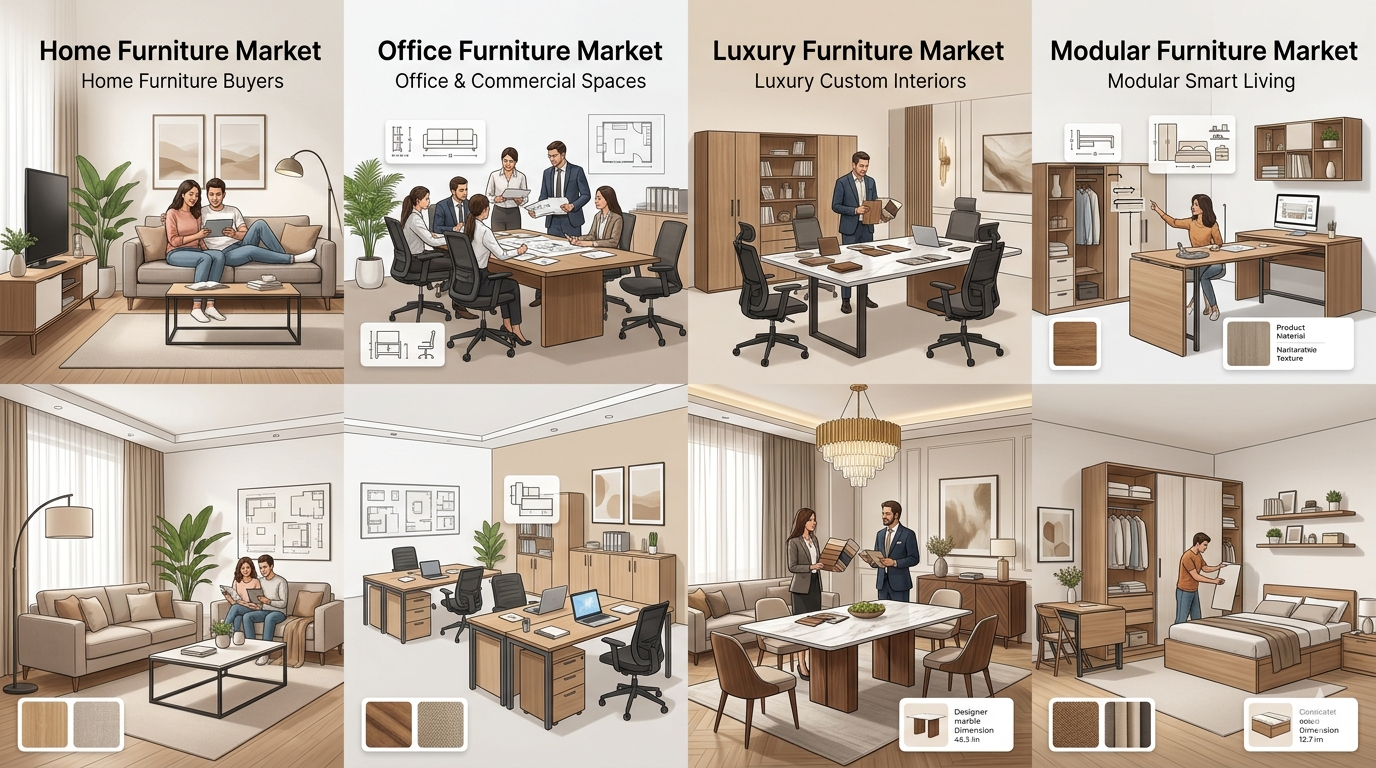
The furniture market is not monolithic. It spans a wide range of customer profiles, price points, and use cases. Before you define your digital strategy, you must define your segment with precision. Knowing how to start a furniture store online begins with knowing exactly who you are building that store for.
Primary Market Segments
Home Furniture
This is the largest and most competitive segment. It includes sofas, beds, dining sets, wardrobes, and living room furniture. Buyers range from first-time homeowners furnishing on a budget to design-conscious professionals seeking premium pieces. Online home furniture purchases are driven by aesthetics, price, and the quality of product imagery.
Office and Commercial Furniture
Driven by corporate procurement, co-working spaces, and the rise of home offices, this segment has distinct buying behaviour. Purchases are often bulk, repeat, and require GST invoicing. Ergonomics, durability, and lead times matter more than aesthetics alone. B2B pricing and catalogue structures are essential here.
Luxury and Custom Furniture
Premium furniture buyers are not price-sensitive — they are quality-sensitive. They seek uniqueness, craftsmanship, and bespoke solutions. Custom furniture brands must invest heavily in storytelling, portfolio showcasing, and a buying experience that feels as premium as the product itself.
Modular Furniture
Modular furniture appeals to urban buyers in compact homes who want flexibility and configurability. The product complexity — multiple components, configurations, finish combinations — demands a platform that can handle product variants, assembly information, and clear visual representation of configurations.
Budget vs. Premium Positioning
Your positioning determines your website’s tone, design language, and pricing strategy. Budget brands compete on price and accessibility; premium brands compete on experience and trust. Trying to occupy both simultaneously rarely works online. Pick your lane and build your digital presence accordingly.
Identify the Gap in the Market
Every market has gaps. In furniture ecommerce, those gaps are often glaringly obvious once you look for them. Identifying and filling these gaps is how new entrants win market share quickly — and how existing players retain relevance.
How to Analyse Competitors Effectively
Visit the top five to ten furniture websites in your target segment and simulate the buying journey.
Note where you feel uncertain, confused, or unconvinced as a buyer.
Check their product pages for completeness: are dimensions clearly shown? Are materials specified? Is customisation explained?
Assess their imagery: do lifestyle shots help you visualise the product in a real space?
Read their reviews — complaints in reviews are direct signals of unmet needs.
Analyse their logistics messaging: are delivery timelines transparent? Is there a tracking system?
Common Gaps in the Furniture Ecommerce Market
Lack of Customisation Options
Most furniture websites offer one or two standard configurations. Buyers who want a different size, fabric, or finish are forced to abandon the journey or call in. Businesses that offer online customisation — with clear pricing for each option — convert significantly better.
Poor Product Visualisation
A single studio image on a white background does not help a buyer decide. The absence of lifestyle photography, room-context shots, and scale references is one of the most common and costly failures in furniture ecommerce. Customers need to see your product in a living space to feel confident.
Unclear or Missing Dimensions
This is perhaps the most critical gap. Furniture buyers need to measure their space before purchasing. If exact dimensions are not immediately visible on the product page — width, depth, height, seat height for sofas, internal dimensions for wardrobes — most buyers will leave and find a competitor who provides them.
Weak Logistics Experience
Vague shipping timelines, no delivery tracking, and zero communication between order and arrival create anxiety for high-value purchases. Brands that invest in transparent, proactive logistics communication build loyalty even before the product arrives.
Turning Gaps into Your Competitive Advantage
Once you have identified the gaps your competitors leave open, design your website, product pages, and operations to explicitly fill them. If no one in your segment offers real-time customisation with pricing, build that. If logistics communication is weak across competitors, invest in it. Your website must communicate these advantages from the moment a visitor lands.
Select Products and Prepare Your Catalogue
Your product catalogue is the backbone of your online store. A well-organised, information-rich catalogue reduces buyer hesitation and increases conversion. Understanding how to start selling furniture online is largely about preparing this catalogue with the precision that high-value furniture purchases demand.
Selecting Your Initial Product Range
Resist the urge to launch everything at once. Start with a focused range that represents your best-selling or most photographable products. For manufacturers, this might mean selecting two or three product lines that illustrate quality and range. For retailers, it means curating a catalogue that is manageable to maintain accurately.
Prioritise products that photograph well, have clear competitive advantages, and for which you have full inventory and logistics readiness. A smaller catalogue done right will always outperform a bloated catalogue full of incomplete listings.
Organising Your Categories
Structure your categories intuitively, the way a customer thinks — not the way your warehouse is organised. Common furniture category structures include room-based navigation (Living Room, Bedroom, Dining, Office), product-type navigation (Sofas, Beds, Tables, Chairs), or material-based navigation for premium and artisan brands (Solid Wood, Upholstered, Metal Frame).
Required Product Information (Non-Negotiable)
Every product listing on your website must include the following information. Incomplete listings erode trust and increase return rates.
Product Name | Clear, descriptive, and SEO-friendly. Include material or style cue where relevant. |
Category | Correctly classified for both site navigation and internal inventory management. |
Material | Specify primary material, secondary material, and surface treatment or upholstery fabric. |
Finish | List all available finish or colour options. Include a finish swatch if possible. |
Exact Dimensions | MANDATORY. Width × Depth × Height in centimetres. For sofas: also seat height and depth. For wardrobes: interior dimensions. For dining tables: seating capacity. |
Weight | Essential for logistics calculation and delivery planning. |
Pricing | Clear MRP. Show discounts, if any, transparently. |
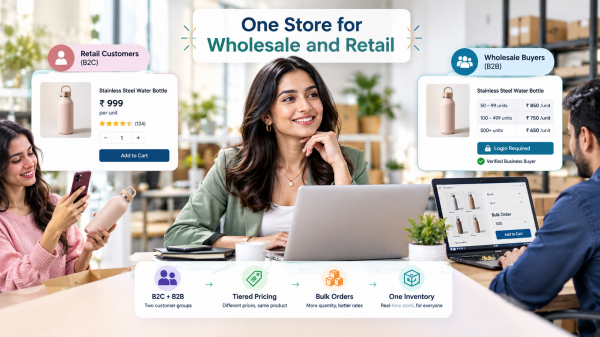
B2C and B2B Pricing | Separate pricing tiers for bulk or institutional buyers where applicable. |
SKU | Unique identifier per variant for inventory and order management. |
Stock Status | In Stock, Limited Stock, Made to Order, or Out of Stock. |
Customisation Options | List available customisations clearly: size, material, finish, upholstery. Include pricing implications. |
Assembly Details | Does it require assembly? Is professional installation available? Are tools included? |
Care Instructions | Cleaning and maintenance guidance. Reduces returns and supports product longevity. |
Delivery Timelines | State standard delivery windows clearly. Separate for in-stock vs made-to-order items. |
Gathering Accurate Product Data
Do not rely on memory or guesswork. Physically measure every product and have a second person verify. Ensure material descriptions match actual materials. If a product is made to order, define the lead time precisely. Accurate data is not optional in furniture ecommerce — it directly determines your return rate and customer satisfaction score.
Hi-Resolution Images and Videos
In physical retail, customers experience your product in person. Online, your images and videos are that experience. Poor visuals are the single fastest way to lose a high-intent buyer. This is not an area to compromise on.
Image Requirements
High Resolution: Minimum 2000px on the longest side. Images should remain sharp when zoomed in.
Multiple Angles: Front, side, back, diagonal, and close-up of material or joinery details.
Lifestyle Shots: Show the product in a styled room setting. This helps buyers visualise the piece in their own home.
Dimension Reference Visuals: Include at least one image with a human silhouette or a common reference object to communicate scale. This is especially critical for sofas, beds, and dining tables.
Variant Images: If a product comes in multiple finishes or fabrics, photograph each variant. Do not ask buyers to imagine what ‘walnut finish’ looks like.
Video Content
Product Walkaround: A 30- to 60-second video showing the product from all angles, demonstrating drawers, hinges, and any functional features. If filming every SKU isn't practical, an image to video tool can turn your existing product photos into this same walkaround style clip.
Scale and Space Video: A brief clip placing the product in a real room context, ideally with a person using it.
Customisation Demo: If you offer customisation, a short video or animation showing available options builds significant confidence.
Images and videos must help customers answer the question: ‘Will this fit in my space, and will it look the way I imagine?’ If your visuals cannot answer that question clearly, buyers will not proceed.
Prepare Your Content
Content on a furniture website serves two functions: it informs search engines and it converts visitors. Both matter equally. Before your website goes live, every content element must be ready, accurate, and consistent with your brand voice.
Core Content to Prepare
Brand Story and About Page
Your ‘About’ page is often the second-most-visited page on a furniture website, because buyers want to know who they are trusting with a significant purchase. Write a clear, honest narrative: how the brand was started, what craftsmanship philosophy drives it, and what the team stands for. Avoid generic corporate language.
Business Goal and Vision
Define internally what success looks like in year one, year two, and year five. This clarity informs every strategic decision — from the platform you choose to the markets you initially target.
Product Descriptions
Each product description must do two things: describe the product accurately and communicate its value. Mention the material quality, the manufacturing process, the design intent, and how it fits into a lifestyle. Avoid generic phrases like ‘high-quality furniture’ — be specific: ‘solid sheesham wood with a hand-rubbed matte finish’ says far more.
USPs (Unique Selling Propositions)
Define three to five USPs that genuinely differentiate your brand. These could be: 10-year structural warranty, free white-glove delivery, fully customisable dimensions, FSC-certified materials, or 30-day hassle-free returns. Display these prominently on your homepage, product pages, and at checkout.
Policies
Write clear, buyer-friendly policies for shipping, returns, warranty, and cancellations. Vague or hidden policies are a major trust barrier in furniture ecommerce. The more transparent your policies, the more confident buyers feel.
Register Your Brand
Whether you are launching a new furniture brand or taking an existing brand online, establishing proper legal and brand foundations is essential before your website goes live.
Legal Registration
Register your business as a sole proprietorship, partnership, LLP, or private limited company depending on your scale and plans.
Obtain a GSTIN — mandatory for B2B sales and for issuing valid invoices.
If launching a new brand name, conduct a trademark search and file for trademark protection early.
If selling internationally in the future, understand import-export codes and cross-border compliance requirements.
Brand Guidelines
Before building your website, define a clear set of brand guidelines. These will govern every visual and verbal element across your digital presence and ensure consistency at scale.
Color Scheme | Primary, secondary, and accent colors. Ensure the palette reflects your brand positioning: earthy tones for handcrafted furniture; clean monochrome for contemporary and premium. |
Typography | Select 1–2 fonts: one for headings, one for body text. Both must be web-safe and legible across devices. |
Tone of Voice | Define how your brand speaks: formal or conversational, aspirational or functional, minimal or expressive. Apply consistently across all copy. |
Visual Identity | Logo usage rules, image style guidelines, photography aesthetic, and icon style. |
Do’s and Don’ts | Document what is off-brand: competitor comparisons, generic stock images, inconsistent font use, informal language in product descriptions. |
Choose the Right Ecommerce Software
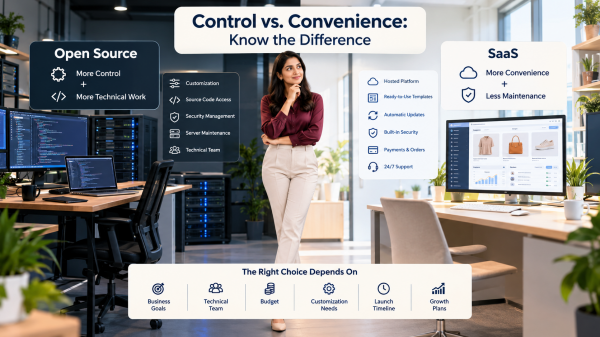
Choosing the wrong ecommerce platform is one of the most expensive mistakes a furniture business can make — not just financially, but in terms of the time and complexity involved in migrating later. If you are learning how to start furniture business online, platform selection must be treated as a core strategic decision, not an afterthought.
What a Furniture E-commerce Platform Must Support
Large and Complex Catalogue Management: Hundreds of SKUs with multiple variants, images, and dimension tables per product.
Product Customisation Flows: Ability to present custom size, finish, or fabric options with dynamic pricing.
Flexible Pricing: B2C retail pricing, B2B bulk pricing, discount rules, and coupon management.
Logistics Integrations: Native or API-based integrations with shipping partners, real-time rate calculators, and order tracking.
SEO Capabilities: Custom meta tags, URL structure control, schema markup support, and blog functionality for content marketing.
Mobile Responsiveness: A significant share of furniture research now happens on mobile devices.
Payment Gateway Flexibility: Support for UPI, credit cards, EMI, and bank transfers.
Analytics and Reporting: Sales performance, traffic data, and customer behaviour tracking built in or easily integrated.
Shop The Look
Your platform should support a "Shop the Look" feature that groups multiple furniture pieces together as a styled room, letting customers visualise how items work together and add several products to cart in one interaction.
Buyers rarely purchase a single piece in isolation — a dining table often comes with chairs, a sideboard, and accessories. Look-based selling directly increases average order value.
The feature should allow you to tag individual products within a lifestyle image so visitors can click any piece and reach its product page or add it to cart instantly.
For premium and interior-led brands, Shop the Look also functions as a digital mood board, reinforcing your design sensibility and helping buyers make confident, coordinated decisions.
Shopaccino is built specifically for Indian ecommerce businesses that need robust catalogue management, flexible pricing structures, and deep logistics integrations — making it a well-suited platform for furniture businesses looking to scale with control. Its support for B2B and B2C operations from a single interface is particularly valuable for furniture brands that serve both retail and trade customers.
Choose Your Design and Theme
Your website design is your digital showroom. For furniture, it must achieve two things simultaneously: create an aspirational visual experience and make the buying journey effortlessly simple. A cluttered, generic, or slow-loading design will cost you sales regardless of how good your furniture is.
Design Principles for Furniture Websites
Brand Alignment: Every design element — colors, fonts, whitespace, imagery — must reflect the brand guidelines you have defined.
Premium Feel: Clean layouts with generous whitespace convey quality. Avoid cluttered product grids and excessive promotional banners.
Product-Focused Layout: Products must be the hero of every page. Category pages, homepage banners, and featured collections should all lead to products quickly.
Intuitive Navigation: Buyers should be able to move from homepage to product page in two or fewer clicks. Mega menus for large catalogues, sticky headers, and persistent search bars all help.
Mobile Responsiveness: Your design must be pixel-perfect on mobile. Test on actual devices, not just browser simulators.
Page Speed: Optimise every image before upload. A slow website costs you both buyers and search rankings.
If your theme requires significant modification to reflect your brand, invest in that customisation. A theme that looks like every other furniture website is a missed branding opportunity.
Upload Your Content
With your platform selected, design live, and content prepared, it is time to populate your website. This phase requires systematic attention to detail. Errors in product data, pricing, or policies at this stage translate directly into operational problems after launch.
Products
Upload all products with complete information as defined in Section 4.
Double-check dimensions, prices, and stock statuses before publishing.
Ensure each product is correctly assigned to its category and all variants are properly configured.
Informative Content
Buying Guides: Help buyers choose the right sofa size for their living room, the right mattress for their sleeping style, or the right study table for their workspace. These guides build trust, reduce returns, and improve SEO.
FAQs: Answer the most common pre-purchase questions: delivery times, return process, customisation availability, assembly requirements, and care instructions.
Visuals and Banners
Ensure all homepage banners, category headers, and promotional banners are high quality and correctly sized for desktop and mobile.
Lifestyle images on banners should feel aspirational — they set the tone for the entire brand experience.
Policies
Publish your shipping policy, return and exchange policy, warranty policy, and privacy policy.
Link these pages in your website footer. They should be accessible from any page.
Past Projects and Portfolio Gallery
For custom furniture businesses especially, a portfolio section showcasing completed projects is one of the most powerful trust-building tools on your website. Include photos of installed pieces in client spaces, brief project descriptions, and — where possible — client testimonials. This demonstrates real-world execution capability, which is what high-ticket custom buyers need to see before committing.
Manage Store, Shipping, and Payments
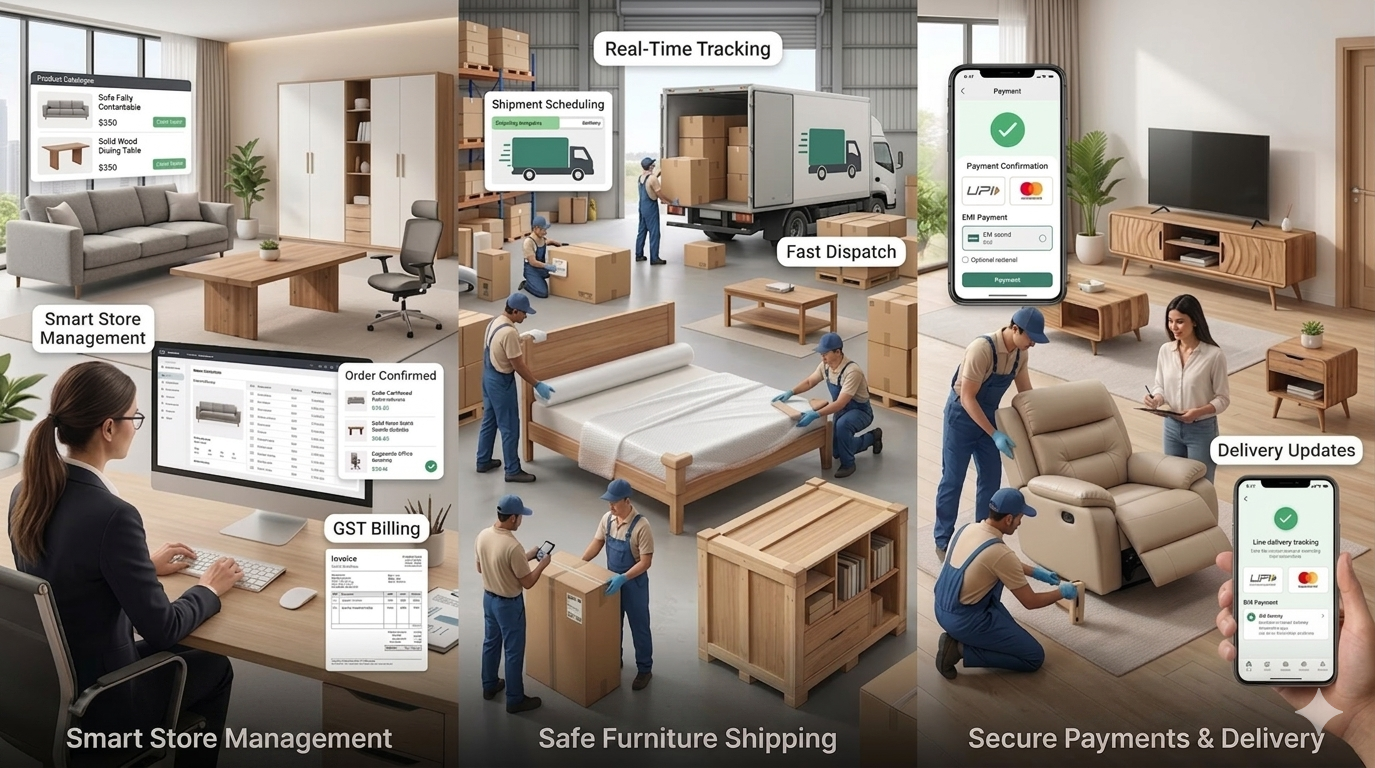
A well-designed website with great products will fail operationally if the backend processes are not airtight. Furniture ecommerce is operationally demanding — high-value orders, complex logistics, and customer expectations around communication all require proper systems.
GST and Invoicing
Configure your GST settings correctly. Furniture typically attracts 18% GST; some categories may differ.
Ensure your platform generates GST-compliant invoices automatically on every order.
For B2B orders, buyers will require accurate GST invoices for input tax credit — errors here create significant downstream issues.
Checkout Configuration
Enable a streamlined checkout with as few steps as possible.
Collect full delivery address including floor, building access details, and contact number — essential for large furniture delivery.
Set up order confirmation emails and SMS notifications immediately upon purchase.
Shipping Integration
Integrate with logistics partners who have experience handling large, fragile items.
Configure shipping zones and rates accurately, including additional charges for remote or difficult-access locations.
Enable real-time order tracking so customers can follow their delivery without contacting support.
Payment Gateway
Integrate a payment gateway that supports UPI, credit and debit cards, net banking, and EMI options.
For high-value furniture orders, EMI availability significantly reduces checkout abandonment.
Ensure PCI-DSS compliance and SSL certification for all payment pages.
Analytics and Security
Google Analytics: Install and configure Google Analytics 4 to track traffic sources, product page performance, checkout funnel drop-offs, and conversion rates.
Google reCAPTCHA: Implement reCAPTCHA on all forms including contact, enquiry, and checkout pages to prevent spam and bot submissions.
Marketing Your Online Furniture Store
Building your website is the foundation. Marketing is what makes it perform. A new furniture website with no marketing strategy will generate no traffic regardless of how well it is built. Understanding how to start an online furniture business that actually grows requires a multi-channel marketing approach from day one.
Search Engine Optimisation (SEO)
SEO is the highest-ROI marketing channel for furniture businesses because buyers actively search for furniture. Invest in it consistently.
Optimise every product page with descriptive titles, relevant keywords, and complete meta descriptions.
How to sell furniture online and category-specific terms like ‘buy solid wood dining table’ or ‘custom sofa manufacturer India’ should appear naturally in your product and category page copy.
Build internal linking between buying guides, blog posts, and product pages.
Earn backlinks through PR, furniture design publications, and interior design communities.
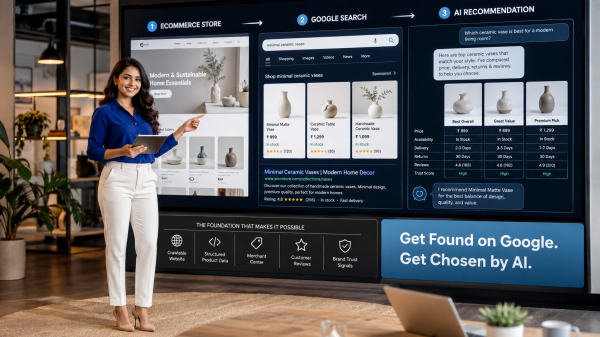
Implement schema markup for products so search engines can display pricing and availability in search results.
Performance Advertising
Google Shopping Ads: Display your products directly in search results with images and prices. High intent, high ROI for furniture brands.
Search Ads: Target high-intent keywords where buyers are actively looking to purchase furniture online.
Meta Ads: Instagram and Facebook offer highly visual ad formats ideal for furniture. Use lifestyle imagery and retarget website visitors who viewed products but did not purchase.
Content Marketing and Blogging
A furniture blog serves dual purposes: it builds organic search traffic and positions your brand as an authority. Topics can include interior design guides, material care instructions, how-to-measure-your-space guides, and trend pieces on furniture styles. Each blog post is an opportunity to rank for a new keyword and drive qualified traffic to your product pages. Naturally incorporate terms like how to start a furniture store online for industry-facing content and consumer guides around furniture buying, styling, and care.
Social Media
Instagram is the primary social platform for furniture brands. Invest in consistent, high-quality content: product shots, behind-the-scenes manufacturing, interior styling inspiration, and client project reveals.
Pinterest drives significant organic furniture traffic. Pin all product images with links back to product pages.
LinkedIn is valuable for B2B furniture businesses targeting corporate buyers, architects, and interior designers.
Order Fulfilment
In furniture ecommerce, the buying experience does not end at checkout. It ends when the product is delivered, assembled, and the customer is satisfied. Fulfilment is where online furniture businesses most frequently lose the trust they have spent months building.
Packaging Standards
Furniture packaging is critical. Inadequate packaging results in damaged deliveries, which leads to costly returns, replacements, and reputational damage. Use corner protectors and bubble wrap for hard surfaces; use poly foam and padded blankets for upholstered items. Double-box fragile components. Clearly mark packages as fragile and indicate the correct orientation.
Timely Delivery and Communication
Send an order confirmation immediately after purchase.
Send a dispatch notification with tracking details as soon as the order ships.
Provide a delivery window notification 24 hours before arrival.
Follow up after delivery with a customer satisfaction check-in and a review request.
Handling Delivery Challenges
Furniture deliveries come with unique challenges: narrow stairways, high-rise building access, rural last-mile difficulties, and assembly requirements. Train your logistics partners to communicate proactively with customers on these issues before arrival — not after a failed delivery attempt.
Scale Your Online Furniture Business
The brands that dominate furniture ecommerce are not those that launched with the most products or the biggest marketing budgets. They are the ones that built systematic processes for learning, improving, and expanding. Knowing how to start an online furniture business that actually scales requires a discipline of continuous iteration.
The Scale Loop: Analyse, Strategise, Implement, Repeat
Analyse
Use your analytics data to understand what is working and what is not. Which products have the highest view-to-purchase ratio? Which pages have the highest bounce rate? Where in the checkout funnel are customers dropping off? Which marketing channels are delivering the best cost per acquisition?
Strategise
Based on your analysis, define your next set of priorities. Reduce checkout friction if abandon rates are high. Improve product imagery for high-traffic but low-conversion products. Reallocate marketing budget from underperforming channels to high-ROI ones.
Implement
Execute changes systematically. Test one variable at a time where possible so you can attribute results accurately. A/B test product page layouts, headline copy, and call-to-action button placements.
Repeat
Scaling is not a one-time event. It is a discipline of monthly and quarterly improvement cycles. The furniture brands that grow fastest are those that treat their website as a living product that improves continuously.
Strategic Growth Initiatives
Expanding the Catalogue: Once your initial range is performing, add new categories, price points, or product lines strategically based on demand signals from your analytics and customer enquiries.
Improving Logistics: As volume grows, negotiate better rates with logistics partners, explore warehouse partnerships for faster delivery, and invest in last-mile visibility tools.
Entering New Markets: Expand geographically within India first, then evaluate export markets. International furniture ecommerce requires attention to customs, duties, packaging standards, and shipping costs.
Building Trade and B2B Channels: Architects, interior designers, and hospitality businesses are high-value repeat buyers. Build a dedicated B2B programme with trade pricing, dedicated support, and faster lead times.
Investing in Technology: As you scale, evaluate tools for inventory automation, CRM, customer personalisation, and AI-powered product recommendations. These technologies pay for themselves at scale.
Ready to Build Your Furniture Store Online?
Shopaccino offers the complete infrastructure for furniture ecommerce — catalogue management, flexible pricing, logistics integrations, payment gateway, and B2B tools. Built for the operational realities of furniture retail in India.