How to Automatically Update Gold and Silver Prices on Your Online Jewelry Store with JewelFlex
A gold rate jump on a Tuesday morning should not be your problem to fix by hand, but for most online jewelry sellers, it still is. Someone opens the store's admin panel, pulls up the day's rate sheet, and starts editing prices one by one, ring by ring, chain by chain, while customers are already browsing the old numbers.
By the time the last product is updated, gold has usually moved again.
This is not a small operational hiccup. It is real margin quietly leaking out of a jewelry business every single day the rate changes and the website does not.
It shows up in small ways at first, a chain sold slightly under its real value, a ring priced slightly above what a competitor is showing an hour later, and it adds up faster than most sellers realize until they actually sit down and calculate the gap over a full month.
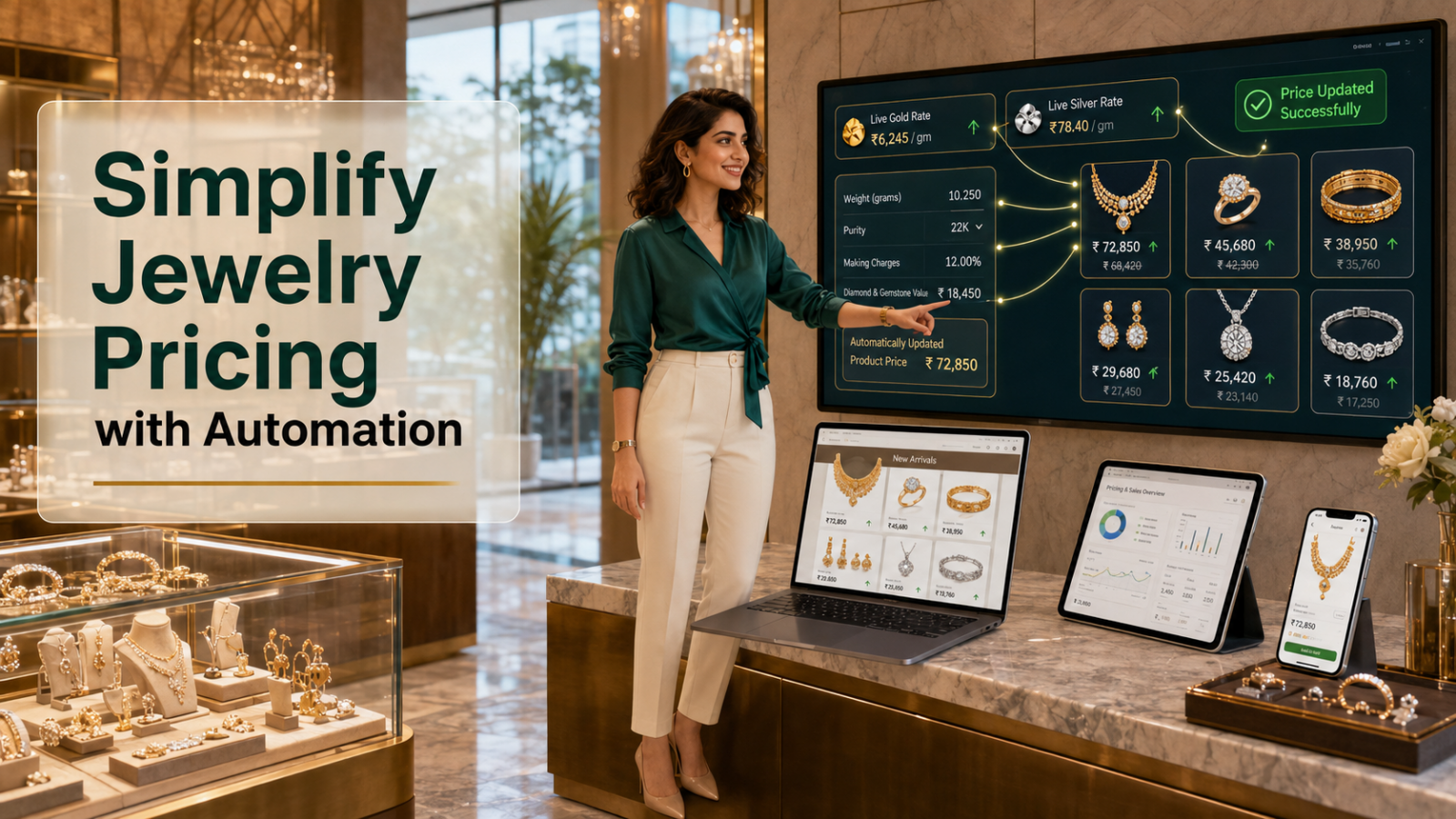
A jewelry price update software connects your online store directly to daily or live gold and silver rates, then recalculates every product's price automatically based on its weight, purity, and current metal value. Instead of editing prices by hand across hundreds of listings, it happens the moment rates change, no one has to touch a single product page.
What Is a Jewelry Price Update Software, and Why Does It Matter?

A jewelry price update software is a tool that sits on top of your online jewelry store and handles one very specific, very repetitive job: keeping product prices lined up with real-world metal rates.
JewelFlex, Shopaccino's dynamic jewelry pricing add-on, is built exactly for this. You update the day's gold or silver rate once, centrally, and it recalculates prices across your entire catalog instantly, based on each product's actual weight and purity.
It is worth being clear about what this is not. It is not an accounting tool, and it does not replace your billing or inventory software. It is the layer that makes sure the number a customer sees on a product page actually reflects today's metal value, not last week's.
Think of it as the difference between a jeweler behind a counter, who can glance at the day's rate board and quote a price on the spot, and an online store that has no equivalent unless someone builds it in. A jewelry price update software is essentially that rate board, wired directly into your product pages instead of hanging on a wall.
Why Manual Gold Rate Updates Quietly Hurt Jewelry Stores
Most jewelry sellers do not lose money on manual updates because they forget to do them. They lose money on the gap between when the rate changes and when every product finally reflects it.
On a catalog with a few hundred SKUs, that gap can stretch for hours. During that window, you are either underselling gold jewelry below its current value, or overpricing it and quietly pushing browsers toward a competitor whose site looks more current.
There is a trust cost too, one that is easy to miss. A customer who checks two jewelry sites in the same afternoon and finds noticeably different prices for similar weight and purity does not usually assume the cheaper one is wrong. They assume the more expensive one is overcharging.
None of this is about a careless team. It is simply not realistic for a person to re-price hundreds of individual products every time gold or silver moves, sometimes more than once in a single trading day.
Picture a store with 400 gold products. Even at a brisk pace of one product a minute, a full manual re-price takes well over six hours, and that assumes nobody gets interrupted, makes a typo, or has to double check a purity mismatch along the way. By the time that pass finishes, the rate has often already shifted again, and the cycle restarts.
The rate does not wait for your admin panel to catch up.
How Does Live Gold and Silver Price Integration Actually Work?

Live gold and silver price integration means your store's pricing engine is connected to a current metal rate, rather than a number someone typed in last week.
Under the hood, the calculation usually works the same way a jeweler would price a piece by hand, just done automatically. The system takes the product's gross metal weight, applies the correct purity factor (14K, 18K, 22K, or the silver equivalent), multiplies that against the current rate you have entered, and then adds making charges and the value of any diamonds or gemstones separately.
Gold and silver rates themselves are not static numbers pulled from thin air. The London Bullion Market Association sets a benchmark gold price twice each trading day, and rates move continuously during global trading hours (lbma.org.uk). A pricing engine that is only updated once a week is, by definition, always a little behind that reality.
With automatic gold and silver price update in place, you decide how often the rate refreshes, once a day is common for most jewelry sellers, and the moment you update that single number, every affected product recalculates on its own.
This also solves a quieter problem: consistency across the catalog. When updates are manual, it is easy for a few products to get missed during a busy day, leaving mismatched pricing sitting live on the site until someone happens to notice. An automated calculation touches every mapped product the same way, every time, so nothing gets left behind by accident.
How to Add Automatic Gold and Silver Price Updates to Your Store With JewelFlex
Here is what setting this up actually looks like, step by step.
- Turn on the JewelFlex app from your Shopaccino apps dashboard. It is listed under the Marketing apps category as a paid add-on. Activating it does not touch your existing product catalog, it simply adds a pricing layer on top of it.
- Set today's gold and silver rates, and decide how often you'll update them. Some sellers update once a day when the local market opens, others update whenever a noticeable rate shift happens. Either way, this is now a single entry point instead of hundreds of individual edits.
- Map each product with its actual weight, purity, and metal type. This is the detail that makes the automation trustworthy. A ring listed as 18K needs its purity marked as 18K, and a piece with an added stone needs its stone weight entered once as a fixed value, so the system prices the metal and the stone correctly rather than lumping them together. This step takes the most upfront effort, but it only needs to be done once per product, not every time the rate changes.
- Decide what customers get to customize. JewelFlex lets you offer purity options (14K versus 18K, for instance) at the product level, with the price adjusting live as the customer picks. Decide upfront which products should offer this flexibility and which should stay fixed, since not every design makes sense to sell in multiple purities.
- Add making charges and any other fixed costs on top of the metal value. The metal rate is only one part of the final price. Making charges, and stone costs need to sit on top of the automated calculation so the number a customer sees is the complete price, not just the raw metal cost.
- Test it on a handful of live products before rolling it out storewide. Change the day's rate once, then check a ring and a chain to confirm the math looks right on the actual product page, not just in the admin panel.
You update one number. Every product listens.
What Customers Actually See on Your Store
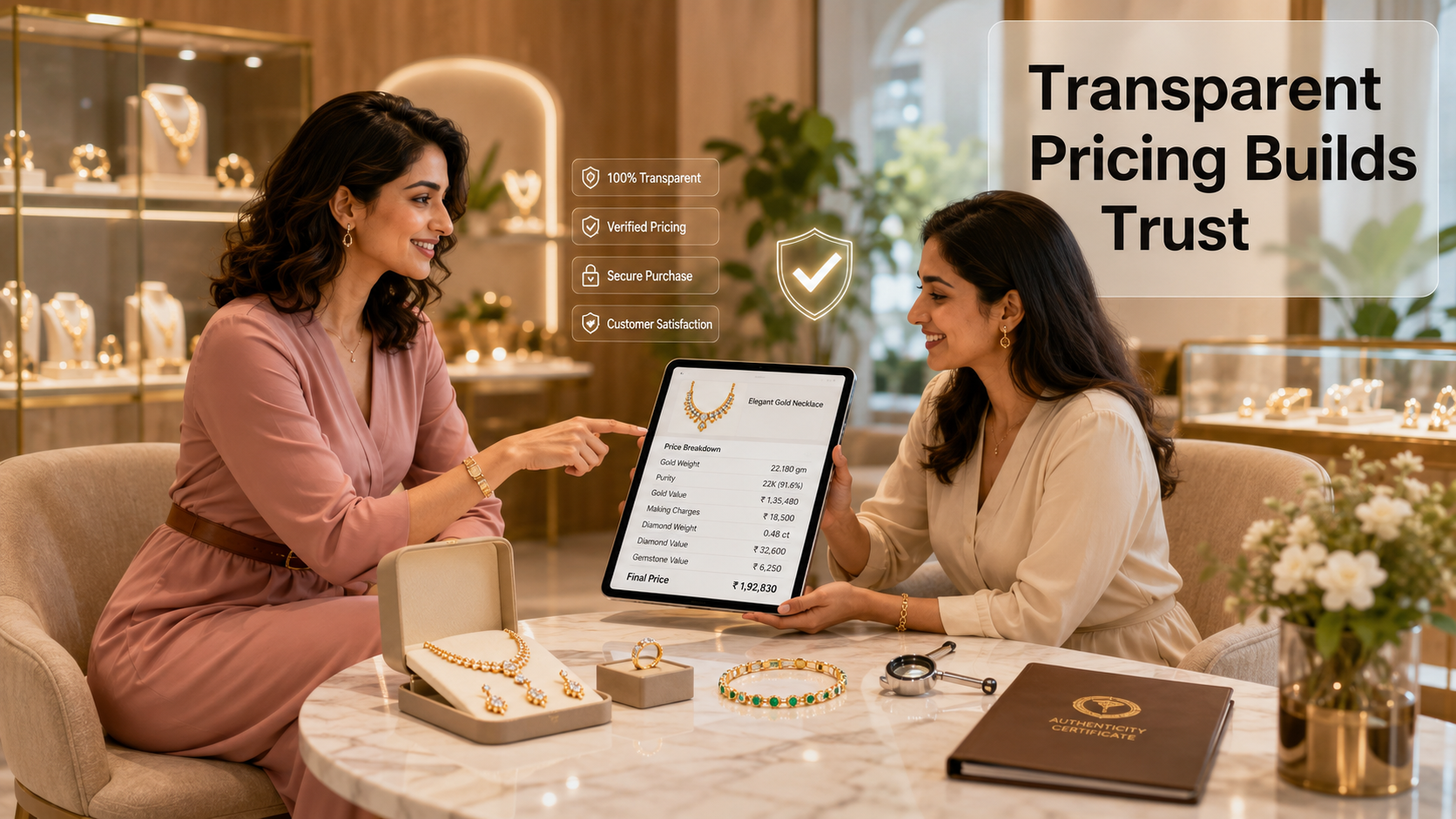
For the shopper, this shows up as transparency rather than automation. Instead of a flat, unexplained price, they see a breakdown: total weight, approximate gross metal weight, diamond weight in carats, gemstone weight in carats, and component weight, all laid out clearly on the product page.
That breakdown does real work. A customer who can see exactly how a price is built, metal value plus making charges plus stone cost, trusts the number far more than one who is just handed a total and asked to accept it.
And when purity or diamond quality is customizable, the price updates live as they choose, the same way it would if they were standing at a counter asking a jeweler to price the same design in a different karat.
This matters more for jewelry than almost any other product category, because the raw material cost is such a visible part of the price. A customer buying a t-shirt rarely wonders what the cotton cost the brand. A customer buying a gold necklace often does exactly that math in their head, and giving them the real breakdown, rather than making them guess, tends to shorten the distance between browsing and buying.
Does Every Jewelry Store Need This?
Stores with a small, slow-moving catalog, say, under fifty products, can sometimes manage manual updates without too much pain, though even then, the daily time cost adds up over a year.
Once a catalog grows past a few hundred SKUs, or spans multiple metals and purities, manual pricing stops being a minor chore and starts being a genuine liability. That is where a jewelry price update software pays for itself quickly, both in staff hours saved and in the margin that stops leaking during rate-change windows.
Silver-focused sellers benefit just as much as gold sellers, arguably more, since silver rates can move by a larger percentage on a given day, making manual tracking even less forgiving.
Diamond and gemstone-heavy brands get an added benefit beyond pricing speed: the ability to show stone details separately from metal cost, which tends to matter more to a customer buying a higher-value piece.
A Few Things Worth Checking Before You Turn It On
- Decide where your daily rate is coming from and how reliable that source is. A pricing engine is only as accurate as the number typed into it each day, so pick a rate source you would be comfortable defending if a customer asked about it.
- Keep a record of rate changes over time. If you ever need to explain a past price to a customer or reconcile it with your accounting, having a simple log saves a headache later, and it takes almost no extra effort to maintain.
- Check how making charges and taxes are applied in your setup, since these vary by product type and region, and it is worth confirming the final displayed price includes everything it should before going live storewide.
- Brief your support team on how the pricing now works, so they can explain a price difference between two visits confidently instead of guessing, especially in the first few weeks after launch when customers are most likely to ask.
How You'll Know This Is Actually Paying Off
Give it a proper month before judging results. Watch how much staff time is no longer spent on manual re-pricing, how often a mismatched or outdated price gets caught before a customer does instead of after, and whether product pages with the new transparent weight and stone breakdown convert better than they did with a flat price alone.
Most jewelry sellers notice the staff-time savings almost immediately, since it is the most visible change. The conversion lift on higher-value, customizable pieces usually takes a little longer to show up clearly, simply because those are lower-frequency purchases to begin with.
Back to That Tuesday Morning Rate Jump
Here is what that Tuesday morning gold rate jump looks like once this is in place. The rate moves, someone updates one number in JewelFlex, and every ring, chain, and pendant on the store reflects it within moments, correctly priced by weight, purity, and stone value, with nobody touching an individual product listing.
That is the entire point of a proper jewelry price update software. Not a fancier calculator, just one accurate number doing the work that used to take an entire afternoon.