Which B2B Ecommerce Platform Is Best for Wholesalers and Distributors?
A wholesale textile manufacturer in Surat. A marble exporter in Rajasthan. A distributor managing 200 dealers across Southeast Asia. A steel fabricator selling both to contractors and directly to construction firms.
These businesses have almost nothing in common with a fashion boutique selling on Shopify. Yet most of them, when they first look for an ecommerce solution, end up evaluating platforms built entirely for retail. The result is predictable: bloated workarounds, missing features, and a system that fights their operations instead of supporting them.
The B2B ecommerce market is now valued at $36.16 trillion globally as of 2026 — nearly five times larger than B2C ecommerce.
Millennials and Gen Z now make up 71% of all B2B buyers (Sopro, 2025). They expect to research, compare, configure, and place orders entirely online — without speaking to anyone. If your business cannot support that experience, they move on.
This guide breaks down what a B2B ecommerce platform actually needs to do for manufacturers, wholesalers, and distributors — and how to evaluate whether a platform is genuinely built for your business model or just marketed that way.
Why Generic Ecommerce Platforms Fail B2B Businesses
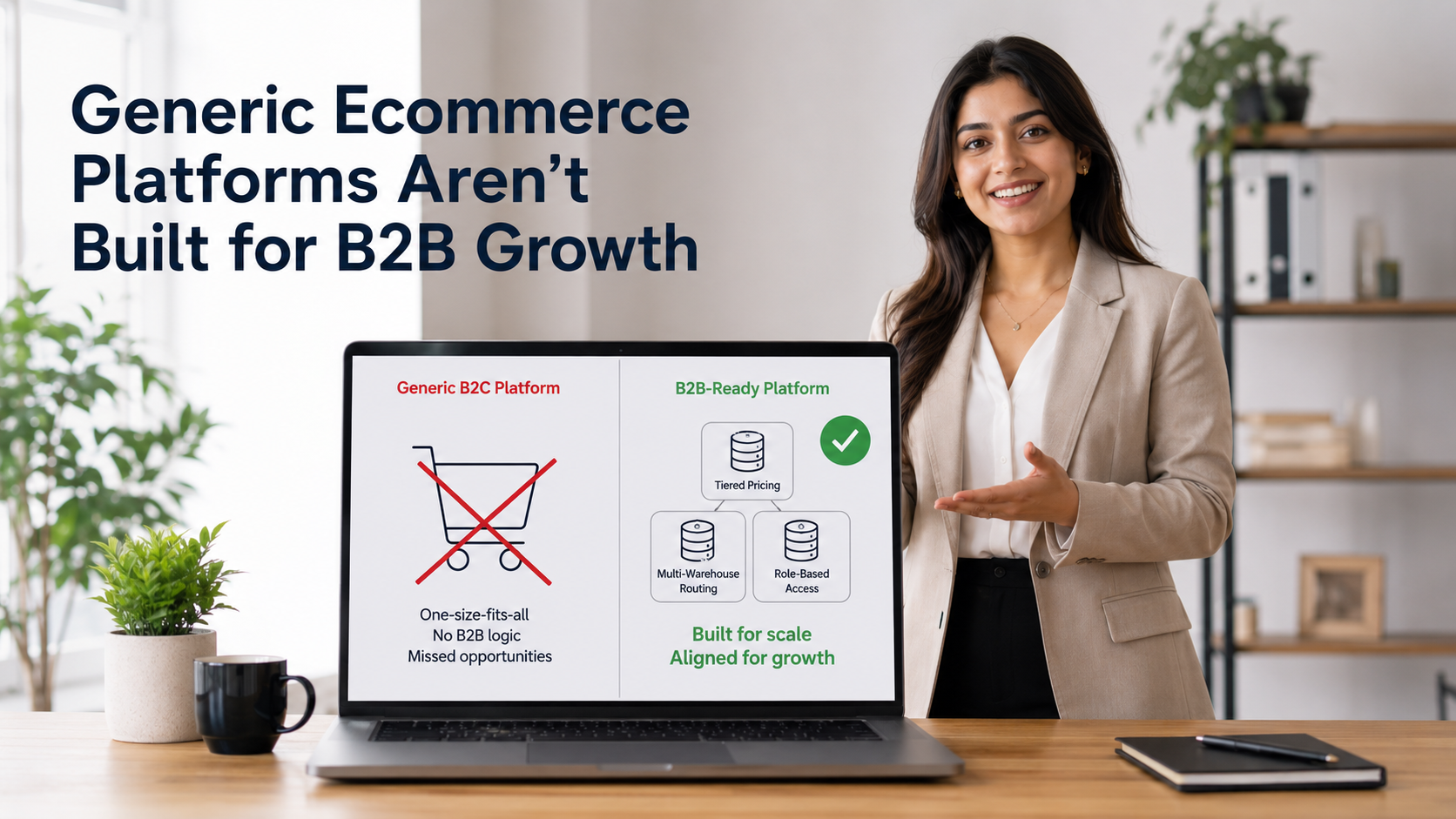
Most popular ecommerce platforms were designed for one thing: helping a retailer list products and take payments. That model works brilliantly for a store selling 50 SKUs to individual consumers.
It breaks down fast when you are a manufacturer with 5,000 SKUs, ten customer tiers with different pricing, multiple warehouses, international buyers requiring custom catalogs, and a sales team managing long-cycle orders with credit terms. See how bulk pricing and tiered discounts work in a proper B2B setup.
Here is where the mismatch typically shows up:
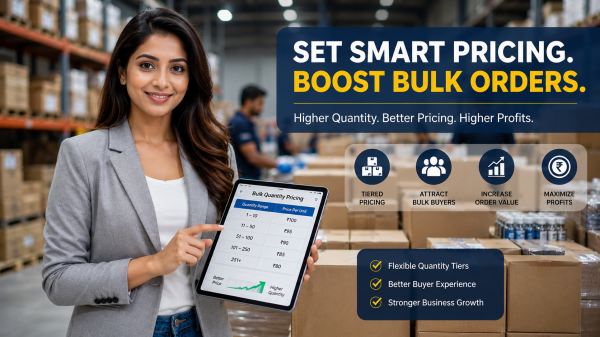
- Pricing: Retail platforms have one price per product. B2B businesses need tiered pricing, customer-group pricing, negotiated contract rates, and MOQ-based discounts.
- Catalogs: In B2B, different buyers see different products. A distributor in Germany should not see the same catalog as a dealer in Jakarta or a direct buyer in Dubai.
- Order complexity: B2B orders involve bulk quantities, partial shipments, split deliveries, and credit-based payment terms. A retail checkout process handles none of this.
- Inventory: Manufacturers and distributors often operate across multiple warehouses. Real-time stock visibility and warehouse-level allocation are essential, not optional.
- Relationships: B2B selling is account-based. Buyers need portals to view their order history, download invoices, track shipments, and reorder without raising a support ticket.
The Core Problem: A B2B ecommerce platform is not a retail ecommerce platform with a bulk order field added. It is a fundamentally different system built around accounts, relationships, pricing complexity, and operational depth that retail platforms were never designed to support. |
What Does the Modern B2B Buyer Actually Expect?
Understanding the buyer is the starting point for understanding what your platform needs to do. The B2B buyer of 2025 and 2026 is not who they were five years ago.
68% of millennial B2B buyers prefer self-service research tools over speaking to a sales rep (Salesforce / Digital Commerce 360, 2025). They want to log in, see their pricing, check stock, place their order, and move on.
73% of B2B buyers are now willing to place orders worth over $50,000 through a digital self-service portal — and 73% are comfortable placing orders of $500,000 or more online. This is not small-ticket convenience purchasing. This is serious procurement happening without a sales rep involved.
By 2026, 80% of all B2B sales interactions will take place across digital channels (Gartner). Businesses that cannot support a self-serve buying experience are already losing deals before they know the buyer was even evaluating them.
What this means practically for your B2B ecommerce platform:
- Buyer portals: Dedicated login areas where each customer sees their pricing, order history, outstanding invoices, and reorder options
- Real-time inventory: Buyers need to know what is available before they place an order, not after they have already committed
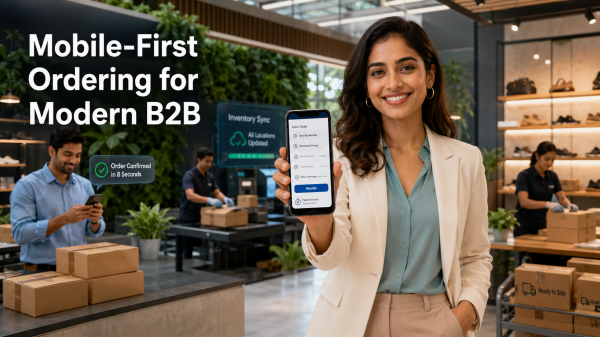
- Mobile-first experience: 38% of B2B transactions now happen on mobile devices. Your platform must work perfectly on a phone, not just on a desktop
- Self-serve reordering: Repeat buyers need to reorder from previous orders in two clicks, not navigate a full product catalog every time
- Multiple payment options: Credit terms, bank transfers, net-30 or net-60 invoicing, and international payment support are all standard B2B requirements
What Are the Must-Have Features of a B2B Ecommerce Platform?
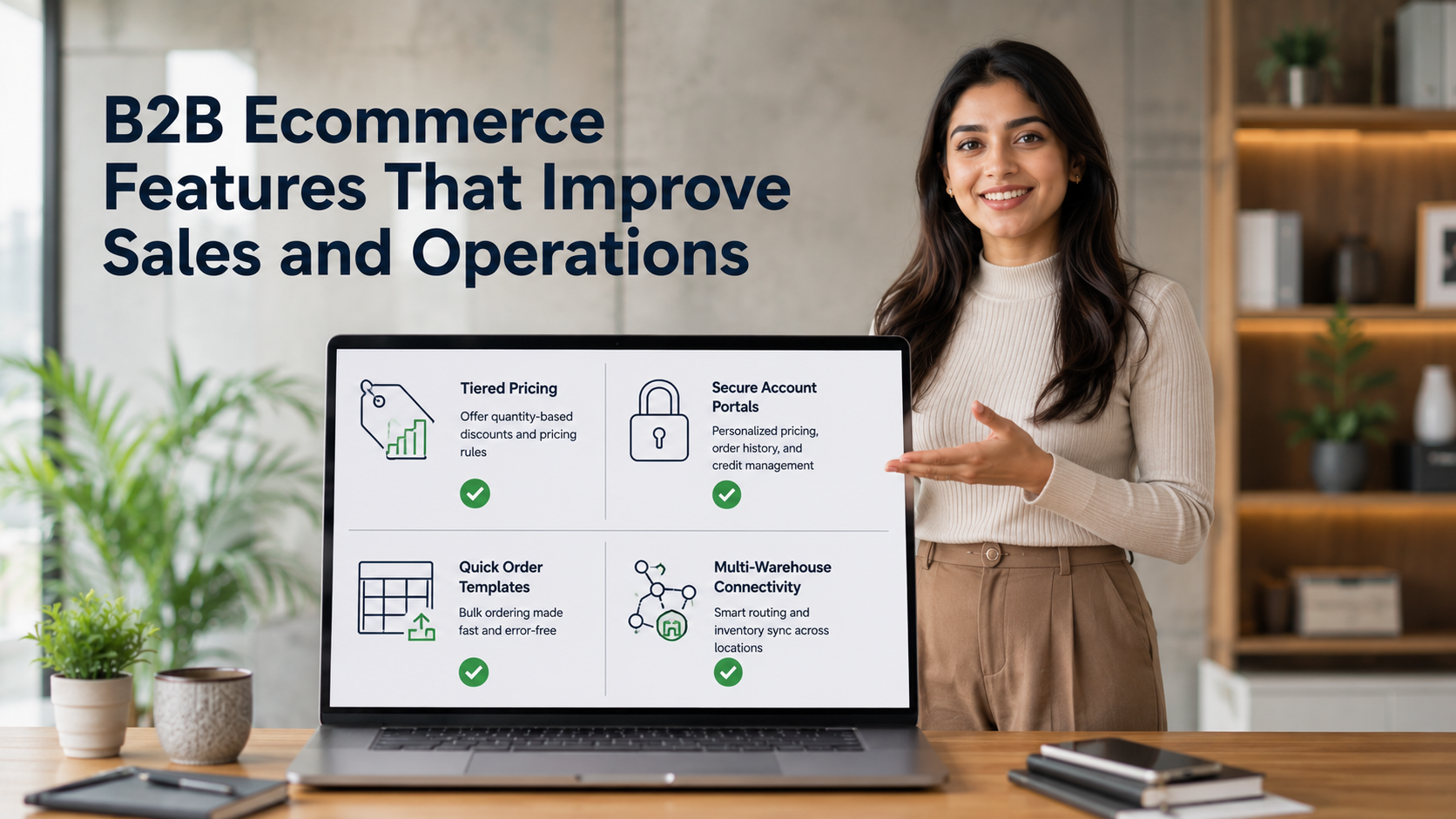
Not all features are equal. Some are nice to have. These are the ones that determine whether a platform actually works for a manufacturer, wholesaler, or distributor.
1.Customer Group-Specific
If you sell through a dealer network specifically, see how manufacturers can maintain different pricing across dealer networks without creating disputes. This is non-negotiable for any serious B2B operation. Different buyers have different agreed rates. A platform must support:
- Customer group pricing (dealers, distributors, direct buyers each see different prices)
- Contract pricing locked to specific groups
2.Custom Catalogs and Product Visibility Control
Not every buyer should see every product. A manufacturer selling to both domestic distributors and international exporters may need entirely different catalog views for each segment, including expiry tracking software.
- Restrict which products specific customer groups can see
- Hide pricing from non-logged-in visitors
- Support for configurable products with custom attributes
3.Bulk Order and Quick-Order Functionality
B2B buyers do not browse like consumers. They know what they want. They need to enter a SKU, a quantity, and place an order. A platform built for B2B makes this fast:
- Quick-order forms where buyers enter SKU codes and quantities directly
- CSV or spreadsheet order upload for large orders
- Saved order lists for frequently purchased combinations
- Reorder from previous orders with one action
How to Evaluate a B2B Ecommerce Platform: The Right Questions to Ask
Before you commit to any platform, ask these questions. The answers will tell you very quickly whether it is genuinely built for B2B operations or just claims to be.
Business Need | What to Ask the Platform | What a Real B2B Platform Says |
Pricing complexity | Can I set different prices per customer group? | Yes, with unlimited tiers and contract pricing per account |
Catalog control | Can different buyers see different products? | Yes, with customer-group and buyer-role-based visibility |
Inventory | Does it support multiple warehouses in real time? | Yes, with warehouse-level stock allocation and routing |
Buyer portal | Can each buyer see their own order history and invoices? | Yes, with branded buyer account portals |
B2B + B2C | Can I run wholesale and direct-to-consumer from one system? | Yes, with automatic logic separating buyer types |
Automation | Does it automate order updates, and invoicing? | Yes, end-to-end automation built in |
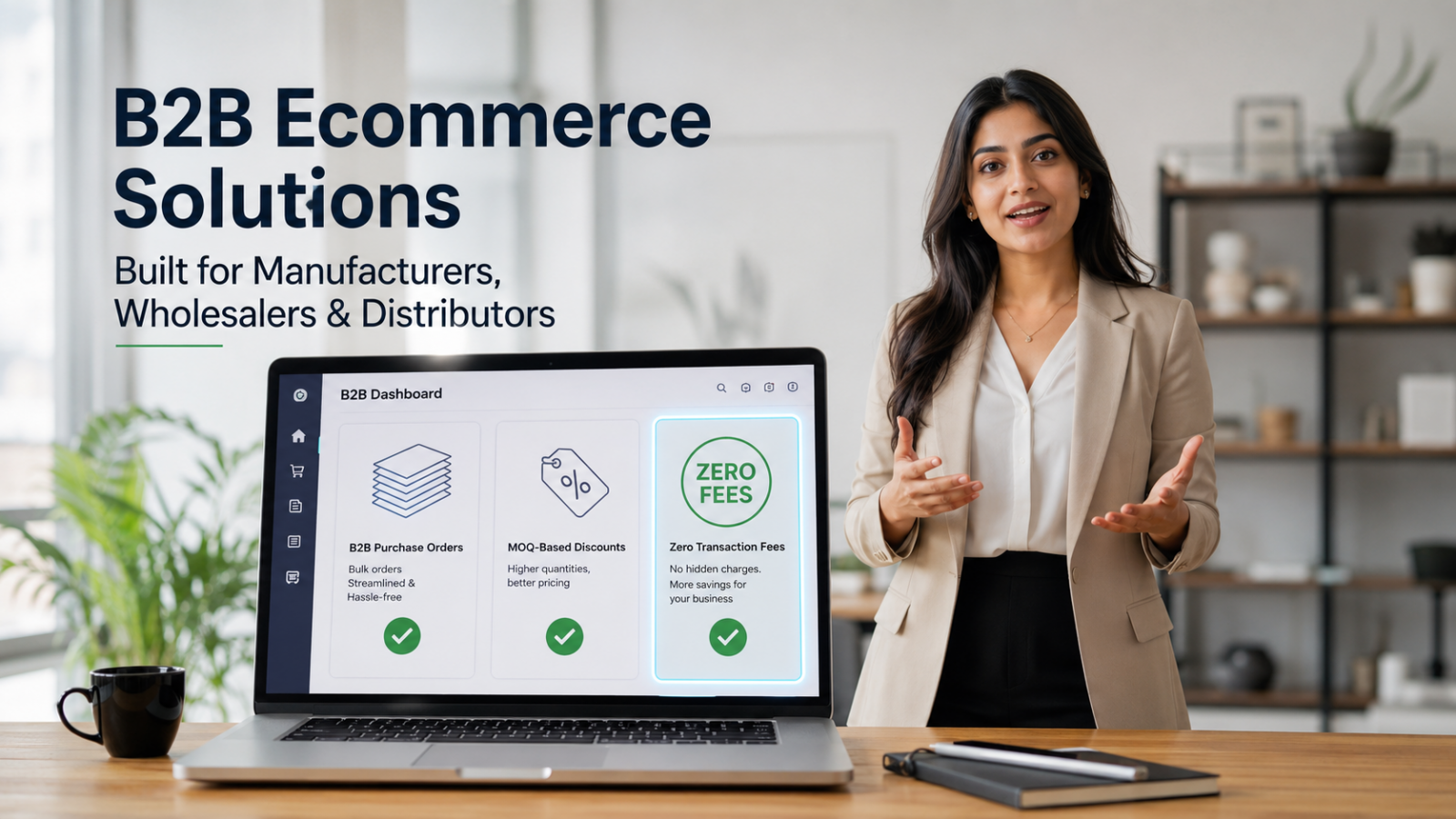
Transaction fees | What percentage does the platform take per order? | Zero transaction fees — you keep everything you earn |
The last row deserves special attention. Platforms that charge a percentage of every transaction are effectively taxing your growth. For high-volume B2B operations processing large orders, this becomes a significant cost that compounds with every sale.
4. Multi-Warehouse Inventory Management
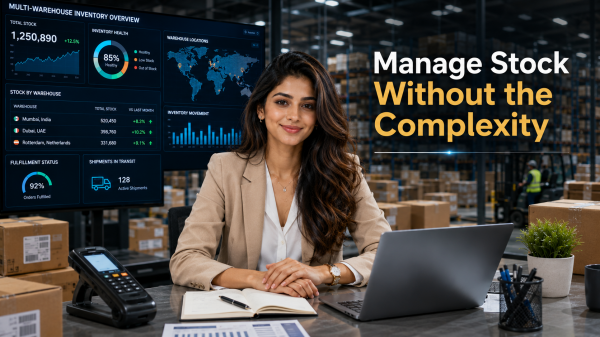
Manufacturers and distributors managing products across multiple locations need live inventory visibility at the warehouse level. Overselling from one warehouse while another has surplus stock is an operational failure a B2B platform must prevent.
Real-World Scenario: A distributor in the UAE manages stock in Dubai, Abu Dhabi, and a fulfillment warehouse in Jebel Ali. Orders from Gulf buyers should route from the nearest warehouse. Orders for export should route from Jebel Ali. A platform without multi-warehouse logic handles this with manual workarounds — which means errors, delays, and unhappy buyers. For a closer look at managing bulk orders and warehouse-wise stock control, see our guide on bulk order and multi-warehouse inventory management for B2B distributors |
5. Buyer Account Portals
Every B2B buyer should have a personalized portal where they can:
- View their complete order history and download invoices
- Track current shipment status in real time
- Set up repeat orders
To see how a buyer portal works in practice — from order capture to real-time stock visibility — check our detailed guide on how distributors can use a B2B portal to receive orders faster and more accurately.
6. Handling Both B2B and B2C from One System
Many manufacturers and distributors sell in two directions at once: wholesale to trade buyers and directly to end consumers. Running these on separate platforms doubles the operational complexity. The right B2B ecommerce platform manages both from a single backend, with logic that shows the right pricing and catalog to the right buyer automatically. See our full guide on how to manage B2B and B2C sales on one platform for a closer look.
7. Built-in Automation for Order Processing and Inventory
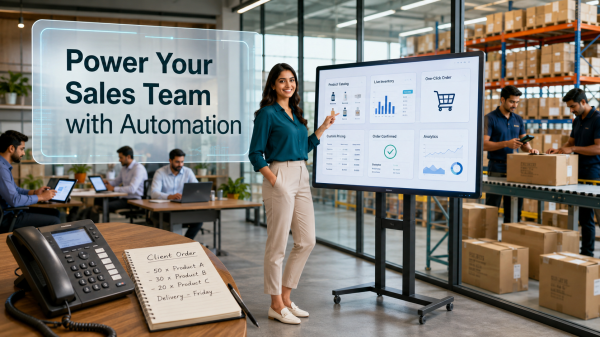
Manual order processing is the first thing to break when volume increases. A B2B ecommerce platform should automate:
- Order confirmation and status updates to buyer
- Shipment notifications integrated with logistics partners
Which B2B Ecommerce Platform Features Matter Most — by Business Type?
Manufacturers, wholesalers, and distributors each have distinct operational needs. A platform that works well for one may lack critical features for another. Here is how the priorities differ:
Business Type | Top Platform Priorities |
Manufacturer selling to distributors | Custom catalogs, configurable products, MOQ pricing, multi-warehouse inventory, dealer portal with account history |
Manufacturer selling direct (D2C + B2B) | Separate buyer-type logic, B2B and B2C from one system, branded mobile app, self-serve reordering |
Wholesale distributor | Tiered pricing, bulk order tools, credit terms and invoicing, multi-location inventory, replenishment automation |
Exporter selling globally | Multi-currency support, international shipping integration, buyer-specific catalogs by region, tax compliance tools |
Distributor managing dealer network | Dealer login portals, territory-based pricing, order approval workflows, sales team visibility on buyer activity |
Why Industry-Specific B2B Ecommerce Platforms Outperform Generic Solutions
There are broadly two types of ecommerce platforms in the market. Generic platforms designed for any business that wants to sell online. And industry-specific platforms built by understanding what particular types of businesses actually need.
The difference shows up immediately when you try to configure your real operations. Generic platforms require you to change how you work to fit the platform's logic. Purpose-built platforms are already configured for how businesses like yours actually operate.
72% of global manufacturers now rely on B2B ecommerce platforms for scalable sales infrastructure (Market Reports World, 2026). The businesses making that move successfully are choosing platforms that speak their operational language — not ones they have to translate everything into.
Shopaccino is built specifically around the real operational needs of manufacturers, exporters, distributors, and D2C brands that are already established businesses moving online. Not for startups experimenting with ecommerce. For businesses that have real operations, real buyer relationships, and real complexity that generic retail platforms were never designed to handle.
The platform enables manufacturers to manage both B2B and B2C sales from a single system, distributors to run multi-warehouse operations with automated order routing, and exporters to sell globally with the pricing and catalog control international buyers require. Built-in automation handles inventory, logistics, payments, and order fulfillment, with zero transaction fees so every rupee, dollar, or dirham you earn stays with you.
For businesses already selling offline that want to move their operations online without rebuilding their workflows from scratch, this is what purpose-built looks like.
Common Mistakes Manufacturers and Distributors Make When Choosing a B2B Platform
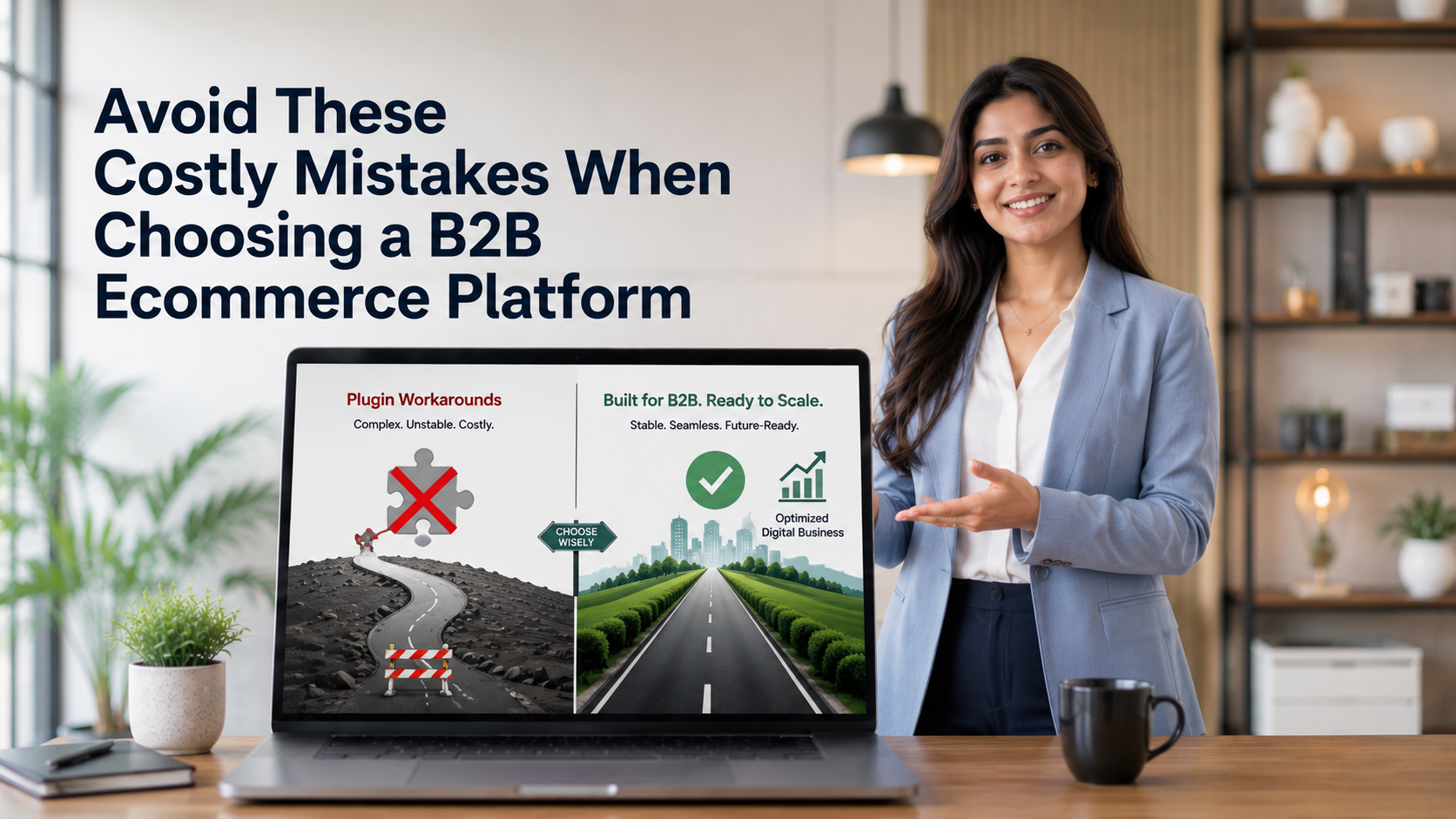
After speaking with businesses across industries, the same mistakes come up repeatedly. These are worth knowing before you start evaluating:
- Choosing the cheapest option and rebuilding it with plugins: A retail platform with five B2B plugins is not a B2B platform. You will spend more on development and maintenance than a purpose-built platform would have cost.
- Focusing on front-end design over back-end operations: A beautiful store that cannot handle your pricing complexity, multi-warehouse stock, or buyer portal requirements will fail your business regardless of how it looks.
- Ignoring transaction fees: On a platform charging 1-2% per transaction, a business processing 1 crore in monthly orders pays 1 to 2 lakh per month just to use the platform. Over a year, that is 12 to 24 lakh in fees.See a real side-by-side breakdown of transaction fees across Shopify, BigCommerce, and Shopaccino.
- Not testing with real buyer journeys: Before committing to any platform, walk through your actual buyer's journey. Log in as a customer. Try to place a bulk order. Try to reorder. Try to download an invoice. You will learn more in twenty minutes than in any demo.
- Separating B2B and B2C into two different stores: Managing dual systems means double the inventory reconciliation, double the catalog maintenance, and double the operational overhead. One system that handles both is always more efficient.
The Numbers That Explain Why This Decision Matters Now
This is not a trend to prepare for. The shift has already happened, and businesses that delayed are already behind.
Data Point | Figure and Source |
Global B2B ecommerce market size (2026) | $36.16 trillion (ITA / SellersCommerce) |
Manufacturing's share of B2B ecommerce market | 24% — largest single industry segment (Swell, 2025) |
B2B buyers who are Millennials or Gen Z | 71% of all B2B buyers (Sopro, 2025) |
Millennial buyers preferring self-service over sales reps | 83% prefer digital self-service (Swell / Salesforce) |
B2B transactions where buyers spend $500K+ online | 73% comfortable placing such orders digitally (Ringly.io) |
B2B sales interactions happening digitally by 2026 | 80% (Gartner forecast) |
SaaS ecommerce platform adoption among B2B businesses | 61% have migrated to SaaS-based platforms (Market Reports World) |
B2B ecommerce market CAGR through 2030 | 14.5% annually (multiple sources) |
Manufacturing alone accounts for nearly a quarter of the entire global B2B ecommerce market. If you are a manufacturer, wholesaler, or distributor still managing orders through phone calls, WhatsApp, and Excel sheets, you are not just missing a convenience feature. You are losing ground to competitors who have already moved online.
The Right B2B Ecommerce Platform Is Not the Most Popular One — It Is the Right Fit for Your Business
The best B2B ecommerce platform for your business is the one that fits how you actually operate — your pricing structure, your buyer relationships, your warehouse setup, and your need to manage both trade and direct-to-consumer sales without running two separate systems.
The B2B ecommerce platform you choose should handle your complexity natively — not through a chain of workarounds, plugins, and customizations that become harder to maintain every time you grow.
Before you sign up for any platform, walk through your real-world operations with it. Set up your actual pricing tiers. Test a bulk order. Log in as one of your buyers and try to reorder. See whether the inventory reflects your warehouse structure. That twenty-minute test will tell you more than any feature comparison list.
Businesses that have already spent years selling offline have operational depth that is an asset. The right B2B ecommerce platform brings that offline expertise online — without asking you to rebuild your business from scratch.
FAQs
A B2B ecommerce platform is built for businesses selling to other businesses — not individual consumers. It handles tiered and customer-specific pricing, bulk ordering, buyer account portals, multi-warehouse inventory, credit terms, and the ability to manage different catalogs for different buyer types. Regular ecommerce platforms are designed for retail and lack these features natively.
Yes, if it is purpose-built for this. The platform should automatically show B2B pricing to verified trade buyers and retail pricing to direct consumers — from the same backend, same catalog, and same inventory system. Running two separate stores for B2B and B2C creates unnecessary complexity and doubles operational overhead.
Critical. Without real-time multi-warehouse inventory, businesses risk overselling from one location while stock sits idle in another, incorrect delivery routing, and delayed fulfillment. Any manufacturer or distributor operating more than one physical location needs warehouse-level stock visibility and automated order routing built into their platform.
Generic platforms work well for retail-style sales. For manufacturers with multiple buyer tiers, configurable products, bulk ordering needs, and dealer network management, the workarounds required on a generic platform quickly become expensive and unstable. A purpose-built B2B ecommerce platform handles these natively and costs less to operate over time.
Look for zero transaction fees. Platforms that charge a percentage per order are effectively taxing your growth.
With a purpose-built SaaS B2B ecommerce platform, most established businesses can go live within 4 to 8 weeks. The key variable is catalog size and pricing complexity. Platforms with built-in B2B logic require far less setup time than generic platforms being customized to handle B2B workflows after the fact.