
How to Optimize Product Pages for ChatGPT, Gemini, and AI Search Engines
You've spent weeks building the perfect product page. Great photos, a clean layout, compelling copy. And it still doesn't rank. Or worse — it ranks on Google, but when someone asks ChatGPT "what's the best [your product category] to buy," your store doesn't even come up.
That's the new reality for ecommerce in 2026. Search isn't just Google anymore. ChatGPT has over 100 million weekly active users. Google's own AI Overviews now appear above traditional results for millions of queries. Gemini is embedded into Android phones and Google Workspace. Buyers are getting product recommendations straight from AI — before they ever click a search result.
The question isn't whether AI search matters. It's whether your product pages are built for it. Most aren't. This guide walks you through exactly how to fix that — whether you sell fashion, home decor, industrial goods, or anything in between, and wherever in the world your customers are.
What Makes AI Search Engines Different from Google?
Traditional SEO is about ranking a URL. AI search is about becoming the answer.
When someone types a query into Google, they get a list of blue links. They click one, browse, decide. When someone asks ChatGPT the same question, they get a single synthesized response — and usually, a product or brand recommendation embedded in it.
Here's the core difference: Google indexes pages. AI search engines synthesize information from pages they've already crawled, trained on, or retrieved via real-time browsing. They're looking for pages that are:
- Easy to extract facts from
- Written in clear, direct language
- Structured so a machine can understand context (not just keywords)
- Trustworthy based on signals like structured data, backlinks, and consistency
One important nuance: ChatGPT with browsing, Gemini, and Perplexity all retrieve live pages from the web. That means your pages still need to be indexable, fast, and technically sound — just like for Google. The optimization layer on top is about structure and clarity.
How Do ChatGPT and Gemini Actually Find and Recommend Products?
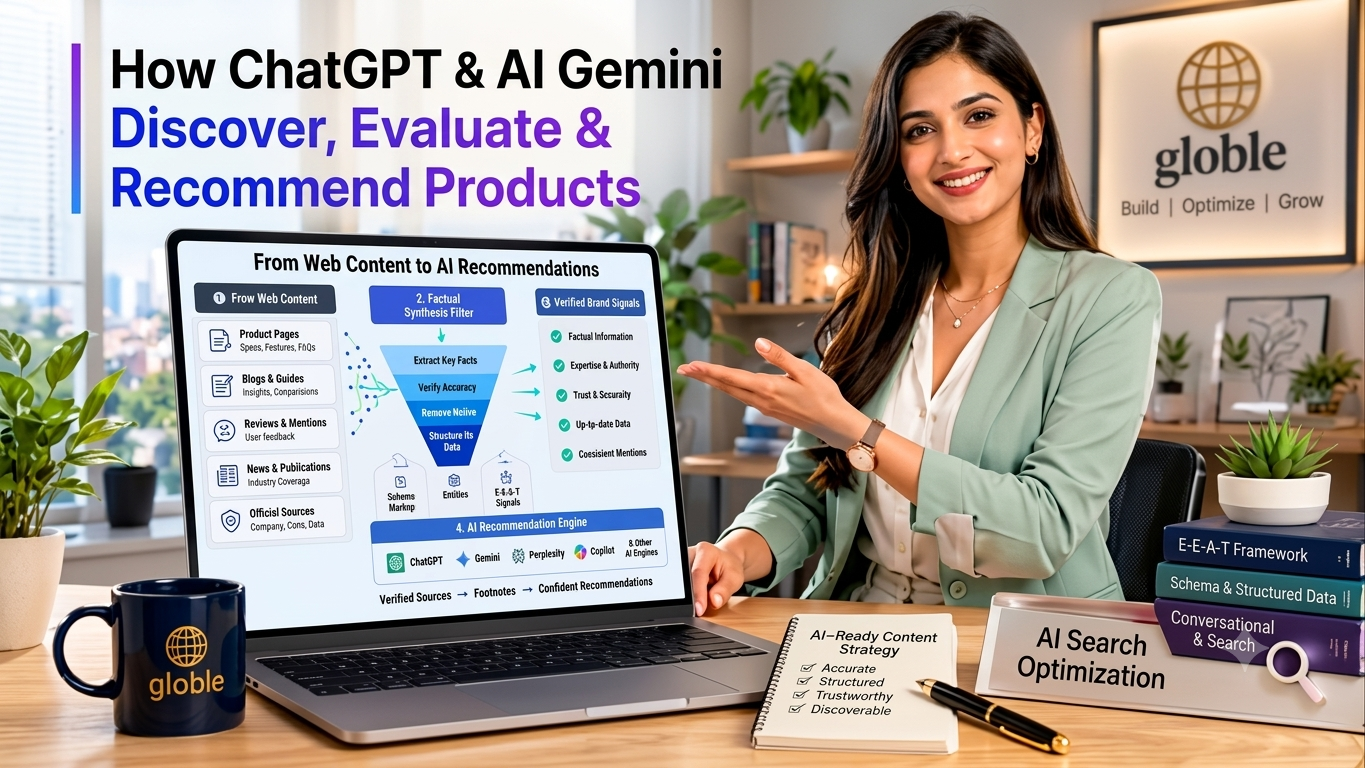
Understanding the mechanics helps you optimize smarter.
ChatGPT (with browsing enabled)
When a user has web browsing turned on, ChatGPT uses Bing to retrieve current pages, then synthesizes a response. It tends to pull from pages that:
- Appear in the top organic results on Bing/Google
- Have clear headings that match the user's question
- Contain specific, factual product details (dimensions, materials, certifications, use cases)
- Have structured data that labels products, prices, reviews, and availability
Google Gemini and AI Overviews
Google's AI Overviews pull from its own index, so traditional SEO authority still matters — but the format of the answer changes. Google is looking for pages with:
- Concise definitions or summaries near the top
- Well-labeled sections using proper heading hierarchy (H1, H2, H3)
- FAQ content that directly answers related questions
- Product schema markup that tells Google exactly what you're selling
Perplexity and Other AI Search Tools
Traditional SEO built its rules around Google — keywords, backlinks, domain authority. Perplexity throws most of that out. It operates as an AI-powered answer engine that cites its sources directly and links back to them — so the traffic is real and attributable. What gets cited isn’t the highest-authority domain; it’s the clearest, most specific, most factual page on the topic. That’s a meaningful shift for ecommerce sellers. A well-structured product page from a mid-size exporter or D2C brand can outperform a big-box retailer if the content is simply better organized and more directly useful to the person asking.
How to Optimize Product Pages for AI Search Engines: 8 Practical Steps
1. Write Product Descriptions That Answer Real Questions
Most product descriptions are written to persuade, not to inform. AI search engines want the latter.
Instead of: "Our premium handcrafted ceramic mug brings warmth to your mornings."
Try: "350ml ceramic mug, dishwasher-safe, microwave-safe. Handcrafted in Portugal. Available in 6 colors. Suitable for coffee, tea, or hot chocolate."
The second version is machine-readable. It answers: What is it? How big? What's it made of? What can I do with it? AI engines can extract and summarize that instantly.
- Include exact dimensions, materials, compatibility, and use cases
- State what the product is in the first sentence — don't save it for later
- Use plain language; avoid metaphors and vague adjectives in factual sections
2. Add Structured Data (Schema Markup)
A well-tagged product page includes:
- Product name
- Price and currency
- Availability (in stock / out of stock)
- Customer reviews and aggregate rating
- Brand name and SKU
- Images (with alt text)
3. Use Question-Based Headings on Your Product Pages
This is one of the most underused tactics in ecommerce. AI systems are trained to match user questions to content. If your headings match the way buyers phrase their questions, your pages are far more likely to be surfaced.
Instead of generic headings like "Features" or "Details," try:
- "What is this product made of?"
- "Is this suitable for outdoor use?"
- "How does this compare to similar products?"
- "What sizes are available?"
- "What do customers say about this product?"
These aren't just good for AI — they're good for buyers who skim pages looking for specific answers. It's a win on both fronts.
4. Build a Product FAQ Section
Good FAQ topics for product pages:
- Shipping times to common regions
- Return and exchange policy
- Product compatibility questions
- Care or maintenance instructions
- Whether the product is suitable for specific uses
Mark up your FAQ with FAQPage schema (also documented at schema.org) for maximum visibility in both Google and AI results.
5. Optimize for Voice and Natural Language
Your content needs to match this. That means:
- Writing in full sentences, not keyword-stuffed fragments
- Including long-tail, question-based keyword phrases naturally in your copy
- Addressing "who is this for?" and "when would someone use this?" explicitly
6. Focus on E-E-A-T Signals
For ecommerce product pages, E-E-A-T signals include:
- Verified customer reviews (with dates)
- Manufacturer or brand information
- Certifications, awards, or third-party endorsements
- User-generated photos or videos
- Transparent return and warranty policies
A furniture exporter listing their ISO certification on a product page signals trustworthiness. A clothing brand showing factory photos demonstrates authenticity. These details aren't just for humans — AI systems pick up on them too.
7. Improve Page Speed and Mobile Experience
This isn't new advice, but it matters more now. AI tools that browse the web in real time skip slow-loading pages. If your product page takes more than 3 seconds to load, it's invisible to a significant portion of AI-driven traffic.
Core Web Vitals — Google's standardized speed and experience metrics — directly affect whether your pages are crawled, indexed, and included in AI results. You can check your scores for free at pagespeed.web.dev.
- Compress product images without sacrificing quality
- Minimize JavaScript that blocks page rendering
- Use lazy loading for images below the fold
- Ensure your pages render correctly on mobile — AI queries are increasingly mobile-first
8. Build Internal Linking with Context
Practical examples:
- Link a marble tile product page to a blog on "How to Choose the Right Marble for Your Home"
- Connect a B2B packaging product to a guide on "MOQ and Bulk Order Pricing"
- From a clothing product page, link to a size guide and a care instructions post
These contextual links help AI tools understand what your product is for, who it's for, and how it compares to alternatives — which is exactly the context they need to recommend it.
Why B2B and Wholesale Sellers Need to Think About This Too
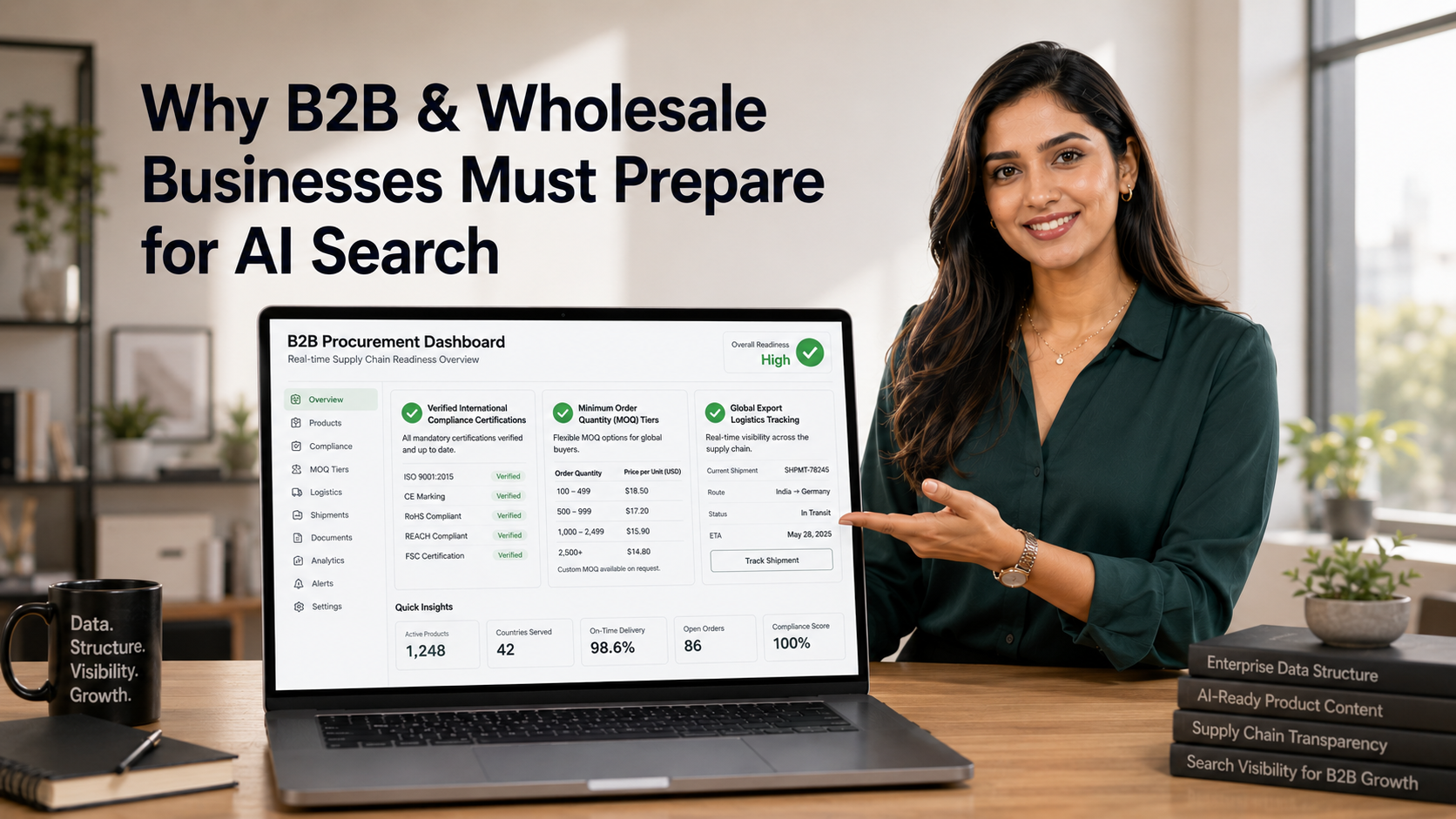
A lot of AI search optimization content is written with D2C brands in mind. But manufacturers, exporters, and distributors selling B2B have just as much to gain — possibly more.
Procurement managers are starting to use AI tools to research suppliers. "Find a reliable marble exporter in Rajasthan who ships to Europe" is exactly the kind of query Perplexity or ChatGPT with browsing might attempt to answer. If your product pages are vague, lack certifications, or don't clearly explain MOQs and shipping terms, you won't show up.
B2B product pages need:
- Clear MOQ (minimum order quantity) information
- Accepted payment terms and currencies
- Export certifications and compliance details
- Country-specific shipping availability
- Contact or inquiry CTAs that are easy to find
For businesses that manage both B2B and B2C sales from a single platform, keeping product information consistent across both buyer types is essential — because AI systems will read the same page regardless of who lands on it.
What Does an AI-Optimized Product Page Actually Look Like?
Here's a practical anatomy:
Page Element | AI Optimization Best Practice |
H1 Product Title | Include category and key attribute: "Handcrafted Marble Dining Table — 6-Seater, White Carrara" |
Product Description (First Para) | Direct, factual. State what it is, what it does, who it's for. No fluff. |
Key Specs Section | Use a structured list or table. Label each spec clearly. |
Question-Based Headings | "Is this suitable for outdoor use?" "What sizes are available?" |
Customer Reviews | Display with dates, verified labels, and aggregate rating schema |
FAQ Section | 5-8 questions; use FAQPage schema markup |
Internal Links | Link to related guides, comparisons, or category pages |
Structured Data | Product schema: name, price, availability, brand, SKU, rating |
How Does This Connect to Your Ecommerce Platform?
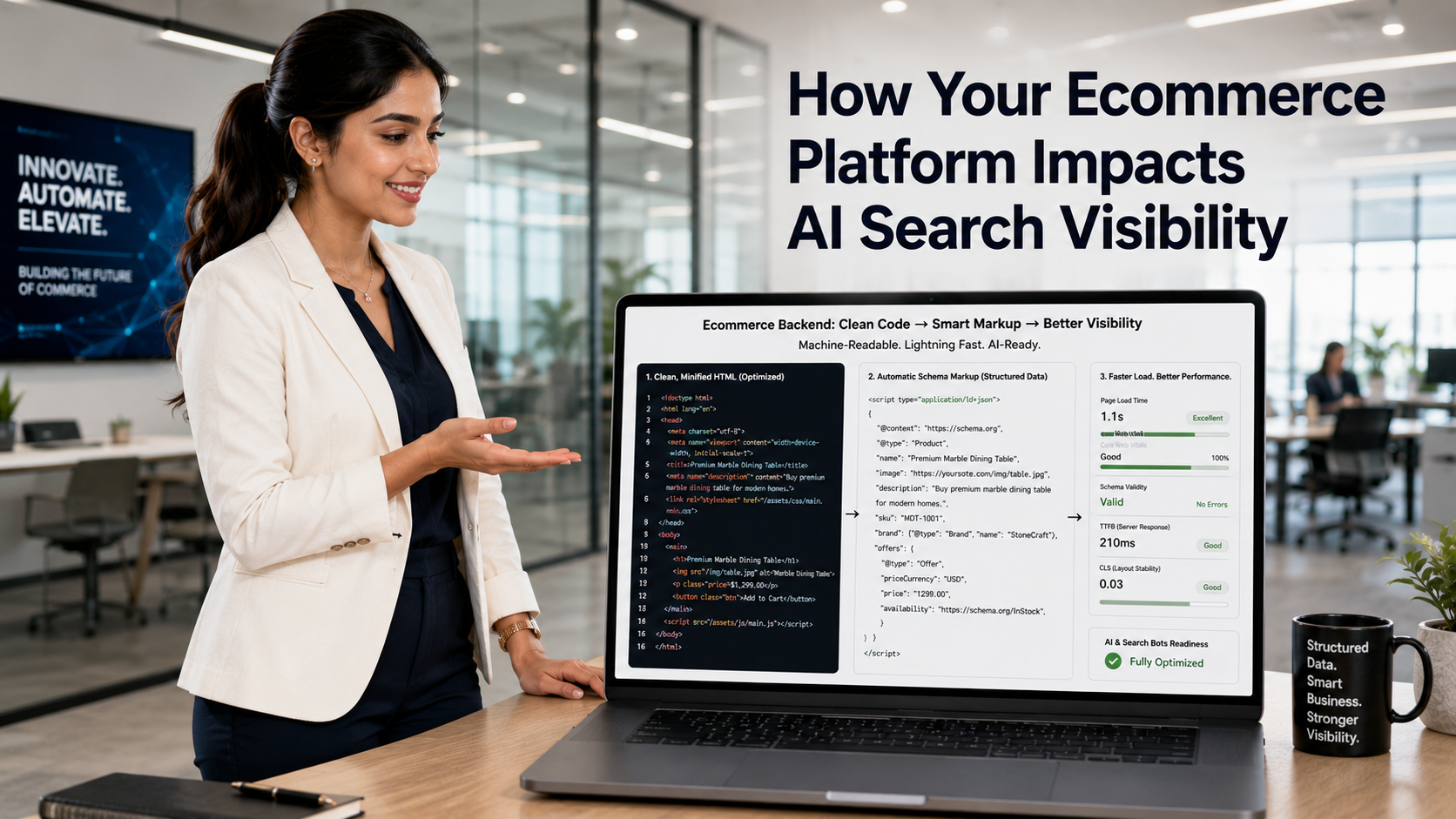
The tactics above assume you have control over your product page structure — headings, schema, FAQ sections, page speed. That's why your choice of ecommerce platform matters more than ever in an AI-first search environment.
Platforms that generate clean HTML, automatically include schema markup, support flexible page structures, and load fast give you the best foundation for AI search visibility. If your current platform produces bloated code, doesn't support schema, or makes it hard to add structured content, you're fighting uphill.
Common Mistakes That Make Product Pages Invisible to AI
Just as important as knowing what to do is knowing what to avoid:
- Duplicate descriptions: Copying manufacturer descriptions verbatim. AI systems deprioritize duplicate content.
- Vague titles: “Premium Quality Product” tells AI nothing. Include category, material, and key attributes.
- Missing or broken schema: Schema with errors gets ignored. Use Google’s Rich Results Test to validate.
- No reviews: AI engines treat review signals as trust indicators. Pages without any reviews get less weight.
- JavaScript-rendered content: If your product details only appear after JavaScript runs, some AI crawlers won’t see them at all. Critical content should be in the HTML.
- No mobile optimization: With mobile-first indexing standard, a product page that breaks on mobile is effectively invisible.
Where to Start If You're Doing This From Scratch
It doesn't have to be overwhelming. Here's a realistic sequence:
- Audit your 10 best-selling products first. These are your highest ROI pages.
- Rewrite descriptions to be specific, factual, and question-answering.
- Add or fix Product schema on those pages.
- Add a 5-question FAQ section to each page.
- Run a page speed check via pagespeed.web.dev and fix the biggest issues.
- Then expand to your next 10 products.
None of this requires a developer on call or a massive budget. It requires attention to detail and a willingness to write for both humans and machines. Once you've done it for a handful of products, it becomes second nature.
FAQs
It means structuring your product pages so AI tools like ChatGPT, Gemini, and Perplexity can accurately read, understand, and recommend your products. This involves clear descriptions, question-based headings, structured data (schema markup), and FAQ sections that answer buyer questions directly.
Partly. Traditional SEO focuses on keyword rankings and backlinks. AI search optimization (also called AEO) focuses on making your content machine-readable and answer-friendly. But the foundations overlap — fast pages, clean HTML, good content, and structured data matter for both.
Not necessarily. Many ecommerce platforms add Product schema automatically. If yours doesn't, plugins or theme settings often handle it. You can verify what schema your page has using Google's free Rich Results Test at search.google.com/test/rich-results.
Yes. Procurement teams and wholesale buyers increasingly use AI tools to research suppliers. B2B product pages need the same structural clarity — plus specific details like MOQs, certifications, shipping terms, and export compliance — to appear in AI-driven search results.
Schema markup and structured content improvements can be crawled within days to weeks. AI recommendations shift more gradually as AI tools update their knowledge. Focus on your top-selling products first for the fastest visible impact.
Product schema (name, price, availability, brand, SKU), AggregateRating schema (for customer reviews), and FAQPage schema (for FAQ sections) are the three highest-impact types. All are documented at schema.org and supported by Google's structured data guidelines.