How to Launch Your Own Quick Commerce Platform and Start Delivering Faster
Building a quick commerce platform looks deceptively simple from the customer side, Open an app, Add items, Place the order, Receive in 15 minutes. Behind that experience sits the most operationally complex part of modern retail. Dark stores stocked with the right SKUs at the right time. A delivery fleet that can dispatch within seconds. Software that routes orders, picks them, and tracks them in real time. Unit economics that have humbled some of the best-funded companies in the world. Quick commerce is one of the biggest ecommerce trends 2026 shaping how stores operate.
This guide is written for established businesses (grocery chains, pharmacy networks, multi-outlet retailers, and D2C brands with existing customer bases) evaluating their own fast-delivery launch. It is not a guide to building the next Blinkit, Gopuff, or Getir competitor. Those operations are venture-funded and operate at a scale most businesses cannot match. The honest opportunity for most companies is launching Q-commerce within their existing markets and customer base, where the structural advantages are real and the unit economics can work.
We will walk through what it actually takes to launch and operate one, structured as four stacked layers: the customer promise, the physical infrastructure, the technology, and the unit economics. Each layer has to work for the layer above it to function. By the end you will know whether your business is the right candidate, what categories actually work, what the physical setup involves, where software fits in, and what the honest economics look like.
What Is a Quick Commerce Platform?
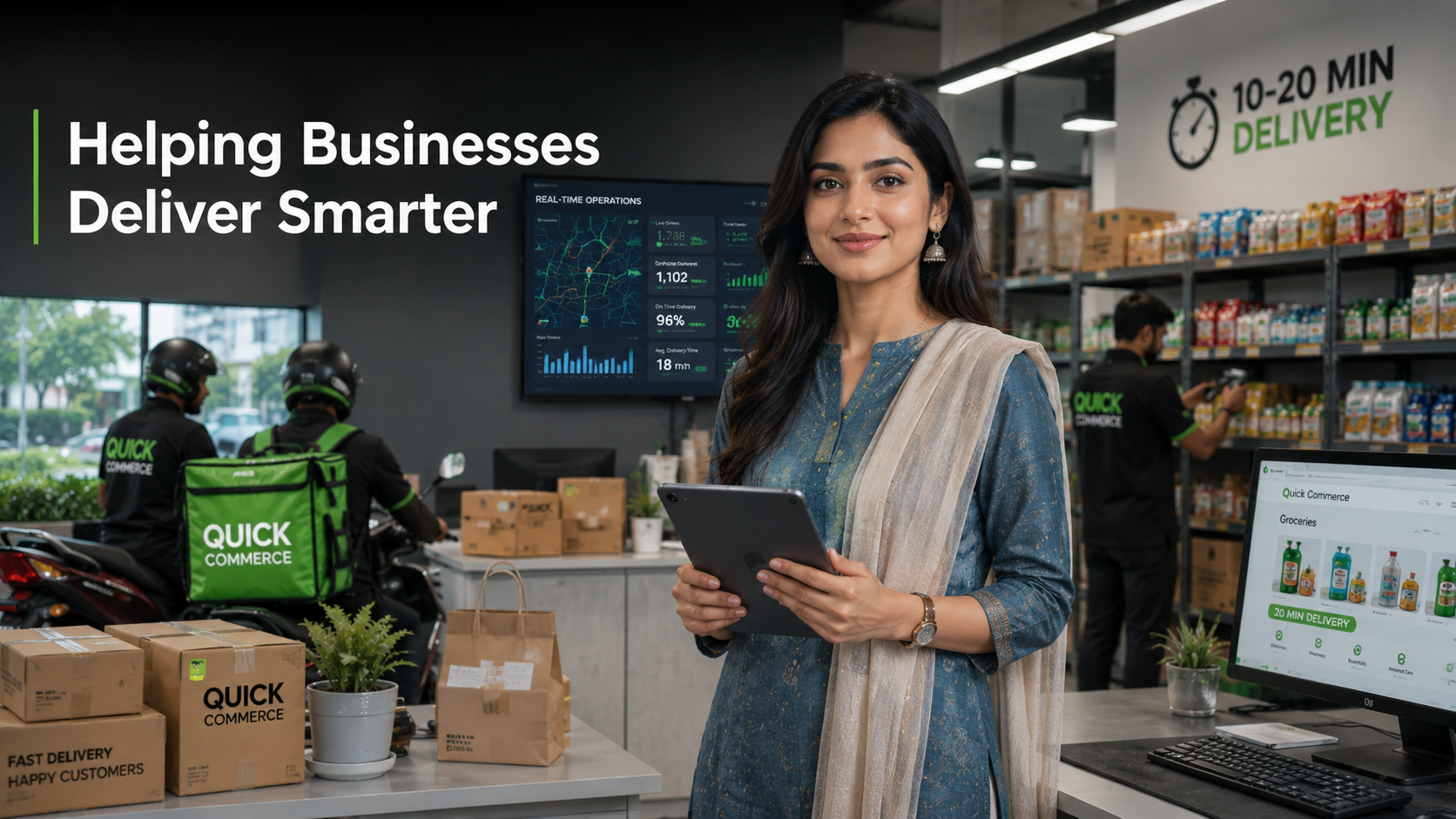
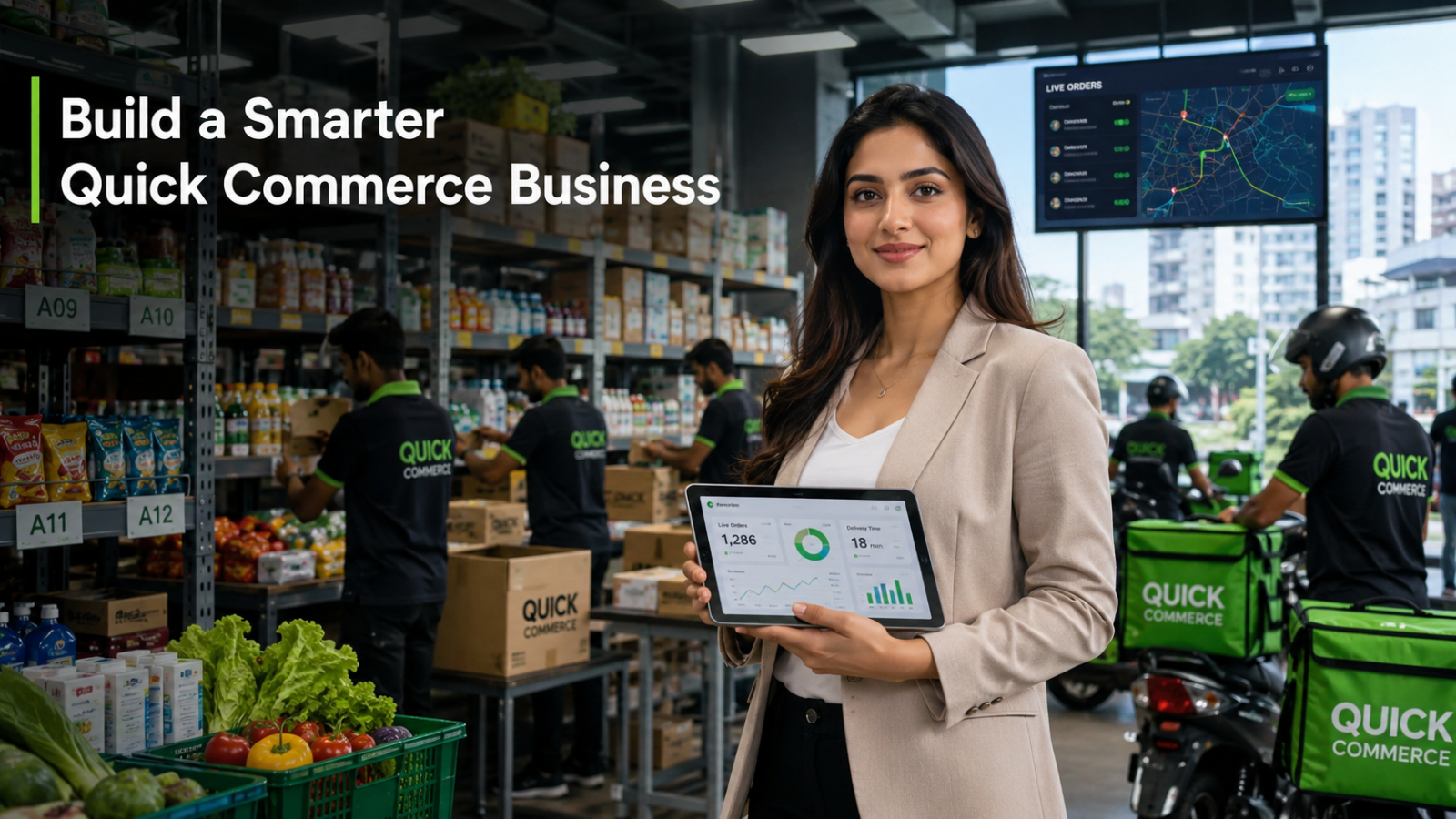
A quick commerce platform is an e-commerce operation that delivers orders to customers within 10 to 30 minutes by pre-positioning inventory in small neighbourhood warehouses called dark stores. Examples include Blinkit, Zepto, Swiggy Instamart, Gopuff, Rappi Turbo, and iFood Mercado. The category covers groceries, pharmacy, pet supplies, beauty essentials, and other high-velocity convenience products.
The defining feature of Q-commerce is speed at the expense of breadth. A regular ecommerce site might offer 30,000 SKUs delivered in two to five days. A quick commerce platform offers a curated 2,000 to 6,000 SKUs delivered in under 30 minutes. The trade-off only works for categories where speed is more valuable to the customer than range, which is why groceries, urgent pharmacy, and convenience products dominate the category globally.
Most failed Q-commerce startups failed not because the technology was wrong but because the unit economics never closed at scale. That is what the four layers below are designed to address.
LAYER 1 • The Customer Promise
Everything starts with the customer expectation. A quick commerce platform makes a specific promise: this order will arrive in 10 to 30 minutes. Once that promise exists, every operational decision is locked in by it. Inventory placement, fleet design, routing rules, and even the categories you sell are all downstream of the time window you commit to.
What Time Window Should Your Quick Commerce Platform Promise?
There is no single right answer. Different time windows enable different operations and target different customer needs.
Time Window | Operational Requirement | Best Categories |
|---|---|---|
10 to 15 minutes | Very dense dark store network within 2.5 km of customers | Groceries, urgent pharmacy, snacks, beverages |
15 to 30 minutes | Dark stores within 5 to 6 km, less density required | General groceries, pet supplies, beauty, OTC pharmacy |
30 to 60 minutes | Larger fulfilment centres further out | Wider grocery, household, electronics |
Same day (1 to 4 hours) | Hub and spoke fulfilment from a few large warehouses | Apparel, books, furniture, considered goods |
The faster you promise, the more dark stores you need, the higher the rent and staffing cost per order, and the narrower the catalogue can be. Going under 15 minutes is exceptionally hard outside dense city centres. Most sustainable Q-commerce operations live in the 15 to 30 minute range. Going to same-day is operationally simpler but is no longer competitive Q-commerce in mature markets.
Which Categories Actually Work for Quick Commerce?
Not every product fits the Q-commerce model. The categories that work share three qualities: they are urgent or convenience-driven, they have predictable demand patterns, and they have high enough margin to absorb the cost of fast delivery.
Categories That Consistently Work for Quick Commerce
- Groceries and fresh produce, the founding category of Q-commerce globally
- Over-the-counter pharmacy, vitamins, and personal care
- Beauty and wellness essentials with a high impulse purchase rate
- Snacks, beverages, and indulgence purchases
- Pet food and pet care supplies
- Household basics like cleaning supplies, paper goods, and batteries
- Hot food and meals through restaurant aggregator-style operations
Categories Where Quick Commerce Struggles
- Apparel and fashion, where buyers want to compare and choose carefully
- Electronics and considered purchases above a certain price
- Furniture and large items requiring scheduled delivery
- Bulk shopping where customers expect significant discounts
- Anything where the buyer wants to inspect the product before paying
If your business sells in the working categories, a hyperlocal delivery business can be a natural extension. If your business sells in the struggling categories, Q-commerce is rarely the right move. Same-day or next-day delivery often serves those customers better at a fraction of the operational cost.
LAYER 2 • The Operational Infrastructure
This is where most businesses underestimate the work. The physical infrastructure of Q-commerce is the hardest, most capital-intensive, and most time-consuming layer to build. The software is comparatively easy. The dark stores, the inventory, and the riders are where the real operational mastery lives.
What Is a Dark Store and Why Does Quick Commerce Need It?
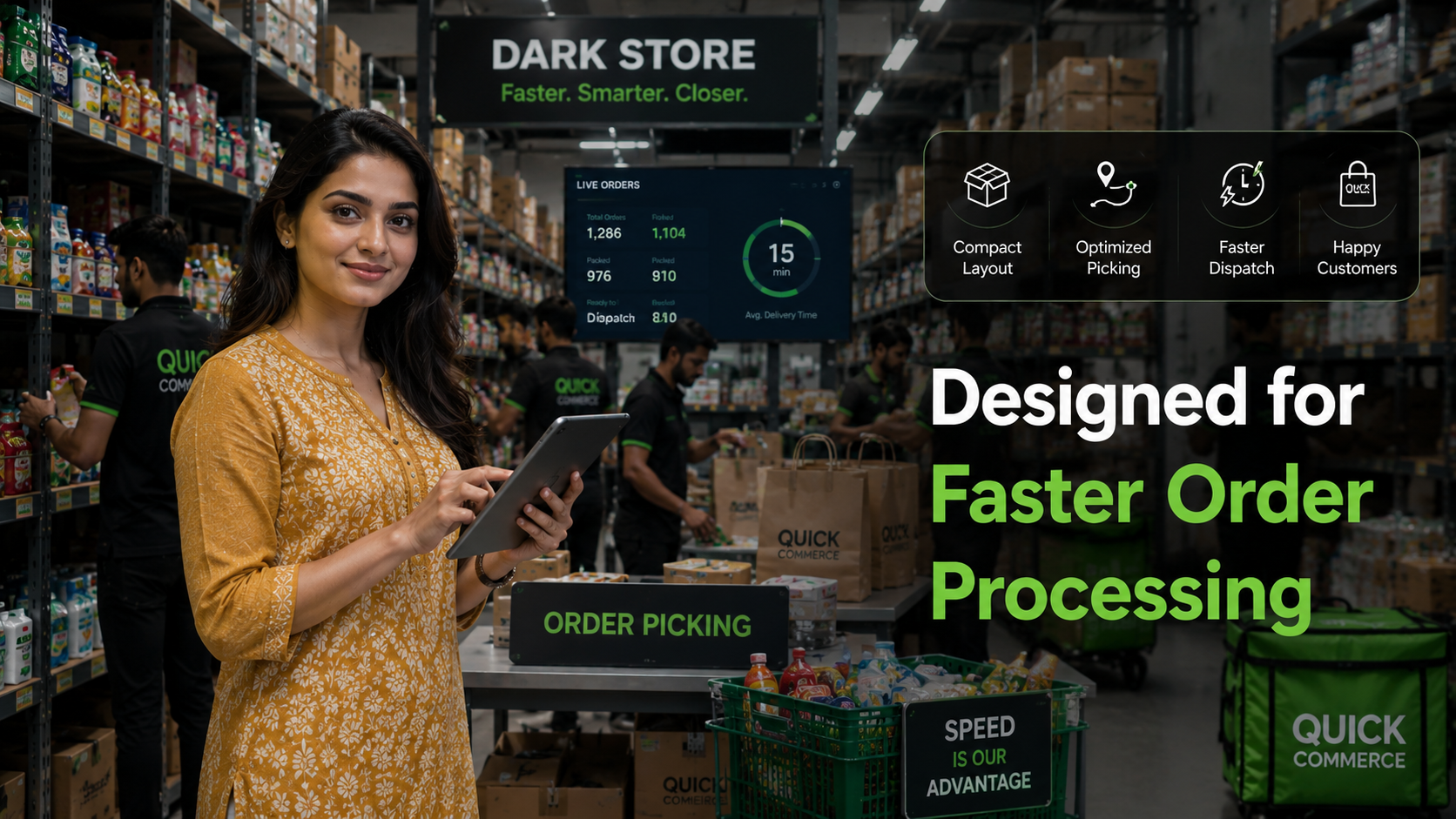
A dark store is a small urban warehouse, typically 1,500 to 5,000 square feet, located within 2 to 3 km of target customers. Unlike a regular retail store, no walk-in customers are served. The space is optimised for fast picking and packing, not browsing. Staff inside the dark store receive orders, pick the items, pack them, and hand them off to riders waiting outside. The dark store operations model is what makes 15 to 30 minute delivery physically possible.
How Do You Choose Dark Store Locations?
Three factors matter most. First, customer density in the surrounding 2 to 3 km. Look at order volume data from any existing operations or rely on neighbourhood demographic data for new launches. Second, accessibility for two-wheelers. Dense neighbourhoods with narrow lanes work well. Highway-facing locations do not. Third, rent. Q-commerce margins do not tolerate prime retail-street rents. Look for street-back locations one block off main commercial roads.
How Many SKUs Should a Dark Store Carry?
Most successful Q-commerce dark stores carry 2,000 to 6,000 SKUs. This is a fraction of what a regular grocery store carries (often 15,000 to 30,000 SKUs). The trade-off is range versus speed. A tighter SKU range means faster picking, lower inventory cost, and fewer stock-outs. Use Pareto-style analysis to identify the SKUs that drive the majority of orders in your target neighbourhoods, then stock those and almost nothing else.
How Much Does Setting Up a Single Dark Store Cost?
Setup costs vary widely by city and category. A realistic range for a 2,500 square foot dark store with initial inventory, racking, point-of-sale equipment, and basic packaging supplies is 25,000 to 80,000 USD. Monthly operating cost (rent, utilities, picker salaries) typically runs 5,000 to 20,000 USD depending on city and team size. These are real numbers. Most Q-commerce businesses need three to five dark stores before they cover even a moderate-sized city.
How Should You Build or Partner for Last-Mile Fleet?
The last-mile fulfilment question divides Q-commerce operators sharply. Should you employ your own riders or partner with an existing fleet platform? Both work. Each has trade-offs.
When Should You Build Your Own Fleet?
Own-fleet works when you have predictable, dense order volume in concentrated areas. The advantages are control over uniforms, service standards, and customer experience. The disadvantages are employment costs, insurance, fleet maintenance, and the management overhead of hiring 30 to 100 riders per dark store. This is a real business inside the larger business.
When Should You Partner With a Fleet Platform?
Partner-fleet works when you need to start fast, scale gradually, or operate in markets where rider supply is fragmented. Platforms like Borzo, Porter, Shadowfax, Dunzo, Rappi (in select markets), Uber Direct, DoorDash Drive, and regional equivalents let you tap into existing rider pools and pay per delivery. The trade-off is per-order cost is typically higher than running your own fleet at scale.
Most Q-commerce operators end up with a hybrid model. Core city centres use own fleet for service quality. Outer zones use partner fleets for flexibility. This combination optimises for both customer experience and unit economics.
How Does Inventory Management Work Differently in Quick Commerce?
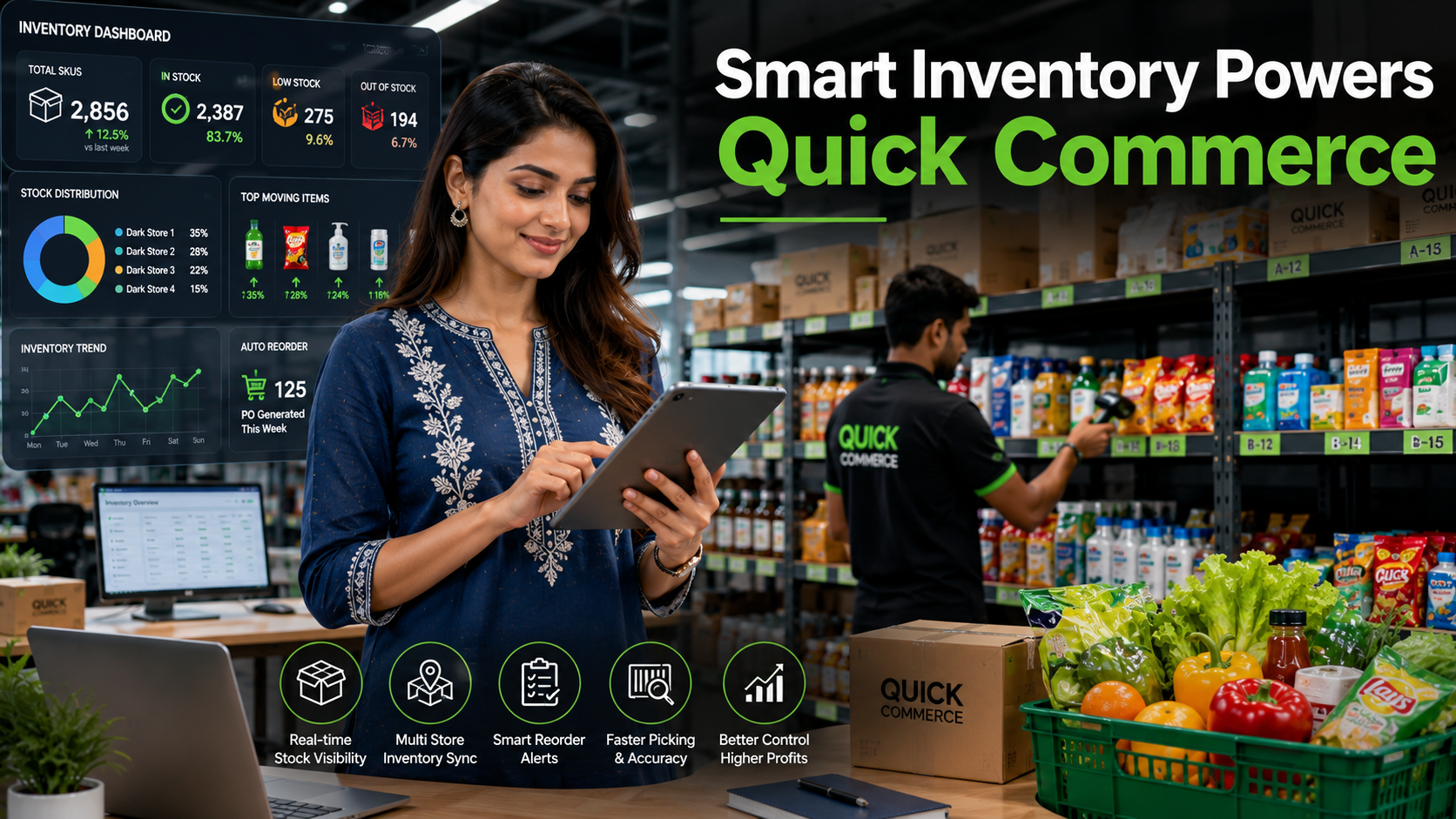
Standard ecommerce inventory updates daily or in real-time across one or two warehouses. Q-commerce inventory must update in real-time across every dark store, with picking algorithms that account for shelf location and product velocity. Three operational disciplines decide whether the inventory layer works:
Real-Time SKU-Level Stock Visibility
Customers placing orders need to see what is actually available in the dark store serving their neighbourhood right now, not what was available this morning. Inventory updates must happen as items are picked, with the customer-facing inventory adjusting before the next customer adds the same item to a cart. Without this, oversold orders become a daily problem.
Velocity-Based Picking Layouts
High-velocity SKUs sit at the front of the dark store, low-velocity at the back. The layout is optimised for picker speed, not customer browsing. Most Q-commerce operations reorganize layouts monthly based on actual order velocity data, since SKU rankings shift as seasons, promotions, and customer preferences change.
Automated Reorder Triggers
With 2,000 to 6,000 SKUs per dark store and same-day delivery promises, stock-outs cannot wait for someone to notice. Automated reorder triggers based on velocity and lead time keep shelves full. Each dark store essentially runs as a continuously replenishing micro-warehouse.
LAYER 3 • The Technology Stack
Once the physical infrastructure is in place, the technology stack ties it all together. This is the layer most blog posts overemphasise because it is the easiest part to talk about. In reality, the software is a smaller portion of total Q-commerce cost than dark stores, inventory, and rider salaries. But software done poorly breaks the whole operation, while software done well becomes invisible scaffolding the business runs on.
What Software Does a Quick Commerce Platform Actually Need?
Four software components together cover the operational requirements. Each can be built, bought, or assembled from off-the-shelf platforms. Most businesses do not need to build any of these from scratch.
Customer-Facing App and Website
The branded Q-commerce app is where customers browse, order, and track. It must show real-time inventory of the nearest dark store, accept payments, schedule deliveries, and surface trust signals. Native Android and iOS apps consistently outperform mobile websites for Q-commerce because push notifications drive order frequency and home-screen presence drives repeat purchase. The app is not optional for a serious Q-commerce operation.
Inventory and Order Management Dashboard
The internal dashboard where operations staff monitor live orders, stock levels per dark store, picker performance, and rider dispatch. This is the operational nerve centre. It must handle multi-warehouse inventory in real-time, route incoming orders to the correct dark store based on customer location, and trigger automated reorder workflows when stock dips below thresholds.
Picker and Packer Workflow App
The handheld application picker staff use to receive incoming orders, navigate the dark store to collect items, scan barcodes for accuracy, and mark orders ready for dispatch. Picking app design directly affects fulfilment time. Apps that show optimal pick routes based on shelf layout can cut picking time by 30 to 40 percent compared to apps that simply list items in order of cart-addition.
Rider Dispatch and Tracking System
The rider-facing system that receives ready orders, assigns them to the nearest available rider, provides turn-by-turn navigation, and communicates back to the customer with live ETA. This is often integrated with fleet management software or partner fleet APIs. Without strong dispatch logic, riders run inefficient routes and operating cost balloons.
How Does Shopaccino Fit Into a Quick Commerce Setup?
Shopaccino is SaaS ecommerce software. For a Q-commerce business, this means the customer-facing app, the website, the product catalogue, the multi-warehouse inventory (each dark store mapped as a warehouse), the order management dashboard, and the payment integrations are handled inside Shopaccino as a unified system. The platform handles the digital layer of the quick commerce platform cleanly.
Shopaccino does not run the physical dark store, the picking staff, the rider fleet, or last-mile logistics. Those stay the responsibility of the business and its operational partners. What Shopaccino does handle is the digital layer of the dark store: each location mapped as a warehouse with real-time inventory sync, so the storefront always reflects accurate stock. A typical Shopaccino-based Q-commerce setup pairs this software layer with separate operational partnerships for fleet (Borzo, Porter, Shadowfax, or own-employed riders) and for staffing the physical warehouse (in-house or rented dark store staff)
What Shopaccino Provides and What It Does Not Shopaccino provides the ecommerce software layer: branded customer app and website, multi-warehouse inventory mapped per dark store, real-time stock sync, order management dashboard, payment integrations, and customer communication. Native Android and iOS apps come built in on growth plans. Multi-currency, B2B plus B2C from one dashboard, and zero platform transaction fees apply across the operation. Shopaccino does not provide physical dark stores, rider fleets, picking equipment, or last-mile delivery operations. Those infrastructure layers remain yours to build or partner for. |
LAYER 4 • The Unit Economics
This is where most Q-commerce launches break down quietly over the first 12 months. The customer experience works. The technology works. The riders deliver fast. But every order loses money, and the business slowly bleeds capital until either funding runs out or someone changes the model fundamentally.
What Does the Unit Economics of a Quick Commerce Order Actually Look Like?
Below is a representative unit economic breakdown for a 15 to 20 USD grocery order in a mature Q-commerce market. Real numbers vary by region, category, and operator, but the structure is consistent across the industry.
Cost Line | Range (USD per order) | Note |
|---|---|---|
Cost of goods sold | 10 to 14 | 60 to 75 percent of order value typical for grocery |
Last-mile delivery cost | 1.50 to 3.50 | Higher when partner fleet, lower at scale own fleet |
Dark store operating cost per order | 1.00 to 2.50 | Includes rent, utilities, picker salary allocated per order |
Payment gateway and platform fees | 0.30 to 0.60 | 1.5 to 3 percent of order value |
Packaging and disposables | 0.20 to 0.50 | Insulated bags, fillers, paper bags |
Customer acquisition cost (amortized) | 0.50 to 2.00 | Heavy in early months, drops with retention |
Net per order before brand investment | Often negative | Many operators lose money per order in early years |
Q-commerce only works at the unit level when one of three conditions holds. First, basket size is high enough that fixed delivery cost is a small percentage. Second, repeat purchase frequency is high enough that customer acquisition cost amortizes across many orders per year. Third, category margin is structurally high (pharmacy, beauty essentials) rather than grocery-thin.
Why Have Some Quick Commerce Companies Failed Globally?
Examining real cases helps. Gorillas (Germany), Getir (Turkey, Europe, US), Jokr, Fridge No More, Buyk, Zapp, Weezy all shut down or significantly retrenched between 2022 and 2024. The common patterns across these closures:
- Customer acquisition cost stayed elevated as paid acquisition got more expensive
- Average basket sizes were too low to absorb delivery costs at the unit level
- Aggressive geographic expansion outpaced the ability to make any single market profitable
- Cheap capital era ended faster than scale could deliver real efficiency
- Repeat purchase frequency in many markets was lower than initial projections
This is not an argument against Q-commerce. Surviving and profitable operators like Gopuff (US), Wolt (Europe), Rappi (Latin America), iFood (Brazil), Blinkit (India), and others continue to operate. The lesson is structural: Q-commerce works when the right business launches it in the right market with realistic capital expectations, not when any business launches it everywhere with growth-at-all-costs spending.
When Does Launching Your Own Quick Commerce Platform Make Financial Sense?
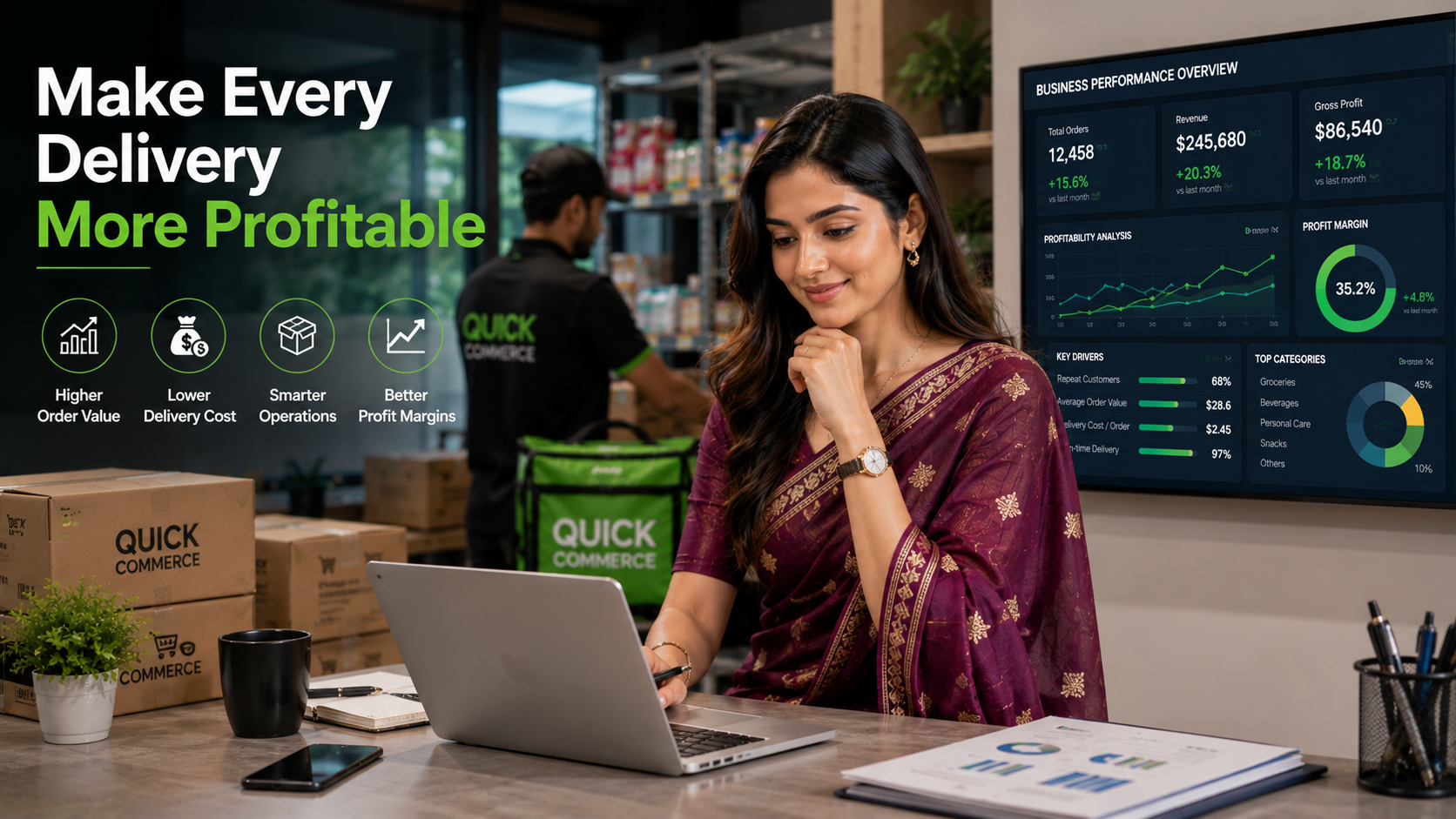
Four scenarios where the economics genuinely support a Q-commerce launch:
Scenario 1: You Already Own Retail Stores in the Coverage Area
Each existing store can serve double duty as a dark store, eliminating the largest startup cost. Grocery chains, pharmacy networks, and multi-outlet retailers in this position have a structural advantage over pure-play Q-commerce startups. The infrastructure already exists. The Q-commerce launch becomes a software and process project, not a real estate one.
Scenario 2: You Have a High-Margin Category
Pharmacy, beauty essentials, premium pet supplies, specialty wellness products. These categories have enough margin to absorb Q-commerce delivery costs at the unit level. Generic grocery struggles with this. Pharmacy and beauty rarely do.
Scenario 3: You Have a Strong Existing Brand and Repeat Customer Base
Customer acquisition cost is the killer of Q-commerce economics. Businesses launching to an existing customer base bypass most of this cost. A restaurant chain launching its own delivery service to existing customers, a grocery brand with a strong loyalty program, a pharmacy chain with prescription customers all have a natural Q-commerce launching advantage.
Scenario 4: You Operate in a Less Saturated Geographic Market
Tier two and three cities, secondary metros, and emerging markets often have unmet Q-commerce demand without venture-funded competitors. Launching there is structurally easier than competing in saturated tier one cities where multiple well-funded operators are already in deep customer acquisition wars.
Should You Build Your Own Quick Commerce Platform or Sell on Existing Ones?
Many businesses ask this question backwards. The right answer is often both, sequenced correctly.
When Should You Sell on Existing Quick Commerce Platforms?
If you are a brand whose products fit Q-commerce categories (snacks, beverages, beauty, pet, OTC pharmacy), listing on existing platforms like Blinkit, Zepto, Swiggy Instamart, BBNow, Gopuff, iFood Mercado, or Rappi Turbo gives you immediate access to their customer base. You pay commission per order (typically 15 to 25 percent) but avoid all infrastructure cost. Most brands should start here.
When Should You Build Your Own Quick Commerce Platform?
Once you have meaningful order volume through partner platforms and a clear understanding of which categories and neighbourhoods perform best, building your own platform alongside the partner channels becomes viable. Your own platform builds direct customer relationships, captures full margin, and removes the long-term dependency on partner platforms whose terms can change.
Should You Run Both Channels Together?
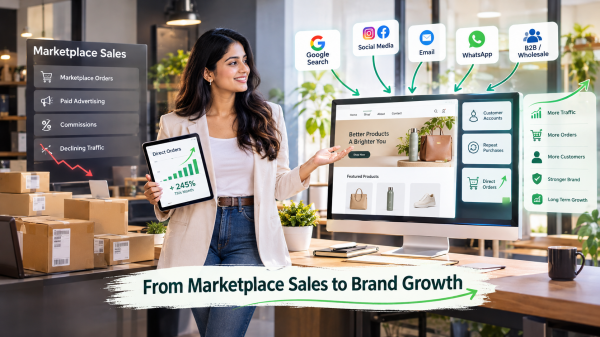
Yes, for most established businesses. Partner platforms handle discovery and new customer acquisition. Your own platform handles repeat purchase and high-frequency customers who already know your brand. This dual-channel approach mirrors the pattern that already works in regular ecommerce (marketplaces for discovery, own store for retention) and applies cleanly to Q-commerce too.
What Are the Common Mistakes When Launching a Quick Commerce Platform?
Four mistakes show up across nearly every Q-commerce launch that struggles. Recognising them early saves significant capital.
Mistake 1: Promising 10-Minute Delivery Before the Network Supports It
Sub-15 minute delivery requires very dense dark store networks. Promising 10 minutes with one or two dark stores covering a large city leads to consistent late deliveries and angry customers. Promise the time window you can reliably deliver, even if competitors promise faster. Customer experience matters more than marketing time-claims.
Mistake 2: Carrying Too Many SKUs in Each Dark Store
Founders coming from traditional retail want to stock everything. Q-commerce dark stores are not retail stores. Carrying 8,000 SKUs when only 2,500 actually move at meaningful velocity slows picking, raises inventory cost, and never delivers proportional revenue. Discipline on SKU range is one of the highest-leverage operational decisions.
Mistake 3: Expanding Geographically Before Local Profitability
Launching in three cities while none of them is yet contribution-margin positive. This is the most common cause of Q-commerce failure globally. Get one market to profitability before opening the next. The discipline is hard but the math is unforgiving.
Mistake 4: Underestimating the Operational Management Burden
Q-commerce is an operations-intensive business. It needs dedicated operations leadership, not a part-time founder running it alongside other businesses. Dark store management, fleetmanagement, picker management, and customer experience management each require focused attention. Treating Q-commerce as a side project ensures it underperforms.
? Key Takeaways: Launching a Quick Commerce Platform ✓ Q-commerce is operationally heavy. Dark stores, fleet, and inventory cost more than the software layer combined. ✓ Promise a delivery window you can reliably hit. Sub-15 minutes is exceptionally hard. 15 to 30 minutes is the sustainable sweet spot. ✓ Some categories work for Q-commerce (groceries, OTC pharmacy, pet, beauty, snacks). Many do not (apparel, electronics, furniture). ✓ Each dark store typically needs 25,000 to 80,000 USD setup plus 5,000 to 20,000 USD monthly to operate. ✓ Most Q-commerce operations lose money per order in early years. Unit economics close when basket size, repeat frequency, or category margin is high enough. ✓ Businesses with existing retail stores in the coverage area have a structural advantage and lower startup capital requirements. ✓ Start by selling on existing Q-commerce platforms before building your own. Use the data to decide which neighbourhoods justify your own dark stores. ✓ Software handles the digital layer. Shopaccino provides the customer app, multi-warehouse inventory, and order management. Operations and fleet remain separate work. |
Where Can You Find Authoritative Research on Quick Commerce and Hyperlocal Delivery?
Government, international body, and primary trade sources worth bookmarking when planning a Q-commerce launch:
- UNCTAD Ecommerce and Digital Economy Reports
- OECD Digital Economy Policies
- World Trade Organization Trade Statistics
- U.S. Census Bureau Quarterly E-Commerce Report
- European Commission Digital Strategy
- World Bank Logistics Performance Index
Final Thoughts on Launching Your Own Quick Commerce Platform
Launching a quick commerce platform is realistic for the right business in the right market. Grocery chains, pharmacy networks, multi-outlet retailers, and established D2C brands with existing customer bases can build credible Q-commerce operations alongside their core business. Pure-play startups with no existing infrastructure and no customer base face a much harder road. The honest assessment is the starting point.
Shopaccino is SaaS ecommerce software anyone running an established business can use to build the digital layer of a quick commerce operation. Branded customer app, multi-warehouse inventory mapped per dark store, real-time stock sync, order management, native Android and iOS apps on growth plans, and zero platform transaction fees. The platform handles the digital scaffolding. The dark store operations, the fleet, the picking, and the 15-minute delivery model execution remain physical work owned by the business and its operational partners.
Pick the right category. Map your existing retail locations or rented dark stores within 2 to 3 km of target customers. Decide on a delivery window you can reliably deliver. Build the digital layer once. Refine the operations every week. Expand only after a single market is contribution-margin positive. That is how quick commerce platforms get built sustainably, not by chasing growth metrics that ignore the underlying unit economics.
FAQs
Realistic startup cost for a single-city quick commerce launch is 200,000 to 800,000 USD covering three to five dark stores, initial inventory, fleet partnerships or hires, software, branding, and working capital. Multi-city launches scale linearly. Businesses with existing retail stores serving as dark stores reduce this significantly because the physical infrastructure already exists.
Not at launch. Most operators start with partner fleet platforms like Borzo, Porter, Shadowfax, Dunzo, Uber Direct, or regional equivalents to enable fast launch with variable cost. Own fleet typically gets added once order density justifies fixed-cost rider employment. Many operators run a hybrid model permanently, with own fleet in core zones and partner fleet in outer zones.
Groceries, fresh produce, over-the-counter pharmacy, personal care, pet supplies, snacks, beverages, and beauty essentials work consistently across markets. Apparel, electronics, furniture, and considered purchases generally do not. The shared quality of working categories is convenience-driven, predictable demand and margin high enough to absorb delivery costs at unit level.
Shopaccino provides the software layer: branded customer app and website, multi-warehouse inventory mapped per dark store, real-time stock sync, order management dashboard, payment integrations, native Android and iOS apps, and zero platform transaction fees. Shopaccino does not provide dark store operations, rider fleets, or last-mile delivery. Those layers remain the responsibility of the business and its operational partners.
From decision to first delivered order, a single-city launch typically takes 4 to 8 months. Software setup takes 2 to 5 days on a modern SaaS platform. The longer timeline is for physical infrastructure: identifying dark store locations, signing leases, fitting them out, hiring staff, sourcing inventory, signing fleet partnerships, and running operational dry runs before opening to customers.
Yes, for most brands. Listing on Blinkit, Zepto, Swiggy Instamart, Gopuff, Rappi Turbo, iFood Mercado, or regional equivalents gives immediate market access without infrastructure cost. Use the data from those channels to identify which neighbourhoods, SKUs, and customer segments justify your own platform investment later. Running both channels in parallel is the most common winning approach.