
How to Rank Your E-commerce Store in ChatGPT, Gemini, and AI Search Engines
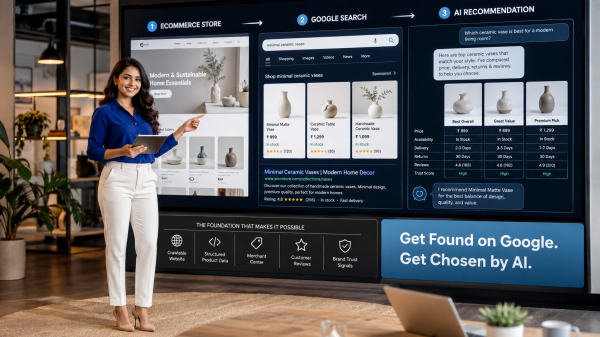
Traditional search was about ranking. You optimized a page for a keyword, climbed Google's results, and hoped the buyer clicked your link over nine others.AI search is completely different. When someone asks ChatGPT for a product recommendation, the AI does not show ten options. It synthesizes an answer and names one or two brands it considers credible. There is no page two. There is no 'almost made it.
You are either in the answer or you are invisible
Picture this. A buyer in Dubai searches: 'Which Indian exporter sells bulk marble tiles online?' They do not open Google. They type it into ChatGPT. Another buyer in Germany asks Gemini: 'Best B2B ecommerce platform for manufacturers?' A retailer in the UK asks Perplexity: 'Where can I source handmade home decor directly from India?'
None of them are clicking through ten blue links. They are getting a direct answer — with a brand recommendation attached. And that brand is either yours, or your competitor's.
This is not the future of ecommerce discovery. It is happening right now
AI-driven traffic to retail websites grew 393% year-over-year in Q1 2026 (Adobe Analytics). ChatGPT alone processes approximately 50 million shopping-related queries every single day. And here is the part most sellers are missing: traffic that arrives from AI recommendations converts 31% higher than regular organic search — because buyers arrive already pre-qualified by an AI they trust.
The question is no longer 'Should I think about AI search?' It is: 'Why is my ecommerce store not showing up there yet?'.
How Do AI Tools Actually Find and Recommend Your Ecommerce Store?
This is where most 'AI SEO' guides get it wrong — including what was written here originally, before deeper research was done. Let us be accurate.
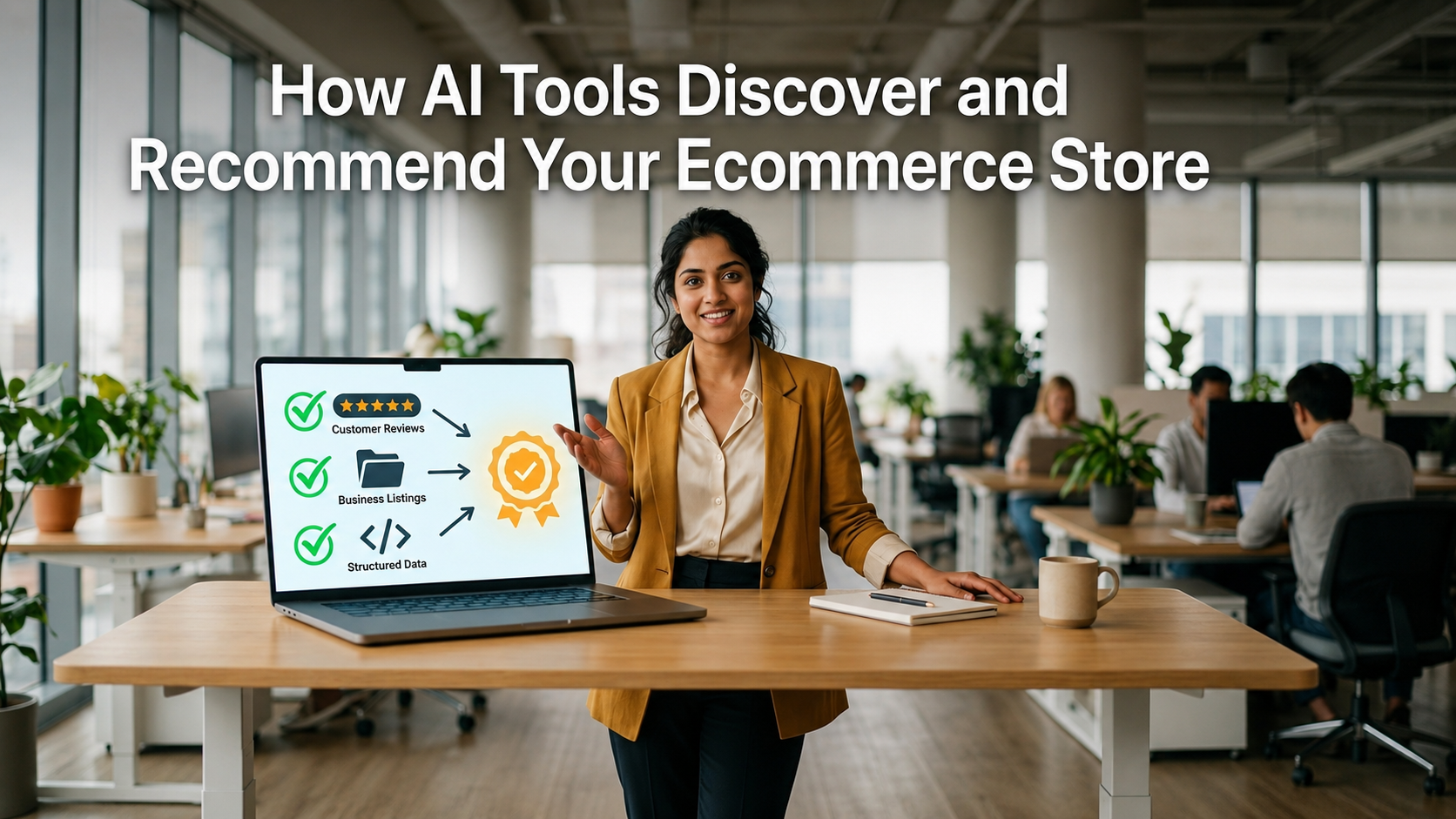
AI tools like ChatGPT, Gemini, Claude, and Perplexity do not browse the internet the way a human does. They build their answers by pulling signals from a fixed set of trusted sources. The more your ecommerce store is consistently mentioned, reviewed, and referenced across those sources — the more confidently AI tools recognize it as a trusted entity and cite it in their answers.
⚡ The Core Insight: AI visibility is not about ranking on Google. It is about being recognized as a credible entity across many independent sources at once. |
Where AI Tools Build Their Knowledge About Your Brand
Here are the primary source types every major AI engine draws from:
- Wikidata and Wikipedia — structured knowledge bases that AI engines treat as ground truth for entity recognition
- Software and business directories — G2, Capterra, Crunchbase, SaaSworthy, Trustpilot, and similar platforms
- High-authority press — publications like YourStory, Inc42, Economic Times, Forbes, TechCrunch, and industry trade media
- Structured data on your own website — schema markup that tells AI exactly what your business is and what you sell
- Social platforms — LinkedIn (Microsoft-owned, feeds into Bing-based tools) and YouTube
- Community discussions — Reddit, Quora, and niche forums where real buyers discuss products in your category
Where Each AI Tool Gets Its Information
This is critical to understand because each engine uses a different backend — and your optimization strategy should reflect that:
AI Tool | Primary Data Source | What This Means for Your Store |
Gemini | Google's search index + Google's internal data (Knowledge Graph, Business Profiles) | Your brand-owned website matters most. 52% of Gemini citations come from brand domains. Schema markup and Google Business Profile are essential. |
ChatGPT | Bing search index + training data + third-party directories | 48.7% of ChatGPT citations come from directories like Yelp, TripAdvisor, and listing sites. Broad distribution across platforms matters. |
Claude | Brave Search index + training data | 86.7% overlap between Claude citations and Brave Search top results. Ranking well in Brave Search = ranking in Claude. |
Perplexity | Hybrid of Google, Bing, and its own real-time crawler | Cites sources directly and visibly. Prioritizes fresh, well-structured content. Industry-specific directories perform well. |
Each engine has its own logic. A store optimized only for Google will perform well in Gemini but may be invisible in ChatGPT if it has no directory presence. A complete AI visibility strategy covers all four pillars simultaneously.
How to Get Your Ecommerce Store Cited in AI Search — 6 Actionable Pillars
GEO — Generative Engine Optimization — is the practice of structuring your online presence so that AI models cite, recommend, and reference your ecommerce store when buyers ask relevant questions. Here is exactly how to build it:
Pillar 1: Build Your Presence Across the Sources AI Engines Trust
Before you touch your website, go where AI tools are already looking. Listing your ecommerce store on the right platforms is the fastest way to appear on AI's radar.
Priority platforms to list your store on:
- Crunchbase — essential for business entity recognition across all AI tools
- G2 and Capterra — especially important if you offer SaaS, software, or platform-based services
- Trustpilot and Google Business Profile — review signals that Gemini and ChatGPT both weigh heavily
- LinkedIn Company Page — feeds directly into Bing-based tools like ChatGPT's directory sources
- Industry export and trade directories — especially important for exporters and B2B sellers operating globally
- Reddit and Quora — community mentions in buyer-relevant threads build trust signals AI engines read
Pillar 2: Implement Schema Markup on Every Important Page
Schema markup is the language AI engines use to understand what your page is. Without it, your ecommerce store is readable to humans but largely uninterpretable to AI systems.
Essential schema types for an ecommerce store:
- Product schema — name, description, price, availability, SKU, brand, and aggregate rating
- FAQPage schema — gets pulled directly into AI Overviews and conversational answers
- Organization schema — establishes your brand as a recognized entity with name, logo, URL, contact info
- BreadcrumbList schema — helps AI understand your catalog structure and navigate between categories
- Review schema — review data is a trust signal that influences citation decisions across all AI engines
- Offer schema — particularly valuable for B2B stores with MOQ pricing, wholesale tiers, and bulk availability
✅ Action Step: Test your product pages at https://search.google.com/test/rich-results Check your schema.org implementation at https://validator.schema.org If your ecommerce platform cannot generate product schema automatically, you need one that can. A modern platform like Shopaccino handles schema generation natively — so structured data is built in, not bolted on. |
Pillar 3: Write Answer-First Content That AI Can Actually Extract
AI engines pull their answers from content that directly responds to questions. The format matters enormously. Content buried under long introductions, vague language, or keyword-stuffed paragraphs does not get cited.
The Answer-First structure that gets you cited:
- Open every blog post and buying guide with a 40-60 word direct answer to the core question. This is what AI models extract as a snippet.
- Use question-based H2 and H3 headings — 'What is...', 'How does...', 'Which is better...' These match how buyers phrase queries in AI tools.
- Add comparison tables — AI models extract tabular data reliably. Product comparisons, spec tables, and pricing tiers perform well.
- Write in short, factual paragraphs — 2 to 4 lines maximum. Dense walls of text are skipped by AI extraction models.
- Include specific data points and dates — AI engines favor content that is verifiable and time-stamped.
Content topics that work for ecommerce stores targeting AI search:
- 'How to choose [your product category] for [specific buyer type]'
- '[Your product] vs [alternative]: A complete comparison for [use case]'
- 'What to check before buying [product] in bulk — a B2B buyer's guide'
- 'Complete guide to [industry your products serve]'
- '[Your product category] for export: What international buyers need to know'
Pillar 4: Add FAQ Sections to Every Key Page
FAQ sections are one of the highest-value additions you can make for AI search visibility. When structured with FAQPage schema, they are pulled directly into Google AI Overviews. When indexed by ChatGPT or Gemini, they become the source for conversational answers.
Where to add FAQ sections:
- Every product page — 3 to 5 questions specific to that product
- Every category page — general buying questions for that product type
- Homepage — trust and business-related questions
- Shipping, returns, and policy pages — these are heavily searched in AI tools
- Export and B2B pages — MOQ, international shipping, payment terms
? Tip: Frame FAQ answers as standalone, complete responses. Each answer should make sense without the question visible — because AI engines sometimes extract just the answer text. Keep each answer under 60 words and write in plain, confident language. |
Pillar 5: Build a Technically Clean, Fast, Crawlable Website
AI engines cannot recommend what they cannot understand. Technical hygiene is the foundation that makes everything else work.
- Page speed under 3 seconds — check at https://pagespeed.web.dev (Core Web Vitals)
- Allow all AI crawlers in your robots.txt — GPTBot, ClaudeBot, PerplexityBot, OAI-SearchBot, and Google-Extended must not be blocked
- Submit your XML sitemap to Google Search Console
- Clean URL structure — no random parameters, no duplicate content
- HTTPS enabled — non-negotiable for trust signals across all AI engines
- Mobile-first design — AI engines weight mobile experience heavily
- Internal linking between product pages, category pages, and blog content
⚡ Important Note on AI Crawlers: Many ecommerce stores accidentally block AI bots in their robots.txt while blocking unwanted scrapers. Check your robots.txt file specifically for GPTBot and ClaudeBot. Blocking these bots silently removes your store from AI recommendations entirely. |
Pillar 6: Earn Real Reviews and Brand Mentions
Reviews are not just for converting buyers. They are a major trust signal that AI engines use when deciding whether to recommend a brand.
Across AI engines, review volume and ratings directly influence citation frequency. AI-referred shoppers already spend 45% more time exploring products than visitors from other channels — and they arrive because an AI trusted your brand enough to recommend it.
How to build the review and mention signals AI engines look for:
- Actively request post-purchase reviews on Google Business Profile and Trustpilot
- Implement Review schema so your star ratings appear in AI-generated answers
- Get featured in industry trade press — even one credible mention in a relevant publication significantly lifts AI recognition
- Encourage genuine discussion about your products on Reddit and Quora threads related to your category
- For B2B exporters: get listed and reviewed on international trade directories your buyers already use
Why Your Ecommerce Platform Directly Affects AI Search Visibility

Most sellers focus on what they publish — the content, the reviews, the descriptions. Fewer think about whether their platform can support AI visibility at a technical level.
Your ecommerce platform is the infrastructure that either enables or blocks AI visibility. A platform that generates clean schema markup automatically, loads fast, supports FAQ sections on product and category pages, and keeps your catalog well-structured gives your store a technical foundation AI engines can parse.
A platform that produces thin product pages, missing schema, slow load times, and unclear site architecture works against you — regardless of how good your products are or how many directories you appear in.
For manufacturers, exporters, distributors, and D2C brands managing both B2B and B2C operations, the platform also needs to handle complex catalog structures without fragmenting the clarity AI engines need.
Shopaccino is built specifically for businesses already selling offline that want to build a serious online presence. Rather than a generic one-size-fits-all system, it is designed around the real operational needs of exporters selling globally, manufacturers managing B2B and B2C from one system, and D2C brands scaling through a branded website and mobile app. With built-in automation, integrated inventory, schema-ready product pages, and zero transaction fees, it removes the technical barriers that keep ecommerce stores invisible to AI engines.
How to Track Whether Your Ecommerce Store Is Being Cited in AI Search
Traditional analytics do not capture AI citations. Most GA4 setups misclassify AI referral traffic as 'direct' — meaning you could be getting recommended by ChatGPT right now and not know it.
Here is a practical tracking approach:
- Manual prompt testing: Regularly search for your product category in ChatGPT, Gemini, and Perplexity. Note whether your store or competitors appear in responses.
- Brand search monitoring: AI citations drive branded search. Track your brand name queries in Google Search Console — a rising trend often signals AI referrals.
- Robots.txt and crawl audit: Check your server logs for GPTBot, ClaudeBot, and PerplexityBot activity. Crawler visits indicate AI engines are indexing your content.
- Schema validation: Run quarterly checks at https://validator.schema.org to confirm your structured data remains valid and complete.
- AI citation tools: Platforms like Otterly and Indexly track citation rates across ChatGPT, Gemini, Claude, and Perplexity on a weekly basis.
What the 2025-2026 Data Says About AI Ecommerce Search
This is not speculative. The numbers confirm the shift is happening now:
Data Point | Figure | Source |
AI-driven traffic growth to US retail sites (Q1 2026 YoY) | 393% | Adobe Analytics |
Daily shopping queries in ChatGPT | ~50 million | OpenAI Economic Research |
Conversion rate: ChatGPT traffic vs non-branded organic | 31% higher | Visibility Labs / Search Engine Land |
Shoppers who used GenAI during 2025 holiday season | 56% of US consumers | Multiple sources |
GenAI adoption for shopping among under-30 buyers | 84% | Shopify Global Holiday Report 2025 |
AI-referred shoppers: additional time spent on products | 45% more | Ringly.io 2026 report |
Gartner prediction: traditional search volume decline by 2026 | 25% drop | Gartner Research |
Claude citation overlap with Brave Search top results | 86.7% | Profound / BrightEdge 2025 |
Gemini citations from brand-owned websites | 52.15% | Yext, 6.8M citation analysis |
ChatGPT citations from third-party directories | 48.73% | Yext, 6.8M citation analysis |
The competitive window is now. Only 23% of marketers are currently investing in GEO measurement (Incremys, 2025). For ecommerce businesses that move early, AI search visibility is a channel where you can build a lasting lead before it becomes crowded.
The Ecommerce Stores That Will Win in AI Search Are Building Now

The shift from keyword search to AI-driven discovery is not a slow trend. It accelerated 5x in a single year. Buyers in your category — whether they are retailers in Europe, distributors in the Middle East, or D2C consumers in your home market — are already using AI tools to find products, compare suppliers, and make purchase decisions.
The stores that appear in those recommendations did not get there by accident. They built entity presence across trusted sources. They implemented schema markup. They structured their content so AI could extract and cite it. They earned reviews that AI engines treat as credibility signals.
None of that is technically difficult. But it does require starting — and starting before your category gets competitive.
Your ecommerce store has the products. It has the experience. The only question is whether AI engines know about it yet.
FAQs
Yes, significantly. Gemini primarily cites brand-owned websites and uses Google's index. ChatGPT relies heavily on third-party directories and Bing. Claude uses Brave Search. Perplexity uses a hybrid crawler and always shows citations directly. A complete AI visibility strategy needs to address all four simultaneously.
Not automatically. A 2026 Authoritas study found that only 37% of sources cited by AI models overlap with Google's top 10 results. AI search is a partially separate channel. Strong Google rankings help with Gemini, but ChatGPT and Perplexity require their own presence-building across directories, reviews, and structured data.
Extremely important. Schema markup is how AI engines interpret what your business is and what you sell. Without Product, FAQPage, and Organization schema, your store relies entirely on AI inference — which is unreliable. Stores with complete, valid schema are significantly more likely to be cited in structured AI responses.
Yes. B2B queries like 'best supplier for bulk marble tiles' or 'Indian exporter of handmade textiles' are increasingly processed through AI engines, especially among international buyers. B2B stores should additionally optimize Offer schema for MOQ pricing, add export-specific FAQ content, and get listed on international trade directories.
Critically. Blocking GPTBot, ClaudeBot, or PerplexityBot removes your store from AI citation pools entirely. Many stores accidentally block these bots while managing other crawlers. Check your robots.txt file specifically for these bots and ensure all are permitted to crawl your product and category pages.
There is no guaranteed timeline, but well-optimized stores with fresh, structured content and strong entity presence typically start appearing in AI citations within 6 to 12 weeks of implementation. Perplexity indexes the fastest due to its real-time crawler. ChatGPT's training-based recommendations take longer to shift.