How to Build a Milk Delivery App
Overview
The milk delivery business has undergone a quiet but powerful transformation. What was once a neighborhood milkman knocking on doors before sunrise has evolved into a structured, subscription-driven, app-powered operation. Consumers now expect freshness, punctuality, and the ability to manage their dairy orders from a smartphone. For dairy entrepreneurs, this shift is not a challenge — it is an opportunity.
App-based milk delivery eliminates the inefficiencies of traditional distribution: manual order taking, cash handling disputes, inconsistent quantities, and unreliable routing. A well-built milk delivery app development solution replaces all of this with a system that is trackable, scalable, and transparent.
What Makes Dairy Delivery Operationally Unique
Before building your app, it is critical to understand the operational demands specific to dairy delivery. Unlike other ecommerce verticals, this business runs on non-negotiable conditions:
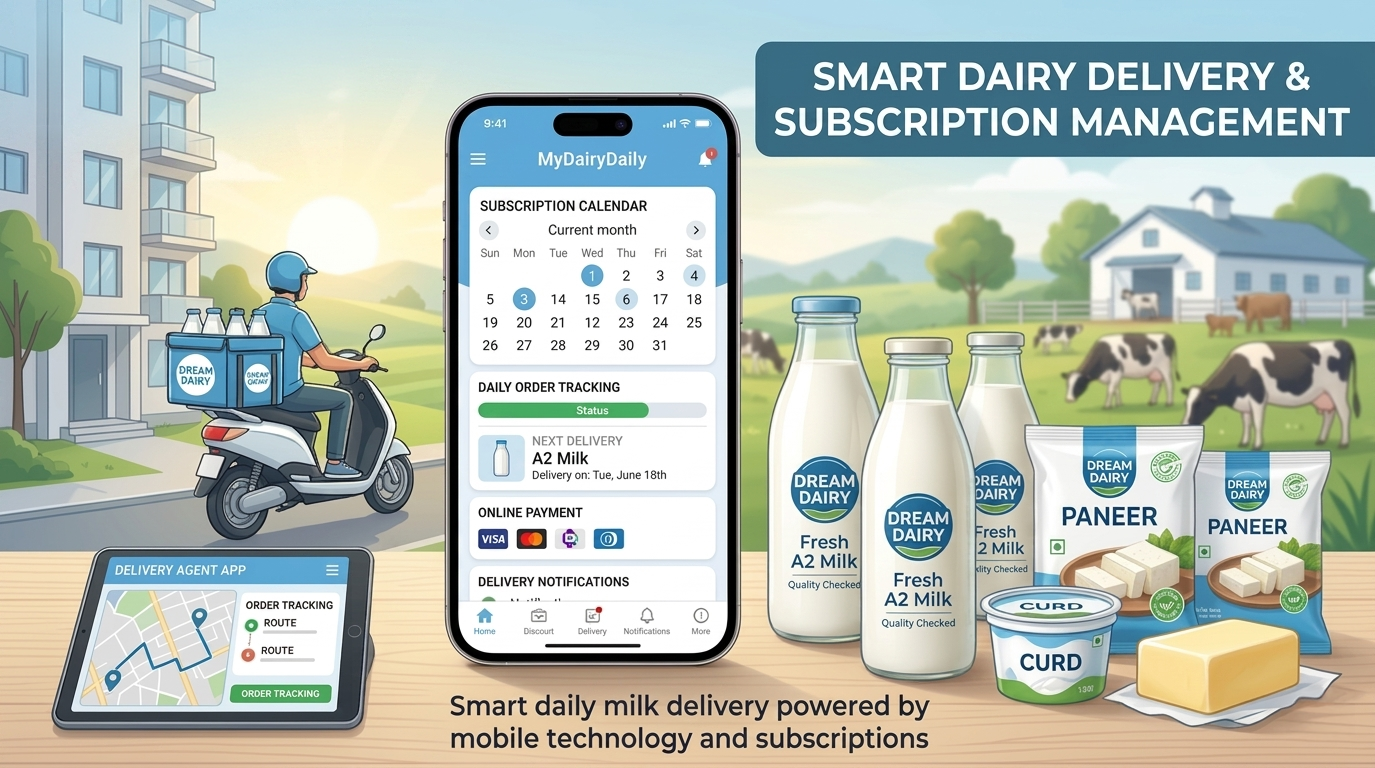
Daily subscription model: Unlike one-time purchases, milk delivery operates on recurring daily or weekly schedules. Your app must handle subscription logic natively — pause, resume, modify quantity, and billing cycles.
Logistics and routing precision: Deliveries happen in a narrow window — typically between 5 AM and 8 AM. Route sequencing and delivery partner coordination are not optional; they are core to operations.
Freshness and quality control: Dairy is perishable. Cold chain considerations, packaging integrity, and consistent sourcing are directly tied to customer retention.
Trust and consistency: A customer who receives the wrong quantity two days in a row will churn. Operational discipline and real-time communication are central to building loyalty.
Payment and ledger management: Many dairy customers pay monthly or in advance. Your system must manage cash-on-delivery cycles, outstanding dues, and prepaid subscription billing simultaneously.
If you're ready to move forward, Shopaccino's milk delivery app development company team can help you go from planning to a live app in days, not months.
Identify Your Market
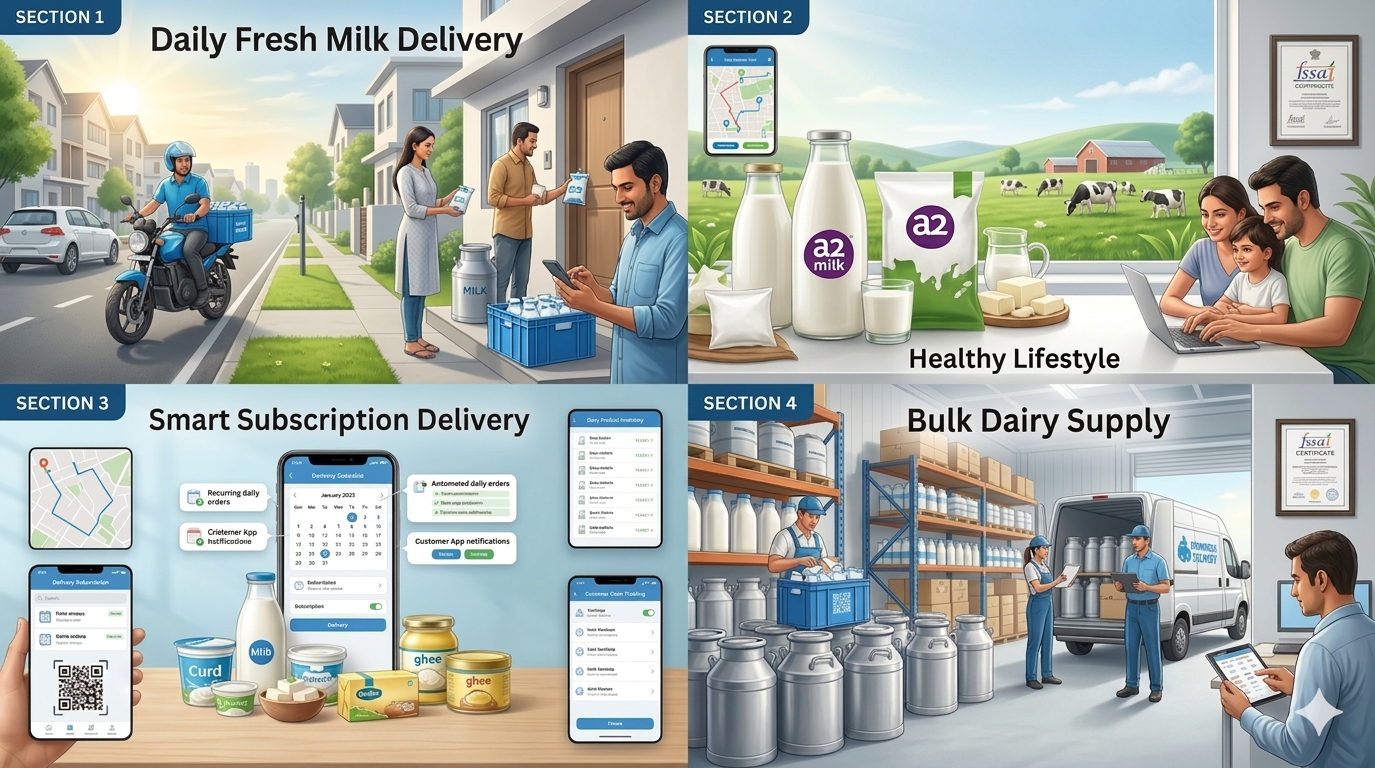
Knowing who you are selling to determines everything — your product mix, pricing, delivery windows, communication tone, and growth strategy. The dairy delivery market is not monolithic. It contains several distinct segments, each with different expectations and margins.
Primary Market Segments
Local Fresh Milk Delivery
The largest and most price-sensitive segment. Customers in residential areas and housing societies want consistent daily delivery of cow or buffalo milk. This segment is volume-driven and operates on thin margins. Winning here requires route efficiency, zero delivery failures, and transparent pricing.
Organic and A2 Milk
A fast-growing premium segment driven by health-conscious urban consumers. These customers are willing to pay 40–80% more than standard milk prices but expect certification proof, sourcing transparency, and premium packaging. Building credibility here requires FSSAI registration, farm documentation, and content-driven trust signals.
Subscription-Based Delivery
A cross-segment model where customers commit to recurring weekly or monthly delivery plans. Prepaid subscriptions improve cash flow predictability and reduce churn. This model works across fresh, organic, and value-added dairy products.
Bulk and B2B Supply
Restaurants, cafes, cloud kitchens, hostels, and corporate canteens need consistent bulk supply. B2B accounts have higher order values, longer payment cycles, and
specific invoicing requirements (GST-compliant). Winning B2B contracts significantly improves per-route efficiency.
Value-Added Dairy Products
Curd, paneer, ghee, butter, and flavoured milk extend the average order value per customer. These products also smooth out demand across seasons when liquid milk consumption may dip. Adding a curated selection of value-added products increases per-customer revenue without increasing delivery complexity.
Identify the Gap in the Market
Entering a new market without understanding its weaknesses is a costly mistake. Most local dairy markets have existing players — but very few have built a genuinely reliable, technology-backed delivery operation. That gap is where your business belongs.
How to Analyse the Competitive Landscape
Map local competitors: Identify who delivers milk in your target geography. Note their product range, pricing, delivery windows, and payment options.
Read customer complaints: Check Google reviews, housing society groups, and social media for recurring complaints about existing dairy services. These are your entry points.
Test the competition: Subscribe to a competitor's service for two to four weeks. Observe their communication, delivery consistency, invoicing, and how they handle issues.
Understand price sensitivity: Know what customers are currently paying and what premium they would accept for better service or higher-quality products.
Common Gaps in the Market
Irregular delivery: The most universal complaint. Customers receive milk late, in wrong quantities, or not at all — with no communication. This is the most correctable gap.
No transparency: Customers have no visibility into whether their order has been dispatched, who is delivering it, or what they are actually consuming (sourcing, fat content, etc.).
No subscription flexibility: Most traditional dairy operations cannot accommodate pause requests, quantity changes, or holiday holds. Modern consumers expect this as a baseline.
Poor or no digital communication: No order confirmations, no invoices, no way to raise a complaint. Customers feel ignored.
Absence of online payment: Customers want UPI, card, and wallet payment options. Cash-only operations are losing younger, urban customers.
How to Fill These Gaps Strategically
Your app is the medium, but the strategy is operational. Define your service guarantee — delivery window, quantity accuracy, complaint resolution time — and build every system to support it. Lead with transparency: show sourcing, delivery status, and invoices. Offer what competitors do not: flexible subscriptions, advance booking, and digital payments. Solve for the most common pain points first.
Select a Product and Prepare Your Catalogue
A well-structured product catalogue is the foundation of your app. Customers should be able to understand exactly what they are ordering — type, quantity, packaging, and schedule — without calling anyone.
Core Milk Types
Cow milk: Lower fat, preferred by health-conscious consumers. Available in full-fat and toned variants.
Buffalo milk: Higher fat, richer taste, popular in North and West India. Commands premium in some markets.
A2 milk: From indigenous (desi) cow breeds like Gir and Sahiwal. Premium pricing with strong urban demand.
Organic milk: Certified organic, no synthetic hormone treatment. Appeals to premium and health-focused segment.
Toned and double-toned milk: Lower fat variants with broader affordability. Suitable for large residential complexes.
Value-Added Dairy Products
Include a curated selection to increase order value per customer:
Fresh curd (100g, 200g, 400g, 1kg packs)
Paneer (200g, 500g blocks or cubes)
Ghee (250ml, 500ml, 1L)
Butter (salted and unsalted, 100g and 500g)
Flavoured milk (chocolate, rose, badam — 200ml Tetra packs)
Buttermilk and lassi (seasonal, 200ml–500ml)
Required Product Data for Each SKU
For every product in your catalogue, collect and verify the following:
Product name: Clear, specific (e.g., "Fresh A2 Cow Milk — 500ml")
Product type: Milk, curd, ghee, etc.
Quantity: In ml/litre for liquids; grams/kg for solids
MRP and selling price: Include GST if applicable
Subscription pricing: Daily, weekly, and monthly rates with any prepayment discounts
SKU code: For inventory tracking and delivery reconciliation
Stock availability: Real-time inventory sync is critical for dairy
Shelf life: Must be accurate and visible to customers
Delivery schedule: Morning only, or also evening — per product
Storage instructions: "Refrigerate below 4°C. Boil before consumption." — clear and concise
Accurate product data reduces returns, complaints, and operational confusion. Do not list a product until its data is fully verified.
Hi-Res Images and Videos
Dairy is a trust product. Customers cannot smell or touch your milk through a screen — they judge quality by what they see. Poor-quality images are not just aesthetically weak; they signal unreliability.
Required Visuals for Each Product
Clean product shots: White or neutral background, sharp focus, true colour representation. Show the product as it arrives — bottle, pouch, or container.
Packaging visuals: Show the seal, label, FSSAI number, and manufacturing details clearly. This builds regulatory trust.
Farm and process visuals: For premium products (A2, organic), images of the farm, cattle, and hygiene practices significantly increase conversion.
Video Content That Builds Trust
30-second sourcing video: farm to doorstep process
Quality testing clips: fat content, purity checks, packaging hygiene
Customer testimonials from existing subscribers
Delivery process walkthrough: how your delivery partner operates
Production Standards
Images should be minimum 1000x1000 pixels. Avoid filters that alter true product colour. Use natural or studio lighting — harsh flash creates an industrial look that undermines freshness perception. Videos should be 1080p minimum with stable filming. Even a 20-second behind-the-scenes clip from your dairy unit is more persuasive than a stock photo.
Prepare Content
Content is not a marketing afterthought — it is a trust infrastructure. Every page of your app communicates either confidence or doubt. Prepare the following before launch:
Brand and Business Story
Business goal: What problem are you solving? Why does your dairy exist? Keep it specific and real.
About the dairy: Origin, size of operation, years in business, and team. Ground-level authenticity converts better than generic language.
Sourcing and quality: Where does the milk come from? What is your quality control process? How is freshness maintained?
USPs: What makes you different? Be precise — "same-day farm-to-door delivery" is stronger than "fresh and pure".
Policies (Customer-Facing)
Delivery policy: windows, geographies covered, missed delivery protocol
Cancellation and modification policy: how many hours in advance
Refund policy: damaged goods, short delivery, quality complaints
Subscription rules: billing cycles, pausing, resuming, and auto-renewal
Regulatory and Trust Signals
FSSAI certification: Display your FSSAI licence number prominently on the app, product packaging, and website. This is non-negotiable for dairy businesses.
Third-party quality test reports (if available)
Subscription count or delivery milestone (e.g., "Delivering to 2,000+ homes daily")
Press mentions or awards if applicable
Register Your Brand
Whether you are launching a new dairy brand or digitising an existing operation, brand identity must be treated as a business asset — not a design exercise.
New vs Existing Dairy Brand
If you are an existing milk supplier transitioning online, you already have brand equity with your customer base. Carry that forward — use familiar names, familiar packaging colours, and your delivery history as social proof. If you are launching a new brand, invest time in naming it: something that signals freshness, locality, or premium quality depending on your positioning.
Brand Guidelines to Define Before Launch
Colour palette: Choose colours that signal freshness and purity. White, sky blue, grass green, and cream tones work well for dairy. Avoid harsh reds or blacks unless you are going for a premium dark-mode aesthetic.
Typography: Clean, readable fonts. Avoid decorative fonts for body text. Primary heading font should be distinctive; body text must be highly legible on small screens.
Tone of voice: Warm and reassuring for family-focused products. Clinical and precise for organic and A2. Playful for youth-targeted flavoured products.
Visual identity: Logo, app icon, delivery bag/bottle sticker, and uniform (if applicable) should be consistent.
Brand Registration
Register your brand name as a trademark to protect it as your business scales. File for FSSAI, GST registration, and — if applicable — a private limited company or LLP registration before going live.
Choose the Right Ecommerce Software
The platform you build on determines not just your customer experience, but your daily operational efficiency. Generic ecommerce platforms are designed for one-time purchases — they are not built for the recurring, route-based, delivery-intensive nature of dairy operations.
What Your Platform Must Support
Storefront App for Customers
Subscription management: start, pause, resume, modify quantity
Product catalogue with SKU-level availability
Delivery schedule selection
Digital invoicing and payment history
Order modification cut-off enforcement
UPI, card, wallet, and COD payment options
Delivery Partner App (Non-Negotiable)
Many platforms offer a customer-facing app but neglect the delivery partner experience. Your delivery partner begins work at 4:30 AM. They need a purpose-built tool, not a desktop website opened on a phone. The delivery app must support:
Directions to delivery address: Google Maps or native map integration per stop, not just a list of addresses.
Customer mobile number dialer: One tap to call the customer if there is a gate issue, absence, or access problem.
Product pickup quantities for daily deliveries: The app must clearly show how much of each SKU to pick up from the dairy point and deliver to each customer — quantity-accurate, per-stop.
Cash ledger for COD orders: The delivery partner must be able to record cash collected, mark paid/unpaid, and reconcile at end of route without manual registers.
Why Platform Choice Is a Business Decision
A platform without a delivery partner app forces your business to run on WhatsApp groups, handwritten lists, and daily morning phone calls. This breaks down at scale. Platforms like Shopaccino are built for both the customer experience and the delivery operation side — offering a unified system that covers storefronts, subscriptions, delivery management, and payment reconciliation in one place. For businesses serious about scaling, the platform is the backbone.
Choose a Design and Theme
Your app's design should do one job exceptionally well: make it effortless to order milk and manage a subscription. Dairy customers are not browsing for inspiration — they want to get in, confirm tomorrow's delivery, and exit. Design must serve that intent.
Design Principles for Dairy Delivery
Clean and trust-focused: White space, clear typography, and product photography do more work than complex UI elements. Clutter signals chaos — the opposite of what a perishable food brand should communicate.
Easy subscription management: The subscription dashboard must be the most prominent feature after the home screen. Pause, resume, and modify must be three taps or fewer.
Mobile-first interface: 80%+ of your orders will come through mobile. Design for a 375px-wide screen first. Desktop is secondary.
Simple navigation: Products, My Subscription, Order History, Help. Four sections cover 95% of customer needs. Do not over-engineer the information architecture.
Visual Design Choices
Use full-bleed product images on category landing pages
Apply your brand colour as an accent — not as a background for every screen
Ensure tap targets are minimum 44x44px for easy use during morning rush
Keep checkout flow under four steps: cart → address → payment → confirmation
Upload Content
Before going live, every section of your app must be populated with accurate, customer-ready content. An incomplete app creates doubt and increases support queries from day one.
Products
All SKUs with correct names, quantities, pricing, and subscription rates
Shelf life and storage instructions per product
Stock status accurately set
Delivery schedule attached to each product
Informational Content
FAQs: Cover subscription management, payment, delivery issues, and quality concerns. Aim for 15–20 questions minimum.
Delivery process: A short page explaining how orders are prepared, when they are dispatched, and what happens if a delivery is missed.
Sourcing transparency: Farm name, location, breed (for A2), testing protocol, and FSSAI number. This single page disproportionately improves conversion for premium products.
Visuals and Banners
Hero banner: freshness-focused, product-forward, clean background
Category banners: one per milk type and dairy product category
Promotional banners: subscription offers, referral programme, seasonal products
Policies
Upload all customer-facing policies as dedicated pages — not buried in the footer. Customers actively look for delivery, refund, and cancellation policies before subscribing.
Manage Store, Delivery, and Payment
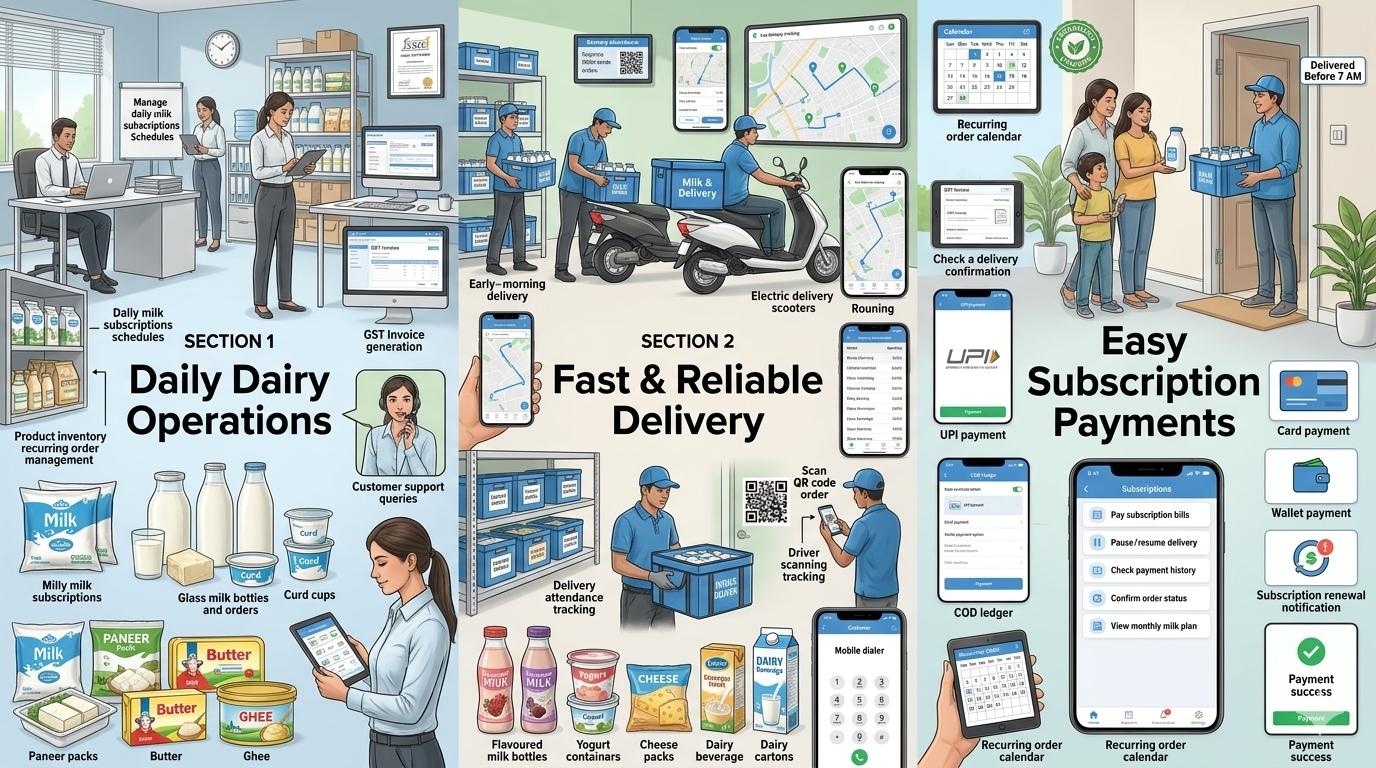
Going live is the beginning, not the finish line. Daily management of a milk delivery operation requires disciplined systems across three fronts: commerce, logistics, and payments.
GST and Invoicing
Milk (not packaged) is exempt from GST. However, value-added products like curd, ghee, and paneer attract 5–12% GST depending on packaging. Configure your platform to apply correct tax rates per SKU and generate GST-compliant invoices automatically. Manual invoicing at scale is error-prone and non-compliant.
Subscription Rules
Set clear cut-off times for next-day modifications (typically 10 PM)
Define auto-renewal logic: billing cycle, reminder notifications
Manage pause and resume without losing subscription data
Communicate plan changes to customers proactively
Delivery Routing
In-house delivery team: Gives you complete control over quality and timing. Requires investment in bikes, uniforms, and training. Best for dense urban geographies.
Third-party delivery partners: Faster to scale, but requires contract SLAs and quality standards to be enforced. Appropriate for suburban or multi-city expansion.
Regardless of model, route optimisation is critical. A well-sequenced route reduces delivery time, fuel cost, and partner fatigue — directly impacting on-time performance.
Payment Gateway and COD
Integrate a reliable payment gateway supporting UPI, net banking, credit and debit cards
Enable wallet-based recharge for prepaid subscriptions
For COD: use delivery partner app to track and reconcile daily collections
Set up automated payment reminders for outstanding dues
Analytics and Security
Google Analytics: Track app traffic, subscription funnel drop-offs, and product popularity to inform content and marketing decisions.
reCAPTCHA: Protect your sign-up and checkout flow from bot registrations that distort your operational data.
Marketing Your Milk Delivery App
Marketing for a dairy delivery business is hyper-local and trust-dependent. You are asking someone to change how they get a daily essential — that requires repeated, credible touchpoints, not a single ad blast.
Search Engine Optimisation
Build content around what your customers are actually searching for. Terms like how to start milk delivery business, how to manage milk delivery business, and how to expand dairy business online indicate the decision-making journey of dairy entrepreneurs — and are also terms your potential customers and partners research. Invest in location-specific landing pages (e.g., "Fresh A2 Milk Delivery in Gurgaon") and informational blog posts that build category authority.
Performance Advertising
Google Search Ads: Target high-intent keywords like "fresh milk delivery near me", "A2 milk subscription", and locality-specific terms.
Meta Ads (Instagram and Facebook): Use video content showing your farm, delivery process, and customer testimonials. Retarget app visitors with subscription offers.
Housing society and RWA targeting: Partner with resident welfare associations for bulk subscription deals. Offer a free trial to an entire apartment block — the word-of-mouth ROI is exceptional.
Informational and Community Content
Entrepreneurs researching how to start a dairy business in India, how to start milk supply business, or how to grow milk delivery business are your future brand advocates and potential partners. Create content that addresses these questions — guides, checklists, operational templates, and video walkthroughs. This builds inbound organic traffic while positioning your brand as a category authority.
Publish weekly sourcing updates on Instagram
Share customer stories and delivery milestones
Run referral campaigns: existing customers earn credit for new subscriber referrals
Order Fulfilment
For a dairy delivery business, order fulfilment is not a backend function — it is the product. Your customer's experience is defined by what arrives at their door at 6 AM, not by your app's UI. Every operational failure in fulfilment directly translates to a subscription cancellation.
Timely Delivery — Non-Negotiable
Define your delivery window and protect it operationally. If you commit to 5:30–7:30 AM, build a system where that window is met 99% of the time. This means dairy pickup happens by 4:30 AM, routes are loaded by 5:00 AM, and delivery partners start their first stop no later than 5:15 AM. Any deviation requires a real-time customer notification. Missing this window even occasionally is exactly what causes customers to cancel — see why missed milk deliveries are the biggest reason customers stop subscriptions."
Daily Consistency
Standardise packaging weights and volumes with daily QC checks
Use tamper-evident packaging for customer confidence
Track daily delivery success rates per route and per partner
Set an internal SLA for missing delivery resolution (within 2 hours, including redelivery or credit)
Real-Time Updates
Send order confirmation the evening before
Dispatch notification when the delivery partner starts their route
Delivery confirmation with timestamp and partner name
Missed delivery alert with next-step options (credit/redelivery)
Packaging for Freshness
Use food-grade pouches or bottles sealed and date-stamped
For curd and paneer: insulated packaging during summer months
Label every package with product name, quantity, FAT %, and shelf life
Scale Your Online Business
Once your core operation is running smoothly, growth is a function of data, experimentation, and disciplined expansion. The pathway to scale in dairy delivery follows a clear sequence.
The Growth Framework: Analyse → Strategise → Implement → Repeat
Analyse: What are your top-performing routes? Which SKUs have the highest reorder rate? Where do customers churn — after week 1, week 4, or month 3? What is your cost per delivered order?
Strategise: Use data to identify your next move. If A2 milk has a 60% repeat rate but only 10% of your catalogue, consider expanding that product line. If a particular route has high churn, investigate delivery consistency or local competition.
Implement: Roll out one initiative at a time. Adding a new product line while expanding to a new geography simultaneously dilutes execution quality. Focus creates speed.
Repeat: Growth in dairy delivery is incremental and compounding. Each operational improvement — better routing, tighter subscription management, stronger supplier relationships — builds on the last.
Route Optimisation at Scale
As your subscriber base grows, manual route planning becomes a constraint. Invest in route optimisation tools that factor in delivery sequence, traffic patterns, and building access restrictions. A well-optimised route reduces delivery time by 20–35% and allows each partner to handle more stops per shift.
Subscription Growth Levers
Referral programmes: credit-based rewards for bringing in new subscribers
Annual subscription plans with upfront discounts to improve cash flow
Family plan bundles: combine milk, curd, and ghee at a unified monthly rate
Corporate subscriptions: partner with offices and coworking spaces for bulk daily orders
Product Expansion
Research into how to expand dairy business online consistently points to product expansion as the highest-margin growth lever. Once your delivery infrastructure is proven, adding paneer, flavoured milk, or artisanal butter requires no additional logistics investment — the route already exists. Each new product increases average order value without increasing delivery cost. This is the same principle explored in how selling multiple dairy products in one app increases daily revenue.
Geographic Expansion
Before entering a new city or zone, validate it operationally. Identify your sourcing partner in the new geography, pilot with a small subscriber base, and measure delivery performance for 30 days before scaling. Expanding dairy delivery geographically without operational readiness destroys brand reputation faster than any competitor. For a deeper look at managing this kind of multi-location rollout, see how a milk delivery app helps expand service to more locations.
Ready to Build Your Milk Delivery App?
Shopaccino offers the complete infrastructure for dairy ecommerce — storefront app, delivery partner app, subscription management, payment gateway integration, and route management. Built for the operational realities of dairy delivery in India.