How to Sell Plants Online: Step-by-Step Guide for Plant Sellers
Plant shopping has quietly moved online. Customers who once visited the nearest nursery for a Money Plant now scroll through online stores at midnight, comparing varieties, prices, and care instructions. Home gardeners order Vermicompost from sellers two cities away. Apartment dwellers buy indoor plants with pots delivered to their door in two hours. Gardening as a hobby has grown rapidly across age groups, and the demand for plants, pots, fertilisers, and tools is now strong enough to support full time online nursery businesses.
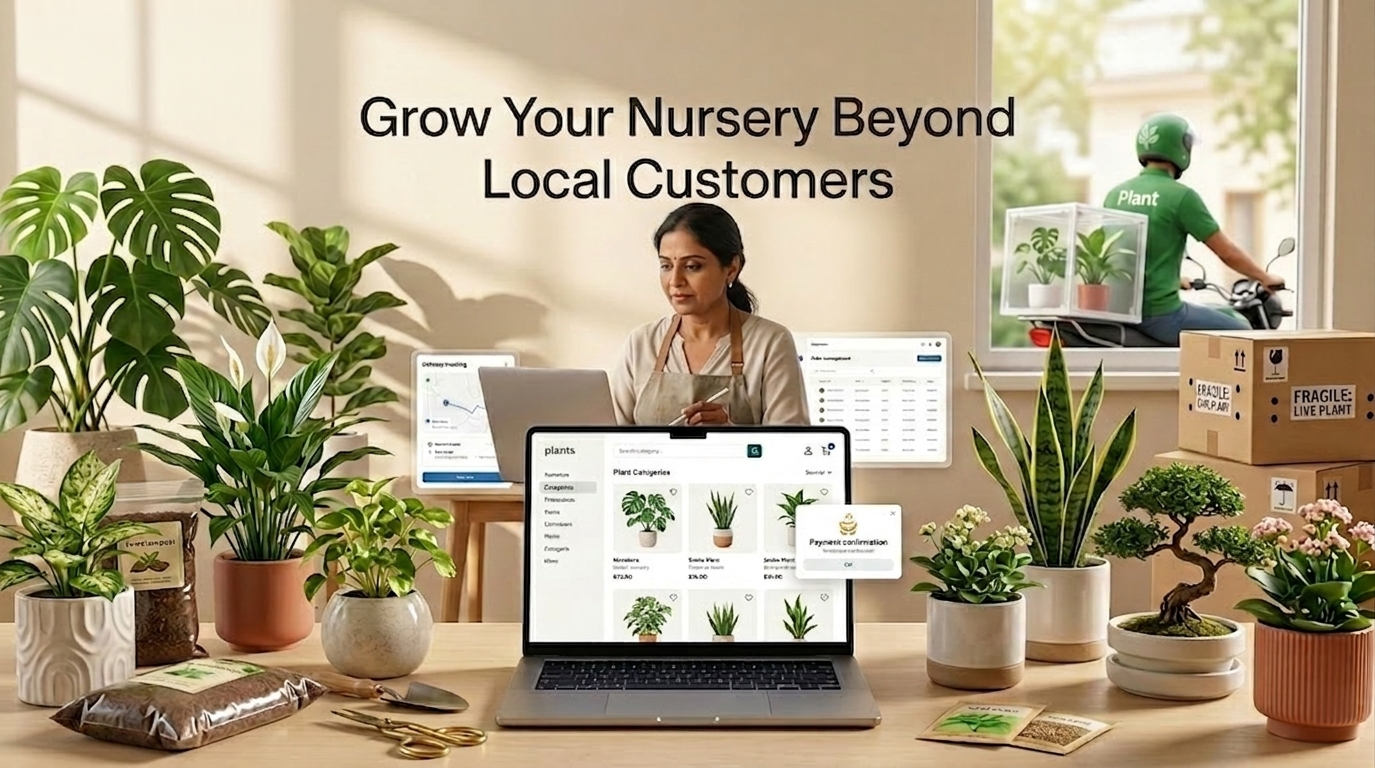
Nursery owners and plant sellers are responding by setting up their own ecommerce websites. The ones still relying entirely on walk in customers, local markets, or WhatsApp order lists are seeing growth flatten while online competitors expand into new cities every quarter. Marketplaces help with discovery but take significant commissions, control the customer relationship, and limit how a small nursery can build its identity. The real opportunity for plant sellers today is to build a branded website that handles orders, payments, and delivery while letting the seller focus on plants and customers.
Working out How to Sell Plants Online is not as complicated as it sounds. The challenge is not the technology. The challenge is operational. How do you photograph dozens of plant varieties consistently? How do you organise indoor plants, flowering plants, bonsai, and gardening products into clear categories? How do you handle live plant delivery without losing half your stock to damaged shipments? How do you take online payments smoothly? A modern ecommerce platform handles most of the technical work, so you can focus on these operational decisions.
This guide walks through everything practical. The limitations of offline only selling, the categories you can list, the features your nursery ecommerce website actually needs, how delivery and packaging work for live plants, and where Shopaccino fits in as SaaS ecommerce software that anyone running a plant business can use to build a branded online store. The focus is on real plant ecommerce operations, not gardening education.
Why Offline Plant Selling Limits Business Growth
Most nursery owners do not start with a goal of running an offline only business forever. They start that way because it is the easiest place to begin. Over time, the limits of offline only selling become harder to ignore.
Limited Local Customer Reach
An offline nursery serves customers who physically know about its location. That circle is usually small. A nursery in one neighbourhood cannot easily reach buyers in the next neighbourhood, even when those buyers would happily order the same plants. Online selling expands the customer base from a few streets to an entire city, and eventually to multiple cities.
Dependency on Walk-in Customers
Footfall depends on weather, season, weekend timing, and how busy customers are. Heavy rain on a Saturday can wipe out a day's sales. Long heat waves can keep buyers indoors for weeks. Walk in dependency makes income unpredictable, and unpredictable income makes business planning very difficult.
Seasonal Sales Fluctuations
Plant sales spike during festive seasons, monsoon planting, and home renovation periods. They drop sharply during peak summer or extended cold weather. Offline only nurseries feel these swings hard. An online channel smooths some of these fluctuations by reaching customers who are buying for indoor plants, gifting, or office decor regardless of weather.
Manual Order Handling
Many small nurseries currently take orders through WhatsApp, phone calls, or written notes. The seller writes down the customer's address on paper, calls a delivery rider, follows up about payment, and updates the customer manually. This works for ten orders a day. It collapses at fifty. The operational overhead becomes the bottleneck that prevents growth.
Difficulty Managing Product Visibility
In an offline shop, only the plants in front of the customer are visible. The rare Anthurium in the back greenhouse stays unsold because no one knows it is available. An online store puts every plant in front of every visitor, with categories, filters, and photos. Products that would never get walk in attention start finding buyers.
Limited Business Scalability
Growing an offline business means renting more space, hiring more staff, and stocking more inventory. Each step requires capital and slow execution. Growing an online business means the same nursery serves more customers through better photography, more product listings, and reliable delivery. The economics scale very differently.
The Real Cost of Staying Offline Only It is not just lost sales. It is lost customer information, lost repeat purchase opportunities, and lost ability to react to demand. Every walk in customer who leaves your shop without a follow up channel is a relationship that ends at the door. An online store turns each visitor into a customer record you can serve again. |
Why Selling Plants Online is Growing Rapidly
The online plant market has grown faster than most nursery owners expected. The reasons are not hard to understand once you look at how customer behaviour has shifted in the last few years.
Increasing Interest in Home Gardening
Home gardening, balcony plants, and indoor greenery have become mainstream. Younger buyers in particular treat plants as part of their home identity, not just decorative items. This shift expands the buyer base from serious gardeners to anyone who wants their home to feel calmer and more alive.
Indoor Plant Demand Growth
Apartment dwellers, office buyers, and small space residents are buying indoor plants like Money Plant, Snake Plant, ZZ Plant, Peace Lily, Areca Palm, and Monstera in steady volume. These plants are sturdy, suit indoor light, and travel well in delivery. The category alone supports hundreds of small plant businesses across Indian cities.
Customers Preferring Home Delivery
The same buyers who shop for groceries, clothes, and electronics online now expect plants the same way. Going out to a nursery, picking plants, carrying heavy pots, and arranging transport is friction. Home delivery removes all of it. Customers who would buy two plants in person often buy six when they can simply tap and pay.
Convenience of Online Plant Shopping
An online plant store is open at midnight. Buyers can browse fifty varieties without rushing. They can read care instructions before deciding. They can compare prices, check reviews, and make a thoughtful choice. None of this is possible in a busy nursery on a Sunday afternoon with three other customers waiting.
Growth Opportunities for Local Nursery Businesses
This shift creates the biggest opportunity in years for local nursery owners. A small online nursery business can serve an entire city with the same physical setup that previously served one neighbourhood. The plants do not change. The customer reach does. Local sellers with their own ecommerce websites are quietly outgrowing larger competitors who relied entirely on retail spaces.
Types of Plant Products You Can Sell Online
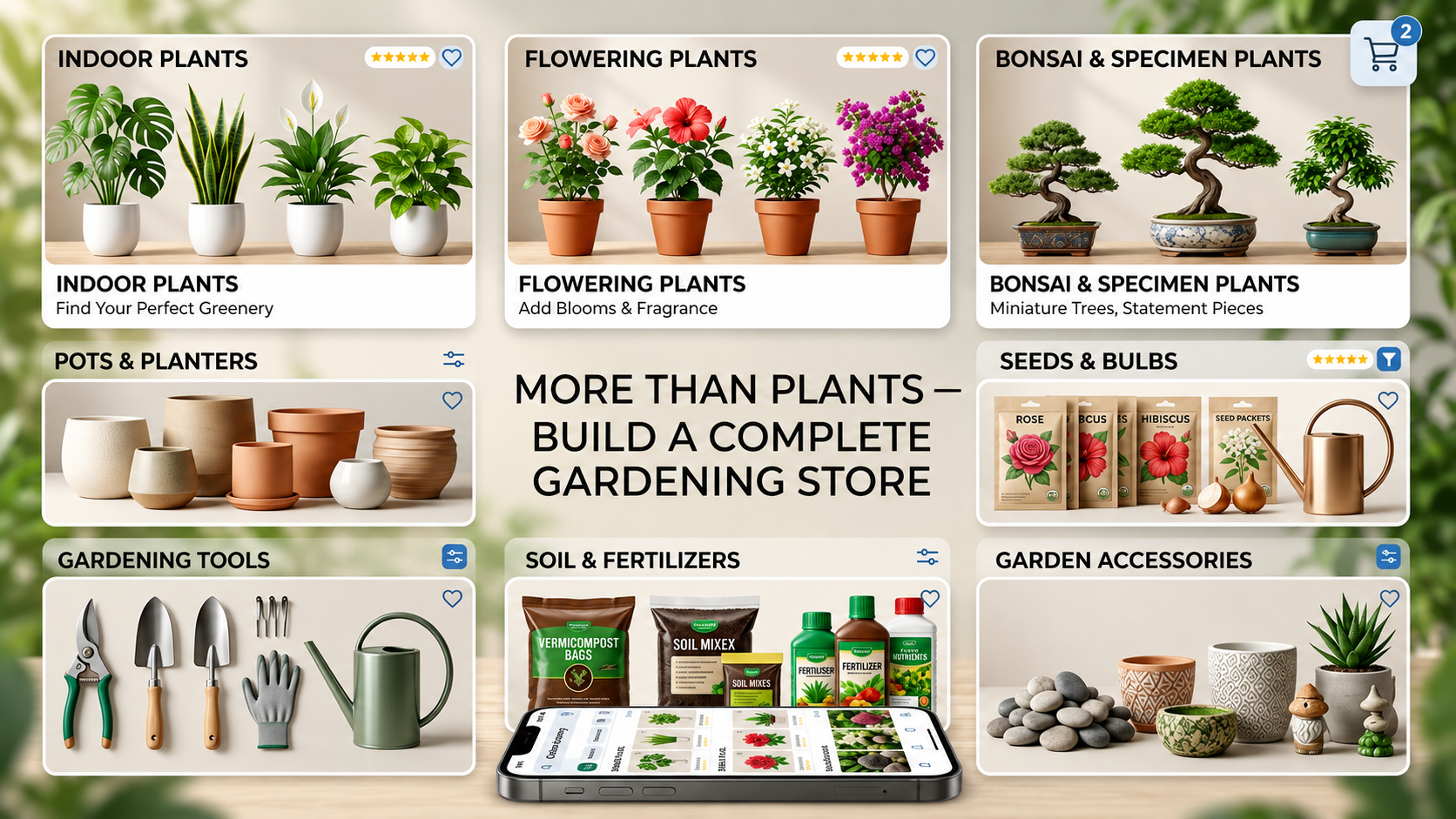
One of the strengths of plant ecommerce is the range of products you can list under one online store. A good nursery website is not just plants. It is a complete gardening destination. Here are the major categories that work well online today, grouped the way most successful plant ecommerce stores organise their catalogue.
Live Plants by Category
- Indoor plants for living rooms, offices, and study spaces
- Bedroom plants like Snake Plant, Aloe Vera, and Peace Lily that improve sleep environments
- Vastu plants like Money Plant, Tulsi, Bamboo, and Jade for traditional buyers
- Plants with pots, pre potted and ready to display, ideal for gifting
- Flowering plants like Hibiscus, Marigold, Rose, Bougainvillea, and Jasmine
- Bonsai plants for collectors and serious gardeners
- Spice plants like Curry Leaf, Mint, Lemongrass, and Coriander for kitchen gardens
- Lucky plants like Lucky Bamboo, Pachira, and Money Tree often bought as gifts
Seeds and Bulbs
- Flower seeds for home gardeners
- Vegetable seeds for kitchen gardens and balcony farming
- Flower bulbs for seasonal blooms like Tulip, Dahlia, and Lily
Gardening Accessories and Supplies
- Pots and planters in different materials such as terracotta, ceramic, plastic, and metal
- Garden tools like trowels, pruners, gloves, and watering cans
- Decor items like garden lights, miniatures, and pebbles
Soil, Fertilisers, and Plant Care Products
- Vermicompost, the highest selling organic fertiliser online for home gardeners
- Liquid Fertilisers for fast acting feeding
- Slow-Release Fertilisers for low maintenance care
- Plant Growth Promoters and rooting hormones
- Soil mixes, cocopeat, perlite, and other potting media
These categories let an ecommerce website for plants cover the full customer journey. A buyer who comes for one Money Plant often also adds a pot, a small bag of fertiliser, and a watering can to the same order. Cross category sales are one of the easiest ways to grow average order value in online plant businesses, and they happen naturally when the catalogue is organised cleanly.
Essential Features Required in an Online Plant Store
Plant ecommerce has slightly different feature needs from a generic product store. Some features that matter less in other categories become essential when the product is alive and fragile.
Product Category Management
With dozens of plant varieties, pots, fertilisers, and accessories, clear categories are essential. The platform should support nested categories like Indoor Plants > Low Maintenance > Snake Plant, plus tag based filtering for size, light requirement, pet safe status, and price band. Customers cannot browse a flat list of 200 products and find what they want.
Product Image Galleries
Plants are bought with the eyes first. Each product needs multiple high quality photos. A clear hero shot of the full plant. A close up of leaves. A photo showing the pot if it is included. An on shelf or styled photo showing scale. Clean galleries with zoom and swipe support are essential. A plant with one blurry photo will not sell, no matter how healthy it is.
Inventory Management
Real time inventory management prevents overselling. When the last of a popular plant variety sells, the product should mark itself unavailable rather than continue accepting orders. Low stock alerts help you reorder fast moving items like Money Plant or Snake Plant. This matters even more for plants because every overshoot creates a difficult customer conversation about cancellation.
Mobile Responsiveness
Most plant browsing happens on phones. A mobile-friendly website with clean product photos, easy category navigation, smooth filtering, and a frictionless checkout is essential. A poor mobile experience kills conversion before customers reach the cart, regardless of how healthy your plants are.
Secure Checkout
The checkout must be encrypted, PCI compliant, and protected against fraud. SSL certificates, verified payment processors, and clean error handling all matter. First time buyers especially look for security cues before entering payment details.
Payment Gateway Integration
A secure payment gateway supporting cards, UPI, wallets, net banking, and Cash on Delivery covers most Indian plant buyers. Plant orders often include Cash on Delivery because some buyers want to verify the plant condition at the door. Enable the methods that suit your delivery model and customer base.
Order Management
All orders should appear in a single order management dashboard with full details, status filters, and the ability to communicate with customers from inside the order screen. Refunds, replacements for damaged plants, and order updates should be handled without switching tools.
Delivery Management
Plant delivery is different from regular ecommerce delivery. The platform should support zone based delivery rules, time slot selection, integration with local hyperlocal delivery services, and clear delivery cost calculation at checkout. We will cover this in more detail in the next section.
Customer Notifications
Automated email, SMS, and WhatsApp notifications keep buyers informed. Order confirmed. Out for delivery. Delivered. Replacement processed. These updates reduce inbound support queries significantly and build customer confidence on first orders.
Product Filtering
Filters for light requirement, plant size, maintenance level, pet safety, indoor versus outdoor, and price band make large catalogues navigable. A buyer looking for a low maintenance pet safe indoor plant under 500 INR should be able to find it in three taps.
Plant Care Instruction Sections
Each product page should include basic care instructions. Light needs. Watering frequency. Soil type. Common problems. This is not a gardening tutorial. It is a confidence builder for nervous first time plant buyers who fear killing the plant. Clear care instructions on every product page increase conversion measurably.
Choosing the Right Delivery Partner for Plant Selling
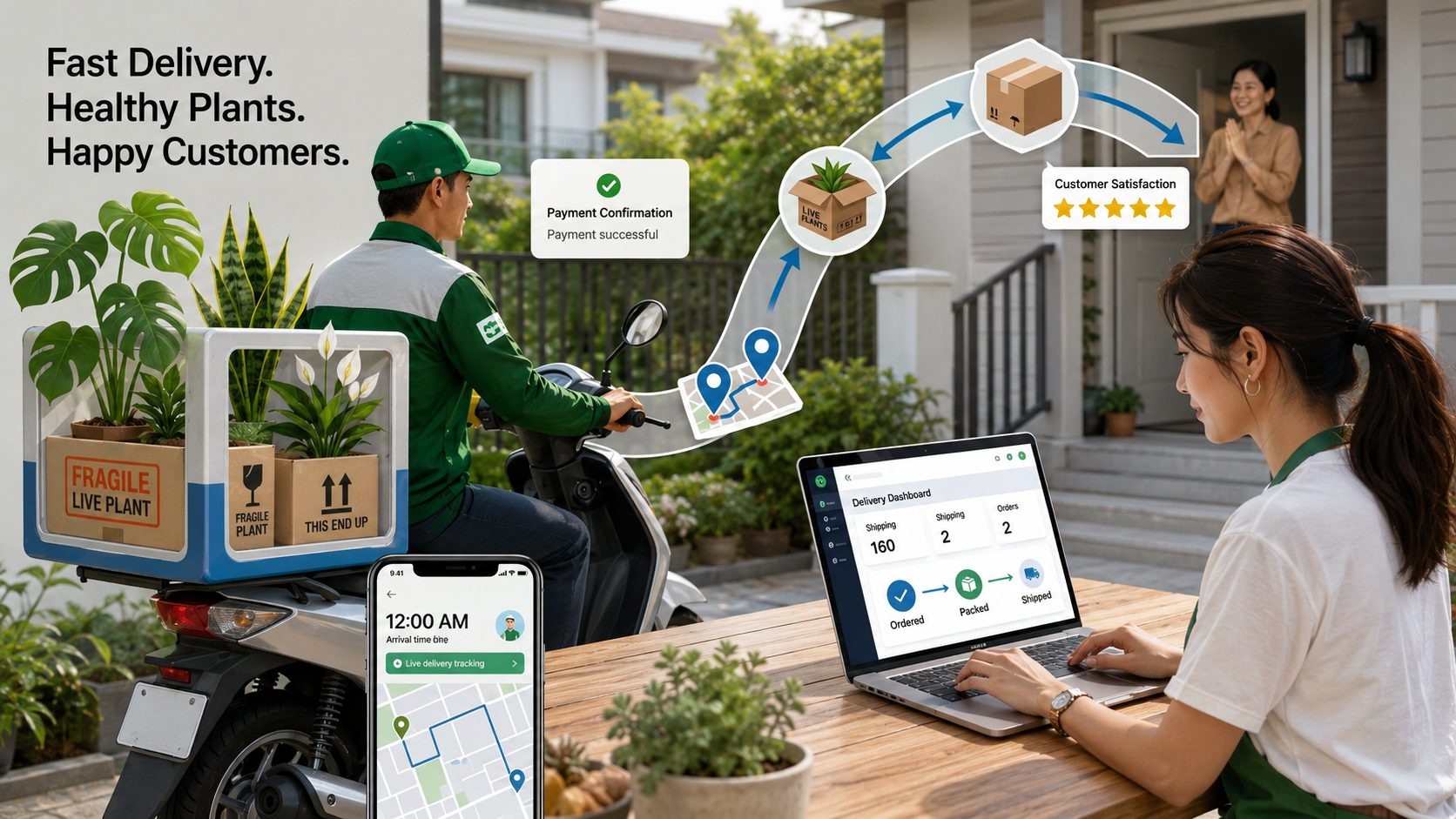
Delivery is where many online plant businesses succeed or fail. Plants are alive, fragile, and sensitive to handling, temperature, and time. A regular courier service that handles books, clothes, and electronics fine can be the wrong choice for live plants. Choosing the right delivery partner is one of the most important operational decisions in plant ecommerce.
Importance of Hyperlocal Delivery for Live Plants
Hyperlocal delivery means delivery within the same city, usually within a few hours of order placement. For live plants, this is the gold standard. Short transit times mean less stress for the plant, less risk of damage, less temperature variation, and fewer broken pots. Hyperlocal delivery turns plant orders into a same day experience that customers genuinely enjoy.
Benefits of Choosing Local Delivery Partners
Local rider services like Dunzo, Porter, Borzo, and similar regional providers often handle plants better than national couriers. The reasons are practical. Local riders can carry plants upright rather than horizontally. They make fewer handoffs. They reach the buyer in two to four hours rather than three to five days. They are familiar with apartment complexes, gated communities, and the realities of urban delivery.
Faster Delivery Advantages
A plant delivered within four hours arrives in almost the same condition it left the nursery. A plant delivered in three days has been in transit through warehouses, temperature changes, and multiple handlers. Faster delivery is not a luxury for live plants. It is operationally essential to keep replacement rates low and customer satisfaction high.
Reducing Plant Damage During Transit
Damage in transit is the single biggest source of refund and replacement requests for online plant businesses. Choose delivery partners who allow upright transport, accept fragile labels seriously, and have actual track records with live products. Have an open conversation about plant handling before signing up. Test with 20 sample shipments before scaling.
Delivery Tracking Importance
Plant buyers are anxious until the plant arrives. Live tracking pages, estimated delivery time, and rider contact details reduce inbound support queries by a meaningful share and keep customers calm during the wait. The platform should support tracking automatically once integrated with your delivery service.
Handling Fragile Live Plant Shipments
For long distance orders that cannot use local rider services, choose courier partners with a perishable or fragile category. These cost slightly more but handle the package very differently. Air shipment for premium plant orders to other cities can also be worth the extra cost when the plant value justifies it. Build the higher shipping cost into the price rather than absorbing it silently.
Proper Packaging for Live Plant Delivery
Packaging is the single most important operational skill you will develop as an online plant seller. Get it right and your replacement rate stays under 5 percent. Get it wrong and you will spend half your day responding to complaints. A reliable packaging process protects both the plant and the customer relationship.
Why Packaging is Critical for Plant Survival
Plant delivery packaging is what stands between a healthy plant and a damaged one. A small Anthurium worth 800 INR can become a refund request worth 800 INR plus shipping plus reputation damage with bad packaging. Treat packaging as a real product, not as wrapping. Invest in materials. Train your team. Document the standard. The savings on replacements pay for the investment many times over.
Moisture Protection
Wrap the root ball in damp sphagnum moss or coco coir, then in thin polythene secured with a rubber band. The aim is humidity around the roots without free water leaking into the box. Stop watering the plant 24 to 36 hours before packing so the soil is moist but not dripping wet.
Root Protection
A healthy root ball is the heart of the plant. Lift the plant gently from its pot, keep the soil intact around the roots, and wrap it before placing it back. For pre potted orders, secure the pot inside the box so it cannot shift during transit. Loose pots break and damage the plant simultaneously.
Airflow Considerations
Punch six to eight breathing holes spread across the sides of the box. Without airflow, a sealed box becomes a small greenhouse in warm weather and the plant cooks from inside within 24 to 48 hours. This is one of the biggest avoidable causes of damage in summer plant deliveries.
Spill Prevention
Wrap the soil and root area in polythene to prevent loose soil from spilling into the box during transit. Spilled soil makes the box look damaged on arrival, creates a poor unboxing experience, and sometimes triggers refund requests even when the plant itself is fine.
Secure Pot Handling
If the plant is shipped in a ceramic or terracotta pot, wrap the pot separately in bubble wrap and brace it inside the box so it cannot move. Bumps and drops during transit shatter unbraced pots. A broken pot at the customer's door creates a negative experience even if the plant itself survives.
Eco-Friendly Packaging Options
Plant buyers care more about environmental impact than buyers in most other categories. Use cardboard rather than plastic where possible. Choose paper based padding over bubble wrap. Source biodegradable wrapping for the root ball. Branded eco packaging also signals brand values clearly and builds genuine loyalty with conscious buyers.
How Shopaccino Helps You Build an Online Plant Store
Shopaccino is SaaS ecommerce website builder software that anyone running a plant business can use to create a branded online nursery on their own domain. The same platform supports a small home nursery, a multi outlet retailer, a regional grower going direct to customer, and a specialty plant brand. Here is a practical look at the features Shopaccino provides for plant businesses.
Customisable Themes
Shopaccino includes a library of themes you can customise through the dashboard. Adjust colours, fonts, banners, and section layouts so the store reflects your nursery brand. A premium tropical plant brand can look very different from a budget home gardening store on the same platform.
Responsive Website Design
Every Shopaccino theme is built for responsive design. The same store automatically adjusts to look right on desktops, tablets, and phones, with no separate design work needed for each screen size. This matters significantly for plant ecommerce since most browsing happens on phones.
Product Management
Plants with variants like pot size, plant size, or pot material fit cleanly into the variant system. Each combination is tracked as a separate stock unit. CSV import and export support bulk catalogue uploads when you have hundreds of varieties. Categories, tags, and filters help customers browse cleanly.
Payment Integrations
Shopaccino supports a wide range of payment gateways including cards, UPI, wallets, net banking, and Cash on Delivery for the buyers who prefer to inspect the plant before paying. Enable the methods that match your customer base.
Shipping and Delivery Integrations
The platform connects with hyperlocal delivery services and major courier services so you can configure local rider delivery for nearby orders and long distance courier shipping for outstation buyers. Shipping management rules support zone based pricing, free delivery thresholds, and weight/amount based rates. Multi warehouse setups are supported for nurseries operating from more than one location.
Order Management
All orders flow into a single order management dashboard where you can view, filter, fulfil, refund, and communicate with customers. Order statuses update automatically as deliveries move through the rider or courier network, and customer notifications trigger at every stage.
Coupon and Offer Features
Built in tools let you create discount codes, automatic discounts, free shipping thresholds, bundle promotions, and seasonal offers. First time buyer discounts, monsoon planting offers, and festival bundles all run from the same screen.
Analytics Integration
Built in analytics give you a clear view of plant sales, top selling varieties, traffic sources, conversion rates, and customer behaviour. The platform also supports external analytics tools where deeper insights are needed.
Secure Checkout System
Shopaccino provides an SSL secured, PCI compliant checkout with multiple payment methods, address validation, and built in fraud protection. The checkout is designed to work cleanly on both desktop and mobile, which matters since most plant orders are mobile first.
Category Management Support
The platform supports nested categories, smart collections, and tag based filtering. This means you can organise your catalogue into Indoor Plants, Bedroom Plants, Vastu Plants, Flowering Plants, Bonsai, Pots, Fertilisers, and other groups, with sub categories under each. Clean category management makes large plant catalogues easy to browse.
What Shopaccino Provides for Plant Businesses Shopaccino is SaaS ecommerce software for building an online store. For plant sellers, this means a branded website on your own domain with the tools to manage plants, payments, customers, orders, and delivery integrations from one dashboard. Shopaccino does not grow plants, manage your packing, or operate delivery riders. It provides the store software so you can focus on the plants, the packaging, and the customer relationships. |
Steps to Create an Online Plant Store with Shopaccino
Setting up an online nursery on a modern platform follows a structured sequence. Following the right order avoids rework and gets you to your first online order faster.
Step 1: Choose a Domain
Pick a domain that matches your nursery brand. Short, memorable, easy to spell. Treat this as a long term decision since changing the domain after launch costs both SEO and customer trust.
Step 2: Select a Nature Friendly Theme
Pick a theme designed for ecommerce with clean support for product galleries, variant selection, and category pages. Themes with green accents, generous image space, and clean typography suit plant brands well. Preview the theme with sample plants before committing.
Step 3: Upload Plant Products
Add each plant as a product with clear titles, multiple high quality photos, accurate descriptions, and proper variant configuration for size and pot type. The quality of your first ten product entries sets the standard for the rest of the catalogue. Take time with photography. Plants are bought with the eyes, so the photos do most of the selling work.
Step 4: Organise Categories
Group products into clear categories matching how customers browse. Indoor Plants, Bedroom Plants, Vastu Plants, Flowering Plants, Bonsai, Spice Plants, Seeds, Bulbs, Pots and Planters, Garden Tools, Fertilisers, and Decor. Use sub categories under each main category if your catalogue is large. Use filters for light, size, maintenance, and price band.
Step 5: Add Descriptions and Plant Images
Each product page should have a clear description, basic care instructions, dimensions, pot size if included, and at least four to six photos. Care instructions matter especially for plants since nervous buyers worry about killing them. A well written product page can lift conversion significantly over a generic one.
Step 6: Configure Payment Gateways
Connect the payment methods your customers expect. Cards, UPI, wallets, net banking, and Cash on Delivery cover most Indian plant buyers. Test each method with a real transaction before going live.
Step 7: Set Local Delivery Rules
Define your delivery zones. Hyperlocal rider zones within your city. Standard courier zones for the rest of the country. Set free shipping thresholds, weight based rates where needed, and delivery cutoff times. Cutoff times help you batch deliveries efficiently.
Step 8: Create Policies
Write clear policy pages for delivery, refunds, plant replacement, privacy, and terms. Plant ecommerce has unique policy questions, like what happens if a plant arrives damaged or if the buyer is not home for delivery. Document these in advance so they do not become disputes later.
Step 9: Publish the Website
Once products, payments, delivery, and policies are configured, do a final review on both desktop and mobile, place a test order with a real plant, and publish. After launch, the work shifts from setup to ongoing operations and brand building.
Designing a User-Friendly Nursery Website
Good nursery website design is about presenting plants confidently and helping nervous buyers decide. A few practical design principles separate websites that build a brand from websites that just sell plants.
Homepage Layout
The homepage should communicate your nursery brand within the first scroll. A strong hero banner featuring a flagship plant or seasonal collection. Clear category links. Featured products. Customer reviews. Avoid clutter. Three or four focused sections almost always outperform ten busy ones.
Category Organisation
Big visual category tiles on the homepage help mobile users tap into what they want quickly. Indoor Plants, Flowering Plants, Bonsai, Pots, Fertilisers, and Garden Tools as visible categories work well. Smaller sub categories live inside each main section to avoid overwhelming the first view.
Banners and Plant Visuals
Use real photography of your actual plants, not generic stock images. A photo of your own Money Plant in your own pot tells the customer this is what they will receive. Original visuals consistently outperform stock photography in plant ecommerce because the buyer can sense the difference.
Easy Navigation
Visitors should reach any plant within two clicks from any page. Top navigation menu with five to seven main categories, plus a clear search bar, covers most needs. Avoid hiding categories behind multiple menu layers, since this makes browsing tedious on mobile.
Mobile Optimisation
Design for the phone first. Large tap targets. Fast loading product pages. Sticky add to cart button. Clean checkout. Test every product page on a real phone before launch.
Trust Building Elements
Visible contact information, clear plant replacement policy, photos of your real nursery, verified payment logos, and customer reviews with plant photos all reduce hesitation at the moment of decision. First time plant buyers worry about being scammed, so trust signals matter more here than in many other categories.
Seasonal Collections
Group plants into seasonal collections like Monsoon Planters, Festival Gifting Plants, Winter Indoor Plants, and Summer Hardy Plants. These collections give returning customers a reason to come back every quarter and signal that the store is actively curated rather than a static catalogue.
Customer Friendly Browsing Experience
Every page should make the next action obvious. Category leads to product. Product leads to add to cart. Cart leads to checkout. Checkout leads to confirmation. Smooth flow turns a casual visit into a completed order. Confusing or jumpy navigation breaks the buying mood.
Managing Orders, Payments, and Plant Deliveries
Running a plant ecommerce business day to day involves a repeating workflow that should feel routine. The platform should make each stage predictable and quick.
Online Payments
Online payments should be fully automated. The customer pays, the gateway verifies, the order is recorded, and a confirmation is sent. Settlement happens on the gateway's schedule, typically within one to three business days. The platform should track payment status alongside the order so you always know what is cleared and what is pending.
COD Options
Cash on Delivery still drives a meaningful share of plant orders in India. Many plant buyers prefer to inspect the plant before paying. Enable COD where it fits your delivery model. Be aware that COD orders typically have a higher cancellation rate, so consider charging a small COD fee or limiting it to verified addresses.
Local Delivery Workflows
Define clear delivery stages. Confirmed, packed, dispatched, out for delivery, delivered. For hyperlocal rider services, the rider often handles dispatch to delivery in one continuous step. For courier shipments, stages stretch over two to four days. Each stage should trigger an automatic customer notification.
Customer Notifications
Automated email, SMS, and WhatsApp notifications keep customers calm during the wait. Order confirmed. Out for delivery. Delivered. These updates feel routine but significantly affect customer satisfaction, especially for nervous first time buyers waiting for a live plant.
Delivery Tracking
Tracking pages with current status, estimated delivery time, and rider or courier details reduce inbound queries by a meaningful share. Customers checking on their plant order is one of the most common reasons for support contact in plant ecommerce.
Order Management
All orders should live in one order management dashboard where you can filter by date, status, customer, or plant. Bulk actions for printing labels, updating statuses, and exporting data save hours when order volume grows. The dashboard becomes the operational heart of the nursery business.
Return and Replacement Communication
Plants occasionally arrive damaged. The platform should support replacement processing from inside the order screen, with clear status updates back to the customer. A buyer who reports a damaged Anthurium and receives a friendly reply within two hours with a replacement promise often becomes a long term customer. Slow or rude responses to damage reports do the opposite.
Common Mistakes Plant Sellers Make While Going Online
Some mistakes show up again and again when nursery owners launch their first online store. Recognising them in advance saves months of slow performance and unhappy customers.
Poor Product Images
Blurry photos, harsh lighting, inconsistent backgrounds, and stock imagery are the biggest single cause of low conversion on plant websites. Plants are bought with the eyes. Invest in consistent product photography from day one. A simple setup with natural light and a phone camera, used consistently across all products, often works very well.
Weak Mobile Experience
Designing for desktop only and treating mobile as an afterthought is one of the most expensive mistakes in plant ecommerce. The majority of your traffic comes from phones. Test every product page and the entire checkout on a real phone before launch.
Unclear Delivery Policies
Vague delivery information at checkout kills first time buyer confidence. Show delivery zones, expected timelines, and costs clearly. Plant buyers especially worry about how the live plant will travel. Be specific. Be honest. Hide nothing.
Poor Packaging
Damaged plants on arrival generate refund requests, replacement costs, and bad reviews. Packaging is part of the product, not an afterthought. Invest in materials. Train your team. Document the standard so every order ships the same way.
Limited Payment Options
Offering only one or two payment methods filters out buyers who prefer something else. Most Indian plant buyers expect cards, UPI, wallets, and Cash on Delivery as standard. Limited options force buyers to abandon orders just before checkout.
Confusing Product Categories
A flat list of 100 plants with no categories is overwhelming. Buyers leave without finding what they want. Organise the catalogue carefully from launch. Indoor, Bedroom, Vastu, Flowering, Bonsai, Pots, Fertilisers, and Tools as primary categories work well for most plant businesses.
Slow Customer Communication
Plant buyers are anxious. They wait for their plant. They worry about it dying. They have questions about care. A nursery that replies within minutes during business hours builds loyalty. A nursery that takes two days to reply loses customers permanently.
Building a Real Online Nursery Business Step by Step
Working out How to Sell Plants Online is not just about setting up a website. It is about building a real plant ecommerce business that holds up beyond the first few months. Pick the right platform. Photograph your plants properly. Organise the catalogue clearly. Set up local delivery carefully. Master packaging. Communicate quickly with customers. Treat every order like a chance to keep the customer for years.
Shopaccino is SaaS ecommerce software anyone in the plant business can use to build a branded plant selling website on their own domain. The platform provides the storefront, the catalogue, the payments, the delivery integrations, and the order workflows from one dashboard. The plants, the packaging, the relationships, and the brand remain yours to build. The store software gives you the foundation to do that work properly.
Pick a domain. Choose a theme. Upload your plant catalogue. Set up payments and local delivery. Master your packaging. Launch with a small initial test. Take real orders. Reply to every customer like the relationship matters. Refine the website monthly. That is how a small nursery becomes a real online plant brand, one healthy plant arrival at a time.