How to Sell Shoes Online and Turn Your Store into a Brand
Footwear shopping has moved online faster than many shoe sellers expected. Customers research sneakers on phones during commutes, compare formal shoes between three websites before deciding, and reorder their favourite slippers without thinking twice. The convenience of browsing fifty options at home, reading reviews, checking sizes, and getting the pair delivered the next day has changed how people buy shoes.
This shift created a clear opening for footwear businesses. Marketplaces opened that door first, and many shoe sellers built their entire online presence on Amazon, Flipkart, Meesho, Myntra, Ajio, and similar platforms. Sales came in, orders shipped out, and the business grew. Then something started to feel off. Commissions kept rising. Price wars never ended. Returns a drained margin. Customers reordered from competitors instead of returning to the original seller. The marketplace had the customer, not the seller.
That experience is exactly why more footwear sellers are now learning How to Sell Shoes Online through their own branded website. The marketplace remains useful for reach, but the real business gets built on a website you control. A branded footwear ecommerce website lets you own the customer relationship, set your own pricing, build a real brand identity, and grow a footwear business that does not depend entirely on someone else's algorithm.
This guide is written for footwear businesses already selling on marketplaces or running offline stores, who want to take the next step. The shop owner watching customers buy similar shoes from a website on their phone instead of from the shelf in front of them. The wholesaler watching distributors keep all the margin. The marketplace seller tired of dropping prices every quarter. By the end, you will have a clear, practical view of what it takes to build your own online shoe store, what features actually matter, and where Shopaccino fits in as the SaaS ecommerce software that helps you do it without a developer.
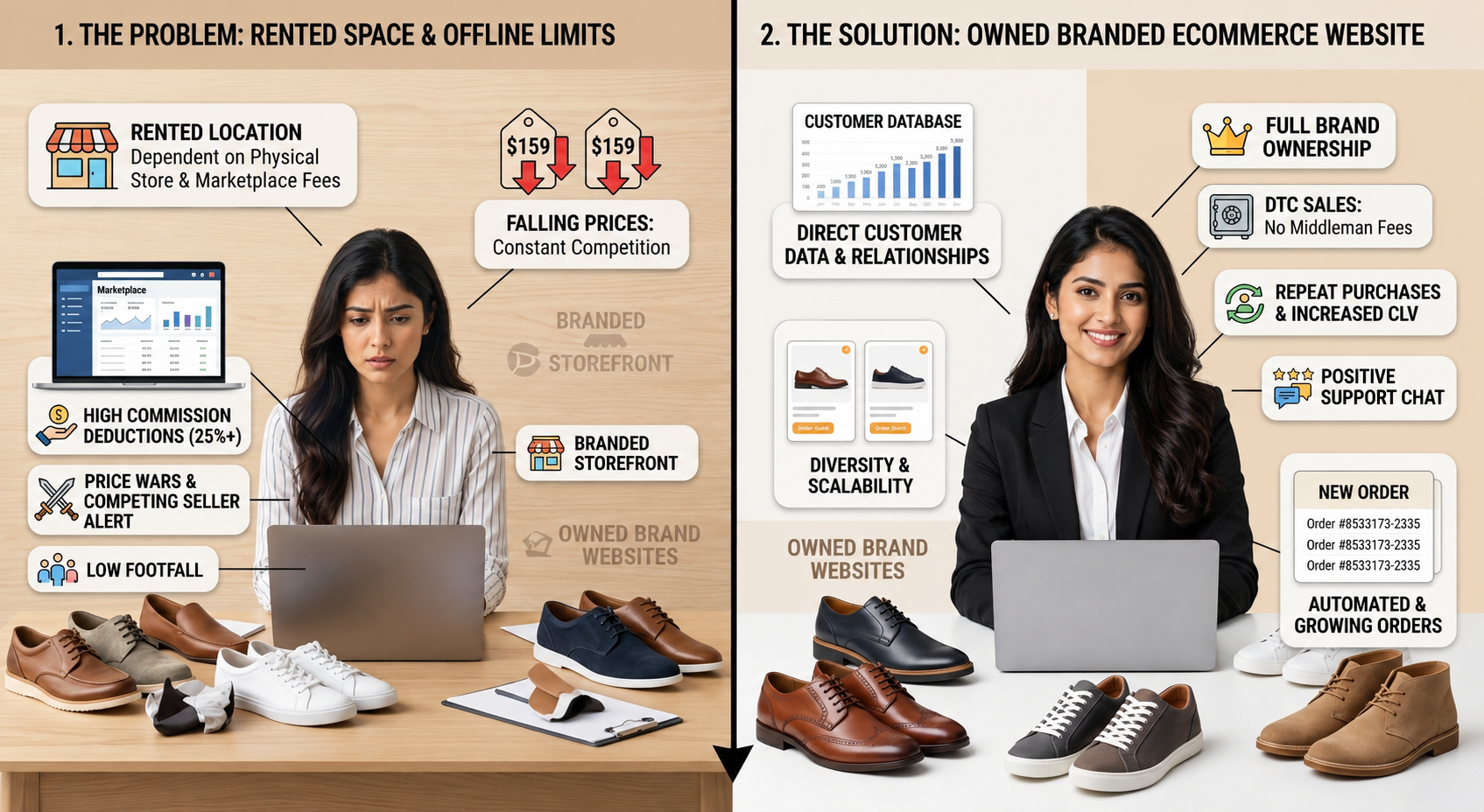
Why Marketplace and Offline-Only Selling Limits Growth
Most shoe sellers do not start with the goal of running marketplaces or offline stores forever. They start because those are the easiest places to begin. Over time, the limits of those channels become harder to ignore.
High Commissions Eat Into Margin
Marketplaces charge commissions on every order, often combined with shipping fees, payment gateway charges, and category specific deductions. For a pair of shoes priced at 2,000 INR, the total platform deduction can easily reach 25 to 35 percent. That is one third of the order value gone before you even count packaging, returns, and operational cost. Margins that look healthy on paper get squeezed to almost nothing by the time the payout hits your account.
Intense Price Competition
Marketplaces are designed for buyers to compare prices side by side. A buyer searching for white sneakers sees ten similar products in a row, often from competitors selling almost the same shoe at lower prices. The algorithm rewards the lowest price, the most reviews, and the fastest shipping. To stay visible, you keep dropping prices. The race to the bottom is real, and it never quite ends.
Dependency on Marketplace Algorithms
Your visibility on a marketplace depends on rules you do not control. The algorithm decides whose products appear at the top of search results, whose listings get featured during sales, and whose stock gets recommended to buyers. A small policy change can cut your orders in half overnight. You are essentially renting space on someone else's platform, with terms that can change without warning.
Lack of Customer Ownership
Every order on a marketplace creates a customer record for the marketplace, not for you. You do not get the customer's email. You cannot run targeted offers to past buyers. You cannot email them when a new design arrives. You cannot build a community. The customer relationship lives with the platform, which means the lifetime value of every sale flows to the marketplace, not to your brand.
Limited Branding Opportunities
On a marketplace, your product page looks like every other product page. The same template, the same layout, the same fonts. Buyers remember the marketplace, not the seller. Even when they liked the shoes, they often cannot recall who actually sold them. Brand building is almost impossible inside an environment designed to make products interchangeable.
Offline Customer Reach Limitations
Offline footwear shops have their own challenges. Customer reach is limited to people who physically walk past or know about your location. Footfall depends on weather, season, and local economic activity. Even a great shop with strong inventory cannot serve customers in the next city without setting up another physical store. Scaling offline means scaling rent, staff, and inventory in parallel, which is slow and capital intensive.
The Pattern Most Shoe Sellers Eventually Notice Marketplaces and offline stores are great places to start, but they cap how much of a real business you can build. Without your own website, you do not own the customer, the brand, or the relationship. You sell shoes, but you do not build a footwear brand. |
Why Building Your Own Shoe Brand Website Matters
A branded e-commerce website is not just another sales channel. It changes the structure of the business. The seller who sells the same shoes through their own website and through a marketplace ends up running two very different businesses, even though the products are identical.
Brand Identity Creation
Your website carries your name, your colours, your story, and your values. Customers experience the brand instead of just the product. Over time, this identity becomes the reason people choose your shoes over similar options. Brand identity is what lets a small shoe seller eventually compete with larger players on something other than price.
Direct Customer Relationships
Every order on your own website creates a customer record that belongs to your business. You have their email, their phone number, their order history, and their address. You can email them when a new collection arrives, message them on WhatsApp about a festive sale, and call them if a high-value order needs personalized follow-up. The relationship is direct, not mediated.
Repeat Customer Opportunities
Most footwear businesses lose 60 to 80 percent of potential lifetime value by not engaging past buyers. A customer who bought formal shoes once is highly likely to buy again, especially when a new style launches. Without their contact details, you have no way to reach them. With your own website, repeat purchases become a deliberate strategy rather than a happy accident.
Better Customer Trust
A branded website with professional photography, clear policies, real reviews, and proper contact information builds trust in a way marketplace listings cannot. Buyers who recognise and trust the brand are more likely to pay full price, more likely to buy multiple items, and more likely to refer friends. This trust compounds over years.
Full Control Over Pricing and Offers
On your own website, you set the prices. You decide when to run discounts and when to hold premium pricing. You design bundles, set tiered offers, configure free shipping thresholds, and create loyalty incentives. None of this requires marketplace approval. You react to your market, not to someone else's algorithm.
Independent Business Growth
A branded shoe-selling website gives you a business that grows on its own foundations rather than on rented space. You build search traffic that returns visitors year after year. You build an email list that keeps producing revenue. You build a brand reputation that opens doors with suppliers, retailers, and partners. The website becomes the asset, not just a channel.
Essential Features Required in an Online Shoe Store
Footwear ecommerce has specific feature needs that go beyond a generic product website. Some features that look optional in other categories become essential when the product is shoes. Customers cannot try them on. They worry about fit. They need to be confident about the return path before they pay. The platform must support these specific needs.
Size and Color Variant Management
Every footwear product has multiple sizes. Many have multiple colour options as well. The platform must support variant management cleanly, with each combination tracked as a separate stock unit. Selling a sneaker that comes in five sizes and three colours means managing fifteen stock units behind one product page. Without variant management, you would need fifteen separate product listings, which makes browsing painful and reordering chaotic.
Inventory Management
Real time inventory management prevents overselling. When the last pair of a popular size sells, the product variant should automatically mark itself unavailable. Low stock alerts help you reorder before bestsellers run out. Multi warehouse setups let you fulfil orders from the closest location if you operate more than one storage point.
Product Galleries
Shoe buyers depend on photos to make decisions. Each product needs multiple high quality images. A hero photo at three quarter angle. A sole shot showing the tread pattern. Detail shots of stitching, lining, and material. An on foot photo so buyers can see how the shoe looks when worn. A clean gallery that supports zoom and easy swiping is essential.
Mobile Responsiveness
Most footwear shopping happens on phones. A mobile-friendly website ensures product pages load fast, photo galleries swipe smoothly, the size selector works easily with thumbs, and the checkout completes without zooming or scrolling sideways. A weak mobile experience is one of the fastest ways to lose orders that were almost completed.
Secure Checkout
The checkout must be encrypted, PCI compliant, and protected against common fraud patterns. Customers entering card details need to feel confident. SSL certificates, verified payment processors, and clean error handling are all standard expectations. A messy checkout drops conversion sharply, especially for buyers visiting your store for the first time.
Payment Gateway Integration
A secure payment gateway supports the methods your buyers actually use. Cards, UPI, wallets, net banking, EMI for premium footwear, and Cash on Delivery where it fits your model. International gateways open the door to cross border buyers. Native integrations are more reliable than third party plugins, which often break unexpectedly.
Shipping Management
Strong shipping management supports zone based rates, weight based pricing, free shipping thresholds, and integrations with major courier services. Footwear is light enough to ship economically, but customers care about reliable delivery times. The platform should generate shipping labels, track shipments, and update customers automatically as the order moves through the courier network.
Order Tracking
Buyers want to know where their order is at every stage. Confirmed, packed, dispatched, out for delivery, delivered. Automated tracking pages and notifications by email, SMS, or WhatsApp reduce inbound support queries significantly and keep customers calm during the wait.
Customer Account System
Customer accounts let returning buyers reorder quickly, save addresses, view past orders, and track current ones. For footwear, this matters even more because buyers often want to reorder the same shoe in a different colour, or a similar style. Account features lift repeat purchase rates measurably.
Return and Exchange Policy Pages
A clear return and exchange policy is non negotiable for footwear ecommerce. Buyers cannot try shoes on before they arrive, so they need confidence that wrong fit or wrong size will be handled smoothly. A visible, public policy on every product page, with simple terms like "7 day no questions asked exchange on size" or "free return pickup on first order", increases conversion meaningfully. Hide your return policy and watch first time buyers walk away.
Why Returns Are Especially Important for Footwear In most ecommerce categories, returns are a problem to suppress. In footwear, returns are a problem to design around. Customers will return shoes that do not fit, no matter how good the product photography is. Brands that make returns and exchanges painless turn this challenge into a competitive advantage. Brands that make returns hard lose first time buyers permanently. |
How Shopaccino Helps Footwear Businesses Build Their Brand
Shopaccino is SaaS ecommerce website builder software that anyone running a footwear business can use to build a branded online store on their own domain. The same platform supports a small home based seller, a multi outlet retailer, a wholesaler going direct to customer, and a D2C founder launching a new shoe brand. Here is a practical look at the features Shopaccino provides for footwear businesses.
Customisable Themes
Shopaccino includes a library of themes you can customise through the dashboard. Adjust colours, fonts, banners, and section layouts so the store reflects your brand. The visual design carries your identity rather than a generic platform style. A premium leather formal shoe brand can look very different from a colourful sneaker brand on the same platform.
Responsive Website Design
Every Shopaccino theme is built for responsive design. The same store automatically adjusts to look right on desktops, tablets, and phones, with no separate design work needed for each screen size. This matters more for footwear than for many other categories, since most shoe shopping is mobile first.
Product and Inventory Management
Footwear products with multiple sizes and colours fit cleanly into Shopaccino's variant system. Each size and colour combination is tracked as a separate stock unit. CSV import and export support bulk catalogue uploads when you have hundreds of SKUs. Low stock alerts help you reorder fast moving items before they run out.
Payment Integrations
Shopaccino supports a wide range of payment gateways including cards, UPI, wallets, net banking, EMI options for premium footwear, and international options for cross border buyers. Enable the methods that match your customer base, and the platform handles the technical work behind the scenes.
Shipping Integrations
The platform connects with major courier services so you can generate shipping labels, calculate live shipping rates, and track shipments without leaving the dashboard. Multi warehouse setups are supported, which helps footwear businesses fulfilling from multiple locations or shipping nationally from regional hubs.
Order Management
All orders flow into a single order management dashboard where you can view, filter, fulfil, refund, and communicate with customers. Order statuses update automatically as shipments move through the courier network, and customer notifications trigger at every stage. Bulk actions handle large order volumes efficiently.
Return Management System
Shopaccino includes a built-in return management system that handles the complete return workflow from inside your dashboard. Before a buyer even places an order, they can see the return window clearly on the product page — because Shopaccino lets you set a configurable return period per product. You decide whether a product carries a 7-day, 14-day, or 30-day return window, and that information displays on the listing before purchase. For footwear buyers who cannot try shoes before they arrive, seeing a clear, product-level return date is one of the strongest trust signals on the page.
After purchase, customers can initiate a return or size exchange request directly through their account. You receive the request in your order management panel, review it, approve or flag it, The audit trail stays attached to the original order so every return has a clear, traceable history.
For footwear specifically, where size-related returns are routine rather than exceptional, having this workflow built into the same system you use for orders and shipping removes the manual back-and-forth that slows down most small footwear stores.
Coupon and Offer Features
Built in tools let you create discount codes, automatic discounts, free shipping thresholds, bundle promotions, and time limited offers. Set usage limits, expiry dates, and minimum order values from the same screen, and track which offers actually drive new business rather than just discounting orders that would have happened anyway.
Analytics Integration
Built in analytics give you a clear view of footwear sales, top selling sizes, traffic sources, conversion rates, and customer behaviour. The platform also supports external analytics tools where deeper insights are needed.
Secure Checkout System
Shopaccino provides an SSL secured, PCI compliant checkout with multiple payment methods, address validation, and built in fraud protection. The checkout is designed to work cleanly on both desktop and mobile, which matters significantly for footwear since most buyers commit on the phone.
What Shopaccino Provides for Footwear Businesses Shopaccino is SaaS ecommerce software for building an online store. For footwear sellers, this means a branded website on your own domain with the tools to manage products, payments, customers, orders, and returns from one dashboard. Shopaccino does not source shoes, run your marketing, or promise sales. It provides the store software so you can focus on the product, the brand, and the customer relationship. |
Steps to Create Your Online Shoe Store with Shopaccino
The workflow for launching a footwear ecommerce website on a modern platform is structured and predictable. Following the right order avoids rework and gets you to your first online sale faster.
Step 1: Choose a Domain
Pick a domain that matches your brand. Short, memorable, easy to spell. Treat this as a long term decision since changing the domain after launch costs both SEO and customer trust. Most platforms let you register a new domain or connect one you already own.
Step 2: Select a Theme
Pick a theme designed for ecommerce with clear support for product galleries, variant selection, and category pages. A clean layout with strong image presentation and prominent add to cart buttons usually works best for footwear. Preview the theme with sample shoes before committing.
Step 3: Upload Products
Add each pair of shoes as a product with clear titles, multiple photos, accurate descriptions, and proper variant configuration for size and colour. The quality of your first ten product entries sets the standard for the rest of the catalogue. Take time with photography. Buyers cannot touch the shoes, so the photos do most of the selling.
Step 4: Add Size Charts and Descriptions
Footwear sizing is one of the most confusing parts of buying shoes online. Add a clear size chart to every product page, with measurements in centimetres alongside UK, US, EU, and India sizes. Include brand specific advice if your sizing differs from a standard reference. The size chart is one of the most read elements on a shoe product page.
Step 5: Configure Payment Gateways
Connect the payment methods your customers expect. Cards, UPI, wallets, net banking, EMI for premium ranges, and Cash on Delivery where it fits. Test each method with a real transaction before going live so you catch any setup issues early.
Step 6: Set Shipping Rules
Define your shipping zones, rates, and delivery times. Decide between flat rates, weight based rates, zone based pricing, or free shipping above a threshold. Free shipping above 999 or 1499 INR is a common pattern in footwear since the perceived value is high enough to support it.
Step 7: Create Return and Exchange Policies
Write a clear return and exchange policy that addresses the questions buyers actually have. Time window for returns. Acceptable condition of returned products. Whether shipping for returns is paid by buyer or seller. How exchanges for different sizes work. Show this policy on every product page, not just in the footer. The visibility itself increases conversion.
Step 8: Publish the Website
Once products, payments, shipping, and policies are configured, do a final review on both desktop and mobile, place a test order, and publish. After launch, the work shifts from setup to ongoing operations and brand building.
Designing a Professional Footwear Brand Website
Good footwear website design is about presenting the product with confidence and making the buying decision easy. A few practical principles separate websites that build a brand from websites that just sell products.
Homepage Structure
The homepage should communicate your brand identity within the first scroll. A strong hero banner featuring your hero product. A clear positioning line. Featured collections. Bestsellers. Customer reviews. Avoid clutter. Three or four focused sections almost always outperform ten busy ones.
Category Organisation
Group shoes into categories that match how customers browse. Men, women, kids. Or by occasion, like formal, casual, sports. Or by category, like sneakers, loafers, sandals, boots. Use filters for size, colour, price, and style. Good filtering turns a 200 product catalogue into a manageable browsing experience.
Banners and Lifestyle Visuals
Banner images should support the buying decision. Use real lifestyle photography rather than generic stock images. Show your shoes being worn in everyday situations. Highlight current promotions. Introduce new collections with strong photography. Lifestyle visuals build aspirational appeal in a way product on white background photography cannot.
Mobile Optimisation
Design for the phone first. Product galleries that swipe smoothly. Size selectors with large tap targets. Sticky add to cart buttons. Clean checkout. Test every product page on a real phone before launch. The mobile experience determines whether the order completes.
Trust Building Elements
Visible contact information. Clear return policy. Verified payment logos. Customer reviews with photos. Real testimonials. SSL padlock. Each of these reduces hesitation at the moment of decision. First time buyers especially look for these signals before entering payment details.
Customer Friendly Navigation
Every page should make the next action obvious. Product pages lead to add to cart. The cart leads to checkout. The checkout leads to confirmation. The confirmation leads to suggested products. Avoid forcing buyers to think about what to do next.
Professional Product Presentation
Consistency matters more than individual photo quality. Use the same backgrounds, similar angles, and consistent lighting across every product. A catalogue with consistent styling looks like a real brand. A catalogue mixing studio shots, phone photos, and stock images looks like a marketplace listing, regardless of how good the individual products are.
Managing Orders, Shipping, Returns, and Customer Experience
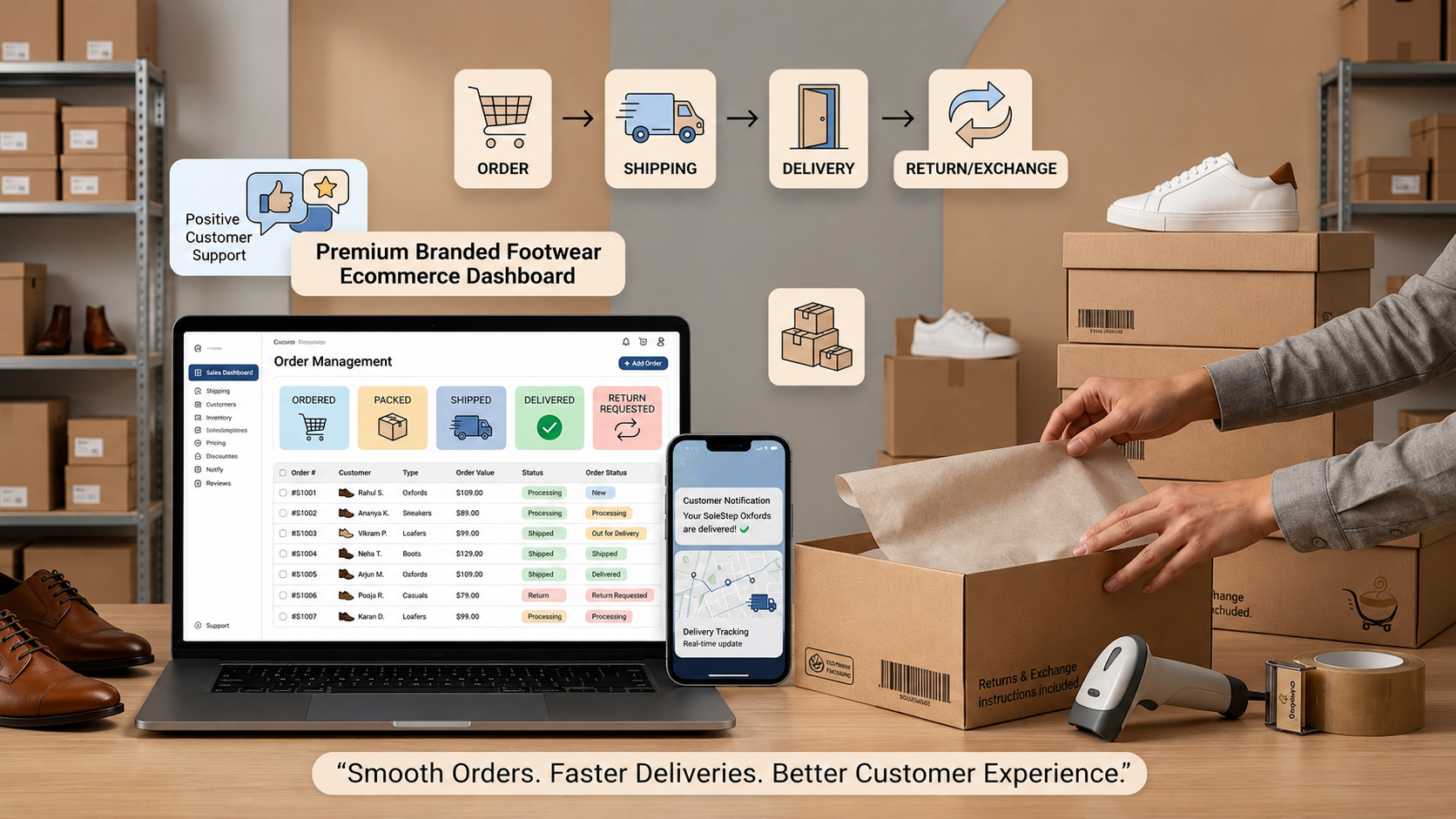
Running a footwear ecommerce website day to day involves repeating workflows. The platform you choose should make each of these workflows predictable and quick.
Online Payments
Online payments should be fully automated. The customer pays, the gateway verifies, the order is recorded, and you receive a confirmation. Settlement happens on the gateway's schedule, typically within one to three business days. The platform should track payment status alongside the order so you always know what is pending and what is cleared.
COD Options
Cash on Delivery still drives a meaningful share of footwear orders in India and several other markets. Enable it where it fits your delivery model and customer base. Be aware that COD orders typically have a higher cancellation rate, so consider charging a small COD fee or limiting it to verified addresses.
Shipping Workflows
Define clear shipping stages. Order received. Packed. Dispatched. Out for delivery. Delivered. Each stage should trigger an automatic customer notification. Your team should be able to move orders through these stages with one or two clicks per order, supported by bulk actions for large volumes.
Delivery Tracking
Customers checking on their shoe order is one of the most common reasons for support queries. A clear tracking page with current status, estimated delivery time, and courier details reduces inbound queries by a meaningful share.
Return and Exchange Handling
Returns are part of footwear ecommerce. The platform should support refund processing from inside the order screen, with the refund automatically reflected on the original payment method. For exchanges, the workflow should allow easy size swap requests without restarting the order entirely. Document your return process clearly so customers know what to expect.
Customer Notifications
Automated email, SMS, and WhatsApp notifications keep customers informed at every stage. Order confirmed. Out for delivery. Delivered. Return received. Refund processed. These updates feel routine but significantly affect customer satisfaction, especially for new buyers placing their first order.
Order Management
All orders should live in one dashboard where you can filter by date, status, customer, or product. Bulk actions for printing labels, updating statuses, or exporting data save hours when order volume grows. The dashboard becomes the operational heart of the business.
How Footwear Businesses Can Grow Beyond Marketplaces
Once your branded website is live and operations are smooth, the focus shifts to growth. Growth on your own website looks very different from growth on a marketplace. The strategies are slower to start but compound much harder over time.
Building Direct Customer Relationships
Every order on your website adds a customer to your database. Over time, this database becomes one of your most valuable business assets. Use it. Email past buyers when new styles arrive. Message them on WhatsApp about seasonal sales. Send personalised offers based on past purchases. The relationship is what marketplaces cannot replicate.
Collecting Customer Data
Beyond just the email and address, your website tells you what each customer browses, which products they almost bought, and what offers they responded to. This data informs every decision, from which new styles to launch to which sizes to stock more of. Marketplaces hold this data themselves and rarely share it with sellers.
Running Brand Offers
On your own website, you can run promotions that build the brand rather than just clear inventory. Loyalty programs for repeat buyers. Early access for newsletter subscribers. Bundle offers that increase average order value. Founder day sales that tell a brand story. None of this is possible on a marketplace where every offer competes against thousands of similar offers.
Improving Repeat Purchases
Repeat purchase rate is the single most underrated metric in footwear ecommerce. A buyer who returns once is far more profitable than one who buys only once, since there is no acquisition cost on the second order. Focus on the post purchase experience. Send the order on time. Pack it beautifully. Include a small note. Email after a week to ask about fit. These small details turn one time buyers into repeat customers.
Expanding Product Categories
Your own website lets you expand catalogue strategically. Start with one product type. Once you have a customer base, add complementary categories. A formal shoe brand might add belts,
socks, and shoe care products. A sneaker brand might add caps and casual accessories. Each new category sells faster to existing customers than to cold traffic, which compounds the value of the database you have built.
Creating Long-Term Brand Value
A branded online footwear business builds value that persists. Search rankings compound over years. Email lists generate revenue every month. Brand reputation opens doors with suppliers, retailers, and partners. None of this happens on a marketplace. The business you build on your own website is yours to keep, sell, or scale.
Common Mistakes Shoe Sellers Make While Going Online
Some mistakes show up repeatedly when footwear sellers launch their own ecommerce websites. Recognising them in advance saves months of slow performance and frustrated customers.
Poor Product Images
Blurry photos, harsh lighting, inconsistent backgrounds, and stock imagery that does not match the actual product are the biggest single cause of low conversion on footwear websites. Buyers cannot touch the shoes, so the photos do most of the selling work. Invest in consistent product photography from the start.
Weak Mobile Experience
Some sellers design only for desktop and treat mobile as an afterthought. The result is a website that looks great on a laptop and feels clunky on a phone. Test every page on a real phone. Most of your traffic will see your website on a small screen.
Unclear Return Policies
A vague or hidden return policy kills first time buyer confidence. Buyers reading three lines of legalese in the footer will simply not commit to a footwear purchase. Show your return policy prominently on every product page in plain language.
Limited Payment Options
Offering only one or two payment methods filters out buyers who prefer something else. Footwear ecommerce in India typically requires cards, UPI, wallets, EMI for premium ranges, and Cash on Delivery for many customer segments. International gateways open cross border sales.
Poor Size Information
Sizing is the single biggest cause of returns and refunds in footwear. Skipping a clear size chart, omitting brand specific sizing notes, or hiding the size guide behind a clickable popup all hurt both conversion and return rates. The size chart should be visible, simple, and consistent across every product.
Complicated Checkout
Long forms, required account creation, surprise charges, and multiple confirmation steps all push buyers away at the moment they were about to pay. Allow guest checkout. Reduce form fields. Show total cost clearly throughout. Test the entire flow on your own phone regularly.
Inconsistent Branding
A homepage that looks premium followed by product pages that look amateur signals that the brand is not quite real yet. Maintain consistent fonts, colours, photo styles, and tone across every page. Consistency is what turns a shop into a brand.
Choosing How You Want to Sell Shoes Online for the Long Term
Working out How to Sell Shoes Online properly means choosing a foundation that supports the business you actually want to build. Marketplaces and offline channels remain useful, but they should be additions, not the foundation. The foundation is the branded website that you control. The marketplace presence reaches new buyers. The website turns those buyers into loyal customers who keep returning.
Build the website carefully. Pick the right platform. Photograph your shoes properly. Write descriptions that help buyers decide. Set a fair return policy that earns trust. Configure payments and shipping smoothly. Treat every order as a chance to build your footwear brand. The compounding effect of getting these basics right pays back for years.
Shopaccino is SaaS ecommerce software anyone can use to build a branded online store. For footwear businesses, this means a branded website on your own domain with everything needed to manage products, payments, customers, orders, and returns from one dashboard. The platform handles the store software. The product, the brand, and the customer relationships remain yours to build and grow.
Pick a domain. Choose a theme. Upload your shoes. Set up payments and shipping. Write a clear return policy. Launch. Take orders. Reply to every customer like the relationship matters. Refine the website monthly. That is how a footwear shop becomes a footwear brand, one well shipped order at a time.
FAQs
Start by choosing a SaaS ecommerce platform like Shopaccino, register your domain, pick a theme, upload products with proper size and colour variants, configure payment gateways, set shipping rules, write a clear return policy, and publish. Drive traffic through search, social, and email, and focus on building repeat customers through a strong post purchase experience.
Marketplaces charge high commissions, control product visibility through algorithms, hold the customer relationship, and force price competition. A branded website lets you own the customer, set your own pricing, build a real brand identity, and run a business that grows on its own foundation rather than rented space.
Look for a platform with strong variant management, payment integrations, shipping support, return workflows, and responsive design. Shopaccino is one of the SaaS ecommerce platforms designed for businesses serious about building a real footwear brand online, with all features available in one dashboard.
Yes. Shopaccino is SaaS ecommerce software that supports building a branded footwear store with size and colour variants, inventory management, payment integrations, shipping connections, return workflows, and order management. All of these run from one dashboard without requiring developers or technical staff.
Footwear buyers cannot try shoes before they arrive. A clear return and exchange policy gives them the confidence to place the order, especially the first time. Visible policies on every product page increase conversion measurably. Hidden or restrictive policies push first time buyers away permanently.
Yes. Modern ecommerce platforms support variant management for size, colour, and width, with each combination tracked as a separate stock unit. This lets you sell a sneaker that comes in multiple sizes and colours from one product page, with accurate stock tracking for each variant.
Connect a secure payment gateway through your ecommerce platform. Most modern platforms integrate with major gateways and support cards, UPI, wallets, net banking, EMI for premium footwear, Cash on Delivery, and international payment methods. The platform handles the technical work, so you only need to enable the methods that match your customers.