Online Retail Website Builder:Features, Benefits and How to Choose the Right One
A few years ago, opening an online retail store meant hiring a developer, waiting months for a build, and spending significantly on a website that could become outdated before it was even fully tested. That reality has changed fundamentally. Today, a retailer with a product range and a domain name can have a live, fully functional online retail store operational within a matter of days.
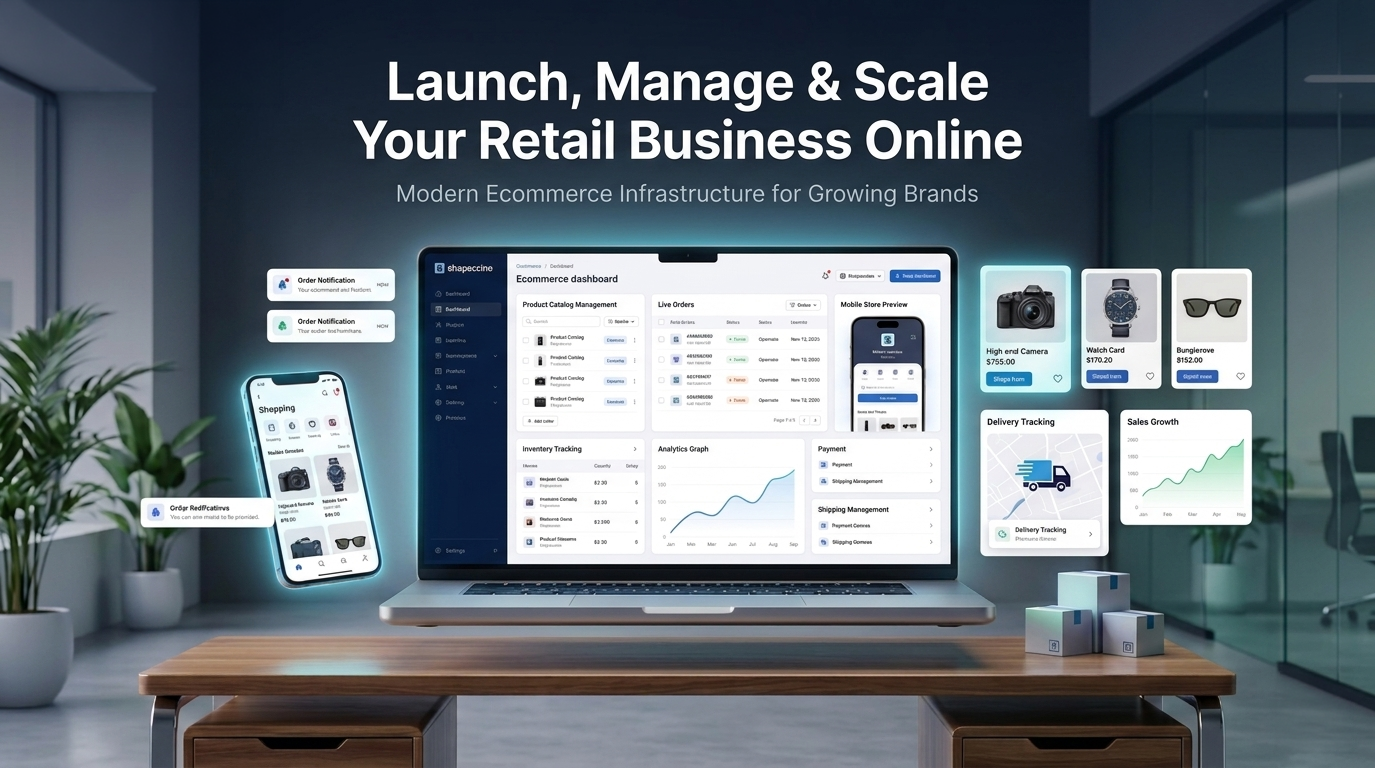
The shift happened because of ecommerce website builder platforms that removed the technical barrier between a retail business and its online presence. These platforms package the infrastructure that every onlin store needs, product management, checkout, payments, shipping, and order tracking, into a system that retailers can set up and manage themselves without writing a single line of code.
This guide explains what an online retail website builder actually does, what features matter most, how to choose the right one for your specific business, and what to look for when evaluating platforms. Shopaccino is one of those platforms, and where it is relevant to the points being made, it is mentioned directly.
What Is an Online Retail Website Builder?
An online retail website builder is a SaaS platform that provides everything a retail business needs to sell online from a single system. It is not a generic website builder with an ecommerce plugin bolted on. It is infrastructure designed specifically around selling: product catalogues, checkout flows, payment processing, shipping configuration, and order management, all built into the same environment.
The distinction from traditional website development is significant. A custom-built ecommerce website requires a developer to build, a separate hosting solution, and ongoing technical maintenance every time something breaks or needs updating. An ecommerce website builder handles the infrastructure layer entirely. The retailer focuses on the business, not the technology.
How does it differ from a generic website builder?
Generic Website Builder | Online Retail Website Builder |
Pages and content creation | Product listings and catalogue management |
Basic contact forms | Shopping cart and checkout workflow |
No native payment processing | Built-in payment gateway integration |
Manual inventory tracking | Automated inventory management |
No shipping configuration | Shipping zone and courier integration |
No order management | Centralised order management dashboard |
Limited ecommerce scaling | Built for retail volume and growth |
For a retail business, these differences are the difference between a website that looks like a store and one that actually operates as one.
Why Retail Businesses Need Their Own Ecommerce Website
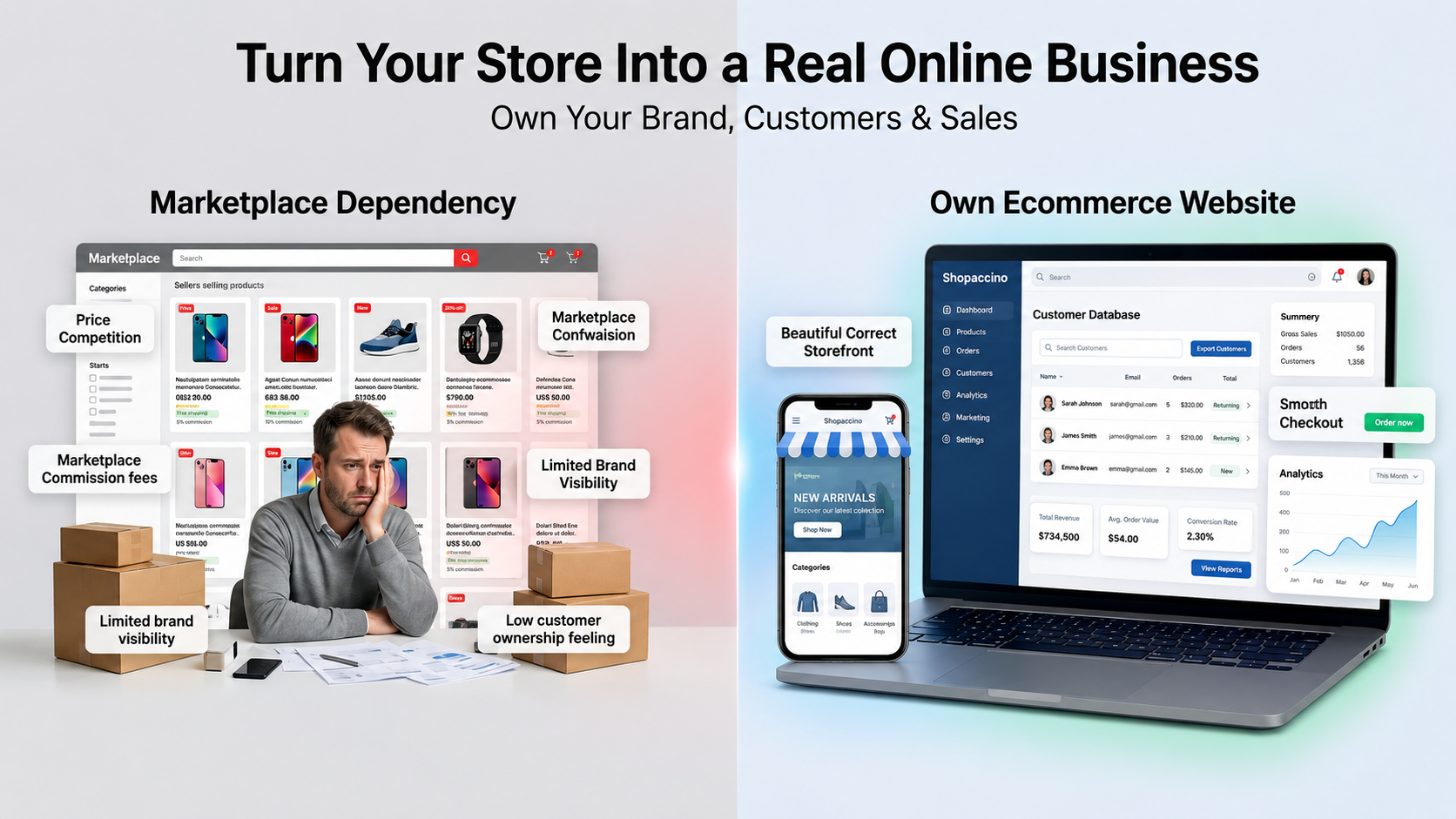
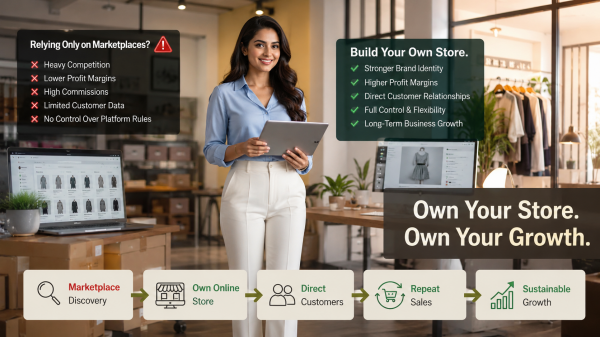
Many retailers begin online by listing products on a marketplace. It is a reasonable starting point. But a marketplace listing is a presence within someone else's business, not a business of your own. The customer who buys from you on a marketplace is that platform's customer, not yours.
What your own online retail store actually gives you
- Direct access to your customers: every buyer's contact details belong to you. You can re-market, send updates, and build a returning customer base
- Full brand experience: your domain, your design, your product presentation. No competing products in the same search results page
- No revenue sharing: marketplace commission rates range from 10 to 35 percent depending on category. On your own store with a platform like Shopaccino, zero transaction fees apply
- Centralised operations: manage products, pricing, stock, orders, shipping, and customer communication from one dashboard rather than separately across multiple platforms
- Mobile commerce readiness: your own mobile-friendly website gives you a presence that works for the majority of shoppers who browse and buy on smartphones
“A marketplace gives you a presence. Your own website gives you a business.”
The combination of brand ownership, customer data access, and zero commission on sales makes building your own online shopping website one of the clearest financial decisions in retail ecommerce.
Essential Features of an Online Retail Website Builder
Not every platform labelled an ecommerce website builder is equipped for the demands of a serious retail business. These are the features that separate platforms built for retail from those that handle ecommerce as a secondary function.
Product catalogue management
Product catalog management needs to handle more than a list of items with prices. A retail catalogue requires categories and subcategories, multiple product images per listing, variant management for size, colour, and other attributes, each with independent stock tracking, detailed descriptions, and the ability to update any of these elements quickly from a dashboard without technical help.
Inventory management
Inventory management at the variant level is essential for any retailer carrying multiple SKUs. When a specific size or colour sells out, that variant must be marked unavailable in real time. Overselling, accepting orders for stock that does not exist, is one of the fastest ways to damage customer trust. A platform that only tracks stock at the product level, rather than the variant level, cannot prevent this reliably.
Mobile responsiveness
Every theme and storefront component must be fully responsive ecommerce design, adapting without layout errors to every screen size. This is not just a design preference. Google uses mobile-first indexing, meaning the mobile version of your store is what Google primarily reads for search ranking. A poorly optimised mobile experience hurts both conversions and organic discoverability simultaneously.
Payment gateway integration
Payment gateway integration must support the full range of payment methods your buyers actually use. For Indian retail, this means UPI, credit and debit cards, net banking, digital wallets, and COD. For global-facing retail, multi-currency checkout and international card support. Every payment method not available on your checkout is a buyer who cannot complete their purchase.
Order management
A centralised order management dashboard lets retailers view every order's status, confirm dispatch, generate invoices, process returns, and communicate with buyers from one screen. This becomes particularly important during high-volume periods like sales events or festive seasons when managing orders manually across email threads is not viable.
Shipping management
Configuring delivery zones, setting shipping rates by weight or order value, connecting courier partners, and automating dispatch notifications should all be manageable from within the platform without external tools or developer assistance.
Coupon and offer management
Promotional campaigns, end-of-season sales, and loyalty offers are part of regular retail operations. The platform must allow retailers to create, schedule, and deactivate discount codes and offers without requiring technical setup or platform-specific expertise.
Benefits of Using an Online Retail Website Builder
The practical advantages of using a purpose-built website builder for retailers extend beyond the initial setup. They compound across daily operations as the business grows.
Faster go-live and lower setup cost
A custom-built ecommerce website can take three to six months from brief to launch. An online store builder compresses that timeline to days or weeks. The cost difference is equally significant: platform subscription fees replace the capital investment of custom development, with no ongoing technical maintenance cost sitting on top.
Centralised business operations
Managing products, processing orders, handling returns, running promotions, and monitoring performance from a single dashboard removes the fragmentation that slows down retail operations. When inventory, orders, and customer all live in the same system, decisions are faster and errors are less frequent.
Scalability without re-platforming
A retail business that starts with 20 SKUs and grows to 2,000 should not need to rebuild its store on a different platform. The right retail ecommerce platform scales with the business, handling increased product volume, higher order frequency, and more complex shipping requirements without requiring a migration.
Improved customer experience
Buyers expect fast-loading product pages, a smooth checkout experience, mobile-optimised browsing, and clear post-purchase communication. These are not premium features on a well-built platform. They are defaults. A retailer on the right platform delivers this experience without custom development work.
How Shopaccino Helps Retail Businesses Build Ecommerce Websites
Shopaccino is a SaaS ecommerce website builder built specifically around the operational needs of retailers, brands, distributors, and exporters selling online globally. It is not a generic website builder with ecommerce features added later. Every aspect of the platform is designed for businesses that sell products, manage inventory, and process orders as their core operation.
Customisable, responsive themes
Shopaccino's theme library provides professionally designed, fully responsive layouts that adapt correctly across desktop, tablet, and mobile. Retailers apply their brand colours, logo, and typography through a visual customisation interface without editing code. Every theme is built as responsive ecommerce design from the ground up, not as a desktop layout adapted for mobile as an afterthought.
Product and inventory management
Upload unlimited products with multiple images, variant configurations, independent stock levels per variant, and detailed descriptions. Organise your catalogue into categories and subcategories. Update pricing, stock quantities, or product details instantly from the dashboard. Inventory management reflects across the live store in real time, preventing overselling and keeping product availability information accurate.
Payment gateway integration
Shopaccino connects to multiple payment gateways to support UPI, cards, net banking, wallets, and COD across India, with international payment support for global-facing retailers. Every transaction processes through a secure checkout environment. Shopaccino charges zero transaction fees, meaning the full sale amount, less only the payment processor's standard charge, comes to the retailer on every order.
Shipping and logistics
Configure delivery zones, set shipping rates, and connect logistics partners directly within Shopaccino. Dispatch notifications with tracking links are sent to buyers automatically on shipment. No manual email follow-up required for standard order communication.
Order management
Every order appears in Shopaccino's order management dashboard with full detail: buyer information, items ordered, payment status, and delivery requirements. Process orders, confirm dispatch, generate invoices, and handle return requests from one centralised interface. During high-volume periods, this consolidation keeps fulfilment accurate and customer communication timely.
Coupon and offer management
Create discount codes, percentage-off promotions, and flat-amount offers directly from the Shopaccino dashboard. Schedule promotions to activate and deactivate automatically. Run seasonal sales, launch campaigns, or loyalty offers without platform configuration support.
Analytics integration
Connect Shopaccino to your preferred analytics tools to track traffic, conversion rates, revenue by product category, and buyer behaviour. Make inventory, pricing, and promotional decisions based on actual store performance data rather than intuition.
About Shopaccino: Shopaccino is an industry-focused SaaS eCommerce platform designed for exporters, manufacturers, D2C brands, and retailers. It provides a complete online retail website builder with branded storefronts, multi-payment support, automated order workflows, and zero transaction fees for businesses selling in India and globally. |
How to Choose the Right Online Retail Website Builder
Choosing the wrong platform is an expensive mistake that compounds over time. A retailer who outgrows a platform's capabilities after 12 months of operation, accumulated products, orders, and customer data, faces a complex and disruptive migration. Evaluating properly at the start prevents that problem.
Ease of use without technical dependency
If adding a new product category or setting up a seasonal discount requires developer assistance, the platform is creating operational friction that will slow your business down repeatedly. Every core retail operation, product management, pricing updates, order processing, and promotion setup, should be complete by a non-technical user through a clear dashboard interface.
Mobile responsiveness as infrastructure
Confirm that mobile-friendly website performance is built into the platform's theme architecture, not something you achieve through custom CSS or additional plugins. Test the checkout flow on an actual smartphone before committing, not in a browser emulator. What you find will tell you whether the platform was genuinely built for mobile commerce or adapted for it.
Payment method coverage
Map your target customer's payment preferences against what the platform supports natively. A platform that requires custom integration for basic payment methods, UPI for Indian retail, for example, is adding technical work that should be handled as a standard feature. Every payment method that requires separate implementation is a delay between you and your buyers.
Inventory and variant handling
Ask specifically how the platform handles variant-level inventory management. If size UK 8 in a specific colour sells out, does the platform mark that variant unavailable automatically while keeping other sizes available? If the answer requires a workaround or manual update, the platform will create operational problems at scale.
Scalability without migration
Understand the platform's product and order volume limits before signing up. A platform that works well at 100 SKUs but degrades at 1,000 is not a platform for a growing retail business. Ask about performance at higher volumes and confirm that pricing and feature availability do not change significantly as your store grows.
Support quality
When something breaks during a promotional period or a seasonal sales spike, the speed of platform support becomes a direct revenue variable. Evaluate the platform's support availability, response times, and the channels through which you can reach them before you are in a situation where speed matters.
Steps to Create an Online Retail Website
Building your online retail store on a platform like Shopaccino follows a clear, practical sequence:
- Register and connect your domain: create your account, select your plan, and point your custom domain to your store
- Choose and customise your theme: select a professional theme from the library, apply your brand identity, colours, logo, and typography
- Set up your product categories: create the category structure that mirrors how your buyers think, not just how your warehouse is organised
- Upload your product catalogue: add each product with multiple images, complete descriptions, all size and colour variants with individual stock counts, and accurate pricing
- Configure payment gateways: connect your payment processors to accept the methods your buyers use
- Set up shipping zones and rates: define delivery zones, connect courier partners, and configure rate rules based on order value or weight
- Write and publish your store policies: return policy, shipping policy, and privacy policy. Link these from your footer and checkout page
- Optimise product and category pages: edit meta titles and descriptions on each page using the platform's built-in SEO tools
- Test and go live: complete a full test transaction across each payment method before publishing your store and promoting it
Designing a User-Friendly Retail Ecommerce Website
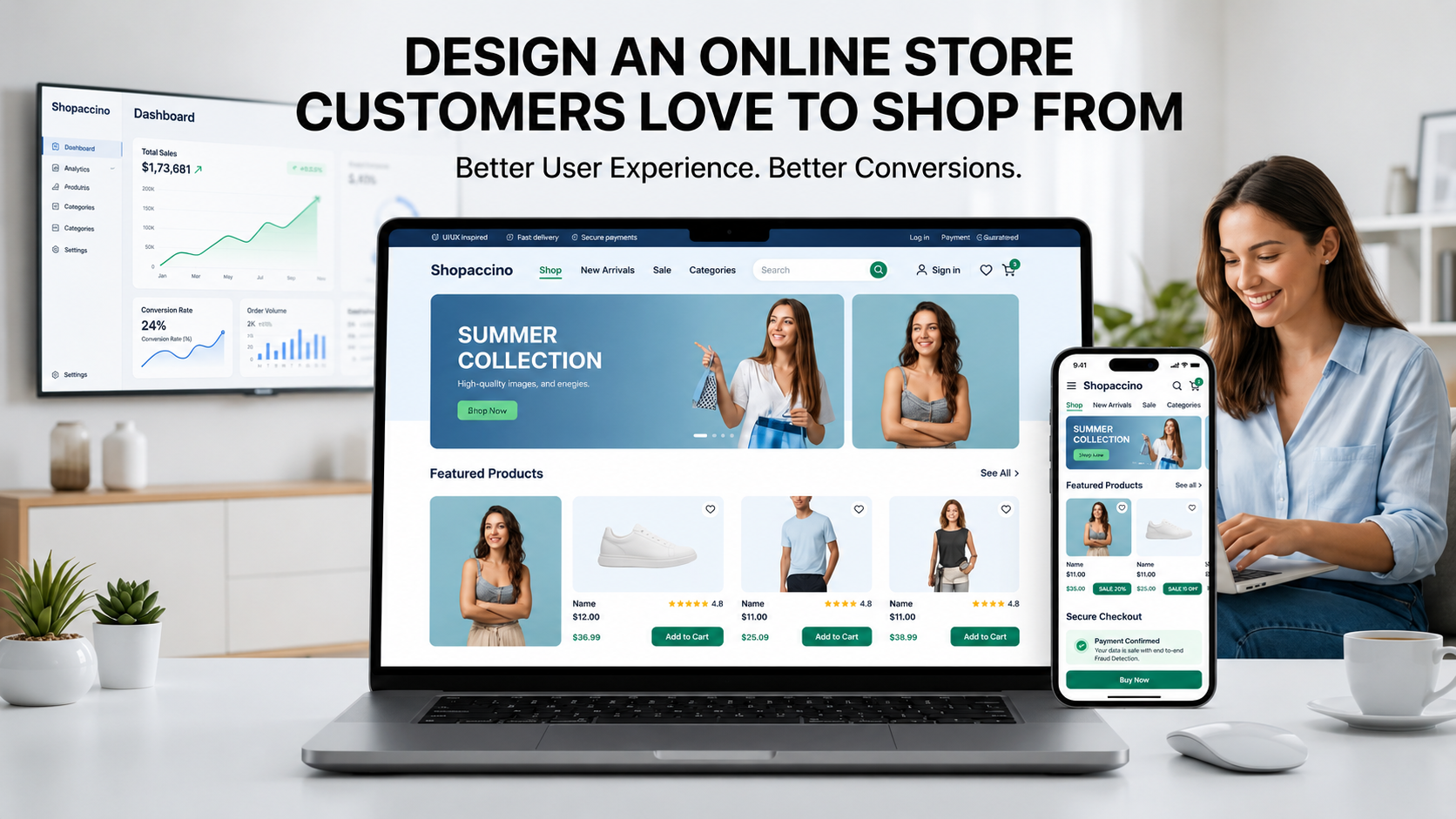
Design in a retail context is not about aesthetics. It is about making the path from discovery to purchase as frictionless as possible. A well-designed online shopping website removes confusion at every step of the buyer's journey.
Homepage structure
Your homepage should orient the buyer within seconds: what do you sell, who is it for, and where should they go first. A clear banner with your strongest collection or offer, visible category navigation, and a selection of featured products visible without scrolling handles this job without requiring heavy design investment.
Product page layout
Every product page needs multiple images from different angles, clear variant selection with real-time availability indicators, a concise and specific product description, accurate delivery timeline, and a prominent add-to-cart action. All of these must be visible without scrolling on both desktop and mobile.
Navigation and category organisation
Buyers should reach any product in no more than two clicks from the homepage. Navigation that requires three or four levels of drilling before reaching a product list is a design problem. Flatten your navigation where possible. Use clear, intuitive category labels that match the language your buyers actually use when searching.
Trust-building elements
First-time buyers need reassurance before they pay. Display your return policy near the cart. Show delivery estimates at the product level. Use customer reviews, particularly those that reference specific product features or fit. These elements do not require additional marketing spend. They are design decisions that compound into higher first-purchase conversion rates over time.
Managing Products, Orders, and Customers Efficiently
A live retail website is not a set-and-forget operation. Day-to-day management, stock updates, order processing, pricing adjustments, and promotional changes is where the platform's operational quality becomes visible.
Inventory updates and restocking
Update stock levels at the variant level immediately when new inventory arrives. Track which sizes and variants are selling fastest using your analytics and plan restocking accordingly. A platform where inventory management updates take more than a few clicks introduces a lag between your physical stock reality and what buyers see on your store.
Order workflow
A retail order workflow should move from received to confirmed to dispatched to delivered with automated notifications at each stage. Buyers who receive proactive updates about their order status generate fewer support enquiries and develop higher trust in the store. Set up these automated notifications once. They run without intervention on every subsequent order.
Return management
Returns are a routine part of retail operations, not an exception. Your platform should allow buyers to initiate a return request through their account, and for you to manage that request through the same order management dashboard where the original order sits. Handling returns outside the platform, through separate emails or spreadsheets, creates process gaps that scale badly.
Promotional and pricing updates
Seasonal price changes, end-of-line clearances, and launch discounts should be schedulable in advance and executable in bulk where relevant. A platform that requires you to manually update pricing on 200 products individually for a sale is a platform that will create operational stress on the days when you can least afford it.
Common Mistakes Businesses Make While Choosing Ecommerce Website Builders
Most platform selection mistakes follow predictable patterns. Understanding them before you evaluate saves significant time and avoids costly migrations later.
Choosing based on price alone
A platform with a lower monthly fee that charges 2 to 3 percent on every sale will cost more in real terms than a higher-subscription platform with zero transaction fees once you reach any meaningful order volume. Calculate total cost of ownership across your projected monthly revenue, not just the subscription price.
Example: At 50 orders per month averaging Rs 2,000 each, a 3% transaction fee costs Rs 3,000 per month in addition to the subscription. At 500 orders per month, that becomes Rs 30,000 monthly in fees alone. Shopaccino charges zero transaction fees regardless of order volume.
Underestimating mobile performance requirements
A platform demo on a fast desktop connection in a well-lit office does not reflect your buyer's actual experience. Test checkout on a budget Android phone on a 4G connection. If the experience is slow, difficult to navigate, or shows layout errors, that is your conversion rate in practice, not the demo you saw.
Ignoring inventory system limitations
A platform that handles single-attribute products well but struggles with multi-variant inventory management will create operational problems the moment your catalogue grows beyond simple listings. Confirm variant handling, stock-level granularity, and bulk update capability before you commit.
Not testing the checkout flow before going live
Every payment method, every device type, and every order scenario should be tested with a real transaction before launch. Broken checkout flows discovered after your first promotional campaign are expensive in both lost sales and customer trust.
Choosing a platform without growth headroom
A platform that works well at your current size but requires migration at 10x your current volume is a platform that will eventually hold your business back. Evaluate on where you are going, not only on where you are now.
Choosing an Online Retail Website Builder Is a Business Decision
The platform you build your retail store on determines how efficiently you can operate, how quickly you can scale, and how much of your revenue you keep on every sale. Those are not technology decisions. They are business decisions.
An online retail website builder that handles product catalog management, inventory management, payment gateway integration, order management, and responsive ecommerce design from a single platform removes the fragmentation that slows retail operations down and the technical dependencies that make growing a business unnecessarily complicated.
Shopaccino is built to serve exactly this need, for retailers, brands, manufacturers, and exporters who want a complete online store builder that works for their business today and scales with it over time. Zero transaction fees, full ownership of your customer data, and a platform designed for how retail businesses actually operate.