Inventory Automation Every Growing Brand Needs
Every growing brand hits the same wall eventually. Sales go up, and the spreadsheet that used to track stock perfectly starts lying. A product shows available when it's already sold out. Two orders come in for the last unit within minutes of each other. Someone spends an entire afternoon manually recounting boxes just to figure out what's actually true.
That wall has a name, and it's not a staffing problem. It's the point where manual tracking stops being able to keep up, and inventory automation becomes the thing standing between steady growth and constant firefighting.
Quick Answer Inventory automation is software that tracks, updates, and manages stock levels across sales channels and warehouses without manual entry. Growing brands need it to prevent overselling, trigger reorders before stock runs out, route orders to the right warehouse, and keep retail and wholesale inventory accurately separated as order volume increases beyond what a spreadsheet can reliably handle. |
What Is Inventory Automation, And Why Does It Matter As You Grow?
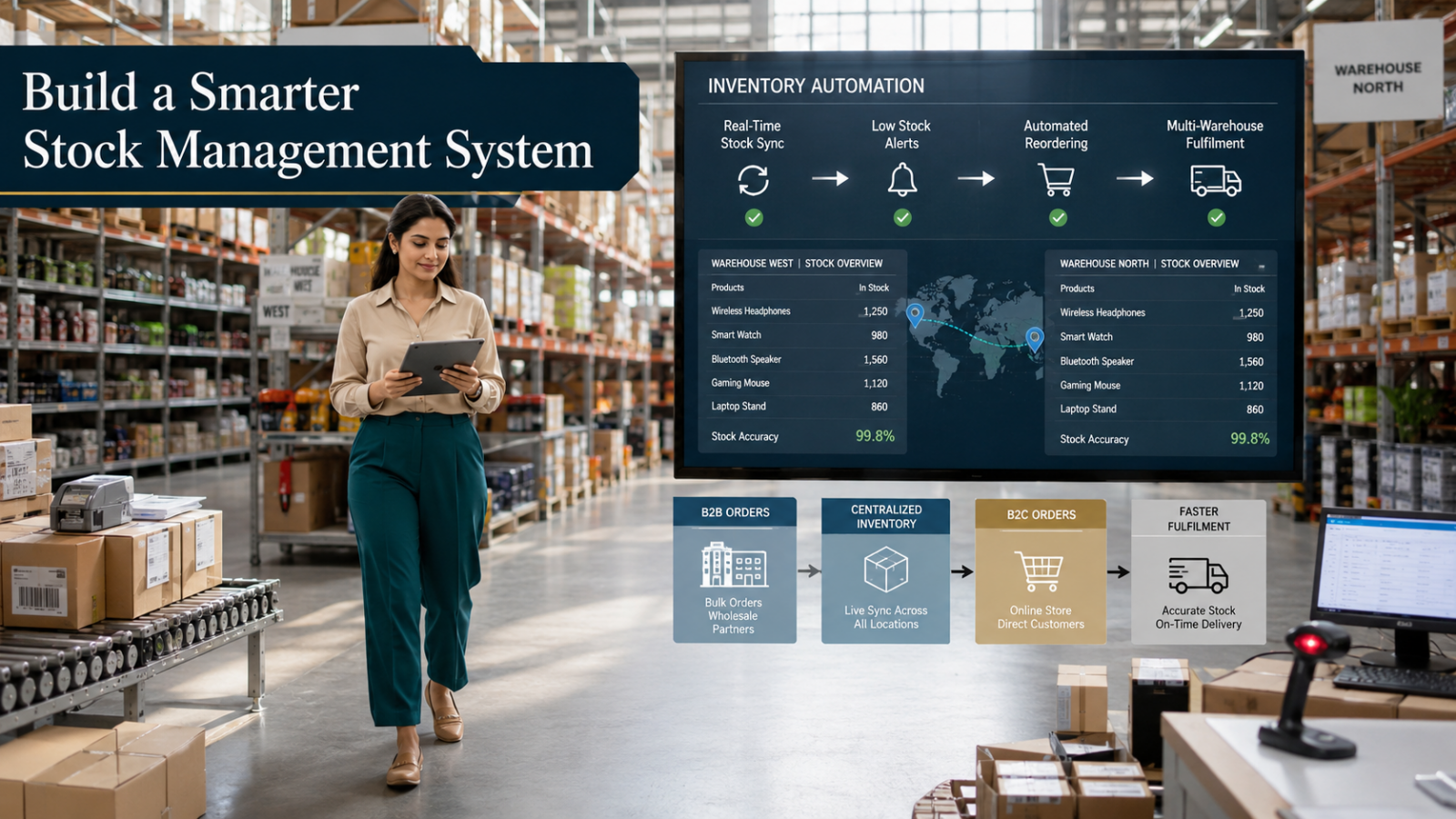
Inventory automation replaces manual stock counting and updating with systems that track quantity in real time, trigger actions automatically, and sync across every place a product is sold. Instead of someone checking a spreadsheet before confirming an order can ship, the system already knows, because it updated the moment the last sale happened.
This matters more with growth, not less. A store doing ten orders a day can survive manual tracking, barely. A store doing two hundred orders a day across a website, a marketplace, and a wholesale channel cannot, because the gap between what a spreadsheet says and what's actually on a shelf widens every single hour orders keep coming in.
The tricky part is that this shift rarely feels dramatic while it's happening. Growth tends to arrive gradually enough that the same manual process keeps technically working, right up until it very suddenly doesn't, usually during a busy sales period when the cost of a mistake is highest and the team has the least time to fix it manually.
What Are The Warning Signs You've Outgrown Manual Inventory Tracking?
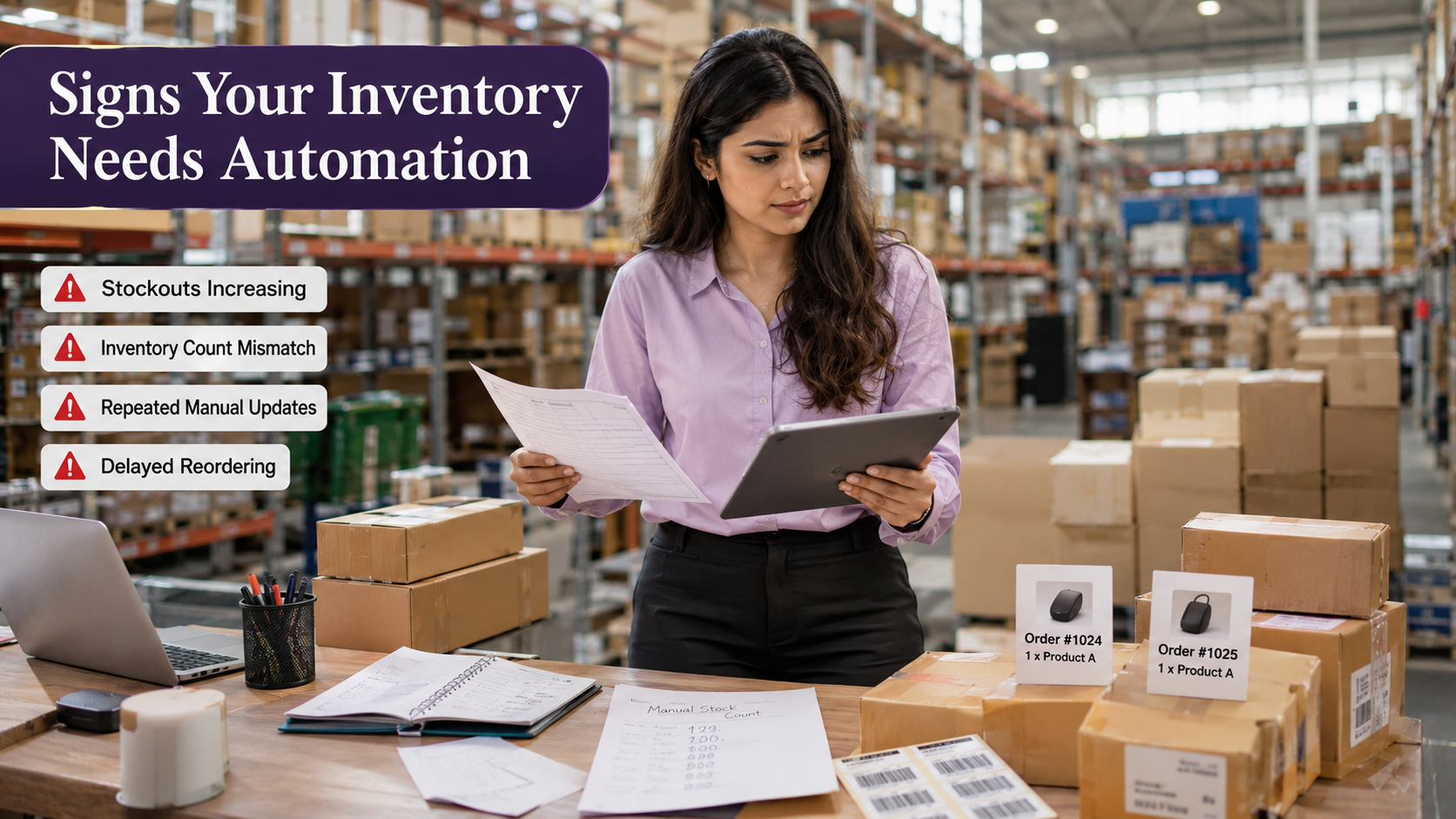 Growing Faster Than Your Inventory System
- You've oversold a product, or come close to it, more than once in the last few months
- Someone on the team spends real time each week manually reconciling stock counts across systems
- Stockouts get discovered by a customer complaint before anyone on the inside notices
- Reordering happens on gut feeling rather than any consistent trigger point
- You're selling the same products across more than one channel and updating stock in each one separately
If two or more of these sound familiar, manual tracking isn't a temporary inconvenience anymore, it's actively costing sales and eating hours that should be going toward growth.
Demand Forecasting
Beyond just tracking what's in stock, forecasting tools look at sales velocity and seasonal patterns to predict what's likely to run out next. Stock forecasting turns reordering from a guess into a decision backed by actual sales history, which matters most for products with long supplier lead times.
Returns And Reverse Logistics Automation
A returned item that doesn't get added back to available stock quickly is functionally lost inventory, even though it's sitting in a warehouse somewhere. Automated returns processing puts usable stock back into the sellable count as soon as it's received, instead of waiting for someone to manually update it.
B2B And B2C Inventory Separation
For brands selling both wholesale and retail, shared inventory without clear rules causes a specific, painful problem, a large wholesale order quietly wiping out stock that retail customers were actively buying at the same time. Automation that separates or allocates inventory by channel prevents one side of the business from accidentally starving the other.
What Inventory Automation Do You Need At Each Stage Of Growth?
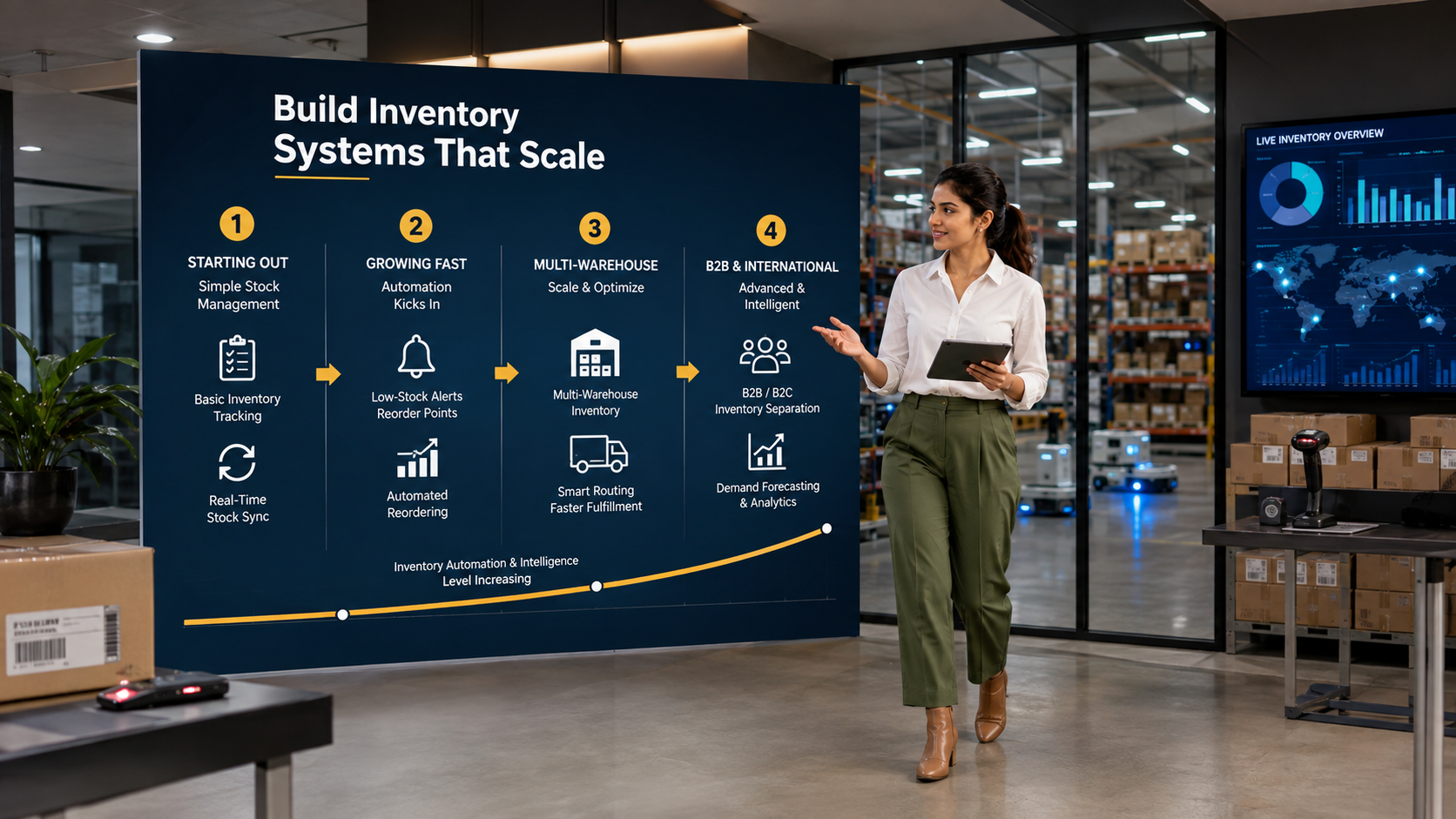
The honest answer is that you don't need everything on that list on day one. What you need shifts as order volume and complexity grow, and trying to implement every layer of automation before it's actually necessary usually just adds cost and complexity without solving a problem you have yet.
Growth Stage | What Breaks Without Automation | Automate This First |
|---|---|---|
Just starting out | Occasional overselling, manual updates still mostly manageable but risky | Real-time stock sync across your storefront and any other channel you sell on |
Growing fast | Stockouts discovered late, reordering happens on gut feeling, spreadsheets fall behind | Low stock alerts with set reorder points |
Multi-warehouse or multi-channel | Conflicting stock counts, orders routed to the wrong location, slower fulfilment | Multi-warehouse routing with centralized, unified inventory |
Scaling into wholesale or international | Wholesale orders draining retail stock or vice versa, cross-border stock visibility gaps | B2B and B2C inventory separation plus demand forecasting |
How Much Does Poor Inventory Tracking Actually Cost A Growing Brand?
The cost rarely shows up as one big number, which is exactly why it's easy to ignore for too long. It shows up as a canceled order and an apology email when something oversells. It shows up as a customer who never comes back after ordering something that turned out to be unavailable. It shows up as staff hours spent recounting stock instead of doing anything that actually grows the business. None of those individually look like a crisis. Added up over a few months of steady growth, they quietly become one of the more expensive problems a scaling brand has, mostly because nobody tracks them as a single line item until the pattern becomes impossible to ignore.
There's a reputational cost too, one that's harder to reverse than a refund. A customer who orders something that turns out to be unavailable rarely gives detailed feedback about why they stopped buying, they just stop buying. By the time overselling shows up in review scores or repeat purchase rates, the damage has usually been building quietly for a while.
How Does This Play Out Across Different Industries?
- Fashion: size and color variants multiply SKU count fast, making real-time sync essential to avoid selling a size that's technically out of stock
- Electronics: serial number or batch tracking matters for warranty claims, making barcode based tracking especially valuable
- Home decor: bulkier, slower moving stock benefits most from demand forecasting to avoid tying up warehouse space in slow sellers
- Marble and stone: batch and slab level tracking is critical, since no two natural stone pieces are identical and mismatched records can mean shipping the wrong slab entirely
- Beauty: expiry dates add another layer, making automated stock rotation and reorder timing more important than in most other categories
- B2B trading: large order quantities make B2B and B2C inventory separation the single most important automation to get right early
What Should You Look For In Inventory Automation Software?
- Real time updates, not batch syncing that only refreshes every few hours
- Multi-warehouse support built in from the start, even if you're only using one location today
- Clear separation between retail and wholesale stock if you sell or plan to sell both
- Alerts and reorder triggers that are actually configurable, not fixed at a default that doesn't match your sales pattern
- Integration with fulfilment and shipping, so stock updates and order routing happen in the same system instead of two disconnected ones
How Does The Right Platform Handle Inventory Automation?
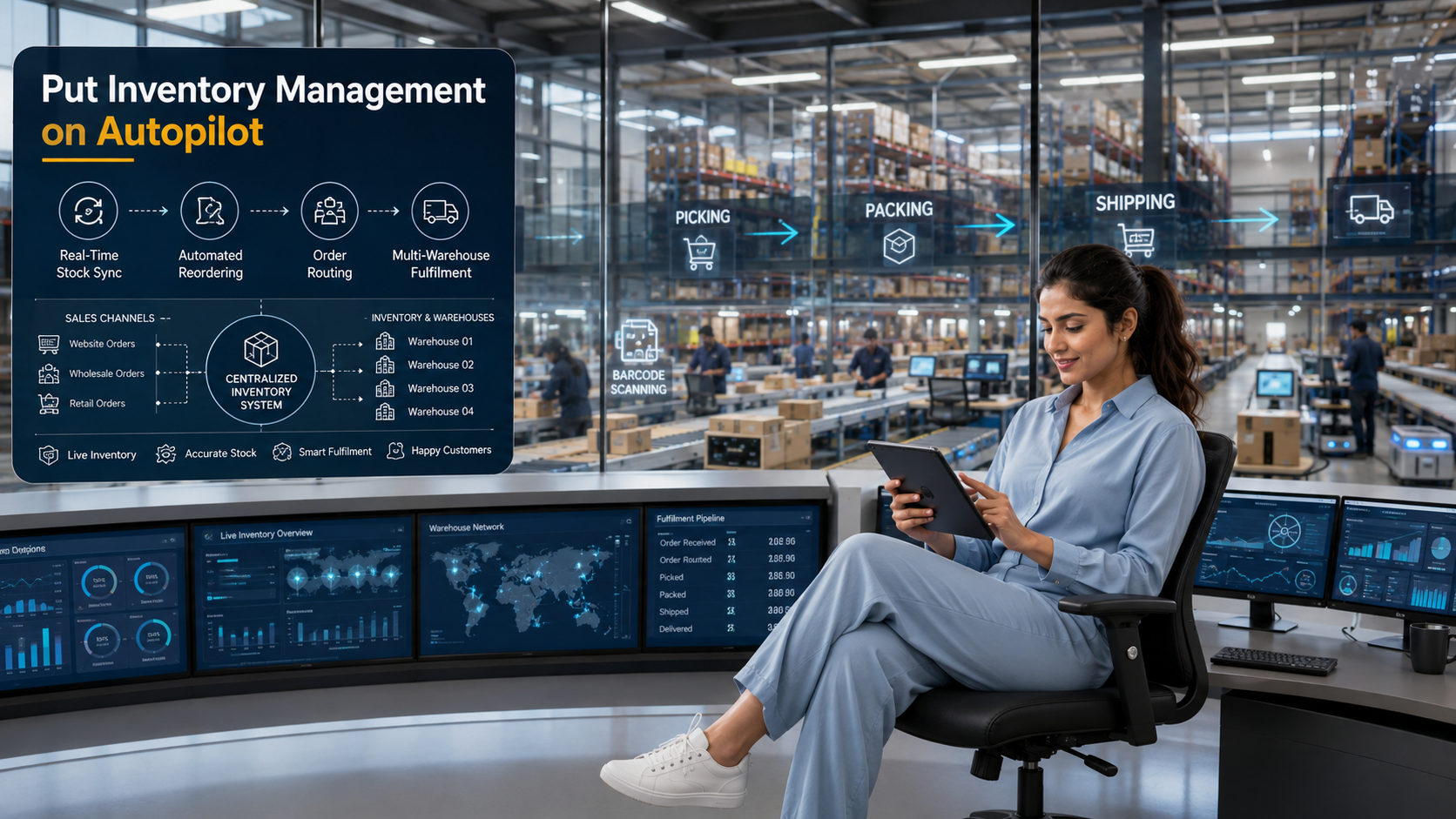
This is exactly the gap Shopaccino is built to close for growing brands. Integrated inventory tracking updates automatically across every sales channel, so stock shown to a customer reflects what's genuinely available, not what a spreadsheet said this morning. Built-in multi-warehouse order fulfilment routes orders to the right location automatically and keeps every warehouse's count synced in real time, which matters as soon as a brand moves beyond a single storage location.
For businesses running both wholesale and retail, Shopaccino's unified B2B and B2C commerce system separates pricing and order handling by buyer type, which protects retail stock from being unexpectedly consumed by a large bulk order. And for brands expanding beyond their home market, built-in multi-currency, multi-language, and international shipping support means inventory stays accurate and visible no matter which region a customer is ordering from, backed by end-to-end automation across.
payments and logistics that keeps the whole operation running without someone manually reconciling numbers at the end of each day.
What Mistakes Do Growing Brands Make With Inventory Automation?
- Waiting until after a major overselling incident to automate, instead of before the pattern becomes visible
- Automating stock sync but leaving reorder decisions manual, which just moves the bottleneck instead of removing it
- Choosing a platform without multi-warehouse or B2B and B2C support, then having to migrate everything once growth demands it
- Setting reorder thresholds once and never adjusting them as sales velocity changes with seasonality or growth
- Treating returns as a separate process instead of feeding them back into automated stock counts immediately
Final Thoughts
Inventory automation isn't a nice to have reserved for large operations. It's the thing that decides whether growth feels like momentum or like constant damage control. Getting real-time sync, reorder alerts, and multi-warehouse routing in place before the spreadsheet starts lying is far easier than untangling the mess after it already has. Whatever stage your brand is at, from a handful of daily orders to running both wholesale and retail across multiple regions, the right inventory automation is what lets that growth actually stay manageable.
How Does Inventory Automation Prevent Overselling And Stockouts?
Overselling almost always comes down to a timing gap, the moment a sale happens and the moment stock actually updates everywhere it needs to. Manual systems have a built in delay there, sometimes minutes, sometimes hours, sometimes an entire day if updates only happen at closing time. Automated systems close that gap to nearly zero, which is the entire reason overselling drops sharply once real-time sync is in place. Stockouts follow the same logic in reverse, automation flags a shrinking quantity early enough to reorder before the shelf actually goes empty, instead of after.
How Does Automation Change Inventory Across Multiple Warehouses?
With one location, inventory is a single number. With several, it's a routing problem as much as a counting one. Good multi-warehouse automation doesn't just track quantity per location, it decides which warehouse should fulfil each order based on proximity to the customer, current stock levels, and shipping cost, then updates every location's available count the moment that decision is made. Without that layer, businesses either oversell by treating warehouses as one pool when they're not, or undersell by being overly conservative and leaving stock sitting unused in the wrong place.
How Does Inventory Automation Work Differently For B2B And B2C Orders?
Retail customers buy one or two units at a time, fairly unpredictably. Wholesale buyers place large, planned orders that can consume weeks of retail stock in a single transaction. Treating both as the same pool of inventory means one side eventually gets shortchanged, usually retail, since a single bulk order can quietly wipe out available stock without anyone noticing until customers start seeing items as sold out. Automation built for both sides allocates or reserves stock by channel, so a large wholesale order doesn't silently take inventory away from retail customers browsing the same catalog.
FAQs
Inventory automation uses software to track, update, and manage stock levels across sales channels and warehouses without manual entry. It syncs stock in real time, triggers reorders, and routes orders to the right location automatically as a business grows.
Once overselling starts happening more than once, or stock reconciliation eats real time each week, manual tracking has already become a liability. Most businesses need it well before they feel ready, usually right as order volume starts becoming unpredictable.
Yes. Multi-warehouse automation tracks stock separately per location while routing each order to whichever warehouse can fulfil it fastest, and updates every location's available count the moment a decision is made, preventing conflicting stock counts.
It separates or allocates stock by channel, so a large wholesale order doesn't silently consume inventory that retail customers are actively buying at the same time. Without that separation, one side of the business usually ends up shortchanged.
Yes. Platforms with built-in multi-currency and multi-warehouse support keep stock visibility accurate regardless of which region a customer is ordering from, which matters most for brands expanding into cross-border sales or exports.
Real-time stock sync across every sales channel comes first, since it's the foundation everything else depends on. Reorder alerts, forecasting, and multi-warehouse routing only work reliably once the underlying stock count is accurate in real time.