
Subscription Business Models Beyond Consumables: How to Build Recurring Revenue
Quick Answer: Subscription business models work for non-consumable products because recurring revenue follows recurring need, not recurring consumption. Four needs can be sold on a schedule even when the product itself never runs out: the need to replace a part, the need to maintain something owned, the need to access terms or stock, and the need to discover what is new. Pick the need your customers already have, then price it against what it saves them.
Every business owner who has looked at a forecast built from one-off sales understands the appeal of recurring revenue. Predictable cash flow, inventory you can plan against, customers whose value compounds instead of resetting to zero after every purchase. The pitch has never been the problem.
The blocker is almost always the same objection: our product does not run out. Furniture, jewellery, lighting, stone surfaces, machinery, a good coat. Nobody needs a fresh one every month, so the whole category of subscription business models gets filed under coffee, razors, and vitamins, and the conversation ends there.
The assumption underneath that objection is worth pulling apart, because it is wrong in a specific and useful way. Subscriptions do not monetise consumption. They monetise a need that returns on a predictable schedule. Consumption is only the most obvious version of that. There are three others, and they are available to almost every product category, including the ones that last for decades.
What Are Subscription Business Models, and Why Do They Work Without Consumables?
Subscription business models are commercial arrangements where a customer pays on a repeating schedule in exchange for ongoing delivery of products, services, or benefits, rather than paying once per transaction. The defining feature is not what ships. It is that the relationship has a renewal date and continues by default until somebody stops it.
That default is the whole economic engine. In a one-off sale, every purchase requires a fresh decision, fresh marketing spend, and fresh persuasion. In a recurring revenue model, the decision was made once and continuing is the path of least resistance. Your acquisition cost gets spread across many cycles instead of one, which is why customer lifetime value on a subscriber routinely runs several times higher than on a repeat buyer who has to be re-convinced each time.
None of that requires the product to deplete. It requires a reason to come back that arrives on schedule. Which brings us to the four reasons that actually exist.
What Recurring Needs Can You Sell?
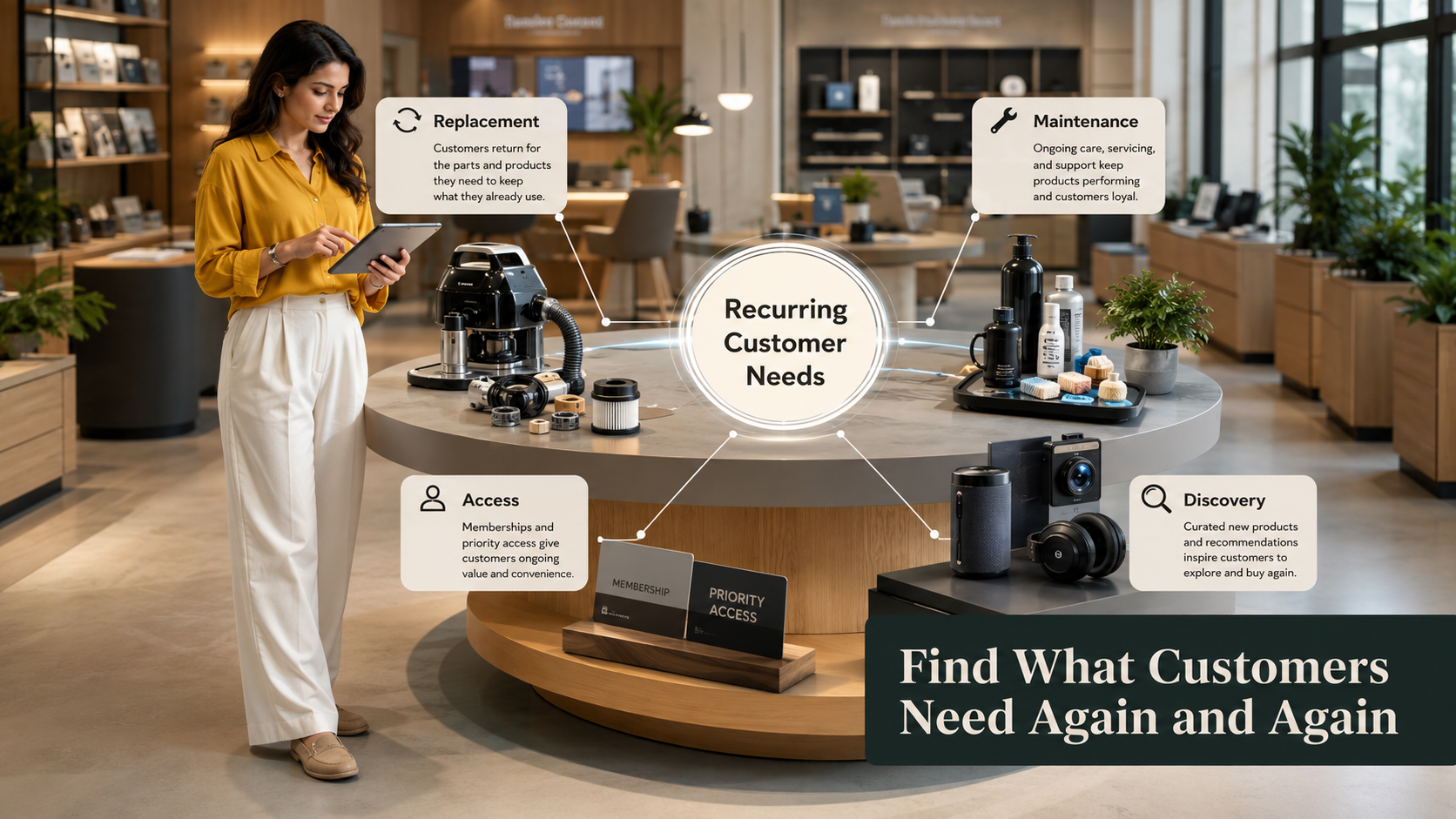
Every workable subscription answers one of four questions the customer already asks. Read these against your own catalogue and at least one will fit.
The need to replace: what wears out around what lasts
Most durable products sit at the centre of a small ecosystem of things that do not last. The appliance outlives the filter. The applicator outlives the refill. The stone surface outlives the sealant. The machine outlives its consumable tooling.
This is the closest cousin to the classic replenishment subscription, except the durable is the anchor and the consumable is the recurring line. It works because timing is genuinely hard for the customer to track. Nobody remembers when a water filter was last changed, and most people replace it late, which slightly damages the product they bought from you. Putting it on a schedule solves a real problem rather than manufacturing one.
Where it fails: when the replacement cycle is longer than about six months, the subscription feels like a bill for nothing between shipments. At that cadence, a reminder programme with easy one-click reordering usually outperforms a subscription, and it is far cheaper to run.
The need to maintain: selling the upkeep, not the object
Expensive things need care, and most owners do not know how to give it. This is the least crowded of the four models and often the most profitable, because you are selling expertise and scheduling rather than goods with a cost of shipment attached.
A stone and surface business can sell an annual care plan: the correct sealant, the right pads, a seasonal reminder, and a resealing service visit at the interval the material actually needs. A furniture brand can sell fabric and leather care with a scheduled treatment. An electronics business can sell calibration, diagnostics, and priority repair. In each case the customer bought something valuable and is quietly anxious about ruining it, and you are the most credible party to fix that anxiety.
Where it fails: when the maintenance is genuinely trivial. If a customer can wipe it down with a cloth, charging annually for the knowledge insults them. Maintenance plans need to require either a product they cannot easily source or a skill they do not have.
The need to access: paying for terms rather than things
Here the subscription ships nothing at all. The customer pays for a standing set of advantages: better pricing, free or faster shipping, free returns, priority on limited stock, early access to new releases, or an allocation reserved in their name. Membership programs are the most category-agnostic model of the four, which is exactly why they are the most over-used and most often badly priced.
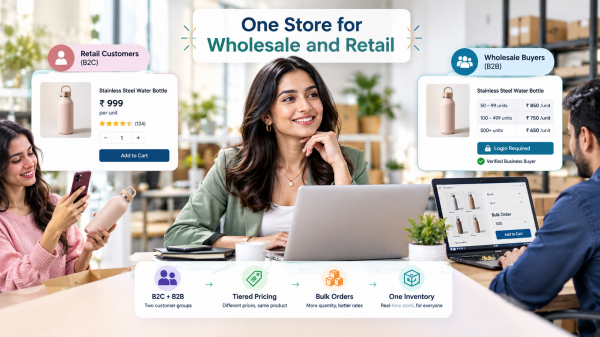
In trade and wholesale this model has a particularly strong form, because access is worth real money to a business buyer. A distributor paying an annual fee for guaranteed allocation during peak season, committed lead times, and a locked trade tier is buying supply certainty, which is a far more compelling proposition than a discount. The same logic underpins standing orders, where a buyer commits to a recurring volume in exchange for pricing and priority.
Where it fails: when it hands your best customers a discount they were never going to need. More on that trap in the pricing section, because it is the single most common way this model destroys margin while looking successful.
The need to discover: curation as the product
The customer wants novelty at a manageable pace and does not want to do the searching. Fashion, home decor, beauty, books, and specialty food all support this, and it is the model most people picture when they hear the word subscription.
The important distinction is that the customer is paying for judgement, not for goods. A curated home decor subscription succeeds when subscribers trust the selector's taste enough to accept surprise. That trust is an asset you build slowly and lose in one bad cycle, which makes this model the most demanding of the four to run well and the easiest to launch badly.
Where it fails: when curation is really just clearance. Subscribers work out very quickly whether they are receiving considered picks or last season's overstock, and the churn that follows is brutal because the breach is one of trust rather than value.
Matching the Four Needs to Your Category
Industry | Recurring Need | What the Subscription Actually Sells |
|---|---|---|
Fashion and apparel | Discovery and access | Seasonal curation, first access to drops, free returns and exchanges as a membership benefit |
Electronics | Replacement and maintenance | Filters, cartridges, batteries, and accessories on schedule, plus extended service and diagnostics |
Home decor | Discovery and access | Rotating seasonal pieces, member pricing, design consultation, priority access to limited runs |
Marble and stone | Maintenance | Sealing and polishing supplies on a care schedule, annual resealing service, care guidance |
Beauty | Replacement and discovery | Refills for a durable applicator or container, plus trial sizes of new formulations |
B2B and trade | Access and replacement | Standing orders at committed volumes, reserved stock allocation, guaranteed lead times, trade pricing tiers |
How Do You Price a Subscription That Ships Nothing Obvious?

Pricing a box of goods is arithmetic. Pricing access or maintenance is harder, because the customer cannot weigh what they are getting. Three principles keep it honest.
Price against what it replaces, not what it costs you
A maintenance plan competes with the customer's alternative, which is usually a professional service call at a much higher rate, or the risk of damaging something expensive. That comparison sets your ceiling far more usefully than a cost-plus calculation does. Cost-plus tells you your floor. Only the alternative tells you the ceiling.
Run the cannibalisation test before you launch
This is the trap that quietly ruins membership programmes. Ask what your best customers currently spend at full price, then model what they would spend as members. If a customer already buys four times a year at full margin, and your membership gives them 15 percent off everything for a modest annual fee, you have not created recurring revenue. You have given your most loyal buyers a discount and called it a programme.
Worked example: A customer spends 800 a year at 45 percent margin, giving you 360 in gross profit. You launch a membership at 79 a year with 15 percent off everything and free shipping. That customer now spends 680 on the same goods, and since your cost of goods has not changed at 440, your gross profit falls to 240. Add the 79 fee and subtract roughly 40 in shipping you now absorb, and you land at 279 against 360 before. The programme looks like a success on subscriber count while costing you 81 per loyal customer, every year.
The fix is not to abandon membership pricing. It is to build the benefit around things that cost you little but are worth a lot to the customer, such as priority access, extended returns, or reserved stock, rather than a blanket discount on items they were buying anyway.
Choose the billing cycle that matches the need
Monthly billing suits frequent, visible benefits. Annual billing suits maintenance and access, where value arrives in occasional bursts and a monthly charge invites monthly scrutiny. Annual also improves cash flow and cuts payment failures, which are a significant and underestimated source of involuntary churn rate. Where you offer both, pricing the annual plan at roughly ten months of the monthly rate is a common and defensible structure.
How Do You Know Whether It Will Actually Work?
Before building anything, run the numbers on a single subscriber. Four figures decide the outcome, and you can estimate all of them in an afternoon.
- Gross margin per cycle. The subscription price minus everything it costs you to deliver that cycle, including shipping, packaging, absorbed returns, and any service time.
- Monthly churn. The share of subscribers who leave each month. Estimate conservatively. Most first-year non-consumable subscriptions land between 4 and 8 percent monthly, and optimism here is the most common modelling error.
- Average subscriber lifespan. Roughly one divided by your monthly churn. At 5 percent monthly, that is 20 months.
- Acquisition cost. Everything spent to sign one subscriber, including discounts on the first cycle, which many businesses forget to count.
Worked example: A surface care plan sells at 120 a year, costing 55 a year to serve, leaving 65 in annual gross margin. Monthly churn of 3 percent implies an average lifespan of about 33 months, so lifetime gross margin is roughly 180. Against an acquisition cost of 60, that is a three to one return, with payback inside the first year. This works. The same plan at 8 percent monthly churn implies a 12 month lifespan, lifetime margin around 65, and a barely positive return, which does not.
The threshold most operators use is that lifetime margin should exceed acquisition cost by at least three times, with payback inside twelve months. If your model only clears that bar under optimistic churn assumptions, the model is not ready. Churn is the variable that decides everything here, and it is the one nobody can predict accurately before launch, which is the strongest argument for piloting rather than committing.
What Has to Work Operationally?
Subscriptions fail operationally more often than they fail commercially. The offer is fine and the execution leaks. Five things have to hold.
- Reliable recurring billing, including failed payments. Cards expire and get declined constantly. Without automated retries and a recovery sequence, involuntary churn alone can quietly cost you a tenth of your subscriber base a year, and those customers never chose to leave.
- Inventory committed against future cycles. A subscription is a promise to have stock on a date. That requires forecasting against a known subscriber count and holding allocation back from general sale, which is harder than it sounds when a product sells well.
- Pause, skip, and change without contacting support. Every friction point in cancelling is also a friction point in staying. Self-service changes reduce churn, because a customer who can pause for a month does not cancel outright.
- Fulfilment that stays cheap at cadence. Shipping economics that work on a single order can collapse when repeated monthly. Fulfilling from the location nearest each subscriber matters far more on recurring shipments than on one-offs.
- Cross-border handling if subscribers are international. Recurring charges in a customer's own currency, local payment methods, predictable duties and delivery times. A subscription that surprises an overseas customer with a charge in an unfamiliar currency tends not to survive its second cycle.
This is where the underlying ecommerce platform matters even more for subscriptions than for one-off sales, because operational weaknesses can repeat with every billing and fulfilment cycle. A system with integrated inventory and multi-warehouse fulfilment can help businesses forecast demand based on active subscriptions and ship each order from the location best positioned to serve the customer, rather than manually reconciling stock across multiple tools each month. For cross-border subscriptions, features such as multi-currency support, international payments, and international shipping can simplify recurring transactions and fulfilment across markets. Transaction fees also deserve attention, as even a small percentage deducted from every recurring payment can add up significantly over time, reducing the revenue generated from long-term subscribers.
How Do You Launch Without Betting the Business?

Treat the first version as an experiment with a deadline, not a product launch.
- Sell it manually to twenty customers first. Before any automation, offer the plan by email or phone to existing buyers who fit the profile. If twenty people will not pay for it when a human explains it, no checkout flow will fix that.
- Run one cohort for a full three cycles. Cycle one tells you whether people will buy. Cycle three tells you whether they will stay, which is the only number that matters. Nothing before cycle three is evidence.
- Watch cancellations closely and ask every leaver one question. A single open question about why they left, asked at the moment of cancelling, produces more useful information than any amount of survey work afterwards.
- Only automate what the pilot proved. Build the billing, the self-service portal, and the inventory allocation around the model that worked, rather than building infrastructure for a model you have not validated.
Where This Leaves You
The businesses that write off recurring revenue because their products last a long time are usually looking at the wrong half of the transaction. They are asking what they could ship repeatedly, when the useful question is what their customer needs repeatedly. Replacement, maintenance, access, and discovery are all live options for products that never run out, and subscription business models built on any of them can carry the same predictability that consumable brands enjoy.
The work is choosing the need you can genuinely serve, pricing it against the customer's real alternative rather than your own costs, and proving retention on a small cohort before you build anything. Get those three right and durability stops being an obstacle to recurring revenue. It becomes the reason the relationship is worth maintaining at all.
FAQs
They are arrangements where customers pay on a repeating schedule for ongoing products, services, or benefits, rather than paying once per purchase. The relationship renews by default, which spreads acquisition cost across many cycles and raises lifetime value.
Yes. Recurring revenue follows recurring need, not consumption. Customers can subscribe to replacement parts around a durable product, maintenance and care, access benefits like priority stock or trade terms, or curated discovery of new items.
Usually maintenance or access. Owners of expensive items want help protecting their investment and priority when supply is tight. Both sell well without requiring the product itself to be repurchased on any schedule.
Build benefits from things that cost little but are valued highly, such as priority access, extended returns, or reserved stock. Model what your best customers already spend at full price first, since a blanket discount often costs more than the fees collected.
Most first-year non-consumable subscriptions see 4 to 8 percent monthly churn. Model conservatively, aim for lifetime margin at least three times acquisition cost, and treat any plan that only works under optimistic churn as not yet ready.
Yes, often better than for consumers. Standing orders at committed volumes, reserved stock allocation, guaranteed lead times, and locked trade pricing sell supply certainty, which business buyers value more highly than discounts.