Planning to Sell Furniture Online? Here’s How a Furniture Website Builder Makes It Easy
Starting a furniture business online sounds like a natural next step today—but once you actually begin, the complexity becomes clear.
Unlike selling small products, furniture involves higher prices, detailed decision-making, customization needs, and complex logistics. Customers don’t buy instantly. They compare, evaluate, visualize, and only then decide. This means your online store cannot be basic—it has to guide, convince, and build trust at every step.
Many business owners make the mistake of thinking:
“I just need a website.”
But the real question is:
Do you need just a website—or a system that helps you sell furniture effectively?
This is where a Furniture Website Builder changes the game.
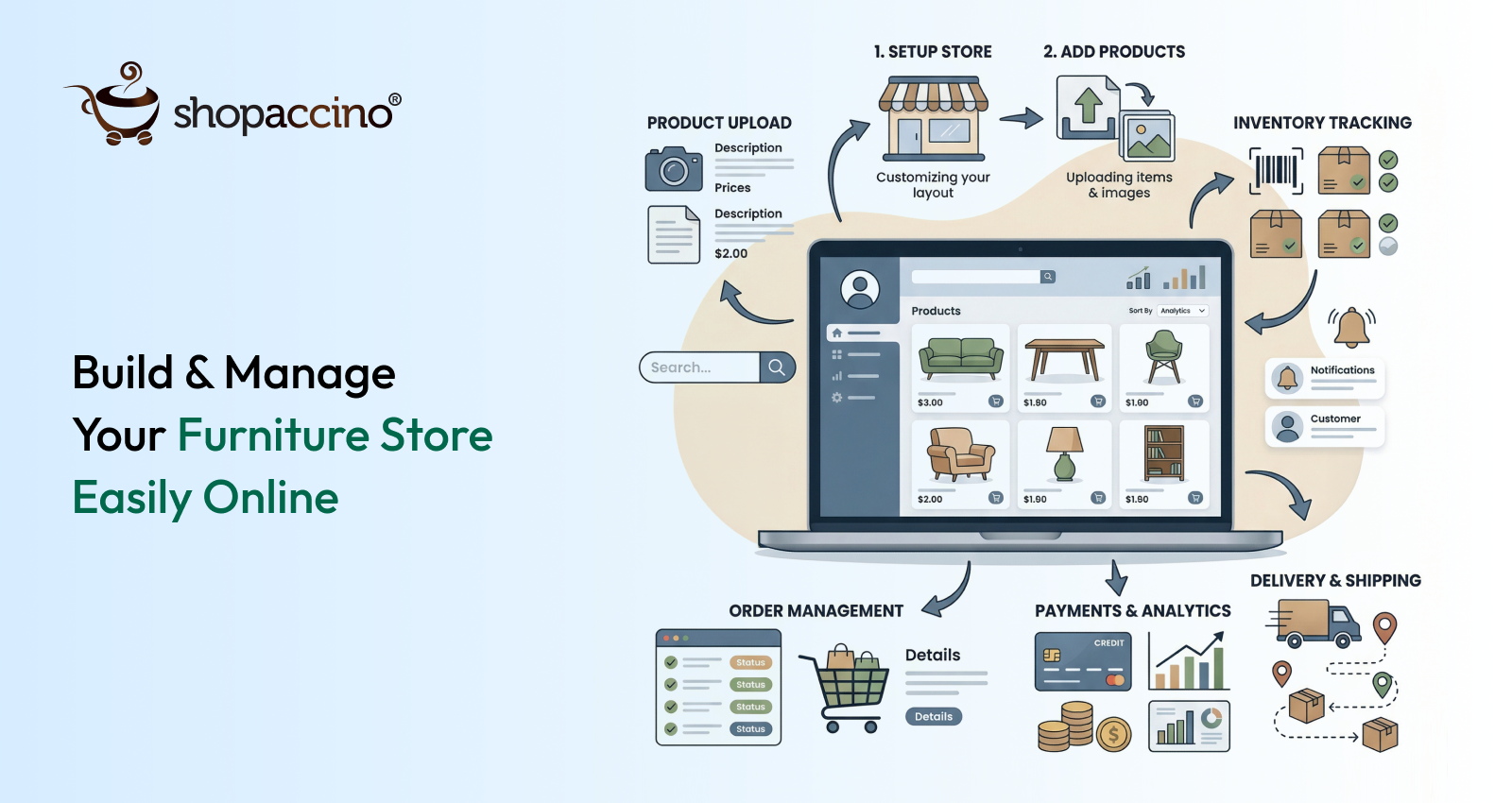
Instead of struggling with developers, design issues, and technical limitations, you get a structured platform that is built specifically for selling furniture online. It doesn’t just help you create a website—it helps you handle how customers explore products, how orders are managed, and how your business scales over time.
Before understanding how it makes things easy, it’s important to understand why selling furniture online requires a different approach altogether.
Why Selling Furniture Online Is Different from Other Products
If you compare furniture with categories like clothing or accessories, the buying behavior is completely different.
Furniture buyers typically:
- Spend more time researching
- Compare multiple options before purchasing
- Look for detailed specifications
- Care about durability, size, and usability
- Often want customization
For example, someone buying a t-shirt may decide in minutes. But someone buying a sofa may:
- Check 5–6 websites
- Compare prices and materials
- Measure their room space
- Discuss with family
This longer decision cycle means your website must do more than display products—it must assist the decision-making process.
If your website fails to provide clarity, users don’t just leave—they move to a competitor who explains things better.
What a Furniture Website Builder Actually Solves
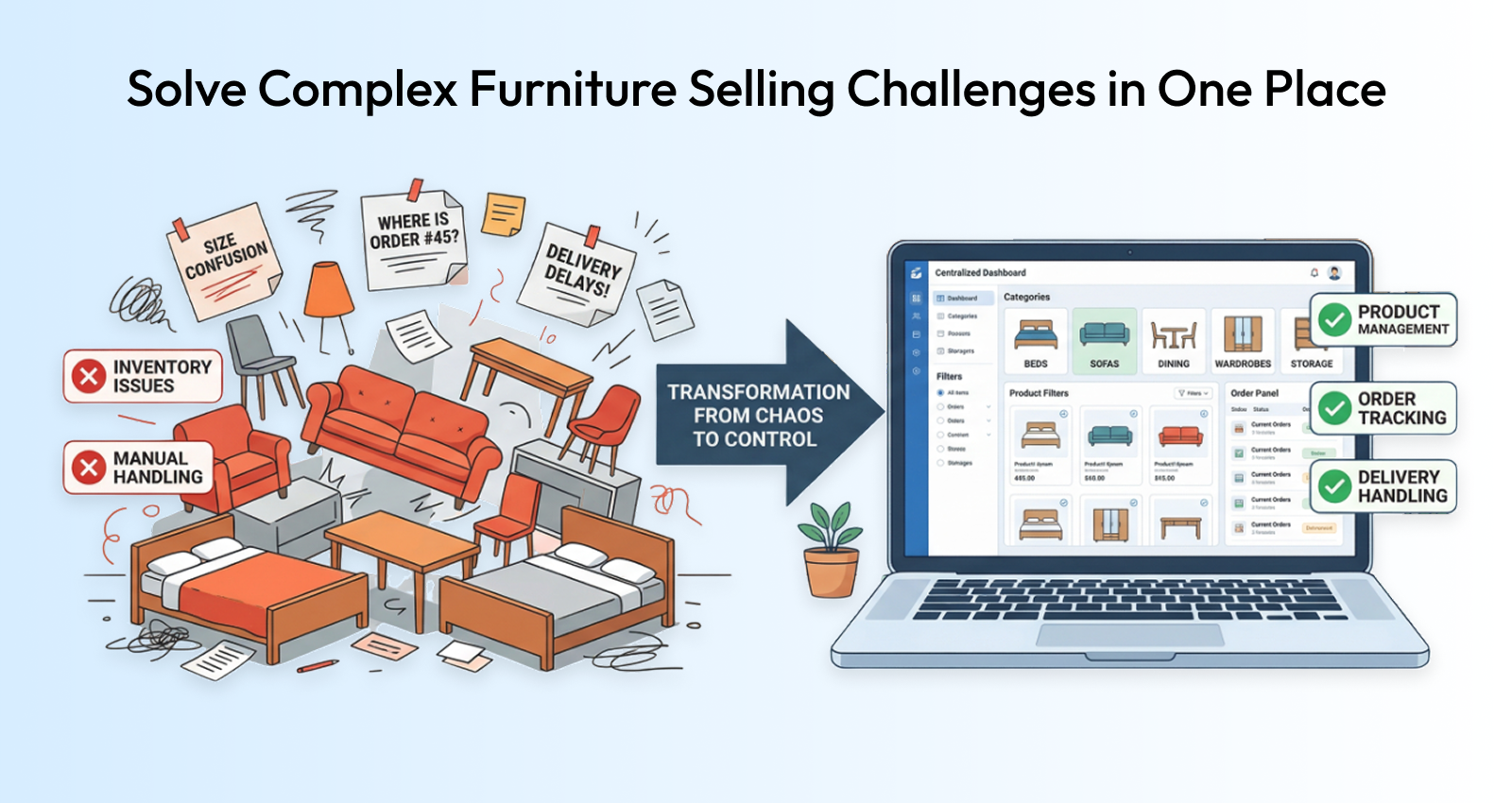
At a basic level, it helps you create an online store. But the real value lies in solving practical business challenges.
Think about the common problems furniture sellers face:
- Difficulty in showing product variations (size, material, finish)
- Managing large catalogs with multiple categories
- Handling delivery based on location and product size
- Managing both ready stock and made-to-order items
- Explaining product details clearly to customers
A well-built system addresses all of this in one place.
Instead of juggling multiple tools, you get a single platform where:
- Products are structured properly
- Customers can filter and find easily
- Orders are tracked efficiently
- Operations stay organized
This is why choosing the best furniture ecommerce platform is not just a technical decision—it’s a business decision.
The Biggest Mistake: Treating Furniture Like a Normal Ecommerce Product
One of the main reasons many online furniture stores fail is because they follow a generic ecommerce approach.
They:
- Upload a few images
- Add basic descriptions
- Set a price
- Expect sales to happen
But furniture doesn’t work that way.
Let’s take a simple example.
If you list a “wooden bed” without:
- Dimensions
- Storage details
- Material type
- Assembly information
The customer is left with questions. And unanswered questions reduce conversions.
A strong furniture maker website understands this behavior and solves it by design—not as an afterthought.
Traditional Website vs Furniture-Focused System (Real Difference)
Many businesses still consider building a custom website from scratch. It sounds flexible, but in reality, it creates more problems than it solves.
A traditional approach usually involves:
- Hiring developers
- Managing design separately
- Adding features later at extra cost
- Facing delays and technical issues
Whereas a dedicated system is built with furniture selling in mind from day one.
Area | Traditional Website Approach | Furniture Website Builder |
Setup | Time-consuming and technical | Fast and structured |
Product Handling | Manual and limited | Built for variations and categories |
Cost | High upfront + ongoing | Predictable and affordable |
Updates | Developer dependent | Self-manageable |
Growth | Difficult to scale | Designed for expansion |
The difference is not just convenience—it directly affects how quickly you can launch and how efficiently you can grow.
How the Right Setup Impacts Your Sales
Most people underestimate this, but your website structure directly affects your revenue.
Here's how:
- If products are hard to find → users leave
- If details are unclear → users hesitate
- If checkout is complicated → users drop off
- If trust is low → users don't convert
On the other hand:
- Easy navigation increases browsing time
- Clear information builds confidence
- Smooth checkout improves conversions
- Organized backend improves operations
So the goal is not just to “go online,” but to create a system where every step supports the buying journey.
How a Furniture Website Builder Simplifies the Entire Process
Now let's look at how it actually makes things easier in real terms.
Instead of thinking in technical steps, think from a business perspective.
You start with your products.
You organize them into categories like:
- Beds
- Sofas
- Dining tables
- Wardrobes
Then you define variations:
- Size
- Material
- Finish
The platform allows you to structure all this clearly so customers don't feel confused while browsing.
When a customer lands on your website:
- They can filter products based on their needs
- Compare options easily
- Understand specifications without confusion
When they decide to buy:
- The checkout is simple
- Payment is secure
- Order is recorded and tracked
From your side:
- Inventory updates automatically
- Orders are managed from one dashboard
- You don't need to depend on developers
This shift—from manual handling to a structured system—is what makes scaling possible.
What You Should Prepare Before Launching
Even with the right platform, preparation matters.
Before launching your store, you should focus on how your products will be presented.
Start with clarity.
Each product should answer:
- What is it made of?
- What are its dimensions?
- Who is it suitable for?
- How is it used?
Images should not just look good—they should inform.
For example:
- Show close-up material texture
- Show the product in a real room setting
- Show different angles
This reduces doubt and improves trust.
Also, define your:
- Pricing strategy
- Delivery process
- Return or replacement policy
These are not optional—they directly affect buying decisions.
A Practical Way to Think About Your Online Store
Instead of thinking:
“I need a website”
Think:
“I need a system that helps a customer go from confusion to confidence.”
Because that's what drives sales.
When a user visits your store, they should:
- Understand what you offer
- Find what they need quickly
- Trust the product quality
- Feel confident to purchase
If your setup supports these steps, your business grows.
If not, traffic alone won't help.
Turning Your Furniture Website into a Sales Engine (Not Just an Online Catalog)
By now, you understand that building a furniture website is not just about going online—it's about creating a system that supports how customers actually buy furniture.
But here's where most businesses struggle.
They launch their website, upload products, and wait for sales.
Traffic may come—but conversions don't.
Why?
Because a furniture website doesn't fail at the product level—it fails at the experience level.
Customers don't just need options.
They need clarity, confidence, and guidance.
This is where the right use of features inside a Furniture Website Builder makes a real difference—not as tools, but as conversion drivers.
How Customers Actually Interact with Your Furniture Website
Before going into features, it's important to understand behavior.
A typical customer journey looks like this:
- Lands on your website (from Google, ads, or social media)
- Searches or browses a category
- Filters options based on need
- Opens 2–4 product pages
- Compares details
- Leaves… and comes back later
- Finally decides to buy
At each step, small friction points can break the journey.
- If navigation is confusing → they leave early
- If product details are unclear → they don't trust
- If comparison is difficult → they delay decision
- If checkout feels risky → they abandon
So your website must not just exist—it must support this entire journey smoothly.
Making Product Discovery Effortless
Furniture websites usually have large catalogs. Without structure, it becomes overwhelming.
Imagine a customer looking for:
“a 4-seater wooden dining table under ₹20,000”
If your website doesn't help them reach this quickly, they won't scroll endlessly—they'll exit.
This is where structured discovery matters.
A well-optimized store allows users to:
- Navigate through clear categories
- Use filters like price, size, material, and seating capacity
- Sort products based on relevance
But the real impact is not just convenience—it's decision speed.
When customers find relevant options faster, they:
- Spend more time on your site
- Explore more products
- Move closer to purchase
This is one of the most underrated factors in improving conversion rates.
The Role of Product Pages in Decision-Making
Once a customer lands on a product page, the real test begins.
This is where most buying decisions are either made—or lost.
Furniture buyers are not impulsive. They actively look for reasons to say “yes” or “no.”
Your product page must answer all their silent questions.
Instead of just listing features, think in terms of clarity.
A strong product page should help the customer understand:
- What exactly they are buying
- Whether it fits their space
- Whether it matches their style
- Whether the quality justifies the price
This is achieved through:
- Multiple real images (not just studio shots)
- Close-up visuals to show material quality
- Clear dimensions (in an easy-to-understand format)
- Use-case context (like room setup images)
What most businesses miss:
They describe the product—but don't help the customer visualize ownership.
And visualization is what drives decisions in furniture.
Customization: The Hidden Conversion Booster
In furniture, a “perfect product” rarely exists.
Customers often want small changes:
- A different color
- A slightly different size
- A different finish
If your website doesn't support customization, the customer has two options:
- Contact you manually (which slows the process)
- Leave and find another seller
A well-built furniture maker website removes this friction.
It allows customers to:
- Select variations easily
- See updated pricing instantly
- Request custom changes without confusion
Business impact:
Customization doesn't just improve experience—it increases your chances of closing high-value orders.
Why Mobile Experience Directly Affects Your Revenue
Most furniture store owners still underestimate mobile users.
But in reality:
- A large percentage of browsing happens on mobile
- Many users discover products through social media on mobile
Now think from a user's perspective.
If your website:
- Loads slowly
- Has misaligned images
- Requires zooming to read text
They won't adjust—they'll leave.
A mobile-optimized experience ensures:
- Fast loading (especially for images)
- Smooth scrolling
- Clear buttons and actions
- Easy checkout
Important insight:
Even if the final purchase happens on desktop, the first impression often happens on mobile.
How SEO Fits into Your Growth Strategy
Many furniture businesses depend heavily on paid ads.
But long-term growth comes from organic traffic.
When your website is structured properly, it starts appearing in searches like:
- “buy wooden bed online”
- “modern sofa designs”
- “custom furniture website”
But ranking doesn't happen just by adding keywords.
It happens when your pages:
- Provide detailed and useful information
- Match what users are searching for
- Load quickly and work smoothly
For example:
A product titled:
“Bed”
Will never compete with:
“King Size Wooden Bed with Storage for Small Bedrooms”
This is not just SEO—it's clarity.
And clarity improves both rankings and conversions.
Managing Operations Without Chaos
As your business grows, managing everything manually becomes risky.
You may start facing:
- Stock mismatches
- Missed orders
- Delayed deliveries
- Customer complaints
Our guide on managing size, shipping, and custom orders for furniture stores breaks down exactly how to avoid this.
This is where a proper system becomes essential.
A good platform helps you:
- Track inventory in real-time
- Manage different order types (retail + bulk)
- Handle order status and updates
- Reduce manual errors
This is especially important if you plan to scale.
Because growth without systems leads to operational problems.
Why Marketing Alone Won't Work Without the Right Setup
Many businesses try to solve low sales by increasing marketing.
They run ads, post on social media, and drive traffic.
But if the website experience is weak, traffic doesn't convert.
Think of it like this:
- Marketing brings users
- Website converts users
If your foundation is not strong, marketing spend gets wasted.
So before scaling marketing, make sure:
- Product pages are clear
- Navigation is simple
- Trust signals are visible
- Checkout is smooth
Only then does marketing deliver real ROI.
Building Trust: The Most Critical Factor in Furniture Sales
Furniture is not a low-risk purchase.
Customers are spending a significant amount, often without physically seeing the product.
So trust becomes the deciding factor.
Your website must reduce uncertainty.
You can do this by:
- Showing real product images (not only edited ones)
- Displaying customer reviews and ratings
- Clearly explaining return or replacement policies
- Providing visible contact details
What happens when trust is missing?
Even interested buyers delay the purchase, or choose a more reliable-looking brand.
A Practical Perspective on Growth
At this stage, your focus should shift from:
“Launching a website”
To:
“Improving how customers interact with it”
Because growth comes from:
- Better product understanding
- Faster decision-making
- Higher trust
- Smoother buying experience
A powerful Furniture Website Builder supports all of this—but how you use it determines your success.
Scaling Your Furniture Business: From Orders to a Growing Brand
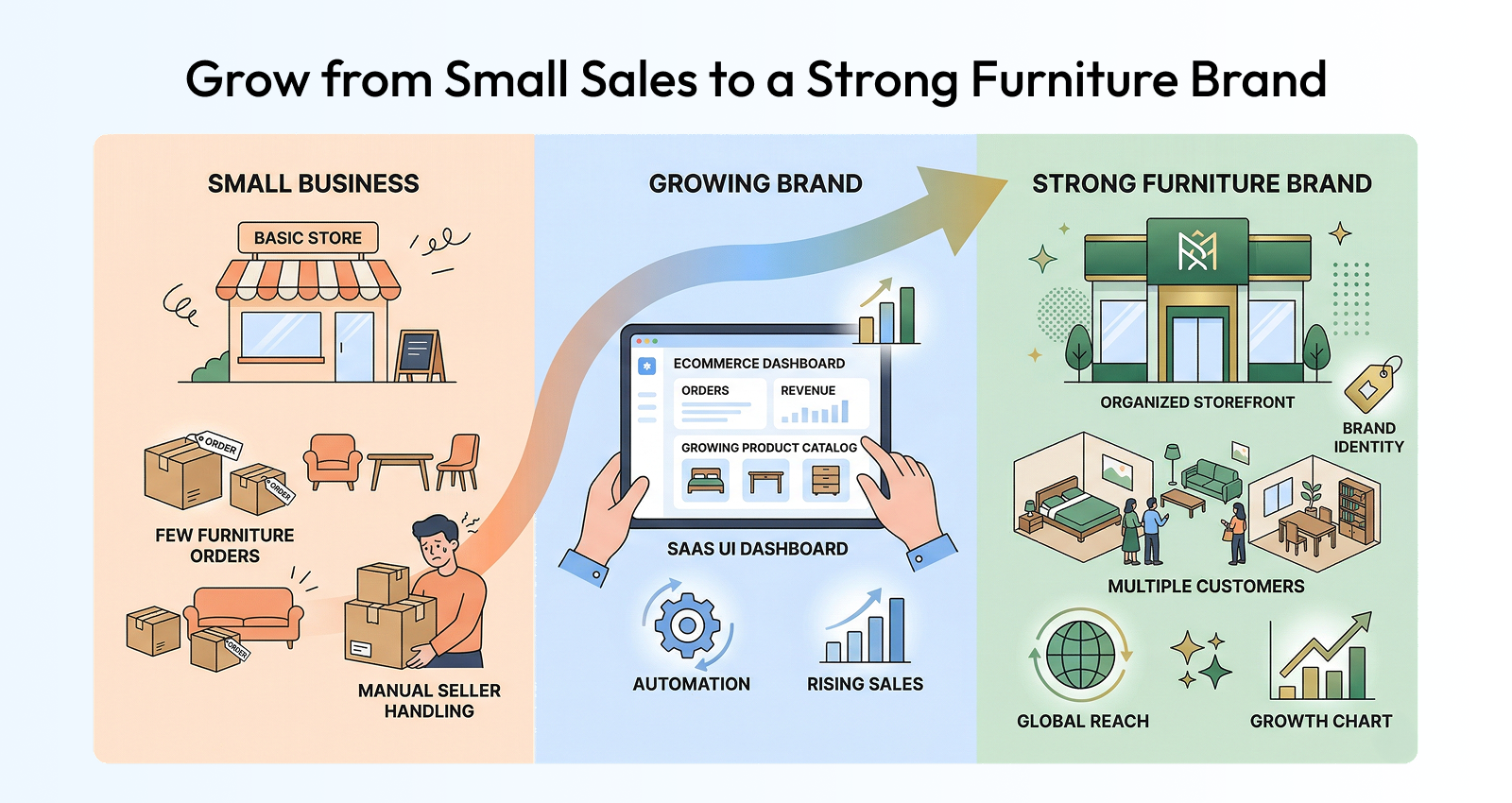
By now, you've built a strong foundation.
- You understand how furniture buying behavior works
- You know how to structure your website for better conversions
- You've seen how the right system improves operations
But here's the real shift:
Launching a website helps you start.
Scaling it is what builds a business.
Many furniture sellers reach a point where:
- Orders are coming in, but growth slows down
- Operations become difficult to manage
- Marketing efforts stop delivering the same results
This is where you need to move from “running a store” to building a scalable system and brand.
The First Growth Barrier: Inconsistent Sales
One of the most common challenges is unstable revenue.
Some days bring multiple orders, while others are completely silent.
This usually happens because:
- Traffic sources are limited
- Marketing is not consistent
- The business depends too much on one channel
To solve this, you need multi-channel demand generation.
Instead of relying on a single source, build a mix:
- Organic traffic (SEO) for long-term growth
- Paid ads for immediate visibility
- Social media for discovery and engagement
Practical approach:
Start by identifying which channel is already working—even slightly—and strengthen it before expanding.
Expanding Your Product Strategy for Higher Revenue
In the early stage, most sellers focus on listing products.
But growth comes from strategic product planning.
Ask yourself:
- Which products are generating the most interest?
- Which ones have higher margins?
- Which categories are trending?
Once you identify this, you can:
- Expand best-selling categories
- Introduce variations of popular products
- Bundle related items together
For example:
If beds are selling well, you can expand into:
- Storage beds
- Premium wooden beds
- Bed + mattress bundles
This increases both visibility and average order value.
Increasing Average Order Value (AOV)
Getting a customer is expensive.
So instead of only focusing on more traffic, increase the value of each order.
You can do this by:
- Offering product bundles
- Suggesting complementary products
- Providing volume-based discounts
Example:
A customer buying a dining table can be shown:
- Matching chairs
- Table décor items
This doesn't just increase revenue—it improves the overall buying experience.
Building a Brand (Not Just a Product Catalog)
Many furniture websites fail to grow because they look like generic catalogs.
Customers don't remember them.
They don't trust them long-term.
To scale, you need to build a brand identity.
This includes:
- Consistent visual style (colors, layouts, images)
- Clear positioning (modern, affordable, premium, custom-made)
- Strong product storytelling
Instead of just listing a product, explain:
- Why it's designed that way
- Who it's perfect for
- What problem it solves
Example shift:
Instead of:
“Wooden Study Table”
Say:
“Compact Wooden Study Table Designed for Small Spaces”
This creates connection—not just information.
Leveraging Customer Trust for Growth
Once you start getting customers, your biggest asset is not your products—it's your existing buyers.
Use them to build credibility.
You can:
- Collect reviews and ratings
- Showcase customer photos
- Highlight real usage scenarios
Why this works:
New customers trust other buyers more than brand claims.
This reduces hesitation and increases conversion rates significantly.
Handling Operations as You Scale
Growth brings complexity.
More orders mean:
- More inventory movement
- More delivery coordination
- More customer queries
If your backend is not structured, problems start appearing:
- Delayed shipments
- Order mismatches
- Customer dissatisfaction
This is where your system plays a critical role.
A strong setup helps you:
- Automate order tracking
- Manage stock across products
- Handle bulk and retail orders together
- Maintain consistency in operations
Scaling without systems creates chaos.
Scaling with systems creates efficiency.
Understanding Customer Behavior Through Data
As your store grows, guessing is no longer enough.
You need data to make decisions.
Focus on tracking:
- Which products get the most views
- Which products convert the most
- Where users drop off
- Which traffic source performs best
This helps you:
- Improve weak areas
- Double down on what works
- Avoid unnecessary efforts
Example:
If many users view a product but don't buy, the issue may be:
- Pricing
- Lack of details
- Low trust
Fixing that one product can improve overall revenue.
Common Challenges and How to Overcome Them
Even with the right setup, challenges are part of the journey.
Here are some common ones and how to handle them:
Low Website Conversions
Problem: Traffic is coming, but sales are low
Solution:
- Improve product pages
- Add more trust signals
- Simplify checkout process
High Cart Abandonment
Problem: Users add products but don't complete purchase
Solution:
- Offer limited-time discounts
- Enable reminders
- Reduce checkout complexity
Operational Delays
Problem: Orders are difficult to manage
Solution:
- Use automated order tracking
- Maintain accurate inventory
- Streamline delivery processes
Difficulty in Standing Out
Problem: Too much competition
Solution:
- Focus on niche categories
- Offer customization
- Build a strong brand identity
Long-Term Thinking: What Actually Builds a Successful Furniture Business
At a deeper level, success in online furniture is not about:
- Just having more products
- Just running ads
- Just lowering prices
It's about building a system where:
- Customers can discover products easily
- They feel confident while buying
- They receive what they expect
- They are willing to return or recommend
This is what turns a store into a sustainable business.
Bringing Everything Together
Let's simplify the entire journey:
- A Furniture Website Builder helps you start quickly
- The right setup helps you convert visitors into buyers
- The right strategies help you grow consistently
- The right systems help you scale without chaos
When all these elements work together, your business doesn't just survive—it grows steadily.
Final Perspective
Selling furniture online is not complicated—but it requires the right approach.
If you focus only on:
- Building a website → you may struggle
If you focus on: - Customer experience + structure + strategy → you grow
The opportunity in online furniture is huge.
But the businesses that succeed are the ones that combine the right tools with the right execution.
FAQs
A furniture website builder is a platform that helps you create an online furniture store without coding. It allows you to design your website, add products with variations like size and material, manage orders, and accept payments. It simplifies complex tasks like inventory and delivery management, making it easier to run your furniture business online efficiently.
You can create a furniture website using a website builder that offers ready-made templates and easy setup. These platforms allow you to upload products, customize layouts, and manage your store without coding knowledge. With drag-and-drop features and built-in tools, even beginners can launch and manage their online furniture store easily.
The best furniture ecommerce platform for beginners is one that offers easy setup, product customization options, mobile-friendly design, and built-in management tools. Platforms like Shopaccino help users manage both online sales and operations without technical complexity, making them suitable for small businesses and growing brands.
A good furniture maker website should support product customization, high-quality image display, detailed product descriptions, and easy navigation. It should also include features like inventory management, secure payments, and mobile optimization to improve user experience and increase conversions.
To increase sales, focus on improving product presentation, using high-quality images, and writing detailed descriptions. You should also optimize your website for SEO, run targeted ads, and use strategies like discounts and bundles. A smooth checkout process and strong trust signals also play a key role in improving conversions.
Product customization allows customers to choose size, material, color, or finish based on their needs. Since furniture is often a personalized purchase, offering customization increases customer satisfaction and improves conversion rates. It also helps you stand out from competitors who offer fixed product options.
SEO helps your website appear in Google search results when users look for furniture products. By optimizing product pages, using relevant keywords, and improving website structure, you can attract organic traffic. This reduces dependency on paid ads and brings long-term, high-intent customers to your store.
Common mistakes include using low-quality images, providing incomplete product details, poor website navigation, and ignoring mobile optimization. These issues reduce trust and increase bounce rates. To succeed, focus on clear product presentation, user-friendly design, and a smooth buying experience.