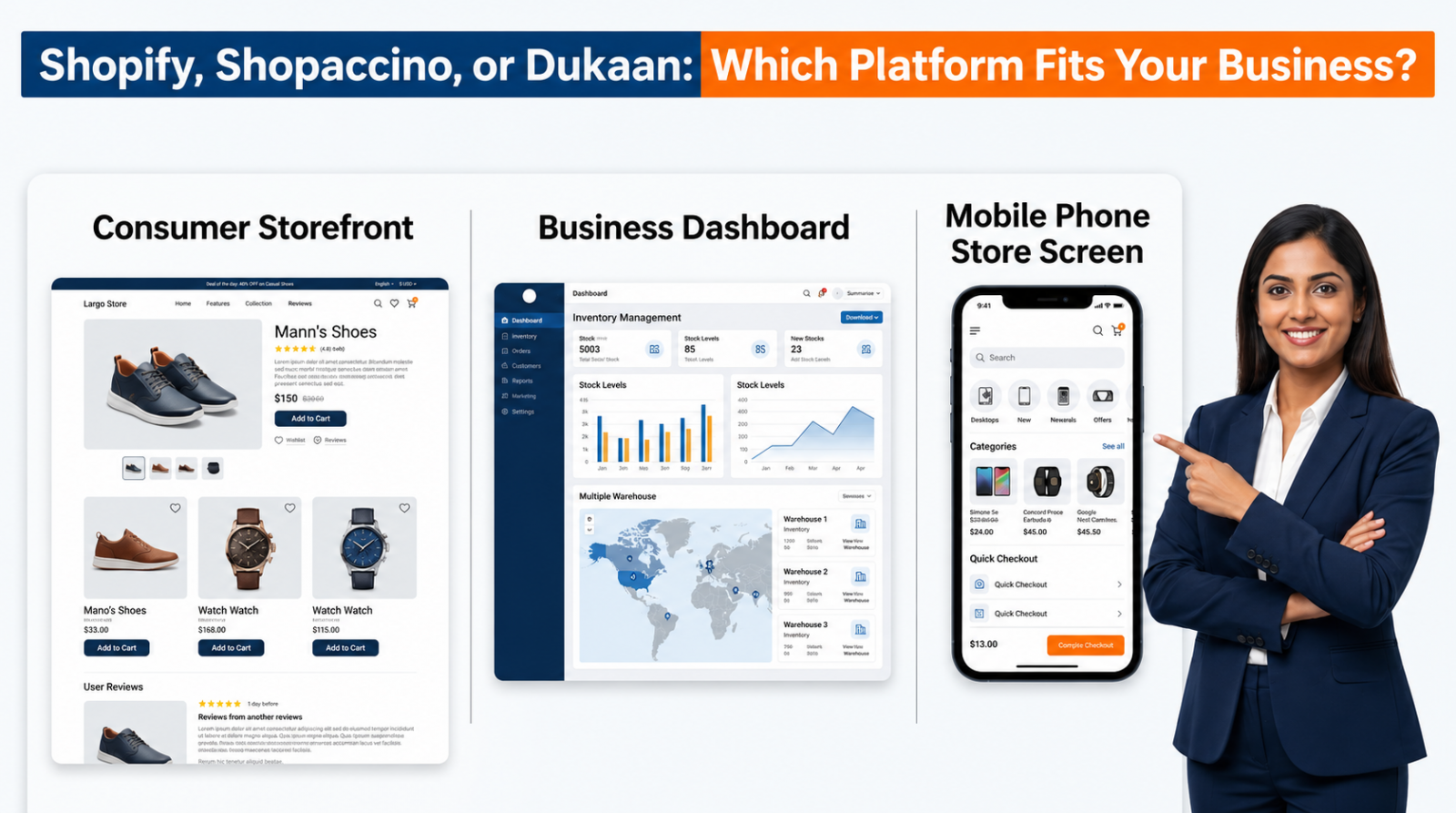
Shopify vs Shopaccino vs Dukaan: Which Ecommerce Platform is Right for Your Business?
Choosing the wrong ecommerce platform is one of the most expensive mistakes a growing business can make. Migration projects take months. Lost SEO authority. Broken integrations. Frustrated customers. A proper ecommerce website builder comparison before you commit is worth a hundred hours of post-launch regret.
This guide compares Shopify, Shopaccino, and Dukaan honestly. Not as a feature checklist, but as three different answers to the question of who you actually are as a business. Each platform serves a specific type of seller well. Each one serves other types poorly. The job here is to help you self-identify which platform actually fits how you operate, not to pick a winner.
By the end of this article, you will know which platform suits established offline retailers moving online, which one suits global D2C brands with heavy app needs, and which one suits small Indian sellers wanting a fast mobile launch. The decision becomes obvious once you see your business in the right column.
Why Does Your Ecommerce Platform Choice Matter So Much?

The platform you pick decides almost every operational reality of your online business. How fast you can list new products. How smoothly payments settle. How you handle inventory across warehouses. How much commission you give up on every order — see how zero commission ecommerce platforms let you keep 100% of your sales. How easily you serve B2B alongside B2C. How well you scale internationally.
A platform that fits your business model gets out of the way. You focus on products, customers, and growth. A platform that does not fit becomes a daily friction tax. Workarounds. Plugins that break. Features you needed last quarter but the platform still does not have. After 18 months on the wrong platform, most businesses migrate. Migration costs time, SEO authority, and customer trust.
The right SaaS ecommerce platform feels invisible. The wrong one feels like a second job you never signed up for. That is the practical difference platform choice makes.
What Is Each Platform Actually Built For?
Before comparing features, understand what each platform was designed around. The original design assumptions shape everything that follows.
What Is Shopify?
Shopify is a global SaaS ecommerce platform launched in Canada in 2006. It serves over 4 million stores worldwide as of 2025. Its primary design assumption is breadth. Shopify aims to be the operating system for any kind of online store, in any country, in any category. To deliver that breadth, Shopify built a massive app marketplace where third-party developers fill the gaps the core platform leaves open.
Shopify's strength is the ecosystem around it. Its weakness is that almost any meaningful customization requires installing apps, and most useful apps charge a monthly subscription on top of Shopify's own fees. A working Shopify store often costs significantly more than the headline plan price suggests.
What Is Shopaccino?
Shopaccino is a SaaS ecommerce platform designed around the operational realities of established businesses. Specifically exporters, manufacturers, distributors, and D2C brands that already have inventory, supplier relationships, and offline sales experience. Rather than aiming at every possible use case, Shopaccino is built around features these specific business types need: multi-warehouse inventory, integrated B2B and B2C from one system, multi-currency for exporters selling globally, native payment and logistics integrations, and zero platform transaction fees.
Shopaccino's strength is that the features are built in rather than bolted on. The weakness is that it is not the right fit for first-time entrepreneurs without inventory or operations. Shopaccino is built for businesses ready to scale a real operation, not for someone testing whether they want to start a business at all.
What Is Dukaan?
Dukaan is an India-focused mobile-first ecommerce platform launched in 2020. Its primary design assumption is speed and simplicity for small Indian sellers. The entire platform can be set up from a smartphone in under 30 minutes. Dukaan focuses heavily on the Indian market with rupee-first pricing, local payment integrations, and mobile-first store layouts.
Dukaan's strength is the low entry barrier and the speed of launch. Its weakness is depth. Sellers with complex inventory, multi-warehouse operations, B2B needs, or global selling ambitions hit limits quickly. Dukaan works very well for what it is. It just is not trying to be the platform you scale a large operation on.
How Do Shopify, Shopaccino, and Dukaan Compare Side by Side?
Here is the factual comparison across the categories that matter most to a buying decision. Pricing reflects publicly available information at the time of writing and may vary by region and plan tier.
Category | Shopify | Shopaccino | Dukaan |
|---|---|---|---|
Founded | 2006, Canada | 2014, established global | 2020, India |
Target Market | Global, all sizes | Established offline businesses going online, worldwide | Small sellers, primarily Indian market |
Best For | D2C brands wanting app ecosystem | Exporters, manufacturers, distributors, D2C with B2B needs | Small mobile-first Indian sellers |
Pricing Model | Monthly subscription, paid apps add up | Monthly subscription with most features built-in | Affordable monthly plans, India-focused |
Platform Transaction Fees | 0.5 to 2 percent unless using Shopify Payments | Zero transaction fees on platform | Varies by plan |
B2B Plus B2C | Requires Shopify Plus or separate apps | Built in, both from one dashboard | Limited B2B features |
Multi-Warehouse | Available on higher plans or via apps | Pro-commerce plan and above | Limited |
Multi-Currency | Strong, native | Strong, native, built for exporters | INR focused |
Mobile App for Store Owner | Yes | Yes, full on-the-go management | Yes, mobile-first design |
Branded Mobile App for Customers | Available | Available | Available |
Learning Curve | Moderate, heavy app ecosystem | Moderate, fewer apps to learn | Low, very simple |
Best Use Case Summary | Global D2C brands wanting flexibility through apps | Real businesses moving online with operations already in place | First-time sellers wanting a fast simple launch |
Which E-commerceda Platform Should You Choose Based on Your Business?

Here is the decision framework, written as honestly as possible. Find your business in one of these three sections.
When Does Shopify Make Sense for Your Business?
Shopify is the right choice if your business fits this description:
- You are a global D2C brand expecting to scale beyond multi-million dollar annual revenue
- You need a very specific third-party app for your category (subscriptions, custom configurators, complex checkouts)
- You have the budget for both the Shopify subscription and additional app subscriptions
- You are comfortable using Shopify Payments to avoid the transaction fee, even though it limits your gateway choice
- You want to hire from the largest pool of e-commerce developers globally
Shopify is genuinely excellent at what it does. The honest caveat is the cost. Many businesses pick Shopify expecting the headline plan price and then discover after launch that 8 to 12 essential apps bring their monthly cost to two or three times the original quote.
When Does Shopaccino Make Sense for Your Business?
Shopaccino is the right choice if your business fits this description:
- You are an established offline business (retailer, manufacturer, distributor, exporter) moving your operations online
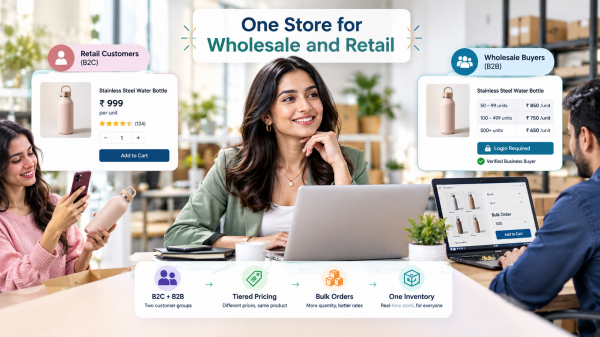
- You sell both B2B and B2C from the same inventory and need both managed in one system
- You operate from multiple warehouses or have ambitions to add warehouses as you grow
- You export or want to export, and need multi-currency support without third-party apps
- You want most features built in rather than assembled from a marketplace of paid apps
- You care about keeping every rupee, dollar, or euro of your earnings with zero platform transaction fees
Shopaccino is honest about who it is not for. First-time entrepreneurs without inventory, dropshippers testing product market fit, side projects, and side hustles are better served elsewhere. Shopaccino is built for businesses that already exist offline and are ready to make online a serious channel. The B2B ecommerce solutions and multi-warehouse ecommerce depth are particularly strong for manufacturers and distributors.
When Does Dukaan Make Sense for Your Business?
Dukaan is the right choice if your business fits this description:
- You are a small Indian seller wanting to test online selling without committing to a complex platform
- Your entire customer base is in India and you do not plan to sell internationally
- You manage your store primarily from your smartphone
- Your product catalogue is small (under 100 SKUs) and unlikely to grow beyond a few hundred
- Your monthly order volume is modest and your business model is fairly simple
Dukaan does what it does very well. The honest caveat is that businesses scale out of Dukaan once they grow. If your business is growing fast or you have international ambitions, plan for an eventual migration to a more capable platform within 18 to 36 months.
What Does Each Platform Actually Cost in Practice?
Headline pricing is misleading on all three platforms. The real cost depends on how you use the platform. Here is the honest breakdown.
Shopify Real Cost
Shopify's basic plan covers the core store. But most working Shopify stores need additional apps: email marketing, reviews, advanced shipping, subscriptions, upsells, page builders, SEO tools. Each app charges 10 to 50 USD per month. A functional Shopify store typically lands at 150 to 400 USD per month including apps, not the headline subscription number. Add Shopify Plus and the figure scales accordingly.
Shopify also charges a 0.5 to 2 percent transaction fee on every order if you do not use Shopify Payments. For high-volume stores, this becomes substantial.
Shopaccino Real Cost
Shopaccino charges a single monthly subscription with most features built in. Multi-warehouse, B2B, multi-currency, payment integrations, and shipping connections are included rather than added as paid apps. The headline price is closer to the real cost than on Shopify.
Zero platform transaction fees mean what you sell, you keep. Payment gateway charges still apply (those go to Razorpay, PayU, Stripe, etc., not to Shopaccino), but the platform itself does not take a cut of each order. For a high-volume business, this difference alone can pay for the platform subscription several times over.
Dukaan Real Cost
Dukaan offers the lowest entry price among the three. Plans start at very affordable INR-based monthly rates. The trade off is feature depth. Sellers who need additional capabilities often discover they require a plan upgrade or that the feature is simply not available.
For a small Indian seller running a simple store, Dukaan delivers excellent value. For a growing business that hits the platform's limits, the cost of those limits eventually exceeds the cost saving.
What Do Real Businesses Actually Experience on Each Platform?
Marketing pages show platforms at their best. Real businesses show them in practice. Here are honest observations from the operational reality of using each platform, drawn from working with hundreds of merchants across all three.
The Shopify Reality
Most Shopify merchants report two things consistently. First, the platform itself is genuinely smooth and reliable. Second, they pay far more than they originally expected. The app marketplace is both Shopify's greatest strength and the source of its hidden costs. Merchants growing fast on Shopify often hire an agency or in-house developer just to manage the app stack. That cost rarely appears in initial budget projections.
The Shopaccino Reality
Shopaccino merchants tend to be operational businesses moving online from existing offline channels. The common feedback is that the platform feels like one tool rather than ten apps stitched together. Multi-warehouse, B2B, and B2C from one dashboard removes the integration headaches that other platforms require. The trade-off is a smaller third-party app marketplace. For businesses that mostly need the core features done well, this is fine. For businesses that need something highly specific that does not exist in the platform, it can require custom development.
The Dukaan Reality
Dukaan merchants are typically small Indian sellers who appreciate the simplicity. Setup from phone, easy product addition, straightforward order management. The common feedback is that scale becomes difficult once the business crosses a certain size. The features needed at that point (advanced reporting, complex shipping rules, B2B workflows, international payments) require migration to a different platform.
According to the U.S. Census Bureau Quarterly E-Commerce Report, ecommerce continues to grow as a share of total retail across mature markets. The UNCTAD Ecommerce and Digital Economy reports show cross-border ecommerce growing faster than domestic in most emerging markets. The platform you choose today is the foundation for capturing that growth tomorrow.
What Are the Key Differences That Decide the Right Choice?
Most platform comparisons drown readers in feature checklists. Here are the four differences that actually decide the right answer for most businesses.
Difference 1: How Are Transaction Fees Structured?
Shopify charges 0.5 to 2 percent on every order unless you use Shopify Payments. Shopaccino charges zero platform transaction fees. Dukaan varies by plan. For a business doing 100,000 USD in monthly revenue, the difference between zero and 1 percent is 1,000 USD per month, which is more than the subscription cost of the platform itself.
Difference 2: How Is B2B Handled Alongside B2C?
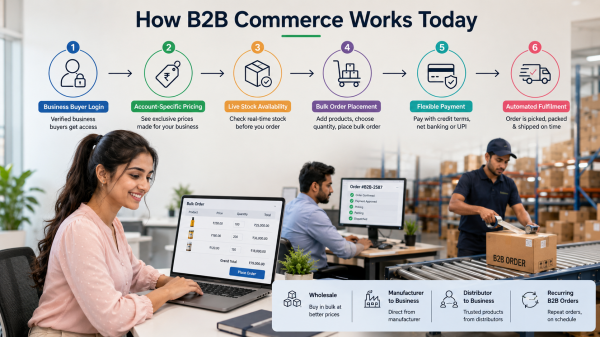
Shopify treats B2B as a separate experience available on higher plans. Shopaccino integrates B2B ecommerce solutions into the same dashboard as B2C from any plan, letting one product catalogue serve both wholesale customers and retail buyers with different pricing tiers. Dukaan has limited B2B capability. For manufacturers and distributors selling to both businesses and consumers, this difference is decisive.
Difference 3: How Does Inventory Work Across Warehouses?
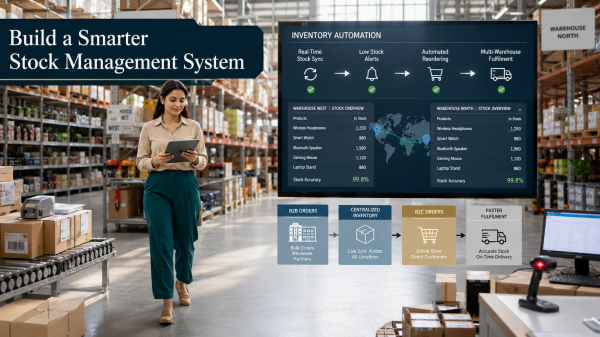
Shopify's multi-warehouse ecommerce capability appears on higher plans or via paid apps. Shopaccino builds multi-warehouse inventory and order fulfilment into the platform from the Pro-commerce plan and above. Dukaan does not focus on multi-warehouse operations. For businesses operating from multiple physical locations, this affects daily operations significantly.
Difference 4: How Built In vs Bolt On Are the Features You Need?
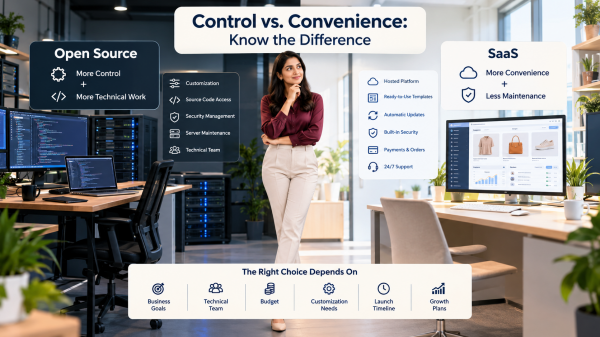
Shopify's strength is the app marketplace. Shopaccino's approach is the opposite: build the features in. Dukaan takes a third approach: it keeps the feature set deliberately minimal and simple, so there is little need for apps, but also little room to add depth as the business grows. For D2C ecommerce software buyers who want the platform to handle most operational needs without 8 to 12 paid apps stacked on top, Shopaccino's bundled approach saves both money and integration complexity. For buyers who want maximum customization and are willing to assemble it from apps, Shopify's marketplace offers more options. For sellers who just need a small, simple feature set with nothing extra to manage, Dukaan's minimal approach works well, until the business outgrows it.
What Are the Honest Weaknesses of Each Platform?
Every platform has weaknesses. A buying decision made without acknowledging them is one made on incomplete information.
Shopify Weaknesses
- Real cost is significantly higher than headline plan price due to required apps
- Transaction fees on every order unless using Shopify Payments
- Significant lock-in: migrating away is complex and time-consuming
- The app marketplace creates ongoing maintenance and integration complexity
Shopaccino Weaknesses
- Smaller third-party app marketplace than Shopify
- Not designed for first-time entrepreneurs or side projects
- Smaller global developer pool than Shopify for custom work
- Less name recognition among consumers outside its core markets
Dukaan Weaknesses
- Limited international and multi-currency capabilities
- B2B functionality is limited compared to more established platforms
- Feature depth is shallower than Shopify or Shopaccino
- Scale ceiling: most growing businesses migrate away within 18 to 36 months
How Do You Make the Final Decision Between These Three Platforms?

The decision becomes simple once you stop comparing features and start matching the platform to your business reality. Here are the takeaways that decide the right choice.
The Final Decision Framework ✓ If you are a global D2C brand that needs a vast app ecosystem and you have budget for both the platform and apps, choose Shopify. ✓ If you are an established offline business (retailer, manufacturer, distributor, exporter) moving online with real operations already in place, choose Shopaccino. ✓ If you are a small Indian seller wanting a quick mobile-first launch with minimal complexity, choose Dukaan. ✓ If you need both B2B and B2C from one system without paid apps, Shopaccino is structurally the strongest fit. ✓ If you operate from multiple warehouses, Shopaccino's built-in multi-warehouse support saves significant operational overhead. ✓ If you sell internationally or export, multi-currency support matters. Shopify and Shopaccino both handle this well. Dukaan does not. ✓ If platform transaction fees matter to your margin (high volume businesses), Shopaccino's zero-fee model has a real financial impact. ✓ Whichever platform you pick, test it with a real free trial. Read the platform's own help documentation. Talk to existing merchants in your category before committing. |
Where Can You Find More Trusted Research Before Deciding?
Independent and government sources worth checking before committing to any ecommerce platform:
- U.S. Census Bureau Quarterly E-Commerce Report
- UNCTAD Ecommerce and Digital Economy Reports
- OECD Digital Economy Policies
- World Trade Organization Trade Statistics
- European Commission Trade and Ecommerce
Final Thoughts on This Ecommerce Website Builder Comparison
The honest answer to which platform is right for you is the one that matches the business you actually are, not the business you wish you were. This ecommerce website builder comparison exists to help you make that match cleanly.
Shopify is brilliant at being a global D2C platform with a deep app ecosystem. Shopaccino is built for established businesses moving online, with B2B, multi-warehouse, and multi-currency built in rather than bolted on. Dukaan is excellent at giving small Indian sellers a fast mobile-first launch. Three different platforms. Three different right answers depending on who is asking. If you are an established offline retailer, manufacturer, distributor, or exporter moving online with real operations and inventory, Shopaccino is the online store builder most likely to fit how you actually work.
Whichever platform you choose, the principles are the same. Build the store carefully. Photograph products well. Set up payments and shipping properly. Communicate with customers fast. Track what works and refine monthly. The platform is the foundation. The business you build on top of it is yours.
FAQs
Shopify and Shopaccino both support international ecommerce well, with multi-currency, multi-language, and international payment gateway support. Shopaccino is particularly strong for exporters because cross-border features are built in rather than added through paid apps. Dukaan is primarily designed for the Indian market and has limited international capabilities.
For established retailers, manufacturers, distributors, and exporters, Shopaccino is typically a better structural fit than Shopify. It includes multi-warehouse inventory, B2B plus B2C from one system, and zero platform transaction fees as built-in features rather than requiring paid apps. Shopify suits businesses needing extensive third-party app integrations and global brand reach.
Shopify charges 0.5 to 2 percent per order unless you use Shopify Payments. Shopaccino charges zero platform transaction fees, regardless of which payment gateway you use. Dukaan transaction fees vary by plan tier. Payment gateway fees (Razorpay, PayU, Stripe, etc.) apply on all platforms because those go to the payment processor, not the ecommerce software.
Yes. Most growing businesses on Dukaan eventually migrate to a more capable platform once they outgrow the feature ceiling. Migration involves exporting your product catalogue, customer database, and order history, then importing into the new platform. Both Shopaccino and Shopify support migration imports. Plan for SEO authority and some operational disruption during the transition.
Dukaan offers the fastest setup, typically under an hour from a smartphone. Shopaccino setup takes a few days for a serious branded store with proper product photography, payment integrations, and shipping configuration. Shopify setup time varies widely depending on how many apps you install. A basic Shopify store can launch in a day. A working Shopify store with all needed apps typically takes one to two weeks.
Value depends on business type. For small Indian sellers, Dukaan offers the best value due to low entry pricing. For established businesses with real operations, Shopaccino typically offers the best value because most features are built in and there are zero platform transaction fees. For global D2C brands willing to invest in apps, Shopify offers value through ecosystem depth. There is no single 'best value' answer that applies to every business.