How To Build A Website To Sell Gold Jewellery
A Strategic Guide for Jewellery Business Owners and Entrepreneurs
Overview
If you want to know how to start a gold jewelry business online, the process has five parts: picking your buyer, sourcing your stock, working out your costs, building your store, and getting your first orders. The online gold jewelry market is growing fast because buyers are now comfortable spending large amounts online, as long as the brand looks credible and the pricing is transparent.
If you are an established jeweller looking to extend your reach, or an entrepreneur exploring how to start a gold jewelry business online, the most important asset you can build right now is a dedicated website. Not a marketplace listing. Not a social media page. A professional, brand-owned ecommerce website that you control.
The reasons are straightforward. A website lets you own your customer relationships, build long-term brand equity, set your pricing strategy, and create a shopping experience that reflects the premium nature of your product. Marketplaces commoditise your jewellery. Your own website positions it.
That said, building a high-performing jewellery website is not simply a matter of picking a template and uploading product photos. It requires strategic thinking across several interdependent areas: understanding your audience, curating your
catalogue, building trust through design and content, configuring the right technology, and creating the operational infrastructure to fulfil orders reliably.
This guide walks you through every stage of that process — practically, in sequence, and without unnecessary filler.
How do you build a website to sell gold jewellery?
To build a website to sell gold jewellery, you set up an online store that supports live gold pricing, secure payments, certification details, and clear product photography. The core steps are: choose an ecommerce platform that handles metal-rate-linked pricing, add your jewellery catalogue with weight and purity details, connect a secure payment gateway, display trust signals like hallmark and certification information, and configure insured shipping. A store that ties product prices to the live gold rate keeps margins accurate as rates change through the day.
Identify Your Market
Before a single page is designed or a single product is photographed, you need to be clear about who you are selling to. The gold jewellery market is not monolithic. It spans vastly different buyers with different motivations, price sensitivities, occasions, and aesthetic preferences.
Understanding Your Buyer
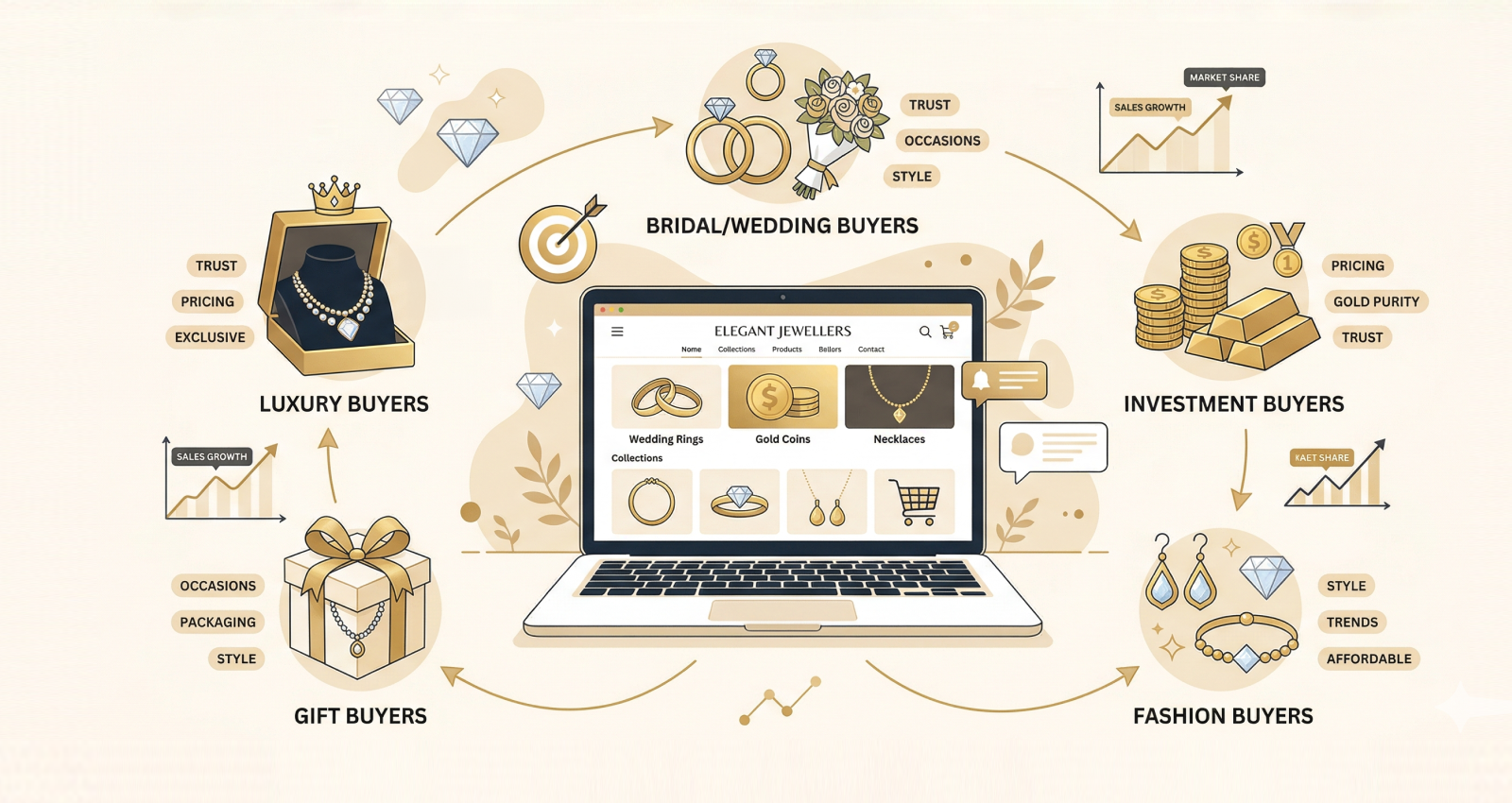
Bridal and Wedding Buyers
This is one of the highest-value segments in the Indian market. Buyers here are purchasing for one of the most significant events in their lives. They research extensively, involve family in decisions, and are willing to spend significantly — but they demand trust, authenticity, and a seamless experience. Wedding jewellery purchases often exceed six figures in value, making trust-building your primary job.
Investment-Oriented Buyers
A meaningful proportion of gold jewellery buyers in India and internationally view jewellery as a financial asset. They are drawn to high-purity gold pieces, coins, and bars. They are price-sensitive in a different way — they track gold rates, care about making charges, and want transparency on hallmarking and certification.
Fashion and Lifestyle Buyers
This segment is growing fast, particularly among urban millennials and Gen Z consumers. They are looking for everyday gold jewellery — lightweight, contemporary designs that can be worn casually. Price points are lower, but purchase frequency is higher. This audience is highly responsive to visual content and digital marketing.
Gift Buyers
Gold jewellery is one of the most popular gifting categories for occasions like birthdays, anniversaries, festivals, and corporate gifting. These buyers often need guidance and curation — they may not be jewellery experts, but they want to give something meaningful and of quality.
Premium and Luxury Buyers
High-net-worth individuals seeking exclusive, artisanal, or designer gold jewellery. They expect a premium digital experience, personalisation options, and concierge-level service. For this segment, the website experience itself is part of the product.
Defining your primary market at the outset shapes every decision that follows — product selection, pricing, content, design, and marketing strategy.
Identify the Gap in the Market
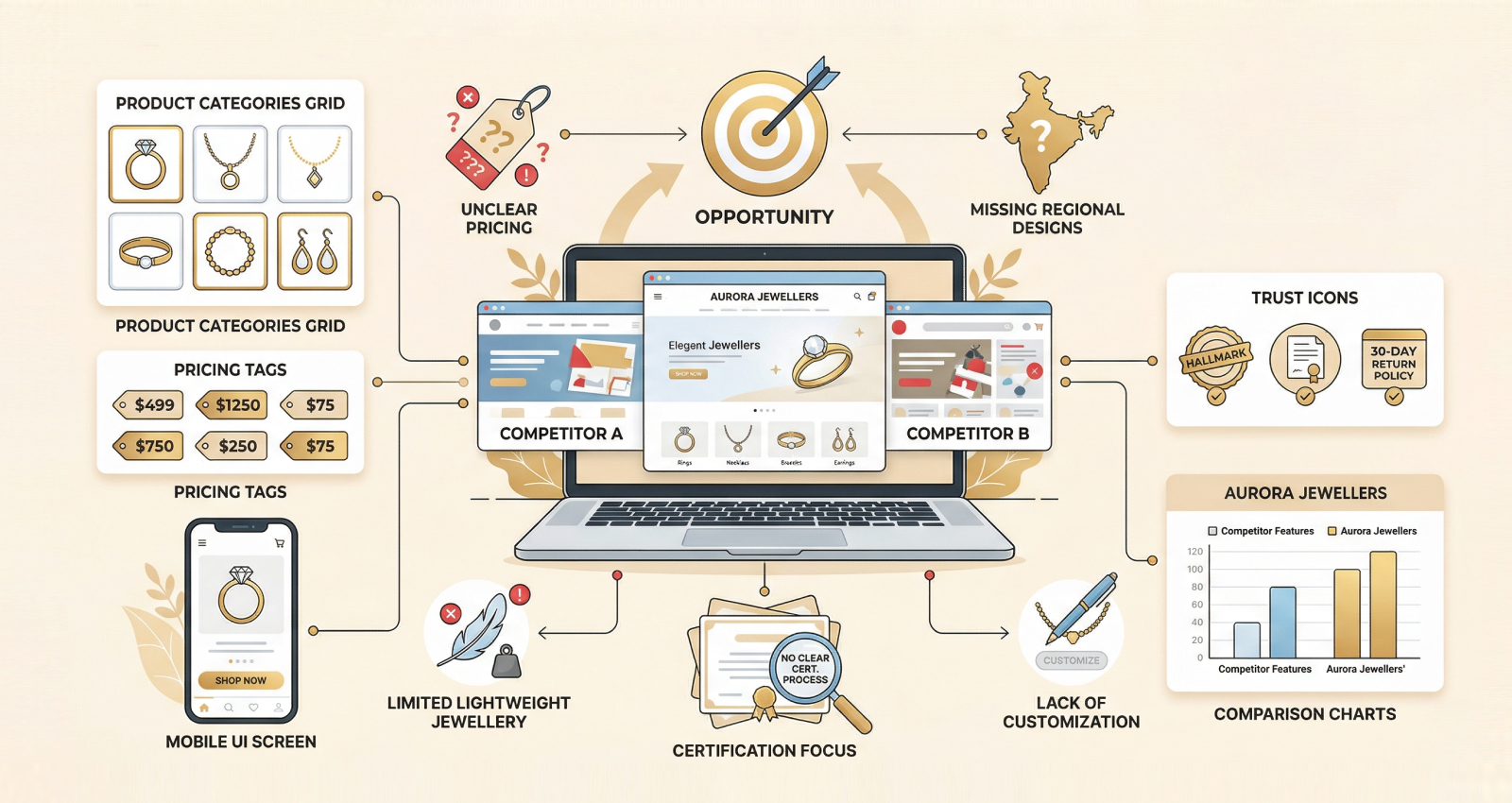
Entering a competitive market without knowing where the opportunity lies is one of the most common and costly mistakes new online jewellery businesses make. The gold jewellery space online is crowded, but it is far from saturated with excellence.
Conduct a Competitor Analysis
Start by mapping out who is already selling gold jewellery online. Look at large established players, mid-tier regional brands, and newer direct-to-consumer labels. For each, evaluate:
- What product categories do they cover?
- How do they handle pricing and transparency?
- What does their website experience look like on mobile?
- How do they communicate trust (certifications, hallmarking, return policies)?
- What are their customers complaining about in reviews?
That last point is where the real intelligence lies. Customer reviews, particularly negative ones, reveal genuine unmet needs — slow delivery, poor packaging, inaccurate product descriptions, lack of size customisation, unresponsive support.
Common Gaps in the Online Gold Jewellery Market
Pricing Transparency: Many jewellery websites display a fixed price that the customer cannot interrogate. Buyers who understand gold markets want to see the live gold rate component clearly separated from making charges. Websites that provide this level of transparency build significantly more trust and convert at higher rates.
Regional Design Availability: India has extraordinarily diverse jewellery traditions — temple jewellery from the South, Kundan and Polki from Rajasthan and UP, Filigree from Odisha, Jadau from Gujarat. Most national platforms carry a generic, pan-India collection. A brand that specialises in a specific regional aesthetic can carve out a loyal niche.
Lightweight Contemporary Gold: There is strong and growing demand for daily-wear gold jewellery — pieces under 5 grams, minimalist in design, suited for professional environments. This segment is underserved by traditional jewellers whose catalogues skew heavy and bridal.
Personalisation and Custom Orders: The ability to engrave names, adjust sizes, or request bespoke pieces is rarely well-executed online. A brand that builds a smooth customisation workflow into its website has a meaningful competitive advantage.
Certificate-First Buying: Younger buyers, particularly those buying online for the first time, place enormous importance on BIS hallmarking, IGI or GIA certification for diamonds, and transparent return policies. Brands that foreground these trust signals rather than burying them in fine print convert significantly better.
Your gap is your entry point. Build your website around filling it.
Select Your Products and Prepare Your Catalogue
Your catalogue is the core of your business. Getting it right before you build your website saves you considerable rework later.
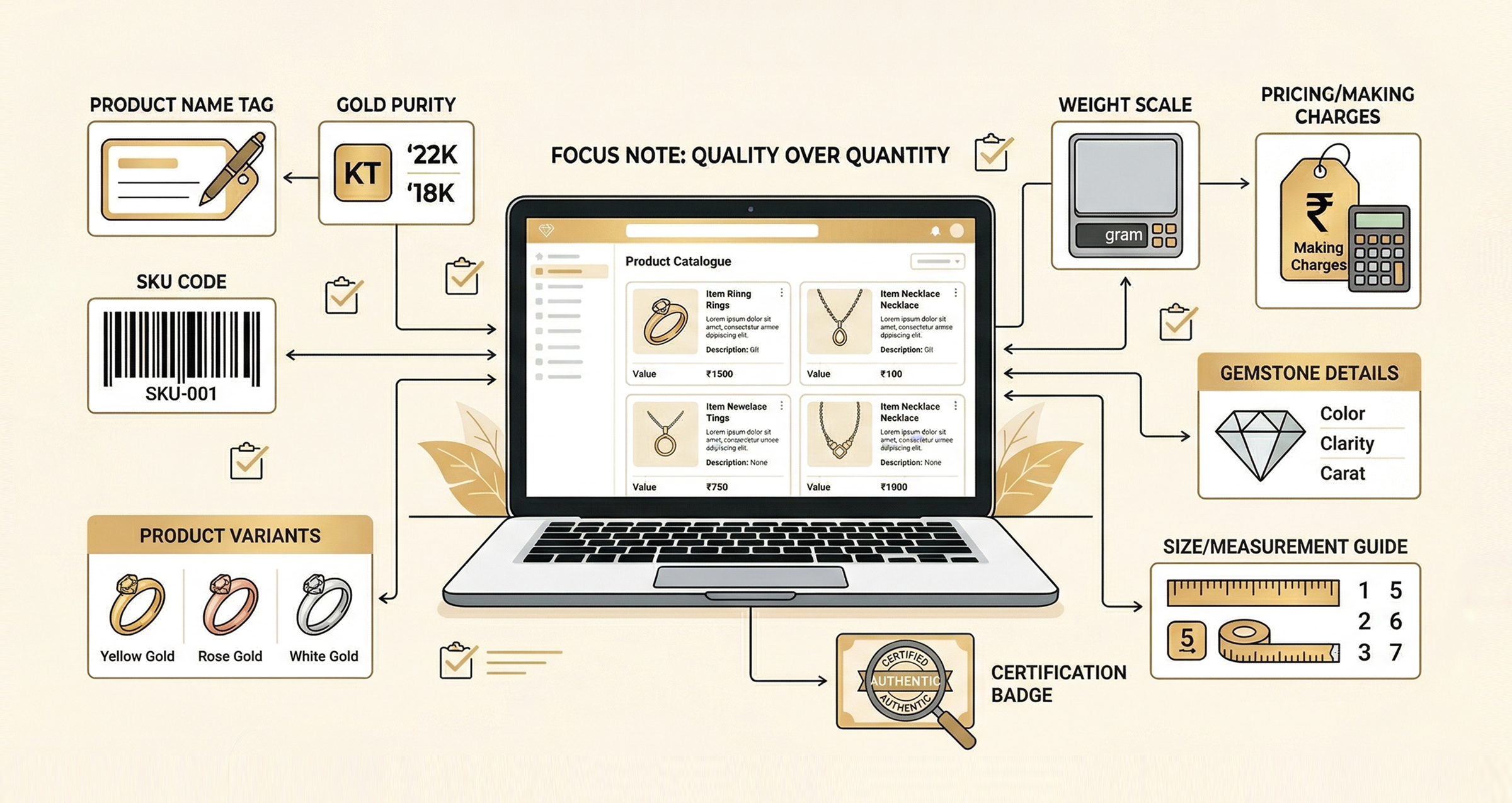
Product Selection Strategy
Start with depth over breadth. It is far better to have 50 well-presented, well-described products than 500 poorly presented ones. Choose a category focus — rings, necklaces, bangles, earrings — and a design aesthetic, and build outward from there. A tightly curated catalogue signals a brand with a point of view. A sprawling, unfocused one signals a wholesale catalogue dressed up as a brand.
Consider your price architecture. A strong catalogue typically has entry-level pieces that attract first-time buyers, mid-range pieces that drive volume, and premium or signature pieces that anchor the brand's positioning. All three serve a purpose.
Required Product Data for Every SKU
For each product in your catalogue, you need to gather and maintain the following information:
- Product Name: Descriptive and searchable. "22KT Gold Twisted Rope Bangle — Set of 2" tells the customer far more than "Gold Bangle."
- Gold Purity: 14KT, 18KT, 22KT, or 24KT, clearly stated.
- Gross Weight and Net Gold Weight: Both are important for price-conscious buyers.
- Making Charges: Whether expressed as a percentage or flat rate, this should be transparent.
- Stone Details (if applicable): Type, carat or weight, cut, colour, and certification.
- Dimensions: Length, diameter, or relevant sizing information with a size guide.
- Certifications: BIS Hallmark number, third-party gemstone certificate, or other quality documentation.
- Product Variants: Size, colour (yellow gold, rose gold, white gold), or finish variations.
- SKU / Stock Code: For inventory management purposes.
This data discipline is not just good practice — it is necessary for accurate pricing, inventory control, and customer trust.
Capture High-Resolution Images and Videos
In jewellery ecommerce, your visual content is your product in the customer's mind. No amount of copy can substitute for a beautifully photographed piece. This is where many jewellery websites fail, and where you can stand out.
Why Visuals Matter More in Jewellery Than Almost Anywhere Else
A customer buying a piece of gold jewellery online cannot hold it, feel its weight, or see how it catches light. Your photography must compensate for that entirely. Underinvesting here is not a cost-saving measure — it is a conversion killer.
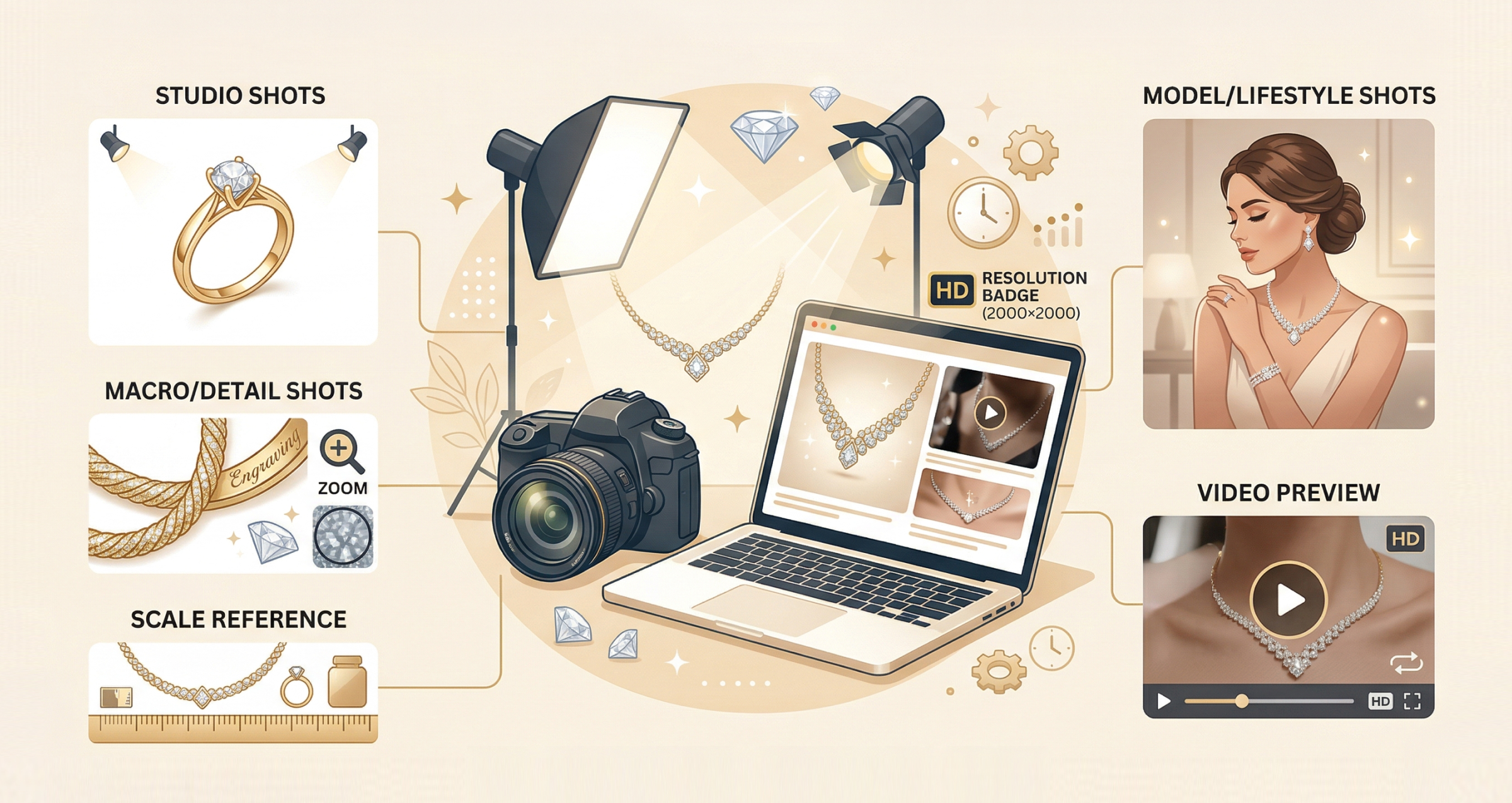
Types of Images You Need
- Studio Product Shots: Clean, white or neutral background, multiple angles — front, side, back, close-up of hallmark or clasp. Non-negotiable for every product.
- Detail and Texture Shots: Macro photography showing surface finish, stone settings, engravings. These shots communicate craftsmanship.
- Model or Lifestyle Shots: Jewellery worn on a real person, in a contextually relevant setting. These shots communicate aspiration, scale, and wearability.
- Scale Reference Shots: A flat-lay alongside a ruler or a familiar object helps customers assess physical dimensions before purchasing.
- Video Content: Short 15–30 second rotational or styling videos are highly effective on product pages and social media.
Technical Notes
Shoot at a minimum of 2000 × 2000 pixels to allow zoom functionality on product pages. Ensure consistent lighting, background, and styling across your catalogue — visual inconsistency undermines brand credibility.
Prepare Your Website Content
Great photography needs great content alongside it. Before your website goes live, you need a full suite of written content prepared, reviewed, and ready to upload.
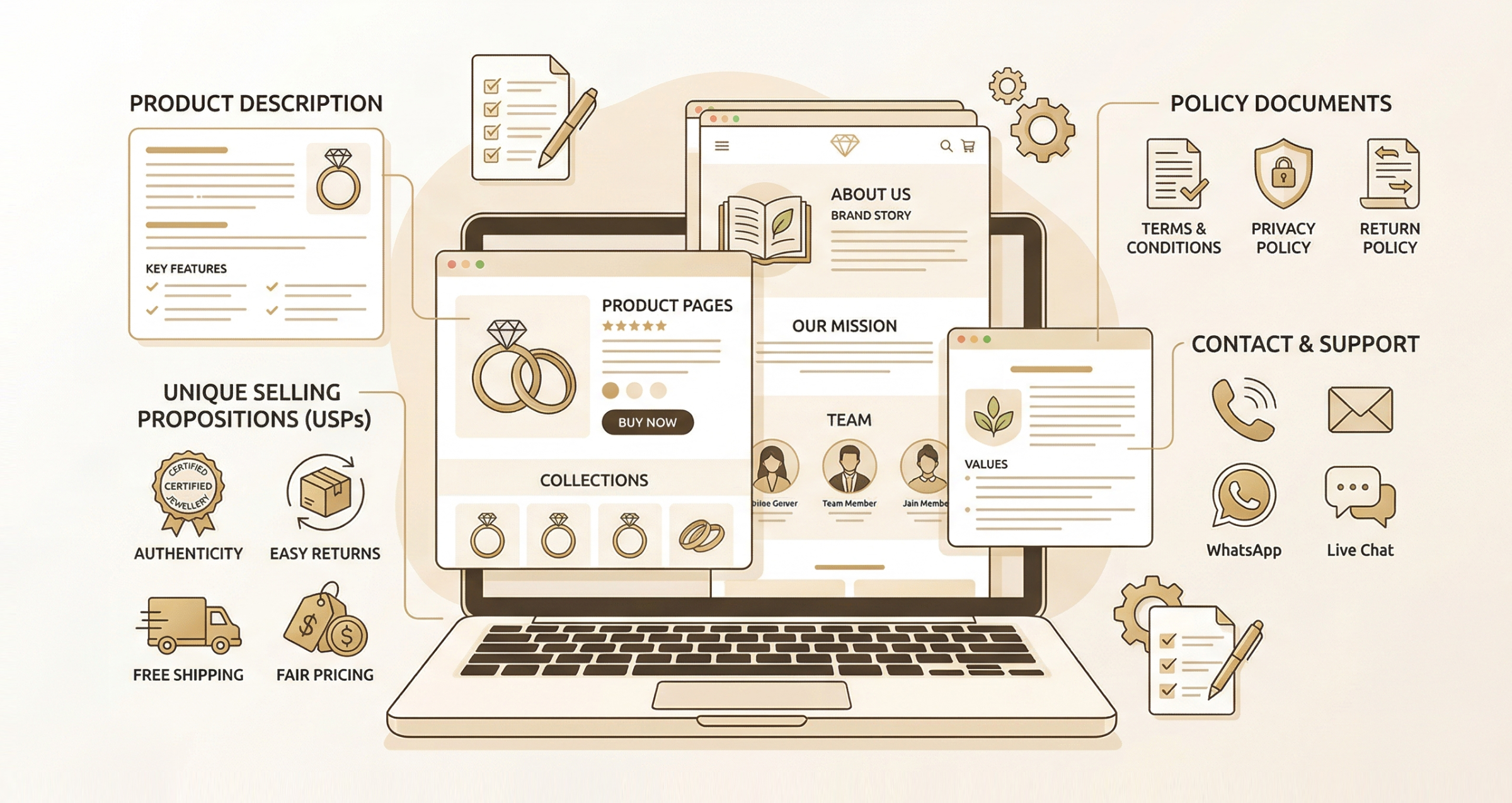
Business and Brand Content
About Us Page: Tell your brand story with specificity. Who founded the business, what is the craft heritage behind it, what values guide your curation? This page is read more than most jewellery businesses realise, particularly by first-time buyers doing their due diligence.
Contact and Support Information: A physical address, phone number, and email address. A WhatsApp contact option is increasingly expected.
Product Descriptions
Each product description should do three things: describe the product accurately, communicate the craftsmanship or design intent, and pre-empt the buyer's likely questions. A good jewellery product description covers material and purity, design inspiration or occasion suitability, care instructions, and available customisation.
Avoid generic copy that could apply to any piece. "Elegantly crafted" means nothing. "Hand-finished in 22KT yellow gold with a twisted rope texture inspired by traditional South Indian kolusu design" means everything.
Your Unique Selling Propositions
- Hallmark certification on every piece
- 30-day return policy, no questions asked
- Free insured shipping above a threshold
- Live gold rate-linked pricing
- Custom sizing available on all pieces
Policies
Write clear, fair, and specific policies for returns and exchanges, shipping, privacy, and terms and conditions. Vague policies erode trust. Specific, customer-friendly policies build it.
Register Your Brand and Establish Brand Guidelines
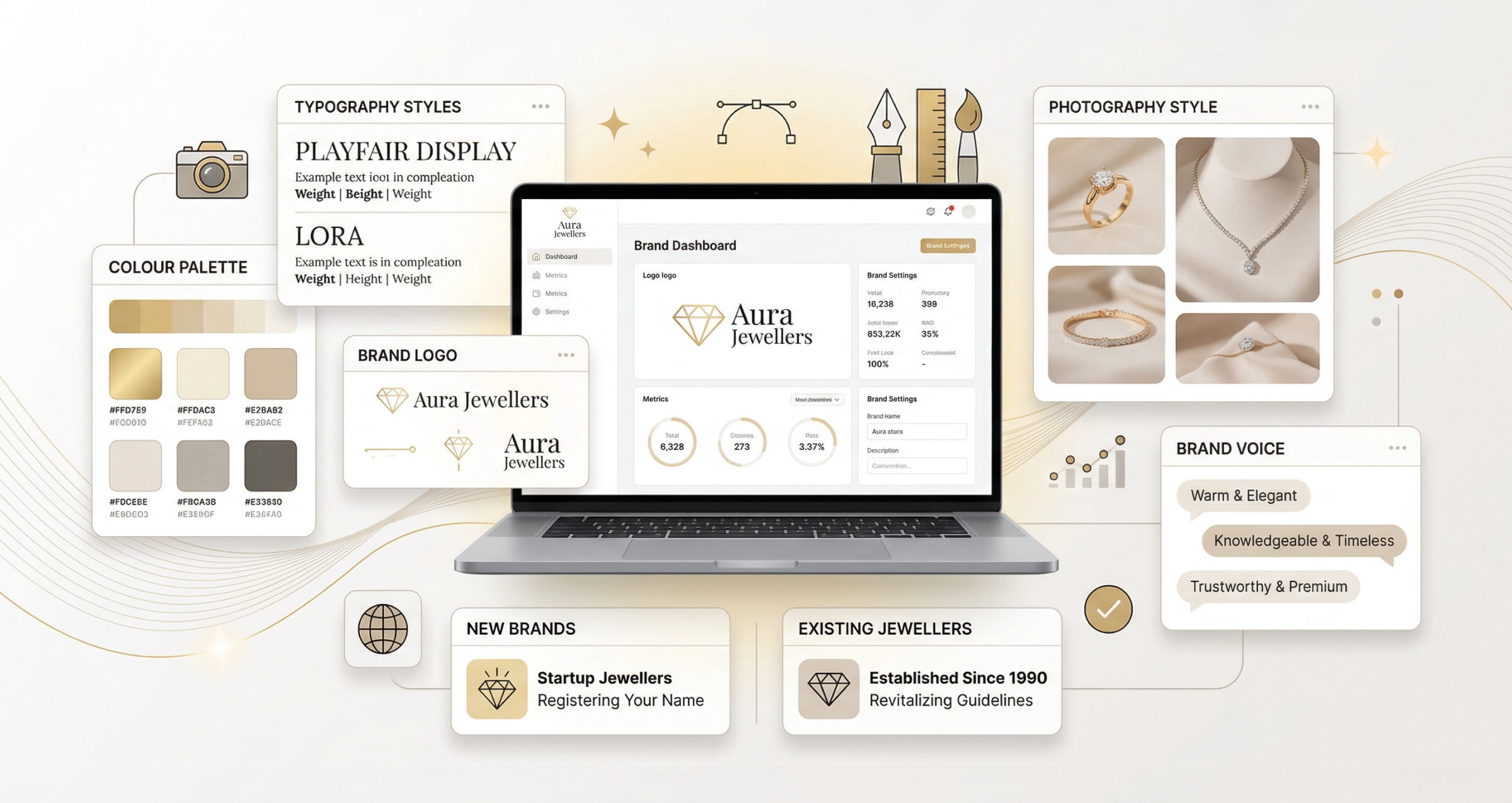
For New Brands
If you are launching a new jewellery brand, register your business entity first — as a sole proprietorship, partnership, LLP, or private limited company depending on your scale and plans. Obtain your GST registration, a current account in the business name, and a trademark registration for your brand name and logo.
For Existing Offline Jewellers
If you are taking an existing business online, ensure your GST registration covers ecommerce supply. Review your existing legal structure and update it if necessary. If you are operating under a trade name, verify that trademark is protected before investing in digital brand building.
Developing Your Brand Guidelines
- Colour Palette: Choose 2–3 primary colours that reflect your brand's positioning. For luxury and premium segments, deep jewel tones, warm neutrals, and accents of gold or black are common.
- Typography: Choose typefaces that reflect your brand character. Serif typefaces communicate heritage and prestige. Limit your website to 2 typeface families maximum.
- Photography Style: Establish a consistent visual language — background colours, lighting style, model type, prop usage — and apply it consistently across all product and lifestyle photography.
- Brand Voice: Define how your brand speaks. Your tone should be consistent across product descriptions, marketing emails, social captions, and customer service interactions.
Choose the Right Ecommerce Software
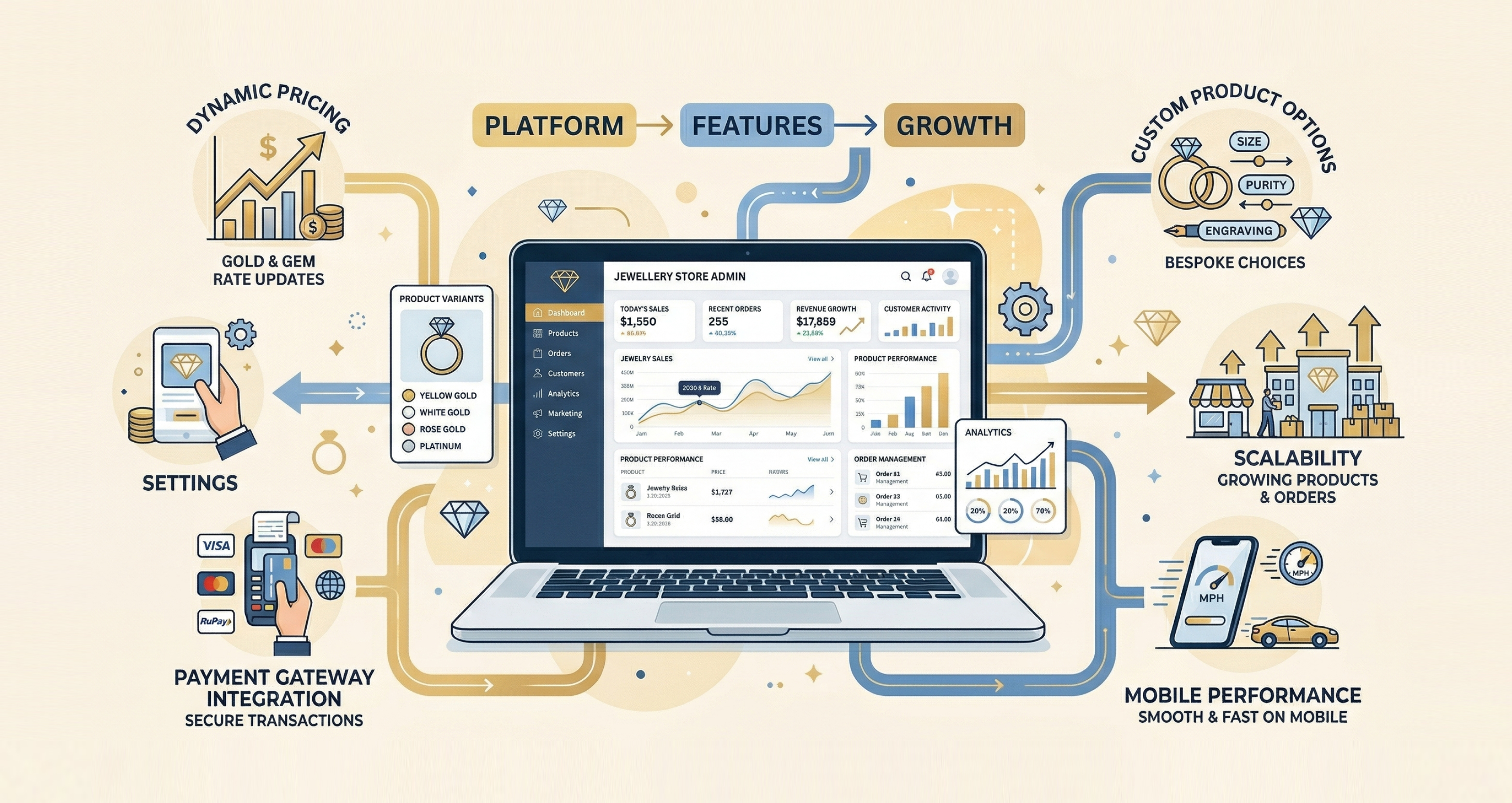
This is one of the most consequential decisions you will make. The wrong platform creates friction at every stage — for you, your team, and your customers. The right one becomes an asset that scales with your business.
When evaluating platforms, the requirements for making a jewellery website go beyond what generic ecommerce tools are built for. Gold jewellery has specific needs:
Dynamic Pricing: A Non-Negotiable for Gold Jewellery
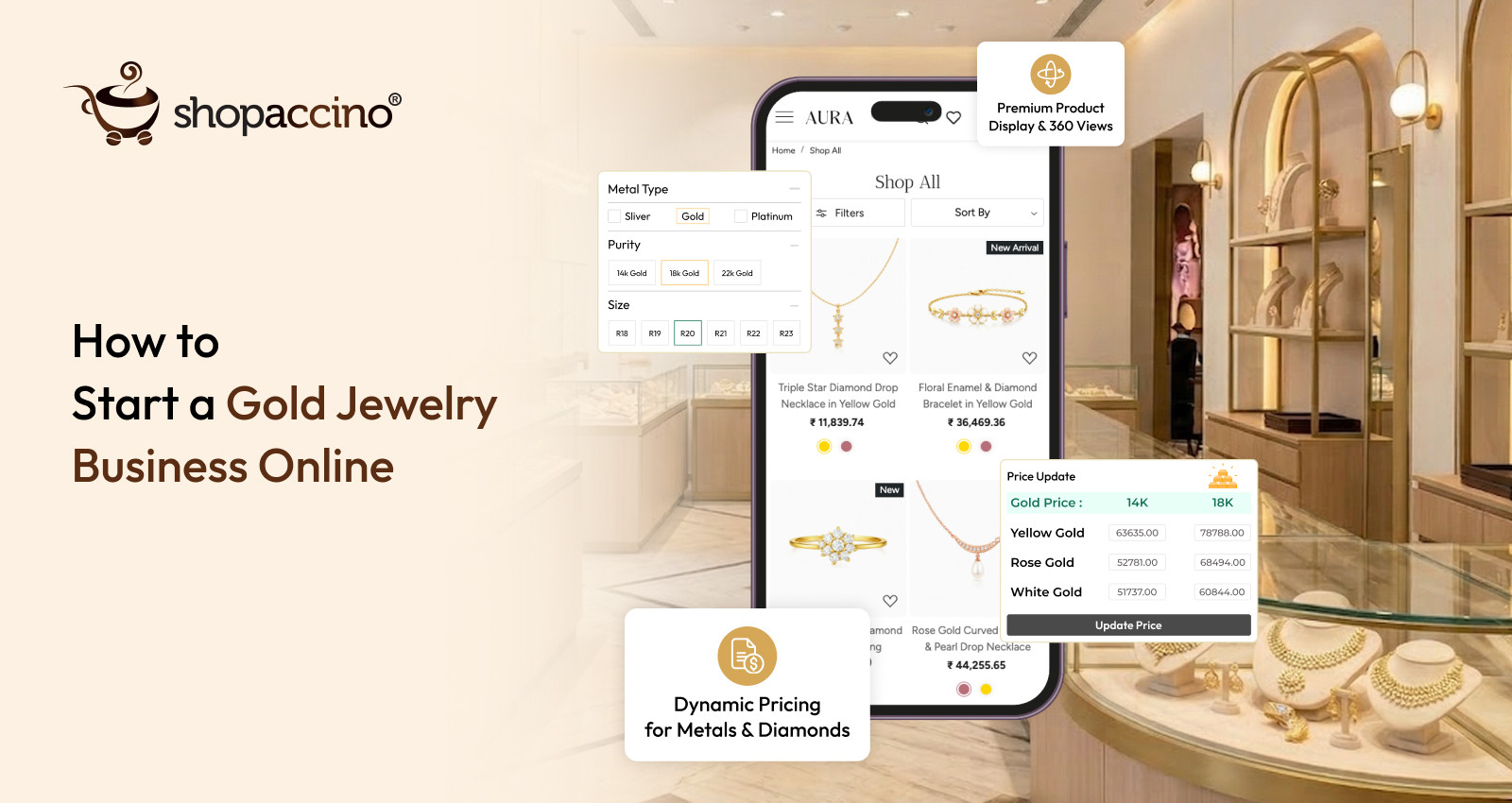
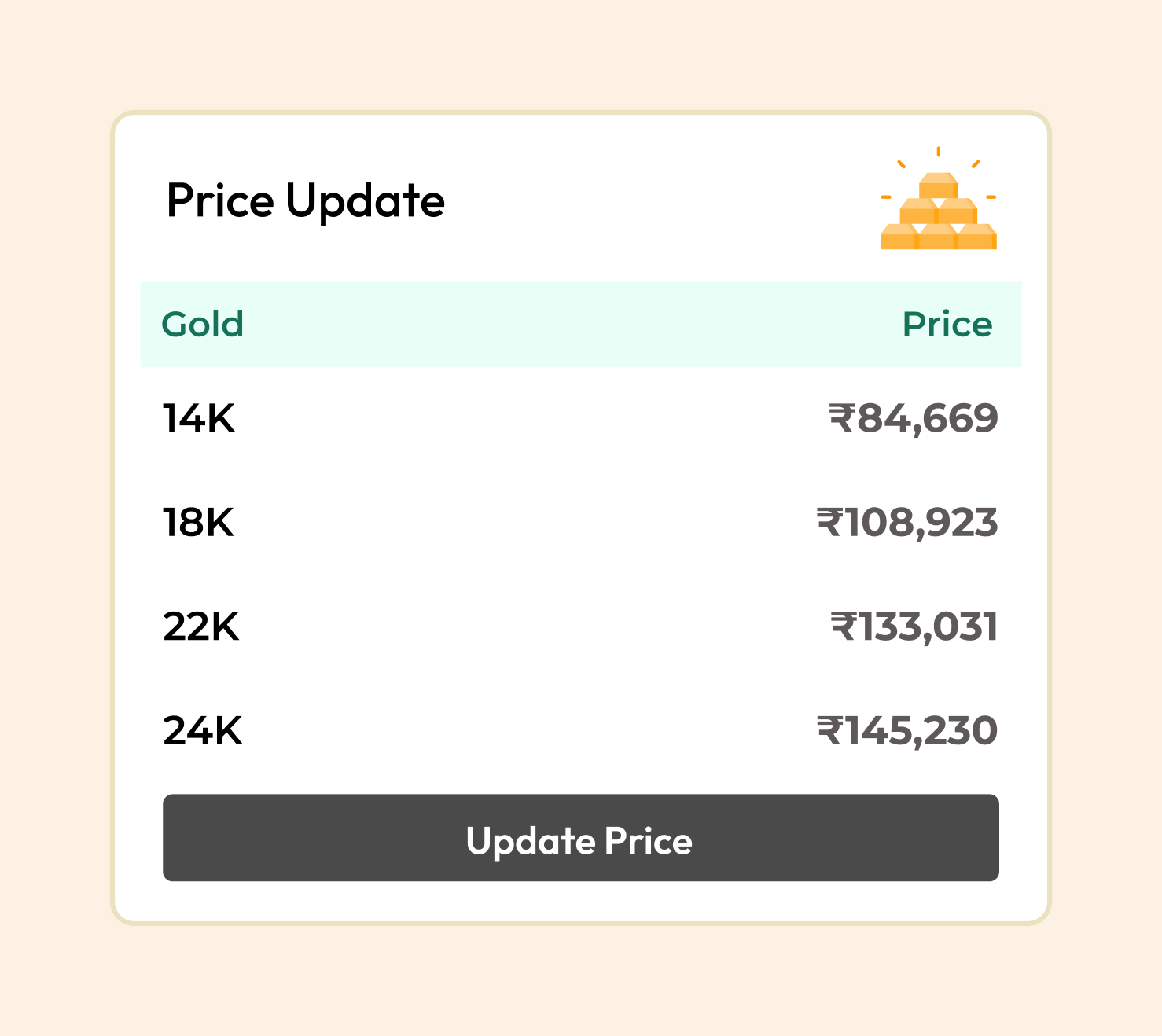
Gold rates fluctuate daily, sometimes multiple times a day. A static pricing model is simply not viable for a gold jewellery business — it either erodes your margins or alienates price-aware buyers. Dynamic pricing software for ecommerce allows you to set a base gold rate and automatically recalculate the selling price of every product in your catalogue the moment that rate changes — in a single update, not product by product. For jewellery sellers, this means your prices are always accurate, your margins are always protected, and your buyers always see a price they can trust. Shopaccino's Gold Rate App is built precisely for this — letting you update the live gold rate across your entire store with one click, with all product prices adjusting instantly
Dynamic Pricing
Gold prices change daily. Your product pricing needs to update automatically based on the live gold rate, plus your making charges and margin. Look for platforms that support dynamic pricing software ecommerce capabilities — either natively or through integrations. Manually updating hundreds of product prices every day is not sustainable.
Custom Product Options
Size variants, metal purity options, engraving fields, and custom order forms all require flexibility in how products are configured and purchased.
Scalability and Mobile Performance
As your catalogue grows and your order volume increases, your platform should accommodate that growth without requiring a rebuild. A significant proportion of jewellery purchases in India are researched and completed on mobile devices. Your platform must deliver a flawless mobile experience.
Platform Selection
The best ecommerce gold jewelry website builder for a jewellery business is one that understands the category's specific requirements. Shopaccino, for instance, is built specifically for Indian ecommerce with features including live gold rate integration, custom product configurations, seamless payment gateway support, and mobile-first design — making it a strong candidate when evaluating the best platform to setup an ecommerce jewellery website.
When choosing, ask not just what the platform does today, but how it will serve you when your business is five times its current size.
How do you show live gold prices on a jewellery website?
You show live gold prices by linking each product's price to the current metal rate so it updates automatically instead of being fixed manually. The price is calculated from the day's gold rate, the item's weight and purity, plus making charges and applicable tax. This keeps every listing accurate as the rate moves, protects your margin, and reassures buyers that pricing is transparent.
What software do you need to sell gold jewellery online?
You need jewelry ecommerce software that supports live metal-rate pricing, secure payments, and certification display in one place. Good jewelry ecommerce software calculates each price from the current gold rate, weight, purity, and making charges, so listings stay accurate without manual edits. If you would rather launch on a ready solution than build from scratch, you can start an online jewellery store with these features already built in.
Can you sell gemstone, silver, and fashion jewellery from the same website?
Yes, the same store can sell gemstones, silver, and fashion jewellery alongside gold. A gemstone ecommerce website needs clear certification, carat, and origin details for each stone. Silver jewellery ecommerce software should link prices to the live silver rate the same way gold pricing works. And a fashion jewellery online store builder lets you list fixed-price, non-precious designs with variants like size, colour, and plating. Running all categories on one platform keeps inventory, pricing, and checkout consistent.
Choose Your Design and Theme
Design is not aesthetics alone. For a jewellery website, design is a trust signal. A poorly designed website — regardless of the quality of the jewellery it carries — will cost you sales.
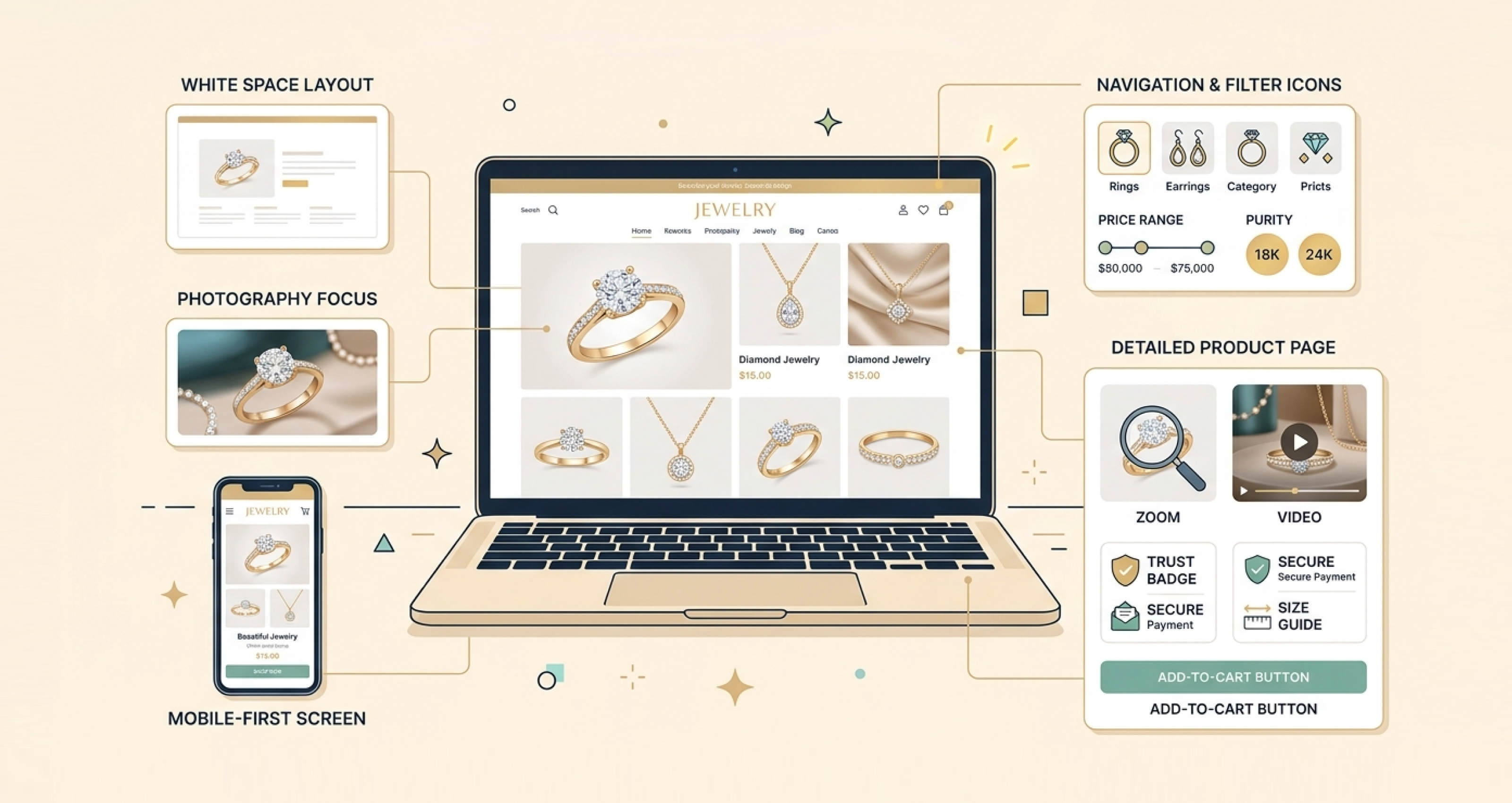
Principles of Effective Jewellery Website Design
- White Space: Jewellery needs room to breathe. Cluttered layouts diminish the perceived value of the product. Generous white space allows each piece to command attention.
- Photography as Hero: Design decisions should frame and elevate the photography, not compete with it.
- Mobile-First, Not Mobile-Compatible: Design your website for mobile screens first, then adapt for desktop.
- Navigation and Filtering: Buyers should be able to filter by category, occasion, price range, metal type, weight range, and purity without frustration.
- Product Page Depth: Include all product data, multiple high-resolution images with zoom, a video where available, trust badges, size guides, and a prominent add-to-cart button.
Engaging gold jewelry web development services from specialists who understand the category can be worth the investment for brands positioning at the premium end of the market.
Upload Your Content
With your platform selected, design established, and all content assets ready, you can begin building your website. Work through this in a structured sequence.
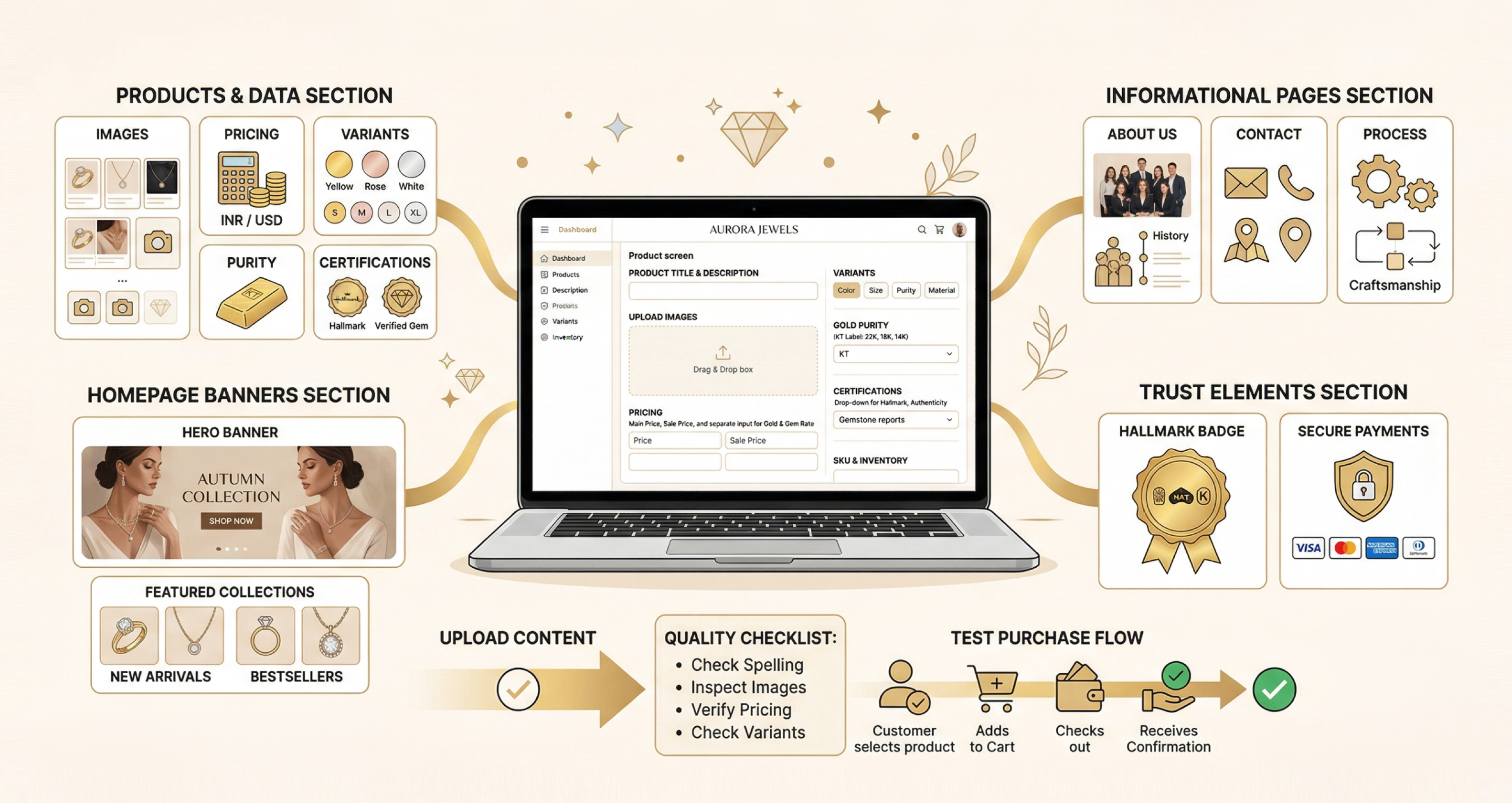
Products
Upload products in logical batches by category. For each product, complete every field — name, description, images, pricing, variants, weight, purity, certifications, and SEO metadata. Do not leave fields empty or filled with placeholder text.
Product Pages Must Reflect Your Catalogue with Precision and Visual Clarity
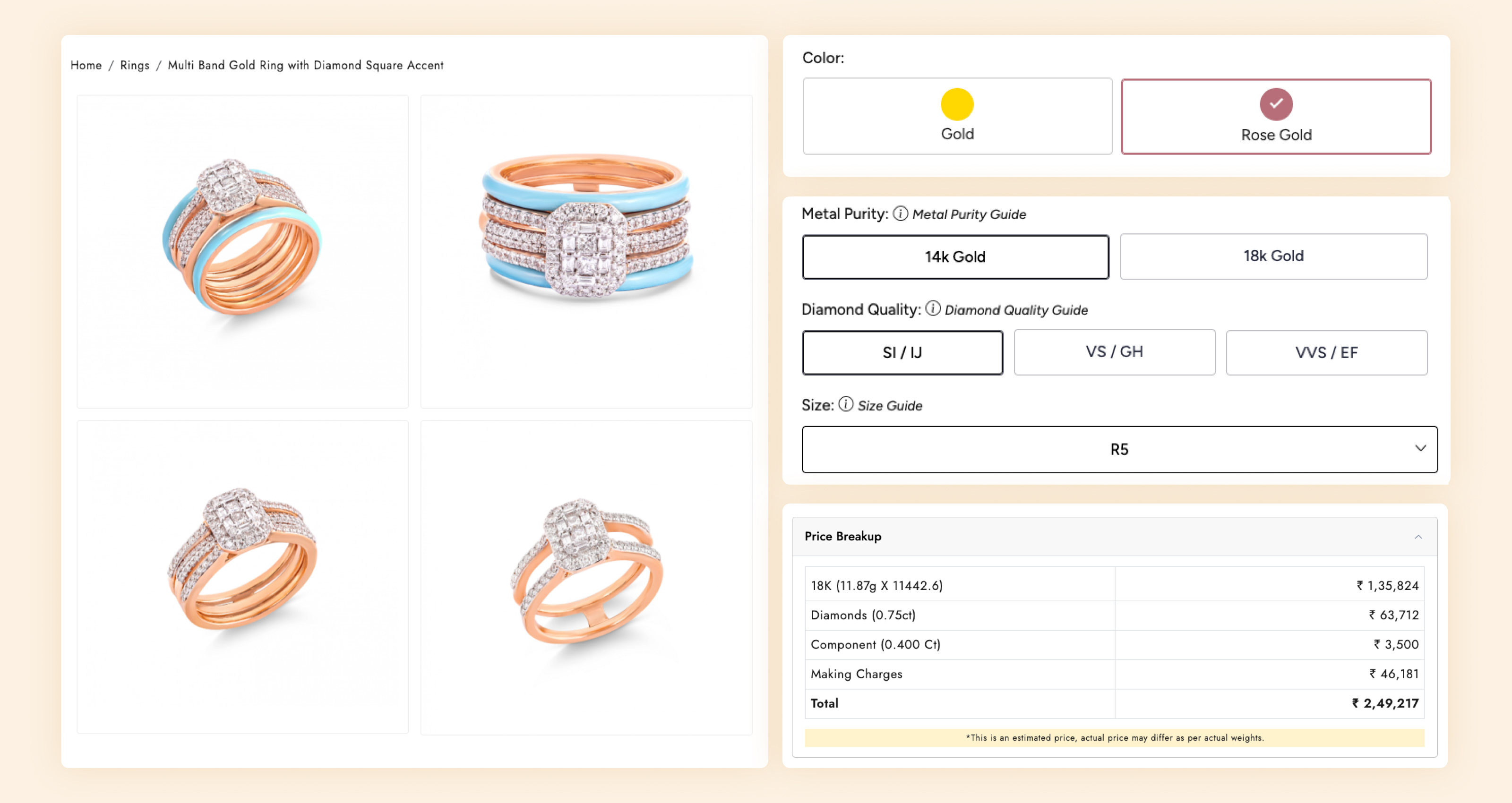
Every product detail page should be a complete, visually coherent buying experience. Product images and videos must accurately reflect the actual piece — in colour, finish, and scale. Options for gold type (yellow, rose, white), purity (14KT, 18KT, 22KT), diamond or gemstone quality grade, and size should be presented as clearly differentiated visual selectors — not plain text dropdowns. A buyer selecting between an SI1 and VS2 diamond should see the difference communicated visually, not guess from a label. Most importantly, every product page should display a transparent price breakup — gold value, making charges, stone charges, and GST — so the buyer understands exactly what they are paying for. Clarity at this stage is one of the strongest conversion drivers in high-value jewellery ecommerce.
Informational Pages
Upload your About Us, Contact, Our Process, and any editorial or brand storytelling pages. These pages serve both the customer experience and SEO purposes.
Banners and Homepage Content
Configure your homepage with your hero banner, featured collections, and any current promotions. Banners should be designed at the correct dimensions for both desktop and mobile.
Trust Elements and Quality Check
Configure trust badges, hallmark certification icons, payment security logos, and industry association memberships at relevant points throughout the site. Before launch, conduct a thorough quality check across the entire website and complete a full test purchase to validate the checkout and payment flow end to end.
Configure Store Operations, Shipping, and Payments
A beautiful website with broken operations is a liability. Before you accept your first order, every operational system must be configured and tested.
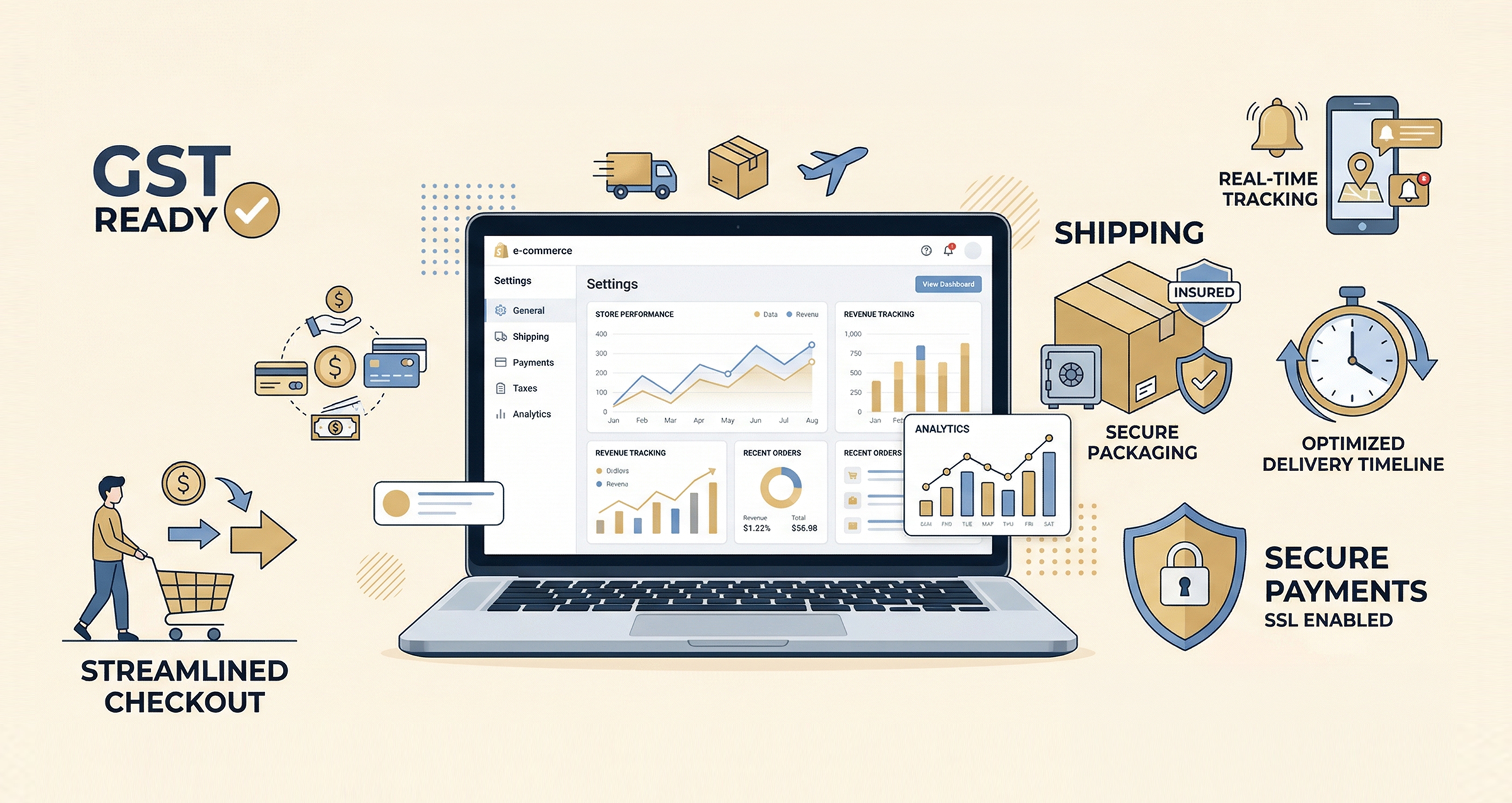
GST Compliance
Ensure your GST registration is correctly configured in your store settings. Gold jewellery attracts specific GST rates (currently 3% on gold and 5% on making charges in India). Your invoicing must be GST-compliant, with an accurate breakdown of components.
Checkout Configuration
Configure your checkout flow to be as short and frictionless as possible. Every additional step or unnecessary field increases cart abandonment. Guest checkout should always be available alongside account-based checkout.
Shipping
- Insured Shipping: All gold jewellery shipments should be insured for their declared value.
- Secure Packaging: Jewellery requires tamper-evident, impact-resistant, and presentationally appropriate packaging.
- Delivery Timelines: Set realistic and honest delivery estimates.
- Tracking: Configure automated shipment tracking notifications.
Payment Gateways
Integrate a reliable, RBI-compliant payment gateway. For the Indian market, options include Razorpay, PayU, Cashfree, and CCAvenue. For a jewellery business, the ability to offer EMI on high-value purchases can significantly increase average order value and conversion.
Analytics and Security
Install Google Analytics 4 and configure conversion tracking before launch. Ensure your website has a valid SSL certificate, regular malware scanning, and is hosted on a server with reliable uptime SLAs.
Build Your Marketing Strategy
A website without traffic is a shop without footfall. Your marketing strategy should begin before your website launches, not after.
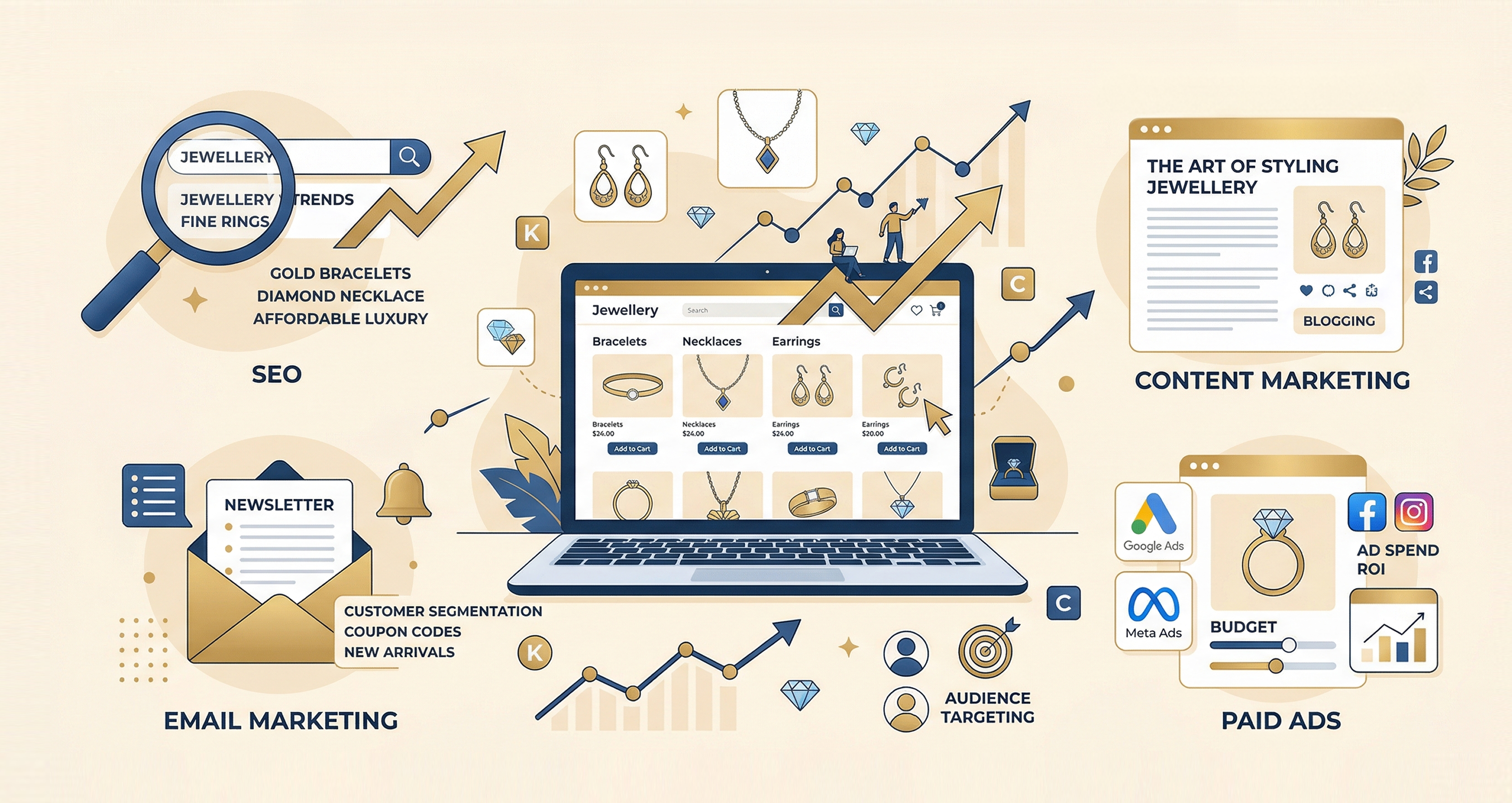
Search Engine Optimisation (SEO)
SEO is the highest-quality source of traffic for a jewellery website because it captures buyers with purchase intent. Research the specific terms your target buyers use, optimise every product and category page with unique meta titles and descriptions, and ensure fast page load times, clean URL structures, and a well-structured XML sitemap.
Content and Blogging
A well-maintained blog is one of the most effective long-term SEO tools for a jewellery business. Topics like "How to choose the right gold purity for everyday jewellery" or "Understanding BIS hallmarking" attract informed buyers and build domain authority over time.
Paid Advertising
Google Shopping campaigns are particularly effective for jewellery ecommerce because they show product images and prices directly in search results. Meta (Instagram and Facebook) advertising is well-suited to jewellery, particularly for reaching bridal and gifting audiences. Start with small, targeted budgets, test rigorously, and scale what works.
Email Marketing
Build your subscriber list from the first day. An email list is a direct communication channel you own. Use it for new collection launches, seasonal promotions, gold price updates, and personalised reactivation campaigns for past buyers.
Order Fulfilment
The experience your customer has after placing an order is as important as the experience that led them to place it. In jewellery — a category where buyers are often spending significant amounts — the post-purchase journey is a major determinant of whether you earn a repeat customer or a negative review.
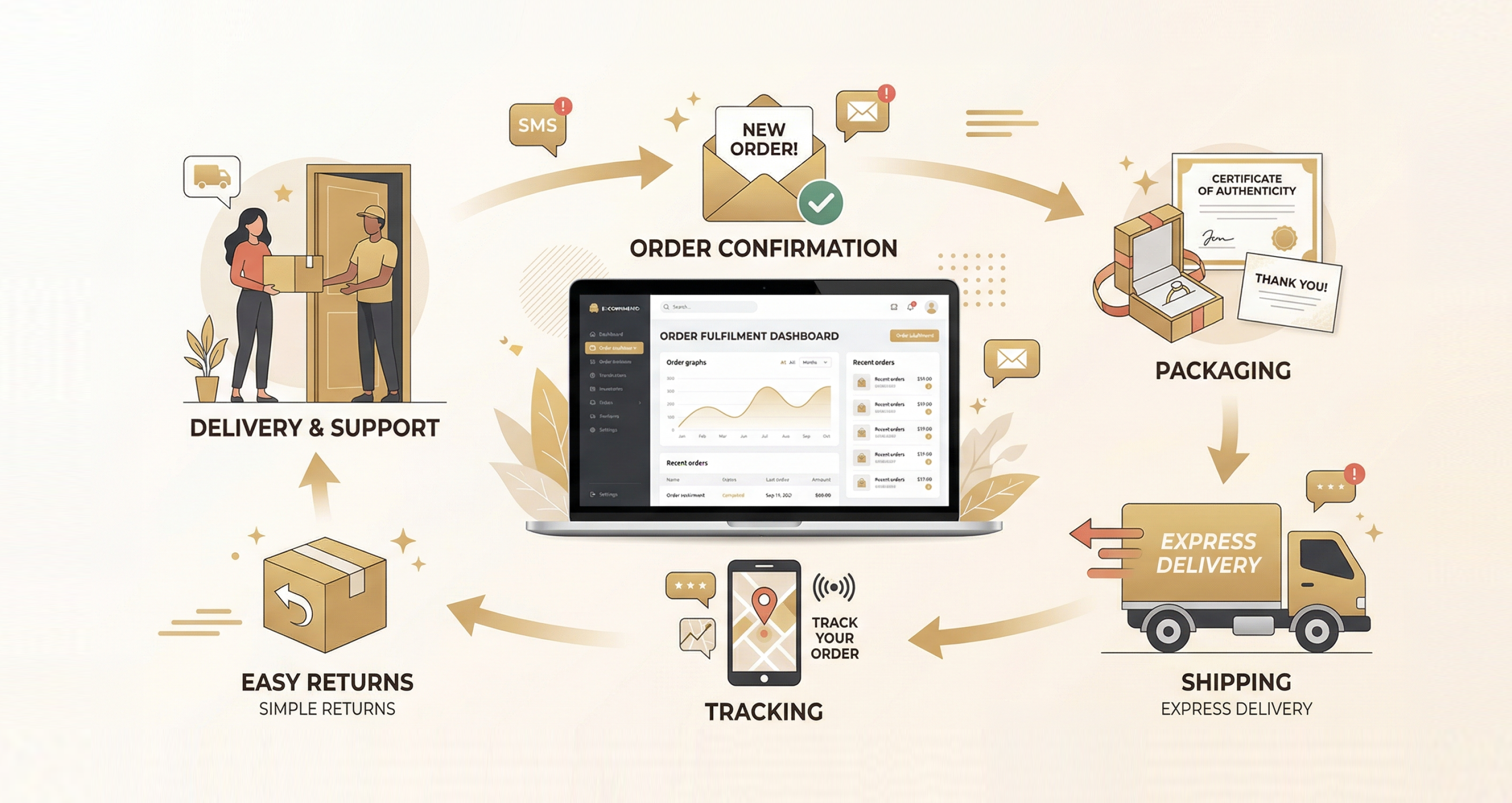
From Order to Dispatch
Process orders promptly. Confirm every order with an immediate automated email that includes the order summary, expected dispatch timeline, and contact information for support.
Packaging
Jewellery packaging should reflect the premium nature of the product. At minimum: a branded jewellery box or pouch, a polishing cloth, a certificate or hallmark card, and a personalised thank-you note. For gifting occasions, offer complimentary gift wrapping and a message card option.
Shipping, Tracking, and Returns
Dispatch promptly and within your stated timeline. Share the tracking link the moment the order is shipped, via both email and SMS. If a delivery is delayed, communicate proactively.
Make your returns process as easy as the purchase process. A smooth, no-hassle return experience is one of the most powerful trust signals for a new jewellery brand.
Scale Your Online Business
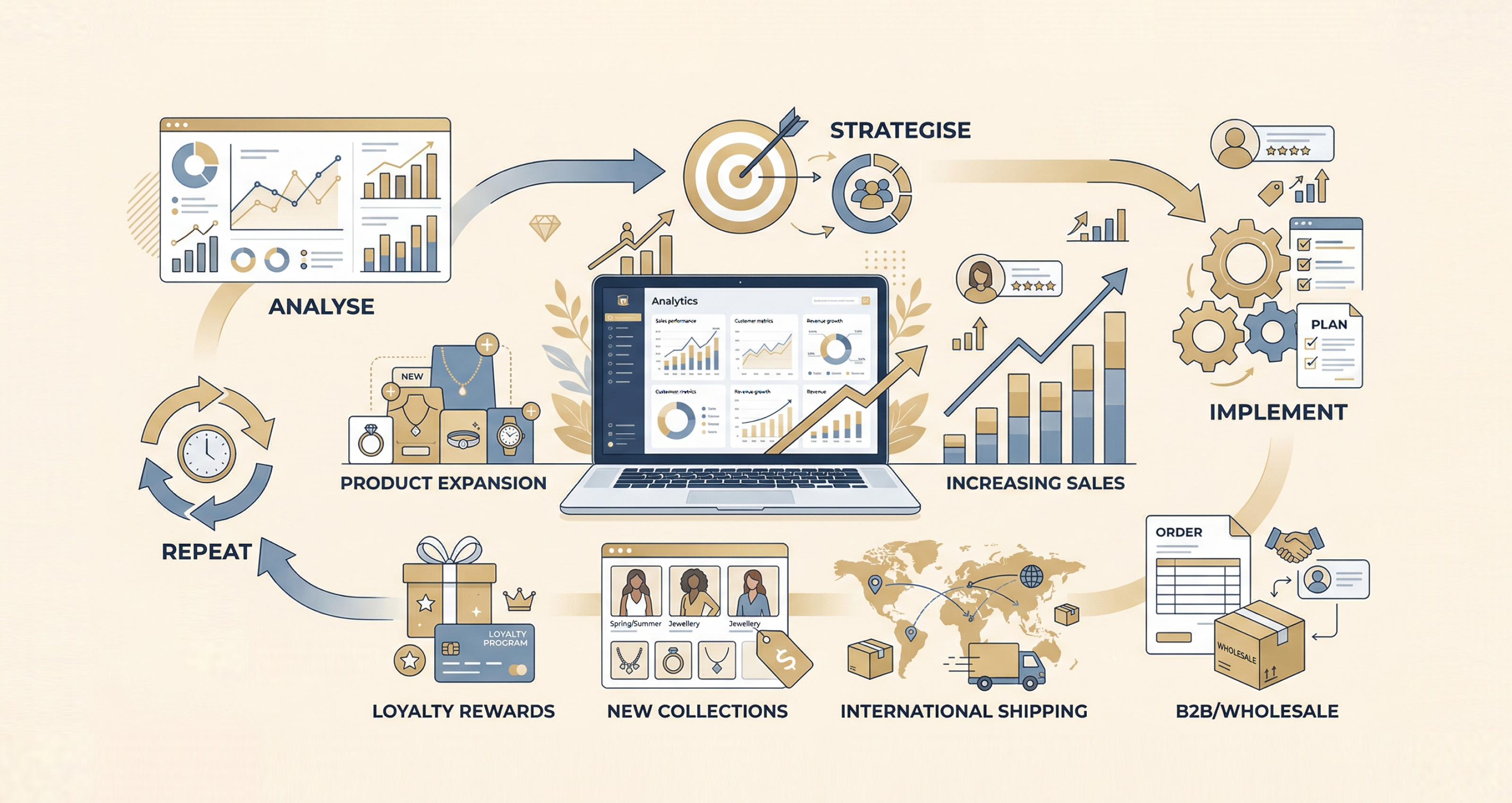
Once your website is live and your first orders are flowing, the work of scaling begins. Growth in ecommerce is not random — it is the product of a disciplined cycle of analysis, strategy, implementation, and iteration.
Analyse
Use your analytics data to understand what is working and what is not. Which products are getting traffic but not converting? Which acquisition channels deliver the highest-quality buyers? What is your average order value, and what drives it up or down?
Strategise
Based on your analysis, identify your highest-leverage opportunities — expanding an over-performing category, investing more in a high-ROI advertising channel, improving product pages with high traffic but low conversion, or launching a personalisation feature.
Implement
Execute your strategy with discipline and adequate resource. Half-implemented growth initiatives produce half-results. Whether you are adding 50 new products or launching a new advertising campaign, do it completely and correctly.
Repeat
Establish a regular cadence — monthly or quarterly — to review performance, update your strategy, and implement improvements. The gold jewellery market evolves. Consumer preferences shift. Gold prices move. The businesses that stay ahead of these changes are the ones that make analysis and iteration a habit.
Additional Scaling Levers
- International Shipping: The Indian diaspora across the US, UK, UAE, Canada, and Australia represents a significant and largely underserved market for authentic Indian gold jewellery.
- B2B and Wholesale: Your ecommerce platform may be able to serve wholesale buyers or corporate gifting clients through a separate B2B pricing tier.
- Loyalty and Referral Programs: Repeat buyers and word-of-mouth referrals are the most cost-efficient customer acquisition channels available.
- New Collections and Collabs: Seasonal collections, festival-specific launches, and designer collaborations keep your catalogue fresh.
A Note on Gold Jewelry Website Development
Building a jewellery website that operates at a professional standard — with live gold rate integration, custom product configurations, smooth checkout, compliance-ready invoicing, and a premium visual experience — requires either a platform built for that purpose or skilled development support.
If you are evaluating gold jewelry website development options, the decision comes down to this: do you want to build something custom, or do you want to get to market faster on a platform purpose-built for your category?
Custom development through a gold jewelry website development company offers maximum flexibility but requires significant time, budget, and ongoing technical resource. It makes sense for businesses with specific functional requirements that no existing platform meets.
For the majority of jewellery businesses — particularly those in growth mode — a dedicated ecommerce platform that already handles gold pricing, product customisation, mobile performance, and payment compliance natively is the faster and more cost-effective path.
Whichever route you choose, ensure that gold jewelry web development services you engage with have demonstrable experience in the jewellery category. The technical and UX requirements of a high-value, trust-dependent product like gold jewellery are materially different from those of a general consumer goods website.
Final Thoughts
Understanding how to start a gold jewelry business online is ultimately about understanding that you are not just building a website — you are building a brand, a system, and a customer relationship at scale.
The businesses that succeed online are those that take every element of this guide seriously: the market intelligence, the visual investment, the content quality, the operational rigour, and the commitment to continuous improvement. Gold jewellery is a category built on trust. Your website is where that trust is first extended and, over time, deepened.
Whether you are figuring out how to take my jewellery business online for the first time, or evaluating the steps to make an online jewellery website for a brand you are about to launch, the framework is the same. Know your market, curate your catalogue, invest in your presentation, choose the right technology, and serve your customers with the same care and craftsmanship that defines the jewellery you sell.
The opportunity is significant. The standards are rising. The time to build is now.