Ecommerce SEO in the AI Era: How to Rank on Google and Get Recommended by AI
For fifteen years, SEO had one job: win a position on a page. Today the very same work - pages search engines can read, product data they can trust, proof that you are a real business - decides three things instead of one. Whether Google ranks you. Whether your words become the answer at the top. And whether an AI names your store when a shopper asks what to buy.
That is what ecommerce SEO in the AI era really means. Not a smaller game - the same foundation, paying out in three places at once.
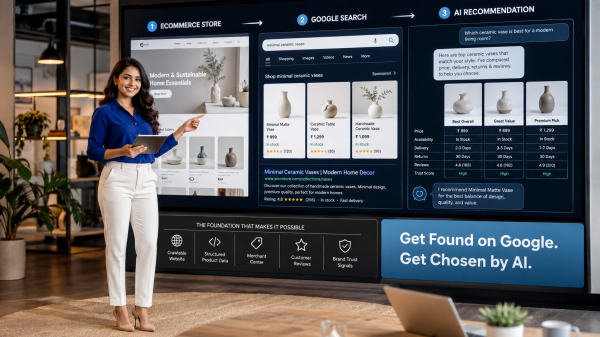
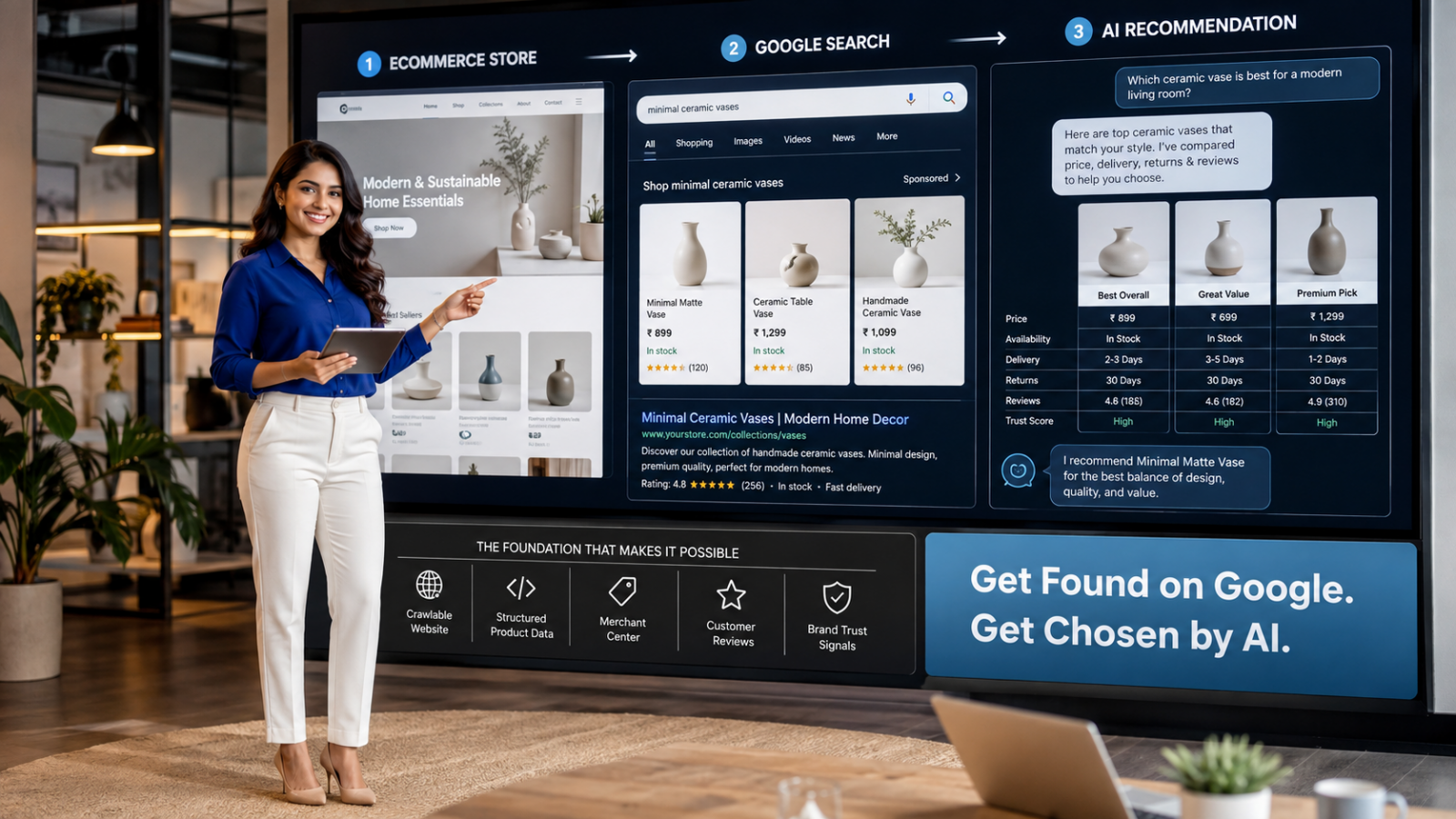
A shopper looking for running shoes today might never see a results page. They might read an AI Overview that names three brands. They might open AI Mode and have a conversation about arch support. Or they might ask ChatGPT to shortlist five options under 8,000 rupees with free returns - and buy from whichever store the model named. In each of those cases the shopper never saw a ranking, but the work behind that ranking is exactly what decided which stores got mentioned. The job now is to make sure the description, the quote and the recommendation are all yours.
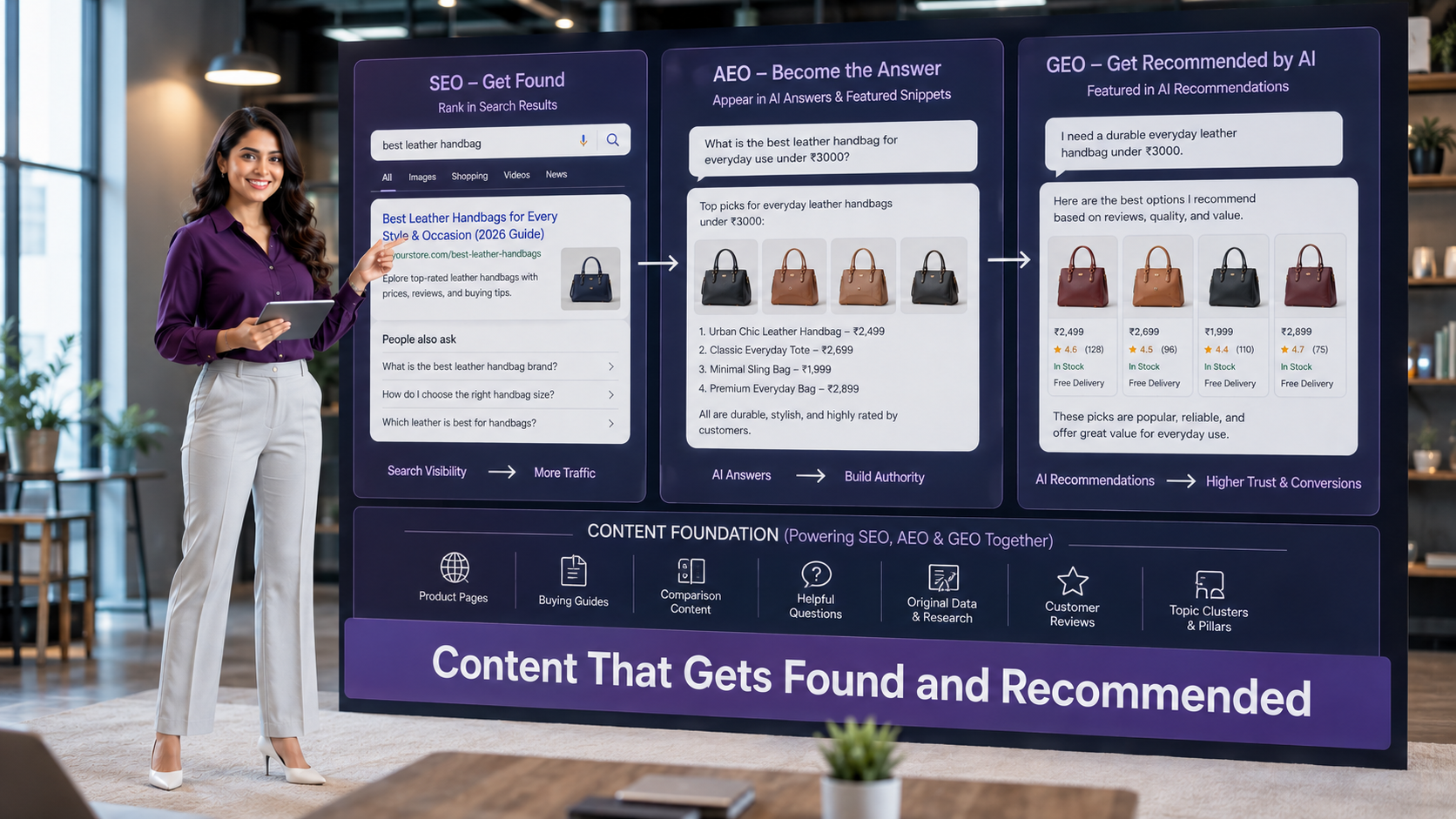
None of this replaces the SEO you are already doing. It extends it, across three layers:
- SEO gets your pages found and ranked.
- AEO (answer engine optimisation) gets your content lifted into the answer - featured snippets, AI Overviews, AI Mode.
- GEO (generative engine optimisation) gets your store named and cited by generative tools like ChatGPT, Gemini, Perplexity and Copilot.
The important thing to understand before you read another word: these layers reinforce each other, they do not replace each other. There is no GEO strategy that skips crawlability. AI systems cannot recommend a store they cannot read. Everything below builds in that order.
Quick answer: SEO ranks your pages, AEO makes your content the answer, and GEO gets your store recommended by AI tools. All three run on the same foundation - crawlable pages, accurate structured product data, and genuine trust signals. You do not choose between them. You layer them.
SEO vs AEO vs GEO at a glance
SEO | AEO | GEO | |
Goal | Rank the page | Become the answer | Be recommended |
Where it shows | Organic and rich results, Images, Shopping | Featured snippets, AI Overviews, AI Mode | ChatGPT, Gemini, Perplexity, Copilot |
Main lever | Crawlability, relevance, authority | Structure and extractability | Entity clarity, quotability, third-party validation |
What you measure | Rankings, impressions, clicks | Snippet and AI Overview presence, zero-click impressions | Citations, brand mentions, AI referral traffic |
Who decides | A ranking system | An extraction system | A recommendation system |
Read the bottom row again, because it is the whole story. Ranking systems reward relevance. Recommendation systems reward reputation — and reputation is built in places you do not own.
Where your store can appear in 2026

Most SEO plans were built when one surface mattered. Several more have opened up since. Here is the full map.
Google Search — organic results plus rich results (prices, ratings, availability) driven by your structured data.
AI Overviews — the generated answer block above results. Google is explicit that there are no additional technical requirements to appear here; eligibility follows the same Googlebot access and quality signals as normal Search. In other words, the SEO you already do is what qualifies you.
AI Mode — Google's conversational search experience, with product cards, side-by-side comparisons and follow-up questions. Same principle: no separate opt-in, no special markup.
The Shopping Graph — Google's product entity layer, built substantially from Merchant Center feeds. This is the data layer underneath most AI shopping answers, and it is the single most underrated surface in this list.
Google Shopping tab and free product listings — feed-driven, high commercial intent.
Google Images and Google Lens - visual and camera search. A shopper photographs a product in a shop window and buys it from whoever Google can match to that image. Following Google's image best practices puts you in Images; having your products in Merchant Center is what gives Lens something to match against.
Business Profile and local surfaces - local inventory, store pickup, "near me" queries.
Social and video platforms — Google now reports how content from social and video platforms performs in Search, and generative tools lean heavily on YouTube and Reddit when answering shopping questions.
Non-Google generative tools - ChatGPT, Gemini, Perplexity, Copilot, Claude. Small traffic today for most stores. Disproportionately high intent.
Nine surfaces, and most stores are properly set up for two or three. That is the opportunity in this article: the other six or seven are open, and the work that wins them is work you have already started.
The technical foundation - Every AI layer stands on this one. An AI system cannot recommend a store it cannot read, which makes technical SEO more valuable now than it has ever been.
Let Google in, and keep the junk out. Every page that matters should be crawlable and indexed; thin and duplicate product pages should not be. Duplicates cost you twice - they waste the time Google spends on your site, and they split your signals across pages that all say the same thing. The essentials underneath this are an accurate XML sitemap, a clean robots.txt and HTTPS everywhere.
In Shopaccino: your XML sitemap is created and updated dynamically. Every new product, category and page is added to it automatically, so the sitemap Google fetches is always current - no regenerating it by hand after a catalogue update, and no products sitting invisible because someone forgot.
Get the speed metrics right. Core Web Vitals are LCP (how fast the page appears), INP (how fast it responds to a tap - this replaced FID in 2024) and CLS (whether it jumps around while loading). Compress images, lazy-load below the fold, cut script bloat. This is one of the few fixes that pays twice: a measurable contribution to rankings, and a much larger one to conversion rate.
In Shopaccino: storefronts are built mobile-first with Core Web Vitals in mind, so you start from a fast baseline instead of auditing your way back to one after launch.
Use links a crawler can follow. Menus link to categories, categories to sub-categories, sub-categories to every product — through real links. Google follows href attributes; it does not click buttons or trigger JavaScript that needs a user action. If your category page reveals products only when a shopper clicks "load more", Google may never see them. Where you do rely on JavaScript, follow Google's JavaScript SEO guidance and back it up with a sitemap or Merchant Center feed so every product stays discoverable. Use anchor text that names the destination, never "click here".
Write URLs a human could read aloud. /product/black-t-shirt, not /product/3243. Keep session IDs and tracking parameters out of internal links, keep casing consistent, and give every paginated page its own unique address. Do not use fragment identifiers (#) to show different content, because Google ignores them when indexing.
In Shopaccino: clean, readable URLs are generated from your product and category names, and you can edit them yourself from the admin panel. Crawler-friendly navigation — real links from menus through to every product — comes as standard, so the site structure Google needs is built in rather than themed in.
Watch your filters. This is where the crawl budget goes on large catalogues. Every combination of colour, size, price and sort order is a potential URL, and a store with eight filters can generate more addresses than it has products by several orders of magnitude. Keep indexable pages for the filters people actually search — "black t-shirts" earns a page, "black t-shirts, size M, under ₹800, sorted by newest" does not — and stop unbounded combinations from becoming crawlable at all. Get this right and every crawl Google spends on you lands on a page you want ranked.
Group your variants. Give each size and colour its own URL, point its canonical at the main product, and reinforce the relationship with ProductGroup structured data so Google reads them as one family. URL structure and schema doing the same job together is far stronger than either alone.
In Shopaccino: canonical tags and variant URLs are handled at the platform level, so your sizes and colours point back to the parent product automatically instead of competing with each other in search results.
Never leave a dead end. An empty category should be noindex. A page that is genuinely gone should return 404 or 410; a replaced one should redirect to its closest equivalent. Out of stock is different — keep the page, mark OutOfStock in your Offer schema, and show alternatives. You keep the rankings and the link equity, and the shopper keeps shopping.
Product and category pages
Here is a quick test. Take a paragraph from your best product page, put it in quotes, and search for it. If forty other retailers come back with the same words, you have just found your biggest available win.
Manufacturer copy-paste is the most common missed opportunity in ecommerce. When everyone publishes the same paragraph, the first retailer to write something original has the field to itself.
What earns the answer:- Answer the buyer's real questions before listing specs. Will it fit, is it warm enough, does it run small.
- Format specs as a table. Extraction systems read tables far more reliably than prose. A spec table is an AEO asset disguised as a UX decision.
- Show genuine customer reviews on the page. Fresh content and a trust signal in one.
- Use several strong images and video — angles, scale, in use — with proper alt text and sensible file names, and keep important facts in text as well as in pictures. AI reads text.
- Be unambiguous about the four facts that decide comparisons: price, availability, delivery time, return window. When an AI weighs three stores selling the same product, that is what it weighs. Making those facts machine-readable is not a technical chore. It is competitive positioning.
- Keep the on-page basics tight: unique meta titles and descriptions, one clear H1, a logical heading hierarchy, descriptive alt text and sensible image file names.
- Ground it in buyer-intent keyword research. "Waterproof hiking boots" and "are hiking boots waterproof" are different jobs — one wants a category page, the other wants a guide. Matching the page type to the intent is half of ranking.
In Shopaccino: meta titles and descriptions are editable on every page - products, categories, pages and blog posts - from the admin panel, with no developer and no theme edits. That matters at scale, because unique meta on 500 products is a job you want to be able to do yourself.
One setting worth knowing about: nosnippet and data-nosnippet keep content out of snippets, and that now includes AI features. Use them deliberately, on the rare content you want held back rather than surfaced.
And treat category pages as high-intent landing pages rather than grids. They are usually your best shot at head terms. A category page with 200 products and a few lines of real intro copy, clear breadcrumbs and sensible internal links has something to rank with and something to quote - and most competitors leave theirs empty.
Share your product data with Google

This is the highest-leverage section in the guide, because it is the one place where SEO, AEO and GEO all cash out at once.
You can tell Google about your products two ways, and you should use both. Structured data on your pages improves how accurately Google reads price, discounts and shipping, and lets Google verify your feed against your live pages. A product feed in Merchant Centerdoes what markup cannot: it confirms Google knows about every product, it lets you control update timing down to hourly, and it can carry data you do not display on-site.
Here is the part that has changed. Merchant Center is technically optional for organic Search and mandatory for the Shopping tab — still true, and it understates the opportunity. Feed data is what populates the Shopping Graph, and the Shopping Graph is what AI shopping experiences are built on. In 2026, treat Merchant Center as infrastructure, not a channel.
Keep site and feed in sync on price and availability, enable auto-update so Google can correct itself when it spots a discrepancy, opt into free product listings, and link your Business Profile. Matching data across both is what earns Google's confidence in your prices.
The schema to actually ship:
- Product — name, brand, description, images.
- Offer — price, currency, availability, SKU, priceValidUntil.
- Product Group and variant markup — hasVariant, variesBy, productGroupID. This is how your sizes and colours reinforce one parent product instead of competing with each other.
- has Merchant Return Policy and shipping Details — now part of merchant listing experiences, and precisely the facts an AI weighs when deciding which store to recommend. A 30-day return window written into schema becomes comparable data; the same promise buried in a policy page does not.
- Loyalty programme and member pricing markup, if you run one.
- Category attributes — size, sizeGroup, color, material, pattern, audience. Apparel especially.
- AggregateRating and Review — with one caveat: customer reviews of products on your product pages are eligible for rich results; reviews about your own business, hosted on your own site, are not.
- BreadcrumbList for hierarchy and ItemList on category pages.
- Organization — your entity anchor. Add sameAs links to your verified profiles, logo and contact details.
- LocalBusiness if you have physical stores — address, opening hours and store codes, paired with your Business Profile so online searches lead to the right branch.
Product identifiers deserve their own paragraph. GTIN, brand and MPN are how Google and AI systems match your listing to a product they already know. With them, you appear as a competing offer on a product shoppers are actively comparing. If you improve one thing in your feed this quarter, make it identifier coverage.
Two things to reallocate effort from. The sitelinks search box is retired, and FAQ and HowTo rich results are effectively gone - FAQ results are now limited to a narrow set of authoritative sites, and HowTo was removed entirely. Keep using question-and-answer formatting, because it still wins snippets and AI extraction. Just point the budget at the markup that does earn placements.
In Shopaccino: structured product data is schema-ready and stays in sync with your live product information, so when you change a price or a stock level, the markup Google reads changes with it. This is the one area where manual implementation breaks most often - the price on the page and the price in the markup drifting apart - and keeping them tied together is what protects your rich results.
Finally, validate and monitor: Rich Results Test, the Search Console enhancement reports, Merchant Center diagnostics. A monthly check catches the one thing that silently costs stores their rich results - structured data breaking after a theme update.
Selling across borders: international SEO and multi-currency
If you sell into more than one country, this section is where a surprising amount of ranking and revenue is won.
First, the distinction that decides your setup. Multilingual means your content exists in more than one language. Multi-regional means you target more than one country. Plenty of stores are both — English for India, the UK and Australia, with different currencies, shipping promises and stock in each.
Give every language and region version its own URL. This is the rule that matters most. Do not swap content based on a cookie or the visitor's browser settings, because a crawler arriving with different settings will only ever see one version, and the others effectively do not exist. A separate URL per market is what makes each one indexable.
Add hreflang annotations. These tell Google which version belongs to which language or region, so a shopper in Dubai gets your UAE page and its price rather than your Indian one. Point every version at every other version, including itself.
Translated content is not duplicate content. Google treats localised versions as duplicates only when the main content is left untranslated — so genuinely translating product copy, not just swapping the currency symbol, is what protects you.
Be careful with locale-adaptive pages. Serving different content based on the visitor's detected country feels helpful, but Googlebot crawls mostly from US IP addresses and without a language preference, so it may only ever see your US experience. Separate locale URLs plus hreflang is the safer architecture.
Keep robots rules consistent across every locale. A rule that blocks a folder on one market's URLs and not another's produces gaps that are very hard to spot later.
Multi-currency: a conversion win and an SEO one
Showing prices in the shopper's own currency reduces abandonment for an obvious reason — nobody wants to do mental arithmetic before they trust a number. There are two SEO-side requirements that come with it.
Keep currency and availability accurate in your Offer schema and your Merchant Center feed for each market. A page priced in dirhams with a feed still quoting rupees gives Google conflicting facts about the same product, and AI tools comparing stores will simply use whichever one they trust — or skip you.
And be explicit about shipping cost, import duties and delivery times per region. These are trust signals for shoppers, comparison data for AI, and the most common reason an international cart gets abandoned at the last step.
In Shopaccino: multi-currency selling is supported across 200+ countries, with international shipping carriers built in. You can present the right products, prices and delivery options for each market, with the localised URLs, schema and feed data staying consistent underneath — no custom development for every region you enter.
Trust, E-E-A-T and reviews
Trust has always been a ranking factor. What is new is that it is now also a retrieval factor, which is why it belongs before the AEO and GEO sections rather than after them. An AI system deciding which of five stores to name is making a trust judgement, and it makes it from evidence it can read.
The foundations, applied to a store rather than a publisher:
- A real About page, real contact details, a named team.
- Transparent shipping, returns and privacy policies — in plain language and, per the section above, expressed in schema.
- Genuine customer reviews, collected through an actual process rather than hoped for.
- A third-party trust footprint: Google Seller Ratings, an independent review platform, marketplace presence. AI systems triangulate across sources, so every independent one that vouches for you compounds.
If you publish reviews or buying guides yourself, Google's guidance on high-quality product reviews is the standard to write to: evaluate from the shopper's perspective, demonstrate real expertise, provide first-hand evidence such as your own photos and tests, share quantitative measurements, explain what sets a product apart, cover comparable alternatives with their pros and cons, and justify any "best" claim with supporting evidence.
That guidance was written for ranking. Read it again as a description of what makes content quotable, and you have most of a GEO strategy already written for you.
Content strategy that serves all three layers
Build topic clusters, not one-off posts. A pillar page on a subject, supported by focused children, all linking sensibly to each other. Topical depth is how you stop being a page about a subject and become the source on it.
Prioritise buying guides and comparisons. These are the formats generative tools pull from most, because they answer the questions people actually ask AI: which one, for whom, versus what.
Write for prompts as well as keywords. "Best running shoes for flat feet under ₹8,000 with free returns" is a sentence someone typed into a chat box. Keyword research still tells you what people want; prompt-shaped headings tell the engines you answer it.
Refresh on a schedule. Accuracy and recency are citation criteria, so a quarterly refresh of your best pages is one of the cheapest ways to stay quotable.
And publish something only you could publish. This is the highest-return item on this entire list. Return rates by size. Which colours sell out first. A genuine side-by-side test of five products you actually own. If your page contains a number that exists nowhere else, generative tools have a concrete reason to cite you by name. You already have this data. Almost nobody publishes it.
Add one original statistic from your own store data here, with the method stated in a sentence. It is the block most likely to earn citations, and the only part of this article a competitor cannot replicate.
AEO: becoming the answer
Answer engine optimisation is the discipline of being the text that gets lifted — into a featured snippet, an AI Overview, or an AI Mode response. The craft is mostly structural:
- Organise content around real questions — how, what, which, best for, versus. Use the question as the heading.
- Answer in 40 to 60 words, immediately. One tight, self-contained paragraph under the heading, then elaborate below it. The elaboration is what convinces the reader; the opening paragraph is what gets quoted.
- One idea per H2. A section with a single job is a section an engine can lift cleanly.
- Define your terms explicitly. "GEO is…" is a liftable sentence. "When we think about the new landscape…" is not.
- Put facts in tables and bullets. On commercial pages, structure is what makes good writing findable.
GEO: getting recommended by AI tools
GEO differs from SEO and AEO in one fundamental way. SEO and AEO are about your pages. GEO is about your brand as an entity — and much of it is earned off your site.
Generative tools reach you through two paths: live retrieval, where the model fetches and cites current pages, and learned association, where it has already absorbed a connection between your brand and your category from the wider web. You influence the first directly. You earn the second by being written about.
Start with the entity stack. One consistent brand name, spelled and formatted identically everywhere. Organization schema with same As pointing to your verified profiles. A presence in the structured knowledge layer — Wikidata, and Wikipedia where you legitimately qualify. Named authors with real credentials. Consistent product and brand information across every marketplace, directory and social profile you appear on.
Entity clarity is the quiet win here. A model that can tell exactly which business you are will name you with confidence — and for most stores this is an afternoon's work with a permanent payoff.
Then earn quotability. Clear facts, defined terms, statistics with sources, original data, kept current. Specific writing gets quoted; general writing gets skipped.
Then get mentioned. Off-site brand mentions shape what AI associates with your store, and unlinked mentions count too — an addition to link building rather than a replacement for it. Roundups, comparisons, reviews, directories and forums are the corpus these tools learned from and often retrieve from.
Finally, go where AI actually grounds. Run the prompts your customers would run and note which sources get cited. You will usually find the same handful: two marketplaces, a Reddit thread, a couple of niche review sites, a YouTube channel. That list is your GEO target list, and it is unusually actionable — on-site work makes you eligible, and presence in those sources is the other half of the job.
AI crawler control and the machine-readable frontier

Get bot access right first. Three different jobs get lumped together. Training crawlers (Google-Extended, GPTBot, ClaudeBot, Applebot-Extended) affect model training and grounding, not search ranking. Retrieval crawlers (OAI-SearchBot, ChatGPT-User, PerplexityBot, Claude-User) fetch pages to answer a live question, so allowing them is what makes real-time citation possible. And Googlebot is what AI Overviews and AI Mode actually use.
That last point corrects a widespread and expensive misconception: Google-Extended does not control whether you appear in AI.
Overviews or AI Mode. It governs Gemini app and Vertex AI grounding. Your normal Googlebot access is what makes you eligible for Google's AI features.
Then check your CDN, not just your robots.txt. Several major CDNs and security providers now block AI crawlers by default under some configurations. It is worth adding to your audit checklist, because it is a fifteen-minute check that sometimes unlocks AI visibility a store did not know it was missing. Verify in your server logs which AI user agents are reaching you and what status codes they get.
On llms.txt. It is a proposed plain-text file at your domain root that gives AI systems a curated map of your important content - key categories, best sellers, buying guides, policy pages, a short description of the store. Here is the honest position, because you will read a lot of confident claims about it: Google states plainly in its own documentation that you don't need to create new machine-readable files, AI text files, or markup to appear in its AI features, and no major AI platform has confirmed using llms.txt for retrieval. A cheap forward bet if your platform makes it easy - just keep it below the fundamentals in priority, because that is where the evidence points today.
What is worth your attention next: agentic commerce. AI agents are beginning to transact on the shopper's behalf. Google has published the Agent Payments Protocol for agent-initiated payments, OpenAI has shipped agentic checkout in ChatGPT, and Perplexity has built buying flows into its assistant. The standards are young; the direction is not. Some proportion of your future orders will be placed by software acting for a human.
What that demands is a familiar list: price, stock, variants, shipping and returns as accurate machine-readable data; a checkout not gated behind JavaScript an agent cannot complete; product identifiers that let an agent confirm your offer is the same product it was asked about; and a bot policy that admits legitimate shopping agents.
Read that list again and notice something. Every item is already on your SEO to-do list for other reasons. That is the best news in this article: the work you are doing now is also the work that prepares you for agentic shopping, and the store whose data an agent can read and trust is the store that gets the order.
Measuring SEO, AEO and GEO
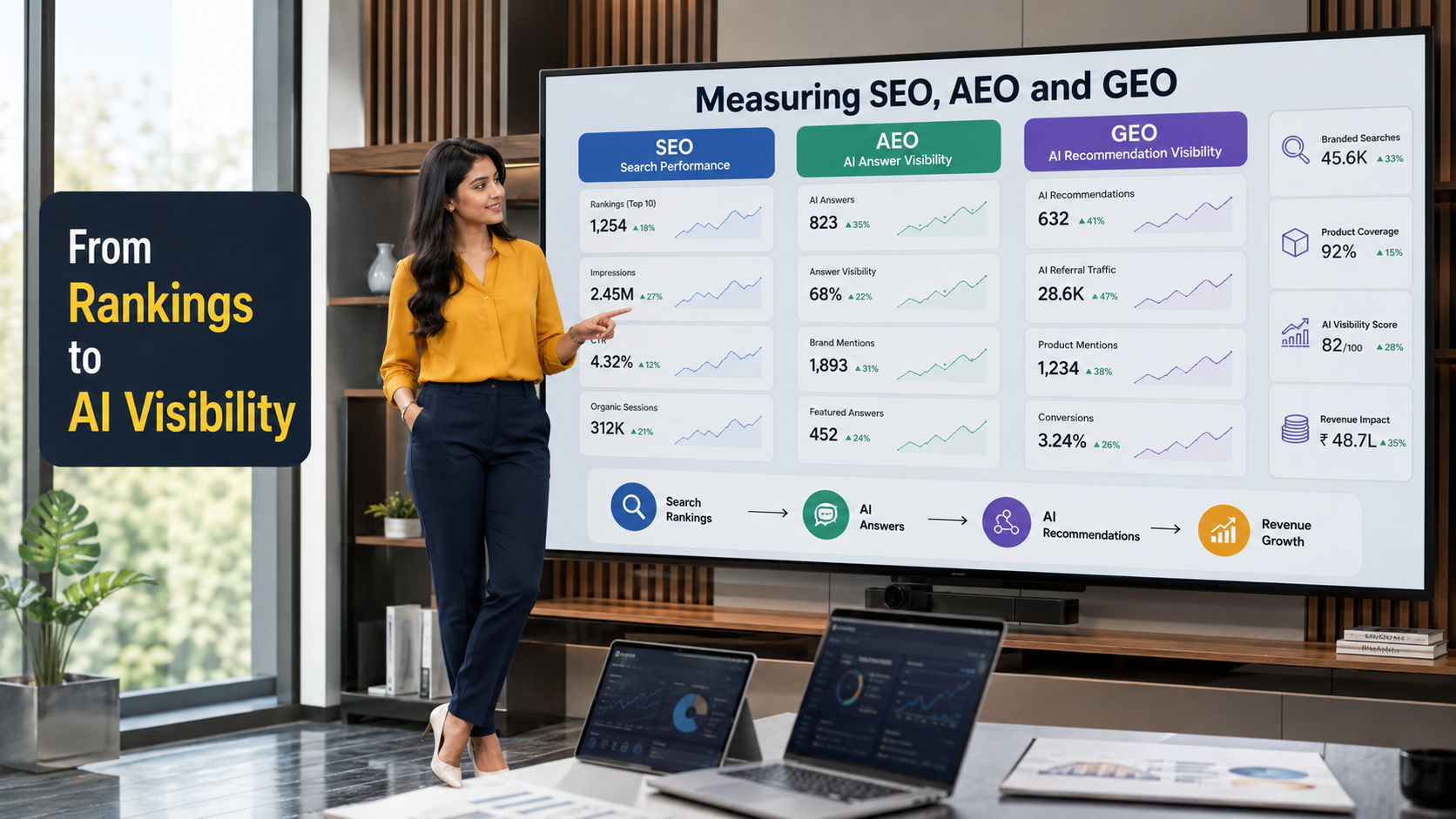
Your current dashboard was built for one surface. Widen it, and the same performance tells a much better story.
Expect impressions to rise and CTR to fall as AI answers expand. That pattern is the surface changing shape, and it means more people seeing your brand for the same work. Judge the channel on sessions and revenue.
Track AI referral traffic as its own segment — chatgpt.com, perplexity.ai, gemini.google.com, copilot.microsoft.com, claude.ai. Set it up now, while the numbers are small, so you have a baseline to show growth against later.
Check Search Console for its AI reporting. Traffic from AI features has historically been folded into the "Web" search type in the Performance report, and Google introduced dedicated generative-AI performance reporting in Search Console in mid-2026. Look at what your own account offers rather than trusting any article's description of it, including this one. This is the fastest-moving piece of the measurement stack.
Measure zero-click brand impressions. Many AI mentions send no click at all, so clicks alone understate your reach. Branded search volume, branded queries in Search Console and direct traffic are your proxies — and a brand being recommended in AI answers usually shows up as more people searching for it by name.
Report conversion rate alongside sessions. AI referral traffic is low-volume and high-intent. Reported as sessions it looks small; reported as conversion rate it is often one of the strongest channels on the sheet, which is exactly how it deserves to be presented.
Confirm coverage, not just performance. The Page Indexing report tells you how many of your products Google actually holds, and Merchant Center diagnostics tells you the same for your feed. Traffic reports show how the indexed pages are doing; these two show what never made it in — which is usually where the quickest wins are hiding.
And once a month, just ask. Run your ten most commercially important prompts through the tools your customers use and write down who gets named. Prompt-tracking tools automate this — Profound, Peec, Otterly, Ahrefs' Brand Radar, Semrush's AI visibility tooling, SE Ranking — and the manual version costs twenty minutes.
Where your ecommerce platform fits
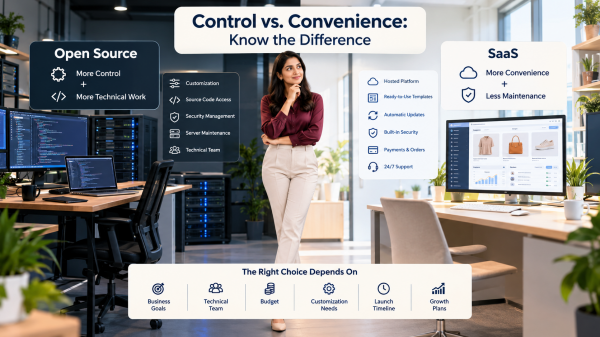
Look back over the technical section and notice how much of it is platform work rather than marketing work: canonical handling, variant URLs, crawlable navigation, paginated URLs, structured data that stays in sync with product data, page speed on mobile. Google's own ecommerce guidance says as much — sellers on a capable platform can skip most of that layer.
That is the argument for not building it yourself. Gathered in one place, here is what Shopaccino handles as a platform feature rather than a project:
- Dynamic XML sitemap — created and updated automatically as products, categories and pages are added.
- Clean, editable URLs — readable paths generated from your product names, editable from the admin panel.
- Canonical tags and variant URLs — handled at platform level, so variants reinforce the parent product instead of competing with it.
- Crawler-friendly navigation — real links from menus through to every product, not JavaScript-only menus.
- Editable meta titles and descriptions on every page — products, categories, pages and blog posts, with no developer involved.
- Schema-ready structured product data — kept in sync with your live product information and your Merchant Center feed.
- Fast, mobile-first storefronts — built with Core Web Vitals in mind.
- Multi-currency selling across 200+ countries — with international shipping carriers built in, so prices and delivery options are right per market without custom development.
What a platform gives you is a clean foundation. What decides whether you rank, get quoted and get recommended is the strategy on top of it: keyword and prompt research, original content, structured data done properly, trust signals, and the off-site reputation work that earns citations. That is where the real gains live, and it is where your time and budget belong.
Launching a new store the right way
If the store is not live yet, you have an advantage most retailers would pay for: you can build the foundation correctly instead of retrofitting it. A few decisions in the first fortnight decide how quickly you appear at all.
Verify ownership and ask to be indexed. Verify your site in Search Console on day one. For a handful of important URLs, use URL Inspection to request indexing directly; for everything else, submit your sitemap and let Google work through it. Then watch the Page Indexing report — it tells you exactly which pages made it in and why the rest did not, which is the single most useful screen in Search Console for a new store.
Get your business details and Merchant Center in place early. Establish your Business Profile, sign up for Merchant Center, and get your product feed submitted before launch week rather than after it. Feed approval and product data checks take time, and the Shopping tab and AI shopping surfaces cannot show what has not been processed yet.
Then choose a launch strategy deliberately. There are four common approaches, and the right one depends on how much you want indexed before your announcement:
- Grand reveal — the whole site goes live at once. Cleanest story, but nothing is indexed on day one.
- Home page first — publish the home page early as a placeholder so Google discovers your domain and brand while the catalogue is built.
- Launch without availability — publish products marked out of stock so they get crawled and indexed ahead of time, then switch availability on when you open. Often the smartest option for a catalogue-heavy store.
- Soft launch — go live quietly, fix what real traffic reveals, then hold the official launch when the site has proven itself.
The point for a new store is simply this: indexing is not instant, and your launch timing decides whether you are visible in Search and the Shopping tab on opening day or three weeks later.
In Shopaccino: the sitemap, clean URLs and product schema are generated as you build the store, so on launch day you have something complete to hand Google rather than a technical checklist to work through first.
Where to start: a 30/60/90 day plan
First 30 days — make sure you're readable. Audit crawling and indexing, and consolidate thin or duplicate product pages. Check server logs and your CDN's bot settings for AI crawler access. Get Merchant Center live with GTIN, brand and MPN coverage on every product. Ship and validate your Product and Offer schema.
Days 30–60 — make yourself extractable and trustworthy. Add ProductGroup, return policy and shipping schema. Rewrite your top 20 product pages with original copy, spec tables and real reviews. Restructure your best category pages as landing pages. Tighten your About, contact, shipping and returns pages. Set up AI referral segments and a monthly prompt check.
Days 60–90 — make yourself recommendable. Publish two buying guides and one honest comparison built around real questions. Publish one piece of original data only you have. Build the entity stack: Organization schema with sameAs, consistent naming everywhere, named authors. Identify the five sources AI cites in your category and start earning presence in them.
The bottom line
Ecommerce SEO in the AI era is not a replacement for what you were already doing. It is three layers stacked on one foundation: technically sound, structurally clear, genuinely trustworthy pages. SEO ranks them. AEO gets them lifted into answers. GEO gets your brand named when a shopper never visits a results page at all.
Search is spreading across more engines every year, which means more places to be found rather than fewer. The stores that win the next few years will be the ones whose data is accurate enough for a machine to rely on and whose reputation is strong enough for a machine to repeat — and both of those are built with the same discipline that has always made SEO work.
FAQs
SEO optimises pages to rank in search results. AEO optimises content to be lifted into direct answers like featured snippets and AI Overviews. GEO optimises your brand to be recommended and cited by generative tools such as ChatGPT and Perplexity. They share one foundation and build on each other.
Not currently. Google states you don't need new machine-readable files or AI text files to appear in its AI features, and no major AI platform has confirmed using llms.txt for retrieval. Add it if your platform makes it trivial, and put your effort into crawlability, structured data and content first.
Blocking Google-Extended does not affect rankings, AI Overviews or AI Mode — those follow Googlebot, so your normal SEO access is what makes you eligible. Allowing retrieval crawlers such as OAI-SearchBot and PerplexityBot is what lets those tools cite you live.
Not technically. It is required for the Shopping tab, and it feeds the Shopping Graph that underpins Google's AI shopping experiences, strengthens Images annotations and improves Lens matching. For any serious store in 2026, treat it as essential.
Be crawlable by retrieval agents, keep product data accurate and machine-readable, build a clear brand entity with consistent naming, publish quotable original content, and earn presence in the third-party sources these tools cite — reviews, comparisons, marketplaces and forums.
Yes. Clicks and impressions from AI features have been included in the Performance report under the "Web" search type, and Google introduced dedicated generative-AI performance reporting in Search Console in mid-2026. Check what your property currently shows.
Give each country or language version its own URL, connect them with hreflang annotations, and keep the price, currency and availability identical between the page and your Merchant Center feed for that market. Avoid switching currency by cookie or browser setting, as crawlers only see one version.
Verify Search Console and submit your sitemap before launch, and get Merchant Center approved early. Publishing products marked out of stock lets them be crawled and indexed ahead of opening day, so you are visible in Search and the Shopping tab immediately rather than weeks later.
Largely no. FAQ rich results are now limited to a narrow set of authoritative sites and HowTo results were retired. Question-and-answer formatting is still well worth using for snippets and AI extraction — just direct your markup budget to the types that still earn placements.