What Is an Ecommerce Platform? How to Choose the Right One
Every online store you have ever bought from, whether it was a small home decor brand or a global electronics exporter shipping across continents, runs on some kind of ecommerce platform working quietly in the background. If you have landed on this page, you are probably at the exact point where you are asking yourself: what is an ecommerce platform, really, and which one should I actually choose for my business? This guide answers both questions in plain language, without jargon or a sales pitch, so you walk away knowing what to look for and how to pick an ecommerce platform that fits the way you actually sell, whether that is B2C, B2B, or both at once.
What Is an Ecommerce Platform, Exactly?
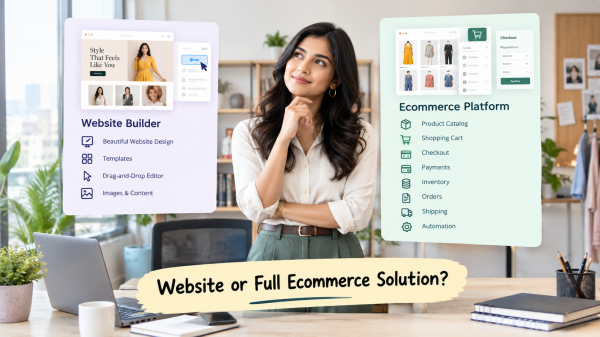
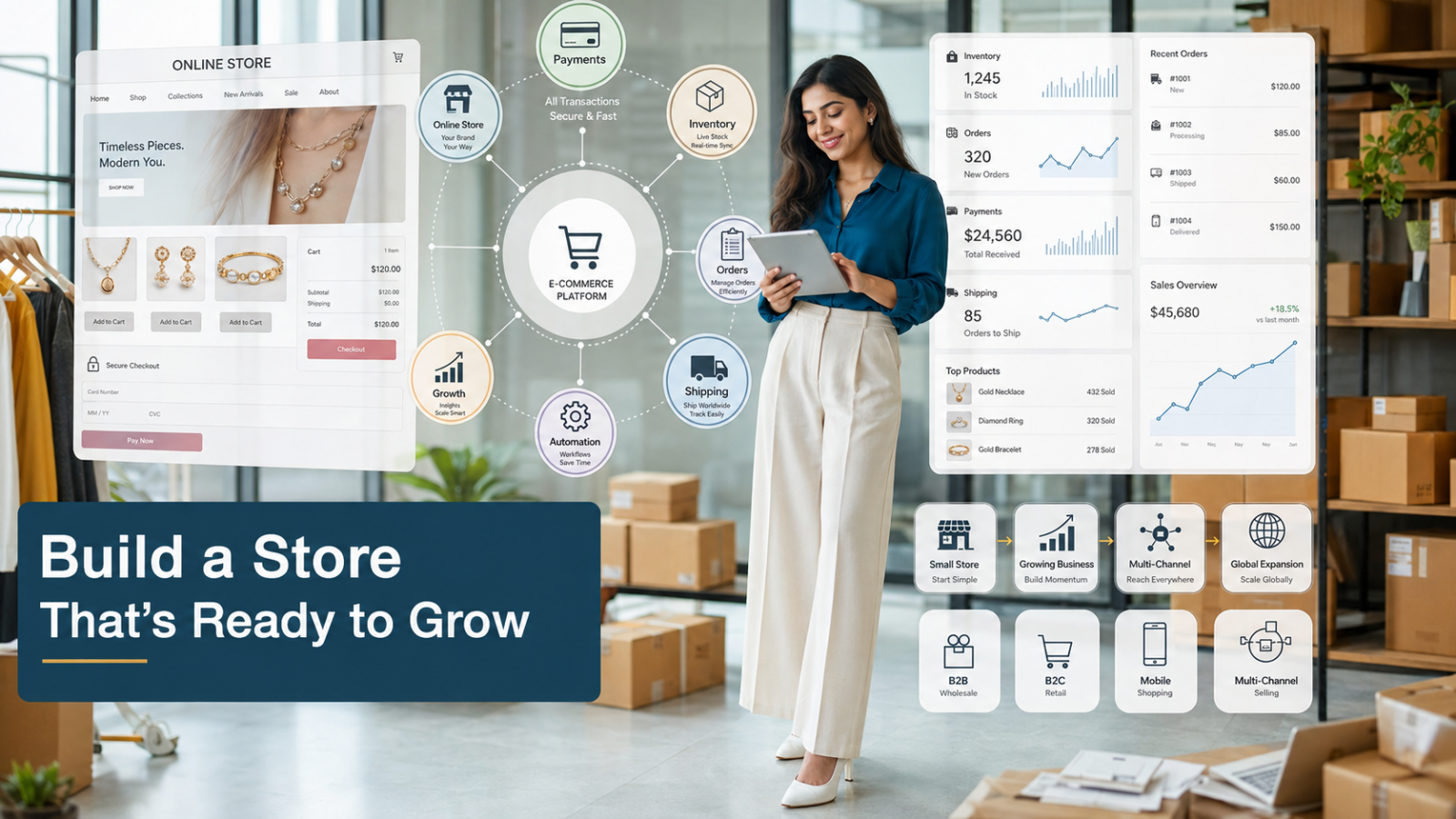
An ecommerce platform is the software that lets a business sell products or services online and run the entire operation behind that sale. Think of it as two things stitched together: the shopfront your customers see, meaning product pages, cart, and checkout, and the back office your team uses, meaning inventory counts, order status, payment records, and shipping labels.
Before ecommerce platforms existed in their current form, building an online store meant hiring developers to code a website from scratch, then separately wiring up a payment gateway, a way to track stock, and a system to manage orders. An ecommerce platform, also called an online store builder or ecommerce software, bundles all of that into one system, so a business owner can set up a fully working online store without writing a single line of code, or scale into a highly customized setup if they have the technical resources to do so.
The important part to understand is that a website alone is not an ecommerce platform. A website that just displays products with no way to take payment, track inventory, or manage an order is a digital brochure, not a store. An actual ecommerce platform closes that gap.
How Does an Ecommerce Platform Actually Work Behind the Scenes?
It helps to follow a single order from start to finish, because that is really what an ecommerce platform is managing.
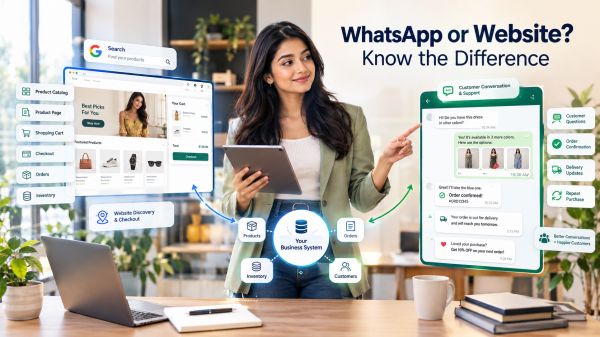
A customer lands on your online store, browses your catalog, and adds an item to their cart. At checkout, the platform calculates tax, shipping, and any discounts, then hands off to a payment gateway to securely process the transaction. Once payment clears, the order lands in your admin dashboard, inventory is automatically adjusted, and a notification goes out for fulfilment. Depending on how automated your setup is, a shipping label may generate instantly, tracking details get emailed to the customer, and your accounting or ERP system updates in the background without anyone touching a spreadsheet.
That entire chain, storefront, payment, inventory, fulfilment, and reporting, is what an ecommerce platform is actually responsible for. The parts a customer sees are maybe twenty percent of what the software is doing.
Why Can't You Just Sell Through Social Media or a Marketplace Instead?

This is a fair question, because plenty of businesses start out selling through Instagram DMs, WhatsApp catalogs, or marketplaces like Amazon and Etsy, and there is nothing wrong with that as a starting point.
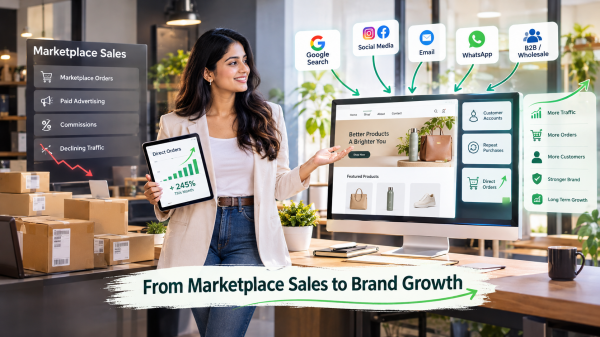
The limitation shows up as you grow. Marketplaces charge referral and transaction fees on every single sale, often somewhere between eight and twenty percent depending on the category, and you are competing on their search results against thousands of similar listings, including your own competitors bidding for the same customer. Social selling has a similar ceiling: you do not own the customer relationship, you are at the mercy of algorithm changes, and there is no real way to build a repeat purchase, loyalty driven business when every sale starts from a fresh direct message.
An ecommerce platform gives you a store you actually own. Your customer data, your branding, your pricing, and your margins stay with you. Many businesses end up running both, a branded website for direct sales and a presence on marketplaces for extra reach, and a good ecommerce platform will let you manage both from one dashboard instead of juggling logins across five different systems.
What Core Features Should You Actually Look For?
Not every ecommerce platform is built the same way, and the features that matter will depend on whether you are a small D2C brand, a manufacturer selling B2B, or an exporter serving customers across borders. That said, a handful of features come up as non negotiable no matter the business type.
- Storefront and website builder: the ability to build and customize a professional looking online store without needing a developer for every small change, while still allowing custom coding if your brand needs something specific.
- Catalog and inventory management: real time stock tracking across warehouses, variant management for size, color, and material, and low stock alerts so you are never overselling something you do not have.
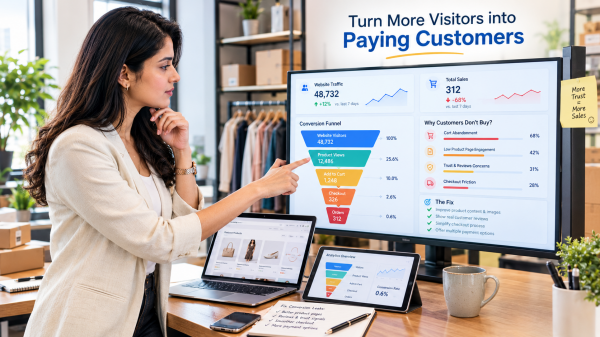
- Payment gateway and checkout: support for multiple payment methods, including local payment options and international cards, with a checkout process that does not force the customer through too many steps. Roughly a quarter of cart abandonment happens because checkout is too complicated or does not offer a preferred payment method.
- Order and shipping management: automated order routing, shipping label generation, multi warehouse fulfilment, and real time tracking updates for the customer.
- Multi-channel selling: the ability to list and sell across your website, mobile app, and marketplaces from one central system, so stock levels and orders stay in sync everywhere.
- Automation tools: abandoned cart recovery emails, automatic invoice generation, and workflow triggers for repetitive tasks, so your team is not manually doing the same thing fifty times a day.
- Security and data protection: SSL encryption, PCI DSS compliant payment processing, and fraud detection, because a single data breach can undo years of customer trust.
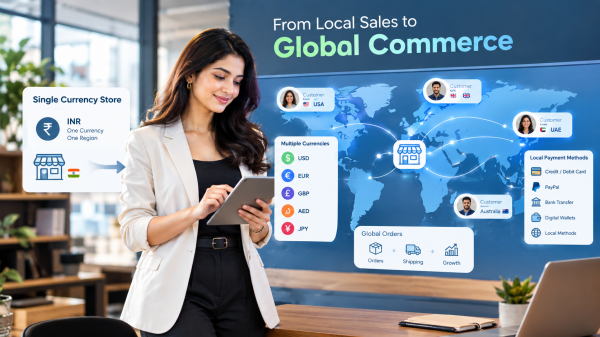
- Cross-border ecommerce tools: multi currency pricing, multi language storefronts, region based pricing, and international shipping integrations, if you plan to sell beyond your home country.
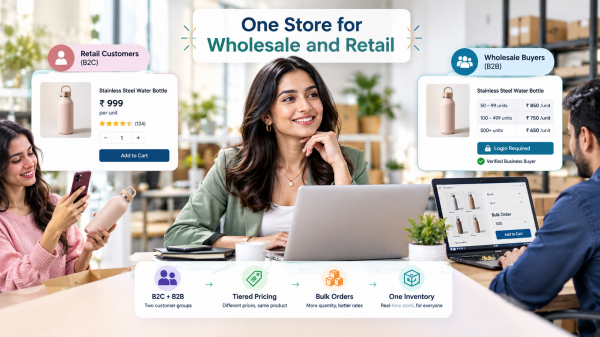
- B2B ecommerce platform tools: tiered pricing based on customer type, bulk order forms, credit terms, and quote based ordering, if part of your business sells to other businesses rather than only individual consumers.
If a platform is missing more than one or two of these, it is worth asking why, and whether you will end up needing three separate tools stitched together to compensate.
What Types of Ecommerce Platforms Actually Exist?
Ecommerce platforms generally fall into a few categories, and knowing the difference will save you a lot of confusion when you start comparing options.
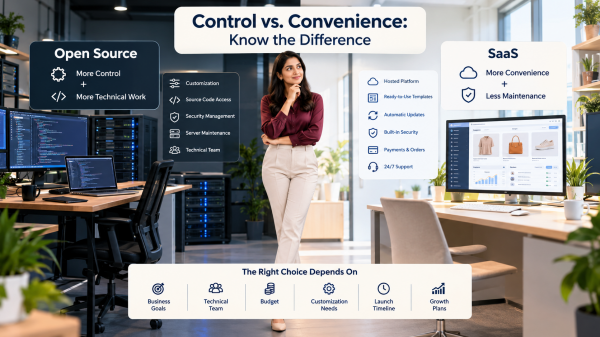
SaaS or hosted platforms handle hosting, security, and updates for you, in exchange for a subscription fee. You log in, build your store, and the provider manages the technical infrastructure. This is the most common choice for small to mid sized businesses because there is no server management required.
Open source or self hosted platforms give you the raw code to install on your own server. They are highly customizable, but you, or a developer you hire, are responsible for hosting, security patches, and maintenance. This route suits businesses with in house technical teams and very specific customization needs.
Headless commerce platforms separate the front end that the customer sees from the back end where orders and inventory are managed, connected through APIs. This gives development teams the freedom to build completely custom shopping experiences, though it typically requires more technical resources to implement.
Marketplaces like Amazon, Etsy, or eBay are not technically ecommerce platforms in the traditional sense, since you do not control the storefront, but they are worth mentioning because many sellers use them alongside a proper ecommerce platform rather than instead of one.
There is no universally best type. A small home decor brand with no developer on staff will likely be better served by a SaaS platform, while a large manufacturer with an in-house IT team might prefer the flexibility of an open source or headless setup.
Which Ecommerce Platforms Should You Actually Be Comparing Right Now?
There are dozens of ecommerce platforms on the market, but most businesses end up comparing a shorter list. Here is an honest look at where each one fits.
Shopaccino
Shopaccino is built around a specific gap that generic platforms tend to leave open, the real, day to day pain points of exporters, manufacturers, distributors, and D2C brands, rather than a one size fits all storefront. It lets manufacturers and distributors run B2B and B2C sales from a single system instead of maintaining two separate setups, and gives exporters the cross border infrastructure, multi currency pricing, multi language storefronts, international payments, region based pricing, and international shipping, needed to sell globally without stitching together five different tools. D2C brands get a branded website and mobile app built for scale, along with built in automation, integrated inventory, multi warehouse order fulfilment, and payment and logistics tools that work out of the box. One detail that stands out for businesses running high sales volumes: Shopaccino charges zero transaction fees on the platform, meaning what you earn stays with you instead of being trimmed by a percentage on every order.
Shopify
Shopify is widely known for being one of the fastest ways to launch a store, with a large app ecosystem and an easy setup process. It works well for D2C brands and smaller catalogs. Where businesses tend to hit friction is around B2B selling, complex multi warehouse logistics, and transaction fees if you are not using Shopify's own payment processor, which can add up at scale. If these limits sound familiar, see why growing brands choose Shopaccino as a Shopify alternative in India with 0% transaction fees and built-in B2B selling.
WooCommerce
WooCommerce is a free plugin that turns a WordPress site into an online store, which makes it appealing if you already have a WordPress website and some technical comfort. It is highly customizable through plugins, but that flexibility comes with a tradeoff, you are responsible for hosting, security updates, and keeping plugins compatible with each other, which can become a maintenance burden as the store grows. Brands that want to skip that upkeep often move to a managed alternative to WooCommerce such as Shopaccino.
Magento, now Adobe Commerce
Magento is a powerful, highly customizable open source platform favored by larger businesses with complex catalogs and in house or agency developer support. It can do almost anything you ask of it, but it also demands real technical investment, both to build and to maintain, which puts it out of reach for most small and mid sized teams.
BigCommerce
BigCommerce sits in a similar space to Shopify, with strong built in features and fewer add on costs for things like multi channel selling. It is a solid mid market option, particularly for businesses that want more built in B2B functionality than some competitors offer without moving to a fully custom build. Teams comparing alternatives to BigCommerce often shortlist Shopaccino for similar B2B depth with 0% transaction fees.
Salesforce Commerce Cloud
Salesforce Commerce Cloud is built for large enterprises with the budget and internal teams to match. It offers deep personalization, AI driven recommendations, and omnichannel capabilities at a scale that most small or mid sized businesses simply do not need yet, and the pricing reflects that enterprise positioning.
The right pick usually comes down to your business model and stage, not which platform has the longest feature list.
How Do You Actually Choose the Right Ecommerce Platform for Your Business?
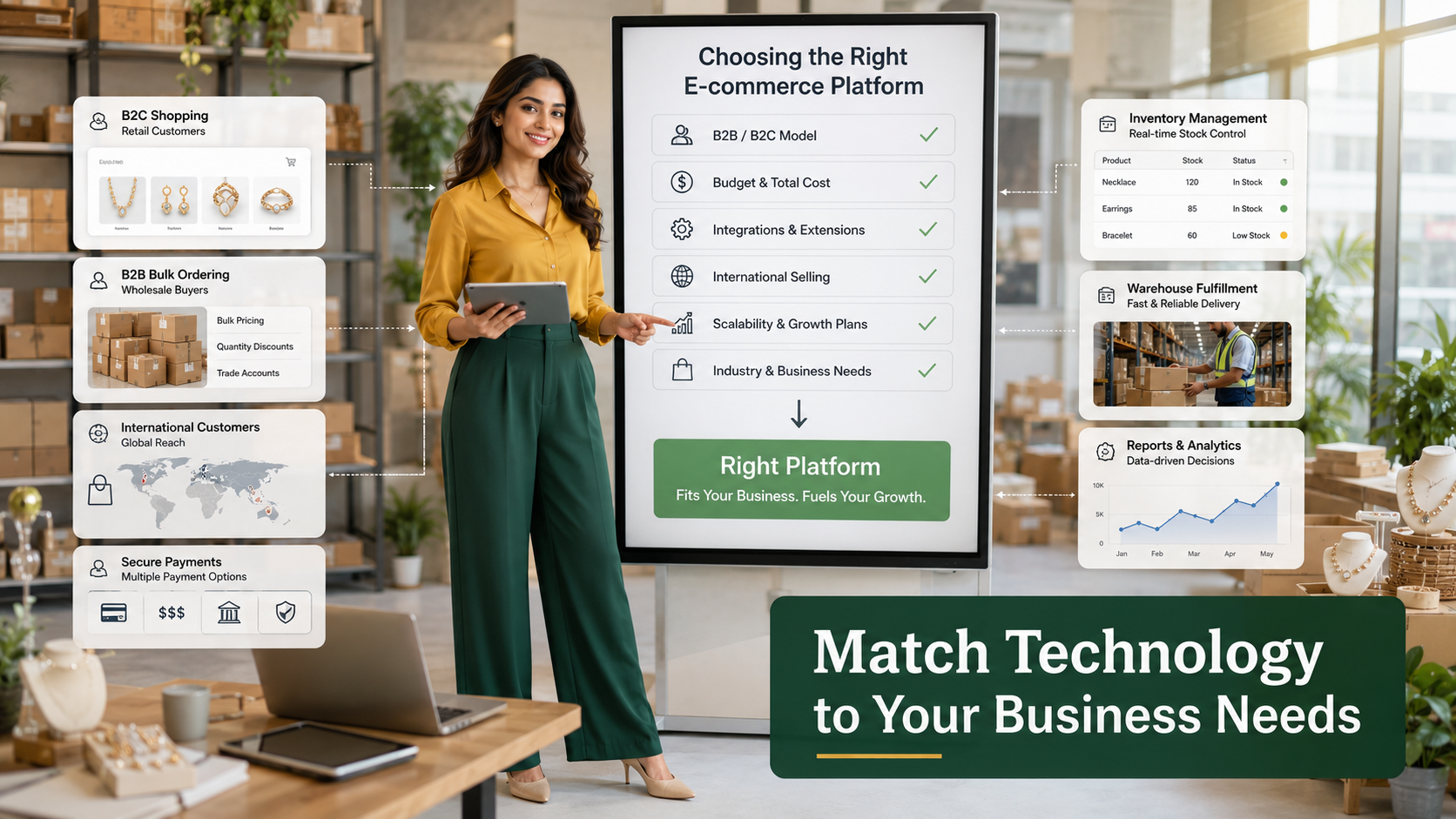
Once you understand what an ecommerce platform does and what is available, choosing one comes down to answering a short set of honest questions about your own business.
What is your business model? A pure B2C brand has different needs than a manufacturer selling both wholesale and retail. If you need both B2B and B2C from one system, narrow your list to platforms that genuinely support that, rather than bolting on a workaround later.
Where are your customers, and where do you want them to be? If you plan to sell only within your home country, your requirements are simpler. If cross border ecommerce is part of your growth plan, even a year or two out, multi currency support, multi language storefronts, and international shipping integrations should be on your checklist now, not after you have already outgrown your first platform.
What is your real budget, including hidden costs? Monthly subscription fees are only part of the cost. Transaction fees, payment processing fees, app or plugin costs, and developer hours for customization all add up. A platform with zero transaction fees can end up cheaper overall than one with a lower subscription price but a percentage cut on every sale.
What do you already use that needs to connect? Your accounting software, your logistics partner, your CRM, your existing payment gateway. Check integrations before you commit, because rebuilding your entire operational stack around a new ecommerce platform is far more disruptive than the platform switch itself.
Can it grow with you? A platform that works well at fifty orders a month should not fall apart at five thousand. Ask about multi-warehouse support, catalog limits, and whether B2B features exist or would need to be added later.
What does support actually look like? Read reviews specifically about support responsiveness, not just features. A platform going down during a sale event with no one to call is a real business risk, not a hypothetical one.
Does it fit your specific industry? A fashion brand needs strong variant management for size and color. An electronics seller needs serial number tracking and warranty management. A marble and stone business often needs quote based, freight calculated B2B ordering rather than.
fixed instant checkout. A beauty brand needs batch and expiry tracking. These are not edge cases, they are the actual day to day requirements that generic platforms often miss.
What Mistakes Do Businesses Commonly Make When Picking a Platform?
A few patterns come up again and again when businesses end up switching platforms within their first year.
Choosing purely on subscription price without checking transaction fees is one of the most common. A platform advertised as cheap can quietly take a percentage of every sale, which becomes expensive fast once volume grows.
Ignoring international growth until it becomes urgent is another mistake. Adding multi currency and multi language support after the fact is far more disruptive than choosing a platform that already supports it.
Underestimating mobile experience is a quieter mistake. A large share of shopping traffic now comes from phones, and a storefront that looks great on desktop but is clumsy on mobile is losing sales every day it stays that way.
Not checking B2B capability early enough catches manufacturers and distributors off guard, since many platforms are built B2C first and treat wholesale as an afterthought bolted on later.
And finally, underestimating support needs. Businesses often only realize how important responsive support is during a crisis, like a payment gateway failure during a big sale, rather than while comparing options calmly beforehand.
What's Changing in Ecommerce Platforms Right Now?
A few shifts are worth knowing about, because they will likely shape what counts as a basic expectation within the next couple of years.
Automation is moving from a nice to have to an expectation. Businesses increasingly expect inventory syncing, order routing, and reporting to happen without manual intervention, freeing teams up for actual customer facing work instead of repetitive backend tasks.
Cross border demand keeps climbing. More small and mid sized businesses are selling internationally earlier in their growth, not just after years of domestic success, which is pushing multi currency and multi language support from a premium feature to a standard one.
B2B ecommerce is finally catching up to B2C in terms of expected online experience. Buyers who order for their businesses now expect the same self service convenience they get shopping personally, quote requests, bulk ordering, and account based pricing handled online instead of over email or phone calls.
Mobile and app based commerce continues to grow as a share of total sales, making a genuinely functional mobile app, not just a mobile responsive website, an increasingly real differentiator rather than a bonus feature.
None of this means every business needs every trend on day one. It does mean that choosing an ecommerce platform with room to adopt these capabilities later, rather than one that is already maxed out on its current feature set, is worth factoring into the decision now.
Getting Started
Picking an ecommerce platform is not a decision to rush, but it also does not need to be paralyzing. Start with an honest list of what your business actually needs today, add a realistic view of where you want to be in two to three years, and use that as your filter rather than getting distracted by every feature comparison chart you can find online.
The right ecommerce platform should fit the way you already sell and give you room to grow into the way you plan to sell later, whether that means adding B2B alongside B2C, expanding into new countries, or simply automating the parts of your operation that currently eat up your day. Take the time to trial a shortlist before committing, most reputable platforms, Shopaccino included, offer a way to test the actual product rather than just reading about it.
FAQs
An ecommerce platform is software that lets you sell products or services online while managing the backend work behind each sale, including inventory, payments, orders, and shipping, all from one system instead of separate disconnected tools.
No. A website can simply display information, while an ecommerce platform includes the functionality to accept payments, track inventory, and manage orders. A website becomes a store once these commerce features are added to it.
It depends on your model. A SaaS platform with low setup complexity works well for most beginners, but if B2B sales, international shipping, or zero transaction fees matter to you, look specifically for platforms built around those needs rather than the most generic option available.
Many do, often a percentage of each sale on top of the subscription cost. Some platforms, including Shopaccino, charge zero transaction fees, which can meaningfully change your margins once sales volume grows.
Yes, though not all platforms are built for it. Look specifically for tiered pricing, bulk ordering, and separate B2B and B2C storefront logic rather than assuming a B2C focused platform will handle wholesale well.
A basic store on a SaaS platform can go live within days. More complex setups involving custom integrations, multi warehouse fulfilment, or cross border configuration typically take a few weeks depending on how much customization is needed.